Email Marketing

The channel you own.
The one that pays back.

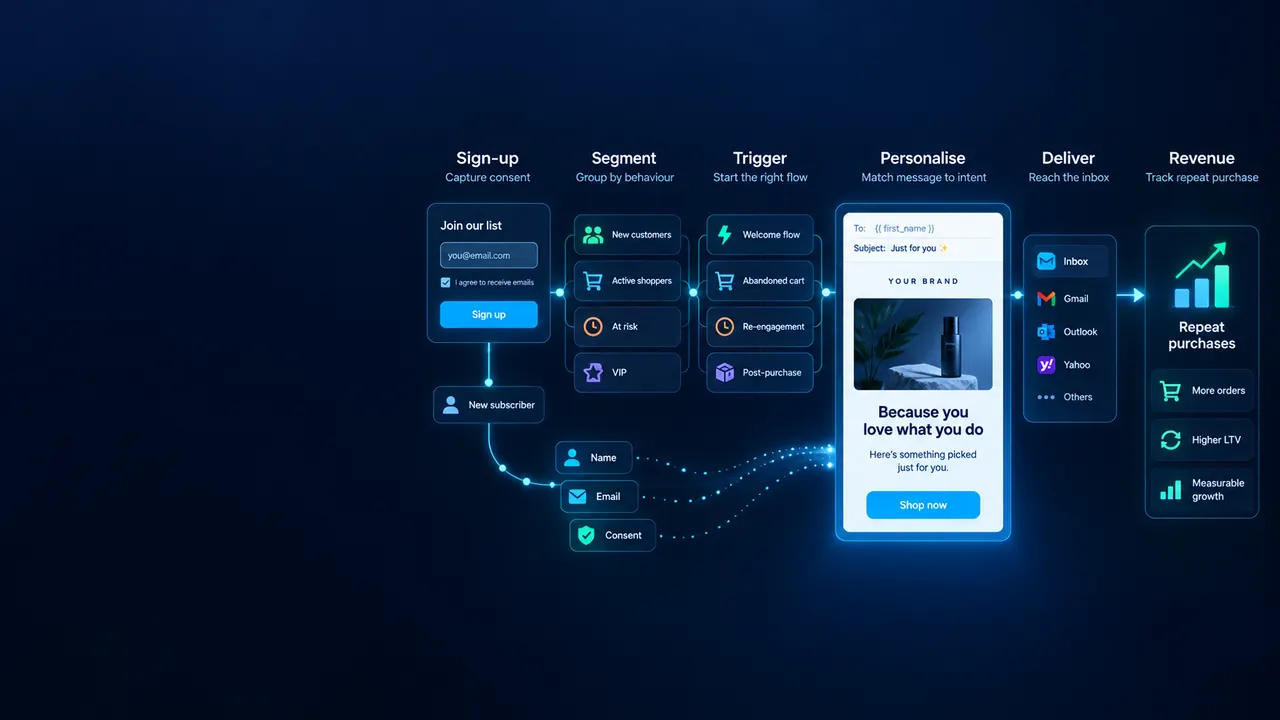
Every other channel rents you an audience. Email is the only one you own outright — no algorithm between you and your list, no bidding war for access. We build the segmentation, automation and deliverability that turn a subscriber list into predictable recurring revenue.

1Open rate48%Click rate12.4%Revenue+186%AUTOMATED24/7 flows
Lifecycle automation
Segmentation
Deliverability
Revenue attribution
01
Why most email underperforms

Most lists are not underperforming. They are being sent the wrong thing, to everyone, at once.

Email consistently returns more per pound than any other digital channel — and most programmes capture a fraction of that. Not because the copy is weak, but because one message goes to the entire list regardless of what that person bought, browsed or ignored. Batch-and-blast trains subscribers to stop opening, and once engagement drops, deliverability follows it down.

One message for everyone

A list contains first-time buyers, lapsed customers and people who have never purchased. Sending them identical campaigns guarantees most of it is irrelevant to most recipients, and irrelevance is what kills open rates.

Deliverability quietly collapsing

Poor authentication, unengaged segments and rising complaint rates push you toward spam folders. Most senders discover this only when revenue drops, because inbox placement is invisible in standard reporting.

No lifecycle automation

Welcome, browse abandonment, cart recovery, post-purchase and win-back flows run continuously and produce a large share of email revenue. Programmes relying purely on campaigns leave that entirely on the table.

Reporting on opens, not revenue

Open rate became unreliable once privacy features started pre-fetching images. Optimising for it means optimising for a number that no longer measures what you think it does.

£36+
Typical return per £1 spent
~40%
Of email revenue from flows
100%
Of the audience you own
8+
Years running email programmes
02
What we actually do

Campaigns are the visible part. Flows are where the revenue is.

Email marketing done properly is two systems working together: automated lifecycle flows that respond to what someone actually did, and campaigns that give them a reason to come back.

The flows do the heavy lifting — they run continuously, trigger on real behaviour and typically generate a disproportionate share of total email revenue from a small fraction of total sends. Campaigns then layer on top for launches, seasonal pushes and re-engagement.

  • Behavioural segmentation — lists split by purchase history, engagement recency, browse behaviour and predicted value — so what arrives is relevant to that specific person.
  • Lifecycle flow architecture — welcome, browse abandonment, cart recovery, post-purchase, replenishment and win-back, each triggered by real behaviour rather than a calendar.
  • Deliverability engineering — SPF, DKIM and DMARC configured properly, list hygiene, sunset policies and warm-up plans so you reach the inbox rather than the promotions tab.
  • Testing that reaches significance — subject lines, send times, offers and creative tested with enough volume to be conclusive rather than declared a winner on forty opens.
  • Revenue attribution — reporting on revenue per recipient and per flow, not open rate — because opens stopped being measurable the moment privacy proxies arrived.
Batch-and-blast
Lifecycle programme
One send to the whole list
Segmented by behaviour
Campaigns only
Flows + campaigns
Deliverability unmonitored
Authenticated & warmed
Optimised for opens
Optimised for revenue
Unengaged kept forever
Sunset policy applied
Guesswork on send time
Tested to significance

The ownership argument: an algorithm change can halve your organic social reach overnight and a competitor can outbid you on every keyword. Neither can touch your email list. It is the only audience that cannot be taken away from you.

03
The Sachkhand blueprint

How we build an email programme that compounds

Six workstreams, sequenced so deliverability is protected before volume increases — because sending more to a damaged sender reputation makes things worse, not better.

01

Audit & deliverability check

Authentication records, sender reputation, list health, engagement decay and inbox placement testing. You get a clear picture of whether your email is actually arriving before we touch anything else.

02

Segmentation architecture

Lists rebuilt around behaviour and value rather than acquisition date. This single change usually lifts engagement more than any amount of copywriting.

03

Core flows built

Welcome, cart and browse abandonment, post-purchase and win-back, each triggered on real behaviour with proper exit conditions so people are not receiving three flows at once.

04

Creative & copy system

Templates that render correctly across clients and dark mode, with modular blocks so campaigns can be built quickly without rebuilding layout every time.

05

Testing programme

A standing test calendar on subject lines, offers, timing and creative — run at volumes that produce conclusive results rather than noise.

06

Revenue reporting

Revenue per recipient by segment and flow, list growth net of churn, and deliverability trend — reported monthly so decline is caught early.

04
What is changing through 2026

Four shifts reshaping email

Privacy changes broke the metrics most programmes were built on, and authentication requirements tightened sharply. Both change how email has to be run.

01

Open rate stopped being a metric

Privacy proxies pre-fetch images, inflating opens for a meaningful share of your list. Programmes still optimising on open rate are tuning against a number that no longer reflects human behaviour.

02

Authentication is now mandatory

Major inbox providers require SPF, DKIM and DMARC for bulk senders, with complaint-rate thresholds enforced. Senders who never configured these properly are seeing placement degrade without warning.

03

Engagement drives placement

Inbox providers weight recent engagement heavily. Continuing to mail people who never open actively damages placement for the subscribers who do — which makes a sunset policy a revenue decision, not housekeeping.

04

Zero-party data is the new advantage

As third-party tracking degrades, information subscribers give you directly — preferences, quiz answers, stated intent — becomes the most reliable basis for relevance.

05
Why Sachkhand

We optimise for revenue per recipient

The metric determines the behaviour. Optimise for opens and you get clickbait subject lines; optimise for revenue per recipient and you get relevance.

Deliverability first, always

We check inbox placement before increasing volume. Sending more from a damaged reputation compounds the problem, and most agencies discover this only after the damage is done.

Revenue per recipient

Our headline metric, not open rate. It cannot be gamed by a clickbait subject line and it maps directly to what the programme is worth.

Flows before campaigns

Automation produces a large share of email revenue from a small share of sends. We build that infrastructure first, then layer campaigns on top.

Compliance built in

GDPR, PECR and CAN-SPAM handled properly — consent records, preference centres and clean unsubscribes. A complaint spike costs more than any campaign earns.

We will shrink your list

Removing unengaged subscribers usually raises revenue, because engagement drives placement. Most agencies avoid it because a smaller list looks worse in a report.

Platform-agnostic

Klaviyo, Braze, HubSpot, Mailchimp or a custom stack — we work in what you already have rather than pushing a migration we happen to be certified in.

06
The Honest Comparison

Why Businesses Choose SDM for Email Marketing

Same budget, very different outcomes. Point by point, here’s how a specialist partner compares to a typical agency or going it alone.

What actually matters With SDM Typical Agency In-House / DIY
Senior specialist on your accountAlwaysOften a juniorStretched thin
Custom strategy built for your goalsTailoredTemplatedGuesswork
Deep audit before any work beginsSurface-levelSkipped
White-hat, penalty-safe methodsGuaranteedVariesHigh risk
Plain-English reporting tied to revenueMonthlyJargon PDFsNone
Direct access to your specialistAccount-manager relayN/A
Deliverability audited before sendingRarelyUnknown
Lifecycle flows, not just campaignsCampaigns onlyAd-hoc
Behavioural segmentationBasic listsWhole list
Reported on revenue per recipientOpen rateSends
Sunset policy for unengagedAvoidedNever
Ongoing competitor gap analysisOne-offManual
Conversion-focused, not just trafficTraffic-firstUnclear
Premium tools included (Ahrefs, SEMrush)SometimesCostly extra
No long lock-in contractsFlexible6–12 mo lock-inN/A
Established agency, operating since 2017VariesLearning curve
Fast onboarding & early quick wins~2 weeksSlowTrial & error
Human, SEO-led content (no AI spam)Outsourced / AI spamTime-heavy
Focus on compounding, long-term ROICore promiseShort-term winsSlow & ad-hoc
Recovery from Google penaltiesSometimesVery hard

20 reasons growing brands make the switch. See the difference for yourself →

07
Measurement

If you are still reporting open rate, you are reporting noise

Privacy proxies made opens unreliable. We measure what still reflects behaviour and maps to money.

Revenue per recipient

The headline number. Revenue generated divided by people mailed, tracked by segment and by flow so you see what is actually working.

Flow vs campaign split

How much revenue comes from always-on automation versus one-off sends — the clearest indicator of programme maturity.

Inbox placement

Seed testing across major providers, because a campaign that lands in spam reports the same as one nobody opened.

Net list growth

Acquisitions minus unsubscribes and suppressions, so growth is not overstated by counting only new signups.

Engaged-segment share

The proportion of your list that opened or clicked recently, which drives both placement and realistic reach.

Email performance
All flows & campaigns — rolling 90 days
LIVE
Rev/recip
+82%
Flow rev
68%
Inbox
96%
Engaged
74%
Net growth
+61%
↑ 186% email revenue vs previous period
08
The engagement

Four stages, repeated every month

Deliverability first, then automation, then volume. Reversing that order is how sender reputation gets damaged.

01

Audit

Authentication, sender reputation, list health, engagement decay and inbox placement testing, plus a review of any existing flows. You get a prioritised plan with the deliverability risks flagged first.

→ Deliverability report + priority plan
02

Fix the foundation

SPF, DKIM and DMARC configured, list cleaned, suppression rules set and a sunset policy applied. This protects placement before we increase send volume.

→ Authenticated, healthy sending
03

Build the flows

Core lifecycle automation built and tested with proper exit conditions, alongside the segmentation architecture that makes each flow relevant to the person receiving it.

→ Always-on revenue from automation
04

Test & scale

Campaign calendar, standing test programme and monthly revenue reporting. Winners get rolled into flows; losers get retired rather than repeated.

→ Compounding revenue per recipient
09
Outcomes

The targets we set for email engagements

Targets we plan against for ecommerce, SaaS and subscription clients after six months.

+186%
Email revenue
Target by month 6
+82%
Revenue per recipient
Across all segments
96%
Inbox placement
Seed-tested
68%
Revenue from flows
vs campaigns

Targets rather than best cases. Gains are largest where a list exists but has never been segmented or automated. Programmes already running mature flows see smaller relative lifts and rely more on testing and list growth. These are planning targets rather than a record of past client averages; we agree a realistic range against your own baseline before an engagement starts.

10
Scenarios

Email in action — three sectors

Different businesses, the same sequence: fix placement, build flows, then scale volume. The scenarios below are composites drawn from situations we encounter repeatedly — they illustrate method, not the account of any single named client.

Ecommerce

A list that had never been segmented

Challenge

A retailer with 90,000 subscribers sent one weekly campaign to everyone. Open rates had halved in a year and placement was slipping toward the promotions tab.

What we did

Rebuilt segmentation around purchase behaviour, applied a sunset policy that removed 22,000 unengaged addresses, fixed authentication and built five core lifecycle flows.

+214%
Email revenue
−24%
List size
B2B SaaS

Onboarding email that reduced churn

Challenge

Trial-to-paid conversion was low and the only email new users received was a receipt. No behavioural triggers existed at all.

What we did

Built a behaviour-triggered onboarding sequence keyed to feature activation, plus a win-back flow for lapsed trials and a re-engagement path for dormant accounts.

+64%
Trial conversion
−31%
Early churn
Subscription

Recovering deliverability after a collapse

Challenge

Revenue fell sharply with no obvious cause. Inbox testing showed a large share of sends landing in spam after a complaint-rate spike.

What we did

Paused broad sending, re-authenticated the domain, warmed a new sending IP on the engaged segment only, and rebuilt volume gradually over eight weeks.

97%
Placement restored
8wk
To full recovery
11
Questions

The questions we get asked most

Straight answers on deliverability, list size and what email can realistically return.

Is email still worth investing in?+

It remains the highest-returning digital channel for most businesses, and the only audience you genuinely own. Social reach depends on an algorithm and paid search depends on outbidding competitors. Neither applies to a list you built. The reason email underperforms is almost never the channel — it is batch-and-blast sending to an unsegmented list.

Why would you want to shrink my list?+

Because inbox providers weight recent engagement heavily. Continuing to mail people who never open actively damages placement for subscribers who do. Removing them almost always raises total revenue even though the list gets smaller. Most agencies avoid this because a shrinking list looks bad in a report — we would rather have the revenue.

How do I know if I have a deliverability problem?+

The clearest sign is revenue declining while send volume stays flat. Others include open rates falling steadily, engagement concentrated in a shrinking segment, or campaigns landing in the promotions tab. We seed-test across major providers during the audit, which shows exactly where your mail is landing rather than guessing from engagement data.

What are flows and why do they matter so much?+

Flows are automated sequences triggered by behaviour — someone joins the list, abandons a cart, makes a purchase or goes quiet. They run continuously without anyone scheduling them and typically produce a large share of total email revenue from a small share of sends. A programme without them is leaving the highest-return part of the channel unbuilt.

Should we still track open rate?+

As a directional signal within a segment, sometimes. As a headline metric, no. Privacy proxies pre-fetch images for a meaningful share of recipients, which inflates opens for those users regardless of whether a human looked. We report revenue per recipient and click behaviour instead, because both still reflect what people actually did.

Which platform should we use?+

Usually the one you already have. Klaviyo, Braze, HubSpot and Mailchimp are all capable of what most programmes need, and migration costs time and risks deliverability during the transition. We recommend moving only when a genuine capability gap is blocking the strategy, not because we prefer a particular tool.

How quickly will we see results?+

Deliverability fixes can restore placement within four to eight weeks. Lifecycle flows start producing revenue as soon as they go live, since they trigger on behaviour that is already happening. Compounding gains from segmentation and testing build over three to six months.

Can you write the emails as well?+

Yes, or work to your brand voice with your team writing. Many clients prefer we build the strategy, flows and templates while their team writes campaign copy, since they know the product best. The architecture is the part that determines performance — copy matters, but sending the right thing to the right segment matters more.

Next step

Ready to make email your best-performing channel?

We will audit your deliverability, review your list health and existing flows, and show you exactly where the revenue is being left behind. No obligation.

Free deliverability audit
Inbox placement testing
Flow gap analysis
Revenue opportunity model
EMAIL REVENUE+186%

Further reading

Go deeper on this

The thinking behind the work. These guides go deeper on the methods this page describes — written by the team that runs them.

Chat With Us
🚀 Book Free Audit & consultation!
45 min · Free audit + strategy + consultation · No obligation