AI answer engines read your HTML
Assistants and AI summaries extract from server-rendered markup. Sites that render content only in the browser get skipped entirely, which is becoming a meaningful traffic risk.
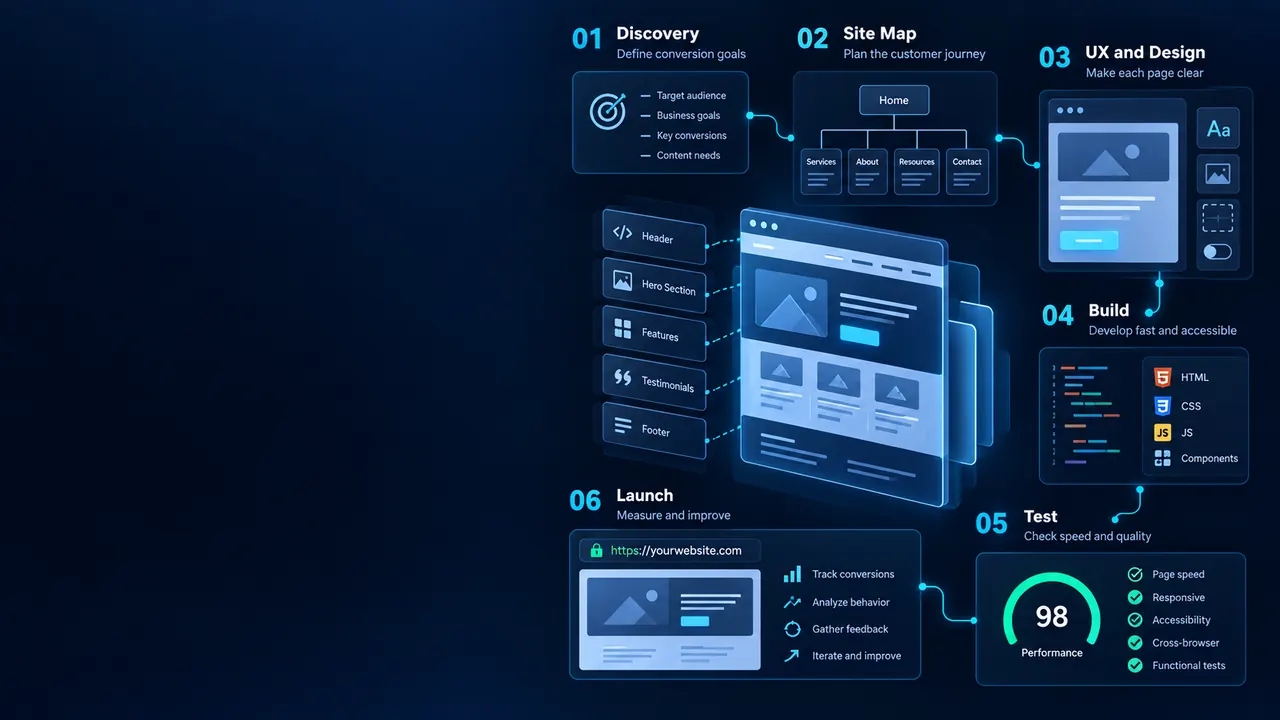
Most business sites are built to look finished, not to perform. Our website design and development services build sites that load fast on a mid-range phone, get crawled properly, and are structured so the next page you add ranks without a rebuild.
Our website development services build fast, accessible, search-ready sites. As a website development company, we deliver custom website development and business website design on WordPress, Shopify, Webflow or headless stacks — with SEO, Core Web Vitals and conversion tracking built in.
Get a free audit →Design, development and the technical SEO that protects your rankings, delivered as one project.
Page structure and navigation built around how customers actually buy.
Reusable components so new pages stay fast and on-brand.
WordPress, Shopify, Webflow or headless — chosen for your team.
Clean markup, internal linking and structured data from launch.
Performance budgets enforced during the build, not bolted on after.
One-to-one redirects, analytics and conversion tracking wired in.
These are not upsells. A site that fails on any of them is not finished, and we would rather argue about it during the build than after launch.
Measured on field data from real devices, not a lab score on a fast laptop. Performance budgets are enforced during the build, because retrofitting speed afterwards is far harder than protecting it.
Server-rendered HTML so crawlers, AI answer engines and assistive technology all receive the actual content rather than an empty shell that needs scripting to fill.
Headings used for structure rather than for font size. It is the cheapest ranking factor available and one of the most commonly broken.
A one-to-one redirect map applied at launch. Without it a redesign discards accumulated authority, which is the single most damaging launch mistake we see.
Contrast, focus states, labels, keyboard paths and alt text. It widens your audience, reduces legal exposure, and correlates closely with clean semantic markup.
Source code, domain, hosting and analytics in your accounts. No proprietary page builder that holds the site hostage if you ever change agency.
Building to today's baseline means launching already behind. These are the changes we design around now.
Assistants and AI summaries extract from server-rendered markup. Sites that render content only in the browser get skipped entirely, which is becoming a meaningful traffic risk.
Interaction to Next Paint measures every interaction, not just the first. Heavy client-side JavaScript that once passed now fails, and it is the vital most sites currently struggle with.
The European Accessibility Act and equivalent rules elsewhere are turning WCAG conformance from good practice into a compliance requirement for many businesses.
The value of a build is now partly in how safely a non-technical person can publish. Sites requiring a developer for every change quietly stop being updated.
Most builds take six to twelve weeks, depending on page count and integrations.
We crawl the current site, map every URL and agree the templates.
Wireframes, then UI designed on your real content.
Server-rendered pages with performance budgets enforced.
Redirects, Search Console checks and 30 days of fixes.
Direct answers on cost, platform, timelines and what happens to your rankings.
It can, badly, and it is the most common way businesses lose organic traffic. The risk comes almost entirely from changing URLs without one-to-one redirects, dropping heading structure, or removing content that was ranking. We crawl the existing site first, map every URL, and treat the pages currently earning traffic as fixed requirements rather than things to redesign freely.
It depends on who maintains it. WordPress is sensible when your team publishes frequently and needs a familiar editor; it becomes a liability when it accumulates plugins nobody audits. A modern framework build is faster and more secure but needs a developer for structural change. We recommend based on your team, not on what we prefer to build.
It scales with page count, integrations and how much content needs writing or migrating. A focused site for a small business sits far below a multi-location or catalogue build. What moves the number most is not visual design but integration complexity, so we scope those first and give a fixed price rather than an hourly estimate.
Typically six to twelve weeks. The stage that slips is almost always content — not design or development. Projects that finish on time are the ones where content is being written in parallel from week one rather than gathered at the end.
Yes, completely. Source code, domain, hosting and analytics all sit in your accounts, and handover includes documentation plus a recorded walkthrough. We do not build on proprietary systems that make leaving difficult, because a client who stays only because leaving is hard is not a client relationship worth having.
Yes, and often that works well. If you have a brand system we build to it. If you have a designer producing page comps we will ask for a component system instead, since page pictures do not tell a developer what happens at other screen sizes or with longer content.
Thirty days of fixes are included, covering anything that does not work as specified. Beyond that we offer ongoing support, but it is optional — you own the code and can take it anywhere. We also verify analytics and Search Console are reporting correctly, since a site nobody measures cannot be improved.
Send us your current site. We will crawl it, show you what is holding it back technically, and outline what a rebuild would need to protect and improve.
Further reading
The thinking behind the work. These guides go deeper on the methods this page describes — written by the team that runs them.
 Web Design
The 5-second website test: how to check if visitors instantly understand what you do, how to run it, the questions to ask and fixes that improve conversions.
Read the guide Web Design
The 2026 conversion rate optimization guide: research, value proposition, friction, trust, forms, A/B testing and prioritisation to turn traffic into revenue.
Read the guide