Content Marketing

Content that ranks,
converts and compounds.

Publishing volume stopped working the moment generated content became free. What earns distribution now is genuine depth, original evidence and named expertise — and that is exactly what most content programmes cannot produce at scale.

RANKS FOR1,240keywordsORGANIC TRAFFIC+247%PIPELINE+64%
Editorial strategy
Search-led briefs
Expert authorship
Pipeline attribution
01
The volume trap

Publishing more stopped working. Publishing better is the only thing left.

For years the content playbook was volume: publish weekly, target keywords, wait. Generated content collapsed the cost of producing that, and its value fell with it. Search systems responded by weighting first-hand evidence, named expertise and originality far more heavily. Programmes still measured on output rather than outcome are producing more, ranking less and cannot see why.

Content produced to a quota

Four posts a month written to hit a deliverable count, targeting nothing specific and covering nothing well. It creates a library that ranks for nothing and dilutes topical focus.

Cannibalisation from years of publishing

Publishing without an intent map leaves multiple articles competing for the same query. Signals split and none ranks properly — the fix is consolidation, not more content.

Anonymous, unattributed writing

Content with no identifiable author and no first-hand evidence is exactly what generated text produces cheaply. It is now systematically discounted.

Measured on traffic, not pipeline

Programmes reporting sessions and keyword counts get cut when someone asks what content earned. Attribution to pipeline is what keeps budget.

10 > 50
Deep pages beat volume
~68%
Clicks to the top three
58%+
Searches ending zero-click
8+
Years running content programmes
02
What we actually do

Fewer pieces. Real evidence. Named experts.

We build content programmes around what search systems now reward: depth that fully covers a query, first-hand evidence that cannot be generated, and authorship that can be verified.

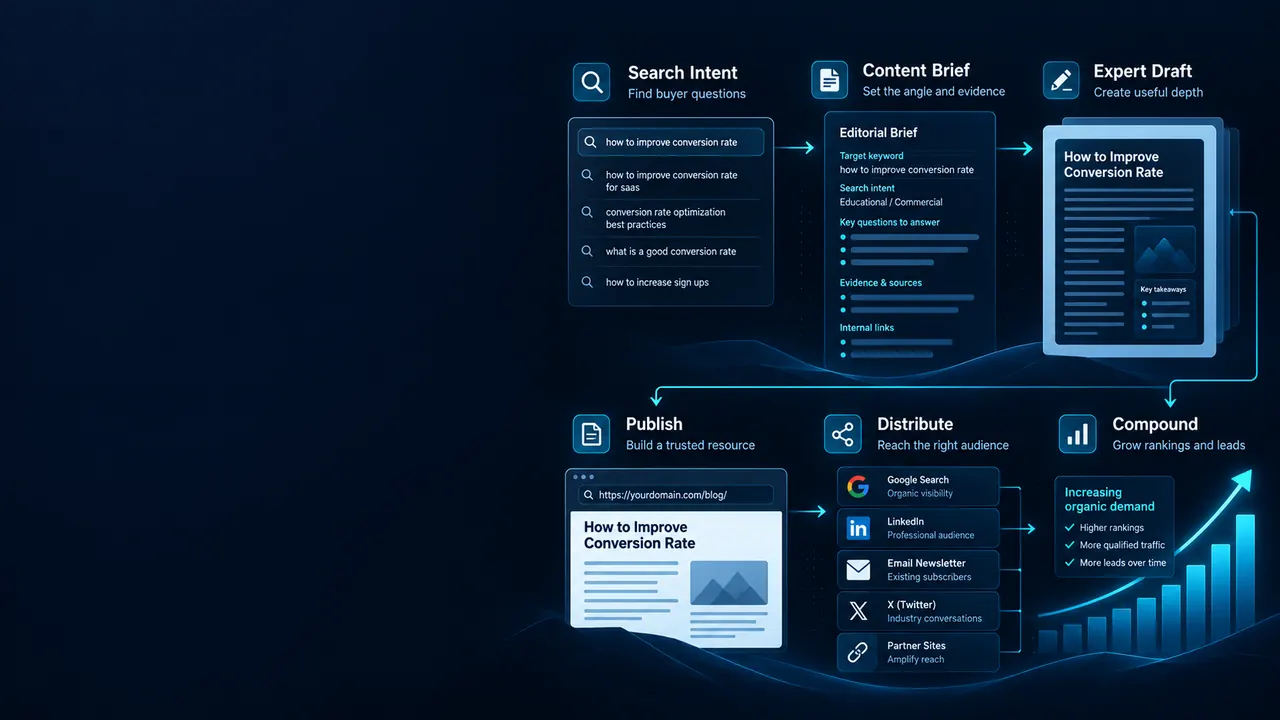
In practice that means fewer, longer, better-specified pieces built from what currently ranks — plus consolidating the back catalogue so existing content stops competing with itself. Most early gains come from fixing what you already published rather than publishing more.

  • Search-derived briefs — every piece specified from the pages currently ranking — required subtopics, entities, format and depth, rather than a word count.
  • Topical clusters — hub-and-spoke architecture with deliberate internal linking, so authority concentrates rather than scattering.
  • First-hand evidence — original data, real examples, named practitioner input — the things that separate content that ranks from content that merely covers the topic.
  • Back-catalogue consolidation — cannibalising pages merged or differentiated, thin pages improved or removed. Usually the fastest return available.
  • Pipeline attribution — content reported on assisted conversions and revenue, not sessions, so investment survives budget review.
Volume content
Evidence-led content
4 posts a month by quota
Published when a query needs it
Word-count targets
Coverage against the SERP
Anonymous authorship
Named, credentialed experts
Keyword-stuffed headings
Question-shaped structure
Flat archive of posts
Linked topical clusters
Reported on sessions
Reported on pipeline

The counterintuitive part: most content programmes improve fastest by publishing less. Consolidating cannibalising pages and deepening what already exists usually beats anything new you could write this quarter.

03
The Sachkhand blueprint

How we build content that earns its place

Six workstreams, starting with the content you already have — because that is where the fastest return usually sits.

01

Content & cannibalisation audit

Every existing page mapped to intent, with competing pages identified. Consolidation decisions come before any new commissioning.

02

Intent & cluster mapping

Topics chosen by commercial proximity, organised into hub-and-spoke clusters so authority concentrates rather than spreading thin.

03

Search-derived briefs

Each piece specified from what currently ranks — subtopics, entities, format, depth and internal link targets. Writers work from evidence, not a topic title.

04

Expert input & attribution

Named authorship with credentials, plus practitioner interviews to capture the first-hand detail that cannot be generated.

05

Distribution & repurposing

Each piece cut into social, email and video derivatives. Publishing is the start of distribution, not the end of the work.

06

Pipeline reporting

Assisted conversions and revenue by cluster, so you can see which topics produce buyers rather than just readers.

04
What is changing through 2026

Four shifts in content

The economics of producing text collapsed, and search systems adjusted what they reward. Both changes point the same way.

01

Generated content is discounted by default

When text became free to produce, its marginal value fell to near zero. Volume plays that worked for years now produce nothing, and on unfocused sites actively dilute existing rankings.

02

First-hand experience is the differentiator

Original data, real photography, named practitioners and demonstrable use now separate ranking pages from competent ones. None of it can be produced cheaply, which is precisely why it carries weight.

03

Passage ranking rewards structure

Engines score sections independently, so a well-sectioned long piece can rank for dozens of related queries. Structure has become a ranking mechanism rather than a formatting choice.

04

Content feeds AI citation

Specific, verifiable, well-attributed claims get cited inside generated answers. Vague marketing prose supplies nothing quotable, which makes precision a distribution strategy.

05
Why Sachkhand

We will recommend publishing less

Most content agencies sell volume because volume is easy to price. We price outcomes, which usually means fewer pieces done properly.

Briefs derived from evidence

Every specification comes from the pages actually ranking for that query, not from a general best-practice checklist that ignores your category's conventions.

Consolidation before commissioning

We fix cannibalisation first. Publishing new content onto a site where pages already compete just entrenches the problem.

Expert input as standard

Practitioner interviews and named authorship built into the process, because that first-hand detail is the part that cannot be replicated cheaply.

Pipeline, not sessions

Reported on assisted conversions and revenue by cluster. Content programmes measured on traffic are the first thing cut in a downturn.

Distribution built in

Every piece cut into derivatives for social, email and video. Publishing without distribution wastes most of the production cost.

Written to be cited

Specific, dated, verifiable claims so content earns citations inside AI answers rather than being summarised away without attribution.

06
The Honest Comparison

Why Businesses Choose SDM for Content Marketing

Same budget, very different outcomes. Point by point, here’s how a specialist partner compares to a typical agency or going it alone.

What actually matters With SDM Typical Agency In-House / DIY
Senior specialist on your accountAlwaysOften a juniorStretched thin
Custom strategy built for your goalsTailoredTemplatedGuesswork
Deep audit before any work beginsSurface-levelSkipped
White-hat, penalty-safe methodsGuaranteedVariesHigh risk
Plain-English reporting tied to revenueMonthlyJargon PDFsNone
Direct access to your specialistAccount-manager relayN/A
Briefs derived from live SERP dataTopic titlesGuesswork
Cannibalisation fixed firstIgnoredUnknown
Named expert authorshipAnonymousAnonymous
Distribution and repurposing includedPublish onlyPublish only
Reported on pipeline, not sessionsTrafficPost count
Ongoing competitor gap analysisOne-offManual
Conversion-focused, not just trafficTraffic-firstUnclear
Premium tools included (Ahrefs, SEMrush)SometimesCostly extra
No long lock-in contractsFlexible6–12 mo lock-inN/A
Established agency, operating since 2017VariesLearning curve
Fast onboarding & early quick wins~2 weeksSlowTrial & error
Human, SEO-led content (no AI spam)Outsourced / AI spamTime-heavy
Focus on compounding, long-term ROICore promiseShort-term winsSlow & ad-hoc
Recovery from Google penaltiesSometimesVery hard

20 reasons growing brands make the switch. See the difference for yourself →

07
Measurement

Sessions are the easiest content metric to grow and the least useful

We report on what content contributed commercially, with traffic as a diagnostic behind it.

Assisted pipeline

Revenue and opportunities where content appeared in the journey, since content rarely converts on last click.

Query coverage per cluster

How many distinct queries each topical cluster ranks for — the real measure of whether depth is working.

Non-branded organic share

Proportion of content traffic from people who did not already know you, which is the point of the investment.

AI citation rate

How often your content is cited inside generated answers, increasingly where research-phase visibility now lives.

Content decay

Pages losing rankings over time, so refresh work is scheduled before traffic is lost rather than after.

Content performance
All clusters — rolling 90 days
LIVE
Pipeline
+76%
Coverage
3.1x
Non-brand
72%
AI cites
44%
Decay
12%
↑ 214% non-branded organic sessions vs previous period
08
The engagement

Four stages, repeated every month

Fix what exists, then build clusters, then distribute. Publishing first is the common and expensive mistake.

01

Audit & consolidate

Every page mapped to intent, cannibalisation resolved, thin content improved or removed. This alone frequently lifts rankings without a word being published.

→ Clean library, resolved conflicts
02

Map clusters

Topics selected by commercial proximity and organised into hub-and-spoke structures with a documented internal linking plan.

→ Prioritised cluster roadmap
03

Brief & produce

Search-derived specifications, expert input captured through interviews, named attribution applied. Fewer pieces, built to actually rank.

→ Content that earns distribution
04

Distribute & measure

Each piece repurposed across social and email, with pipeline reporting by cluster. Decaying pages scheduled for refresh before traffic is lost.

→ Compounding pipeline contribution
09
Outcomes

The targets we set for content engagements

Targets we plan against for B2B, SaaS, professional services and ecommerce clients after twelve months.

+214%
Non-branded sessions
Target by month 12
3.1×
Queries per page
From depth and structure
+76%
Assisted pipeline
Attributed to content
−42%
Pages published
vs previous programme

Targets rather than best cases. Note the last figure: most clients publish considerably less with us than before and perform better. The gains come from consolidation, depth and distribution rather than output volume. These are planning targets rather than a record of past client averages; we agree a realistic range against your own baseline before an engagement starts.

10
Scenarios

Content in action — three sectors

Different categories, the same finding: less content, better specified, outperforms more. The scenarios below are composites drawn from situations we encounter repeatedly — they illustrate method, not the account of any single named client.

B2B SaaS

Publishing half as much and tripling pipeline

Challenge

Two posts a week for eighteen months had produced a large archive, heavy cannibalisation and almost no attributable pipeline.

What we did

Consolidated 140 posts into 38 canonical pieces, rebuilt around problem-framed buyer queries with named authorship, and cut publishing to two pieces a month.

+286%
Assisted pipeline
−73%
Pages published
Healthcare

Clinician-authored content that outranked publishers

Challenge

Genuine clinical expertise, but content was anonymous, undated and consistently beaten by large consumer health portals.

What we did

Rebuilt condition content with named clinician authorship, dated clinical sourcing and answer-first structuring for AI and snippet extraction.

+248%
Organic sessions
+92%
Enquiries
Ecommerce

Buying guides that carried the category pages

Challenge

Product pages competed unsuccessfully with marketplaces, and there was no content capturing research-phase demand.

What we did

Built buying-guide clusters around use case and comparison queries, linked into category pages to concentrate authority where revenue happens.

+164%
Category revenue
3.4×
Query coverage
11
Questions

The questions we get asked most

Honest answers on volume, AI-written content and what content marketing returns.

How much content should we publish?+

Almost certainly less than you are publishing now. Ten genuinely authoritative pieces with original data or real expertise outperform fifty generic posts by a wide margin. We usually reduce publishing frequency and redirect that budget into depth, expert input and distribution — most clients publish substantially less with us and perform considerably better.

Can we just use AI to write content?+

For drafting from a strong brief and a subject-matter interview, it is a useful tool and we use it that way. As the whole process it fails, because what search systems now reward is precisely what generated text cannot supply — first-hand experience, original data and verifiable expertise. Publishing unedited generated content at volume is the fastest way to dilute a site's topical authority.

Why start with our existing content?+

Because that is usually where the fastest return is. Most sites with a publishing history have significant cannibalisation — multiple pages competing for the same query, splitting signals so none ranks well. Consolidating them frequently lifts rankings without publishing anything new, and it stops new content inheriting the same problem.

How long before content produces results?+

Consolidation and on-page work on existing pages can move rankings within four to eight weeks. New cluster content typically takes three to six months to rank competitively. Pipeline contribution lags visibility, since research-phase content influences buyers weeks or months before they convert.

How do you measure content when it rarely converts on last click?+

Assisted conversions and revenue by cluster, not last-click. Content usually appears early in a journey and gets no last-click credit, which is why programmes measured that way look like they fail. We also track query coverage and AI citation rate as leading indicators that arrive before pipeline does.

Do you write it, or do we?+

Either, and the specification matters more than who types. Many clients have genuine subject expertise we cannot replicate, so we build the brief and their team writes. Others have us write from practitioner interviews. What does not work is either party writing without an evidence-derived brief.

What about content for AI search?+

It is largely the same work done more precisely. Specific, dated, verifiable claims with clear attribution get cited inside generated answers; vague marketing prose does not. We build that into every brief rather than treating AI visibility as a separate service, because the underlying requirement is the same.

Next step

Ready to make content earn its budget?

We will audit your existing library for cannibalisation and decay, show you what is already there to fix, and map the clusters worth building.

Free content & cannibalisation audit
Cluster opportunity map
Decay analysis
Pipeline attribution setup
NON-BRANDED SESSIONS+214%
Chat With Us
🚀 Book Free Audit & consultation!
45 min · Free audit + strategy + consultation · No obligation