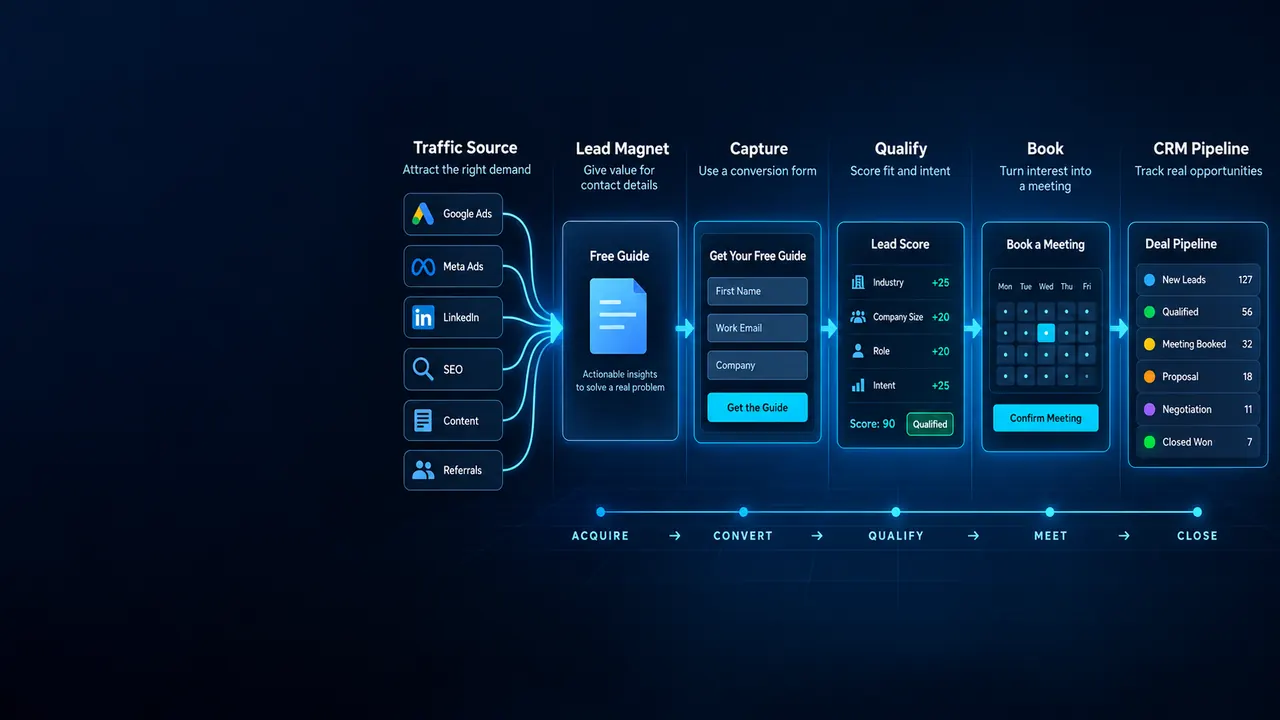
Lead Generation Services at a glance
Our lead generation services deliver qualified leads, not raw volume. As a lead generation agency and lead generation company, we combine search, paid media and conversion optimisation, including B2B lead generation — with every lead tracked to source and outcome.
Get a free audit →- Qualified lead targeting
- Search & paid campaigns
- Landing pages
- Lead scoring
- CRM integration
- Cost-per-lead reporting
A lead count is the easiest number in marketing to inflate
Loosen a form, add a competition, buy a list, and lead volume doubles in a week. None of it produces revenue, and all of it looks like progress on a dashboard. The gap between what marketing reports and what sales will actually work is the single most common source of friction between the two functions — and it is a measurement problem before it is a performance one.
Form fills counted as leads
A newsletter signup and a request for pricing are not the same event. Counting them together means the cheaper one dominates the number and the expensive one gets optimised away.
Bought lists
Purchased contact data is unconsented in most of the markets we work in, converts terribly, and damages sender reputation for the email programme that had been working.
No feedback from sales
If nothing flows back from the CRM, marketing optimises toward whatever produces the most submissions. That is almost never what produces the most revenue.
Leads with no context
A name and an email with no record of what they read or what they were looking for gives sales nothing to open with, which is why so many go uncontacted.
Define a lead first. Then go and earn it.
Before anything runs we agree with your sales team what a qualified lead actually is — company size, budget signal, role, timing, whatever genuinely predicts a deal in your business. That definition becomes the target, and everything gets measured against it.
Then we build the demand: search visibility for the queries buyers use when they are ready, content that answers the questions blocking a decision, paid where it is genuinely cheaper than organic, and conversion paths that do not lose people at the last step.
- Counts form fills
- Buys contact lists
- No CRM connection
- Volume targets
- Leads handed over raw
- Optimises to the dashboard
- Counts qualified leads
- Earns inbound demand
- Two-way CRM feedback
- Cost per SQL targets
- Context passed with each lead
- Optimises to closed revenue
what percentage of last month’s leads did sales actually contact? If it is under half, the problem is lead quality or lead context, and buying more of them makes it worse rather than better.
- Agreed lead definition
- Written down with sales before launch, so marketing and sales are optimising toward the same thing rather than arguing about the number.
- Intent-led acquisition
- Organic and paid aimed at the queries that carry purchase intent rather than the ones that carry volume.
- Conversion path repair
- Most sites lose more at the form than they do in the ranking. Fixing that is usually cheaper than buying more traffic.
- Two-way CRM integration
- Outcomes flow back from your CRM so we can optimise toward what closed, not toward what submitted.
- Lead context passed through
- What they read, what they searched, what they downloaded — handed to sales so the first call is not a cold open.
How a lead generation programme is built
Six components. The first two decide whether the rest is worth building.
Lead definition workshop
Sat down with sales to define what qualifies. Company profile, role, budget signal, timing — whatever actually predicts a close in your business.
Tracking & CRM wiring
Conversion tracking verified end to end and connected both ways, so outcomes come back rather than disappearing into the pipeline.
Intent acquisition
Organic and paid built around the queries buyers use when they are close to deciding, not the ones with the biggest volume.


Conversion path
Landing pages, forms and calls to action rebuilt so the traffic you already earn converts before you spend on more.
Nurture for the not-yet-ready
Most enquiries are not ready today. Email and retargeting sequences keep them warm instead of writing them off as failed leads.
Closed-loop reporting
Cost per qualified lead and cost per closed deal, reconciled against your CRM rather than against platform-reported conversions.


We report the number sales agrees with
If marketing and sales are quoting different lead counts, the programme is being measured wrong.
Sales in the room at the start
The lead definition is agreed with the people who work the leads, before anything launches. It removes the argument later.
Two-way CRM, not one-way
Outcomes flow back so we optimise toward what closed. Without that loop, every lead-gen programme drifts toward cheap, useless volume.
No purchased data, ever
It is unconsented in most markets, converts poorly and burns the sender reputation your email programme depends on.
Cost per qualified lead
Reported as the headline number rather than raw volume, because it is the only one that compares meaningfully to what a customer is worth.
Context travels with the lead
Sales gets what the person read and searched, so the first conversation starts somewhere useful.
We will say when volume is the wrong goal
In high-value B2B, twelve good conversations beat four hundred form fills. We scope for whichever your economics actually reward.
Why Businesses Choose SDM for Lead Generation
Same budget, very different outcomes. Point by point, here’s how a specialist partner compares to a typical agency or going it alone.
| What actually matters | With SDM | Typical Agency | In-House / DIY |
|---|---|---|---|
| Senior specialist on your account | Always | Often a junior | Stretched thin |
| Custom strategy built for your goals | Tailored | Templated | Guesswork |
| Funnel & CRM audit before any spend | ✓ | Surface-level | Skipped |
| Consented, GDPR-compliant data only | Always | Varies | Risky |
| Plain-English reporting tied to revenue | Monthly | Jargon PDFs | None |
| Direct access to your specialist | ✓ | Account-manager relay | N/A |
| Lead definition agreed with sales | ✓ | Rarely | No |
| Two-way CRM integration | ✓ | One-way | None |
| Cost per qualified lead reported | ✓ | Raw volume | Unclear |
| No purchased contact data | ✓ | Common | n/a |
| Lead context passed to sales | ✓ | Name and email | No |
| Ongoing competitor offer analysis | ✓ | One-off | Manual |
| Conversion paths fixed before buying traffic | ✓ | Traffic-first | Rarely |
| CRM, tracking & call analytics included | ✓ | Extra cost | Patchy |
| No long lock-in contracts | Flexible | 6–12 mo lock-in | N/A |
| Established agency, operating since 2017 | ✓ | Varies | Learning curve |
| Fast onboarding & early quick wins | ~2 weeks | Slow | Trial & error |
| Human-written offers & nurture copy | ✓ | Templated | Time-poor |
| Optimised to closed revenue, not volume | ✓ | Lead count | Unclear |
| Speed-to-lead process built in | ✓ | Rarely | Slow |
20 reasons growing brands make the switch. See the difference for yourself →
Everything ties back to cost per closed deal
Volume is reported, but it is never the number we optimise against.
Qualified leads (SQL)
Enquiries meeting the definition agreed with sales, not total submissions.
Cost per qualified lead
Total spend divided by leads sales accepted — the number that compares to customer value.
Lead-to-opportunity rate
How many accepted leads become real opportunities. The clearest signal of whether targeting is right.
Cost per closed deal
Reconciled in your CRM. The only figure that settles whether the programme is profitable.
Contact rate
The share of leads sales actually pursued. Low contact rate means quality or context problems, not a volume problem.


Our Lead Generation process: four stages to a working pipeline
The first stage takes an afternoon and prevents most of the arguments that follow.
Define and wire
Lead definition agreed with sales, tracking verified, CRM connected both ways before anything launches.
One agreed numberBuild demand
Organic and paid aimed at genuine purchase intent, with the conversion path fixed before spending on more traffic.
Enquiries that qualifyNurture the rest
Sequences for the majority who are not ready today, so they are not written off as failures.
Pipeline over timeClose the loop
Outcomes from the CRM feed back into targeting, creative and budget allocation every month.
Cost per deal falling
Lead Generation FAQs: the questions we get asked most
On quality, cost and why volume is usually the wrong target.
Further reading
Guides, terms and related services
Go deeper on the methods behind this service, with guides written by the specialists who run them, plain-English definitions and the services that usually work alongside it.
 Performance Marketing
The Omnichannel ROI Framework: Stop Burning Ad Spend
A digital marketing ROI framework for 2026: server-side tracking, MER, incrementality testing, marketing mix modelling, LTV:CAC and payback period.
Read the guide Web Design
The 2026 CRO Guide: Turning Traffic Into Revenue
The 2026 conversion rate optimization guide: research, value proposition, friction, trust, forms, A/B testing and prioritisation to turn traffic into revenue.
Read the guide Google Ads
The Complete Google Ads Guide for 2026
The complete Google Ads guide for 2026: campaign types, Performance Max, bidding, keywords, Quality Score, conversion tracking, costs and scaling.
Read the guide