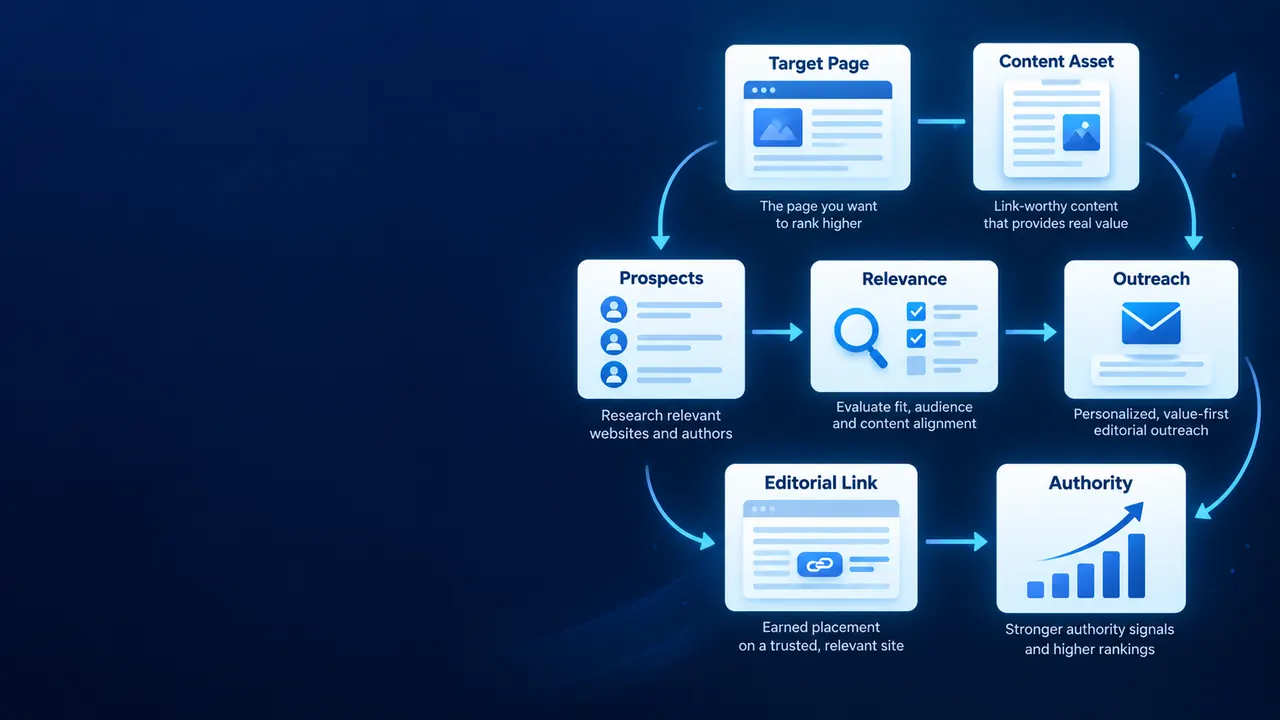
Link Building Services at a glance
Our link building services earn high-quality backlinks through digital PR, editorial guest posting and relationship-led outreach — white hat link building and off-page SEO that strengthens topical authority without risking a penalty. As a link building agency, we measure links by the rankings they move, not by the count.
Get a free audit →- White hat link building
- Digital PR
- Guest posting
- Broken link building
- Backlink audit
- Anchor text strategy
Link volume stopped correlating with rankings. Link quality never did.
Manipulation is now neutralised continuously rather than in periodic sweeps, which changed the economics of link building entirely. Bought links increasingly do nothing at all — not penalised, simply ignored — which makes them a pure waste before they ever become a liability. Meanwhile a small number of genuine editorial placements still moves rankings decisively, because those are the links the system was built to count.
- Volume link packages
Volume packages that do nothing
Bulk directory, network and marketplace links are trivially detectable and largely discounted. You pay for a number that appears in a report and produces no ranking movement whatsoever.
- Toxic link history
Historic toxic profiles
Links built by previous providers frequently sit unexamined until an update devalues them. Cleanup through auditing and disavowal is slow and costs far more than doing it properly would have.
- Links to wrong pages
Links to the wrong pages
Authority pointed at a homepage does little for the commercial pages that need to rank. Without deliberate target mapping and internal routing, earned authority sits where it cannot convert.
- Nothing worth linking
No genuine reason to be linked
Outreach fails when there is nothing worth linking to. Without original data, research or genuinely useful assets, campaigns default to paying for placement — which is where the risk starts.
Not acquiring links. Creating reasons for people to link.
Modern link building is the work of producing assets genuinely worth citing — original research, proprietary data, expert commentary, useful tools — then getting them in front of the journalists, editors and site owners whose audiences would care.
That is slower and less impressive as a monthly number than buying placements. It is also the only approach that survives algorithm updates, because the links are indistinguishable from organic editorial coverage — which is precisely what they are.
- Bulk directories & networksEditorial placements only
- Links counted monthlyRelevance and traffic assessed
- Everything to the homepageMapped to commercial pages
- Templated outreach at scaleAssets worth covering
- Risk deferred to laterNothing needing cleanup
- Reports link countsReports ranking movement
We build fewer links than a volume provider and they cost more each. They also still work after the next update, which is the entire point — penalty recovery routinely costs more than a year of doing it properly.
- Competitor gap analysis
- The domains linking to competitors but not to you, prioritised by relevance and realistic attainability rather than raw authority score.
- Digital PR & original research
- Data-led assets journalists genuinely want to cover, which earn placements that no amount of outreach on thin content ever will.
- Editorial guest placement
- Genuine contributions to publications your audience actually reads, written to their standards rather than templated for link value.
- Target page mapping
- Authority deliberately pointed at commercial pages and routed internally, so earned links land where they affect revenue.
- Profile auditing & cleanup
- Historic toxic links identified, assessed and disavowed where warranted — often the first thing a new engagement needs.
How we build authority that lasts
Six workstreams, starting with cleaning up what is already there before adding anything new.
Profile audit & cleanup
We assess your existing link profile for toxic patterns from previous providers, disavow where genuinely warranted, and establish a clean baseline. Building on an unexamined profile compounds problems you have not yet seen.
What’s included
- Full backlink profile audit
- Toxic and spammy links identified
- Disavow file where it is genuinely needed
You receive: A backlink audit and disavow file
Competitor gap analysis
Domains linking to competitors but not to you, scored by relevance, traffic and realistic attainability. This produces a concrete target list rather than an aspirational one.
What’s included
- Referring domains competitors have and you lack
- Domain authority gaps by topic and page type
- Priority link targets ranked by value
You receive: A backlink gap analysis
Linkable asset creation
Original research, proprietary data analysis, tools or expert commentary that journalists have a genuine reason to cover. Without this, outreach has nothing to offer and defaults to paying.
What’s included
- Research, tools and guides that attract backlinks
- Built around topics journalists already cover
- Hosted to strengthen key pages
You receive: A linkable asset ready for outreach
Digital PR outreach
Targeted pitching to journalists and editors covering your sector, built on real relationships rather than bulk mail-merge. Response rates depend far more on relevance than on volume.
What’s included
- Journalist and editor outreach
- Newsworthy stories that earn editorial backlinks
- Coverage tracked with links and brand mentions
You receive: A digital PR coverage report
Editorial placement
Genuine contributions to publications your audience reads, written to their editorial standards. Placements that would stand on their own merit without the link.
What’s included
- Links placed inside genuine editorial content
- Relevant, high-authority publications
- No sponsored or paid-link footprints
You receive: A placement report with live URLs
Authority routing
Internal linking that distributes earned authority to the commercial pages that need it. Links landing on a blog post do little unless that authority is deliberately routed onward.
What’s included
- Internal links that pass link equity to priority pages
- Redirects and consolidation of split authority
- Backlink targets aligned with commercial URLs
You receive: An authority flow plan for key pages
Get a free audit →Zero penalties since 2017
That record is not luck. It comes from refusing an entire category of tactics that most providers still sell.
No networks, no marketplaces
We do not use private networks, paid directories or link marketplaces at any price. Not because they are always caught — because they increasingly do nothing, then eventually cost you.
Every placement manually vetted
We check the publication is real, read, editorially genuine and topically relevant. Automated prospecting fills reports with domains no human would consider linkable.
We create the reason to link
Original research and data assets, not just outreach. Campaigns without something worth covering inevitably collapse into paying for placement.
Mapped to commercial pages
Authority pointed deliberately at pages that generate revenue and routed internally, rather than accumulating on a homepage where it does least good.
Reported on rankings, not counts
A link count is an activity metric. We report ranking and traffic movement on the target pages, which is the only reason to build links at all.
Cleanup included
If you arrive with a toxic historic profile we audit and remediate it first. Building on an unexamined profile is how good money follows bad.
Why Businesses Choose SDM for Link Building
Same budget, very different outcomes. Point by point, here’s how a specialist partner compares to a typical agency or going it alone.
| What actually matters | With SDM | Typical Agency | In-House / DIY |
|---|---|---|---|
| Senior specialist on your account | Always | Often a junior | Stretched thin |
| Custom strategy built for your goals | Tailored | Templated | Guesswork |
| Deep audit before any work begins | ✓ | Surface-level | Skipped |
| White-hat, penalty-safe methods | Guaranteed | Varies | High risk |
| Plain-English reporting tied to revenue | Monthly | Jargon PDFs | None |
| Direct access to your specialist | ✓ | Account-manager relay | N/A |
| Every placement manually vetted | ✓ | Automated lists | Guesswork |
| No PBNs, directories or marketplaces | Guaranteed | Often used | Tempting |
| Original research assets created | ✓ | Outreach only | None |
| Authority mapped to commercial pages | ✓ | Homepage only | Random |
| Toxic profile cleanup included | ✓ | Extra cost | Very hard |
| Ongoing competitor gap analysis | ✓ | One-off | Manual |
| Conversion-focused, not just traffic | ✓ | Traffic-first | Unclear |
| Premium tools included (Ahrefs, SEMrush) | ✓ | Sometimes | Costly extra |
| No long lock-in contracts | Flexible | 6–12 mo lock-in | N/A |
| Established agency, operating since 2017 | ✓ | Varies | Learning curve |
| Fast onboarding & early quick wins | ~2 weeks | Slow | Trial & error |
| Human, SEO-led content (no AI spam) | ✓ | Outsourced / AI spam | Time-heavy |
| Focus on compounding, long-term ROI | Core promise | Short-term wins | Slow & ad-hoc |
| Recovery from Google penalties | ✓ | Sometimes | Very hard |
20 reasons growing brands make the switch. See the difference for yourself →
A link count is activity. Ranking movement is the result.
We report on what the links did, not how many arrived — because those two numbers frequently disagree.
Referring domain growth
New genuine referring domains and their relevance and traffic distribution, rather than a raw count that rewards volume.
Target page rankings
Position movement on the specific pages links were pointed at — the direct test of whether the campaign worked.
Authority metrics
Domain and page-level authority trend, used as a directional indicator rather than the objective itself.
Referral traffic
Actual visitors arriving from placements, which correlates strongly with whether a link carries genuine ranking weight.
Profile health
Toxic link ratio and anchor text distribution, monitored so risk is caught before it becomes a recovery project.
Our Link Building process: four stages, repeated every month
Clean first, then create something worth covering, then earn placement. Skipping the middle stage is why most campaigns fail.
Audit & clean
Existing profile assessed for toxic patterns, disavowal where genuinely warranted, and competitor gap analysis producing a prioritised, attainable target list.
DeliverableClean baseline + target listCreate the asset
Original research, data analysis or expert commentary journalists have a real reason to cover. This is what separates campaigns that earn coverage from campaigns that end up buying it.
DeliverableLinkable asset publishedOutreach & place
Targeted pitching to relevant journalists and editors, plus editorial contributions to publications your audience reads. Every placement manually vetted before pursuit.
DeliverableEarned editorial placementsRoute & measure
Earned authority routed internally to commercial pages, with reporting on target-page rankings and referral traffic rather than link counts.
DeliverableRanking report + next campaign
Proven results from real SEO clients
Published case studies from our clients — each with the starting point, the dates, the source and what the numbers don’t prove.
A home services franchise group — 34.1K ranking keywords and 1.8K AI mentions.
Read the case study →B2B SaaS SEO77.9K Google clicks in three months — organic is the top channel.
Read the case study →Home services SEOTop 3 for “emergency plumber”, cited on 218 pages in AI answers.
Read the case study →Link Building FAQs: the questions we get asked most
Direct answers on what works now, what does not, and where the risk actually sits.
Further reading
Go deeper on this
The thinking behind the work. These guides go deeper on the methods this page describes — written by the team that runs them.