Week 1
Category and prompt baseline
You choose the categories that matter most. We test real buying questions for them in each assistant and record which products and stores are named.
You receive
A baseline by category.
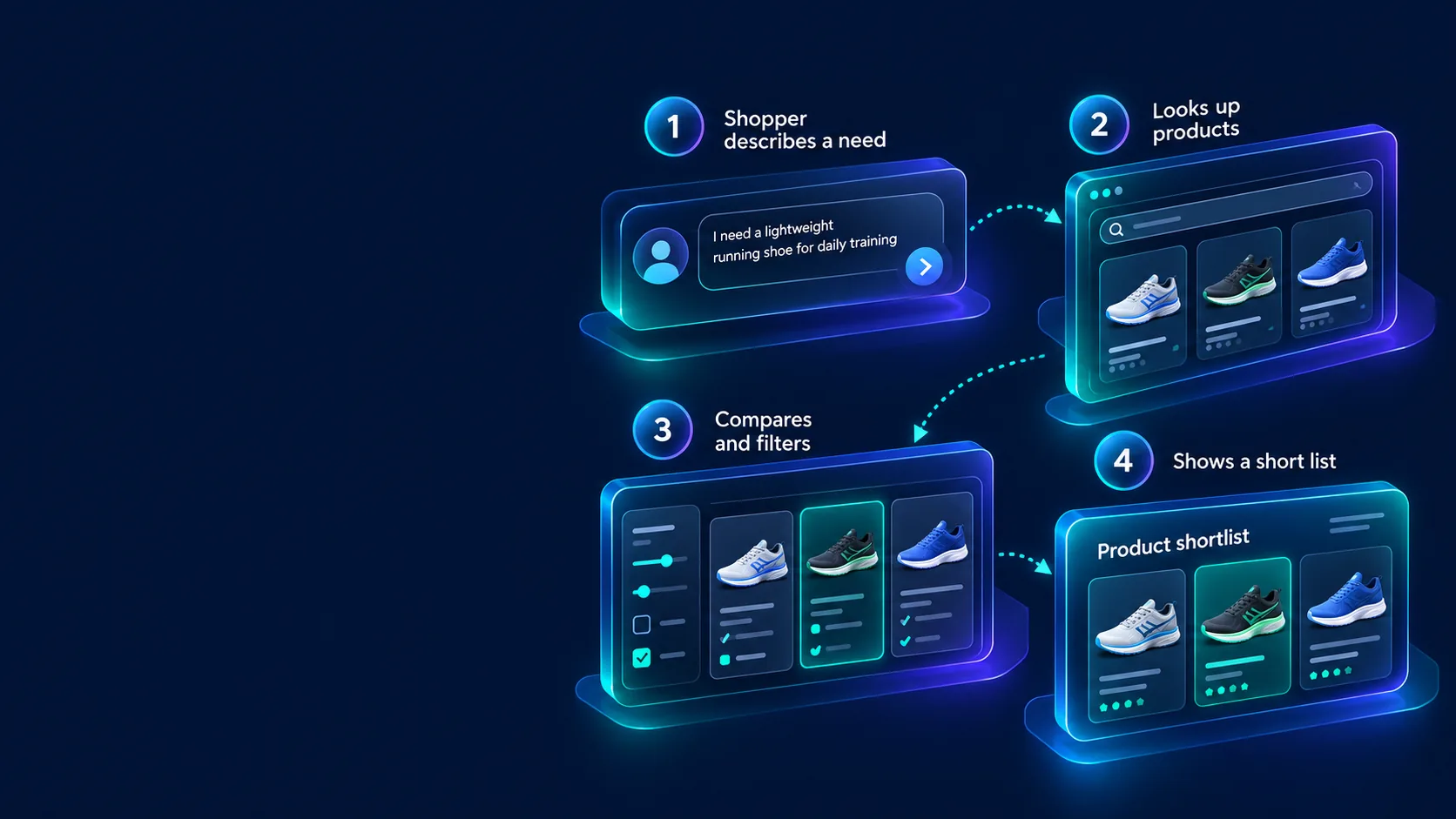
Shoppers now ask AI assistants what to buy and receive a short list of products with prices and links. We prepare your product data, pages and reviews so your items can be on that list.
AI shopping optimisation is the work of getting an online store's products recommended when a shopper asks an AI assistant what to buy. The assistant replies with a short list of products, each with a price, a reason and a link.
Shoppers increasingly describe what they want to an assistant and receive a short list of products with reasons. The assistant can only recommend what it can describe with confidence: a product with a complete specification, a current price, real reviews and independent mentions. Gaps in any of those are the usual reason a good product is left out.
AI shopping optimisation makes an online store's products easy for AI assistants to find, compare and recommend. Assistants build product answers from structured product data, merchant feeds, reviews and independent buying guides. The work is making sure each of those carries complete, consistent and current information about your products.
Best waterproof hiking boots under 150?
Ranks category and product pages in search.
Here are three options. Your product is a good pick for wide feet and has strong reviews for grip.
Makes each product eligible to be picked and compared by an assistant.
A product recommendation is built from data, not from browsing a shop window. It takes four steps.
A budget, a use and any constraints, in a full sentence, where a search would use two keywords.
It draws on merchant product feeds, the structured data on product pages and a web search for reviews and buying guides.
Attributes are matched to the request, then price, availability and reviews are weighed. Products with missing data drop out here.
A few products appear, each with a price, a reason and a link to a store.
An AI shopping answer names three or four products. A store that is not on that list is not considered at all.
An assistant comparing options needs price, availability, sizes, materials and use cases. Products missing those details cannot be matched to a specific request.
Recommendations usually cite what buyers and reviewers say. Products with few or no independent reviews are hard for an assistant to justify.
When the feed, the page and the structured data show different prices or stock, the product looks unreliable and may be dropped.
If two or more of these sound familiar, this service is likely to pay back. If none do, tell us and we will say so.
Not sure where you stand? We will check for you.
Ask for the free auditWhen shoppers describe what they want instead of typing a product name, your catalogue has to answer in detail.
SDMBuilt around product cataloguesFit, fabric and sizing notes decide whether an item makes the shortlist.
Specifications are compared line by line, so gaps count against you.
Dimensions, materials and delivery terms settle the practical questions.
Ingredients and skin-type guidance match products to personal needs.
Buyers ask by activity and weather, not by brand.
Age range, budget and occasion are the filters that matter.
Dietary labels and tasting notes get quoted directly.
Breed, weight and life stage narrow the choice.
From the product feed to third-party coverage.
Request a free auditTitles, descriptions, attributes, identifiers, price and stock are checked for completeness and consistency.
Your Google Merchant Center and other product feeds are cleaned up so every attribute an assistant can use is present.
Product, Offer, Review and shipping markup added and validated on product pages.
Pages rewritten to state who the product is for, what it is best at and how it compares.
A plan to earn genuine reviews on your site and on the platforms assistants cite.
We test real buying questions in each assistant and track whether your products appear.
The differences that matter when you decide where to put time and budget.
| Aspect | The usual wayE-commerce SEO | What we doAI shopping optimisation |
|---|---|---|
| Goal | Rank category and product pages | Have products recommended in AI answers |
| Core asset | Optimised pages | Complete, consistent product data everywhere |
| Data sources | Your website | Website, merchant feeds, reviews and buying guides |
| What wins | Relevance and authority | Specific attributes that match the shopper’s request |
| Measured by | Rankings and organic revenue | Share of shopping prompts where you appear |
Six stages. We start with your priority categories and widen the work as results come in.
You choose the categories that matter most. We test real buying questions for them in each assistant and record which products and stores are named.
A baseline by category.
Titles, descriptions, attributes, identifiers such as GTINs, price and stock are checked across your feed, your product pages and your structured data. We look for gaps and for places where the three disagree.
A product data report showing gaps by category and by attribute.
Your Google Merchant Center feed and any others are cleaned up so each attribute is present and current. Product, Offer, Review and shipping markup is added to your templates and validated. We work inside your store platform or alongside your developer.
Cleaned feeds and validated product schema.
Product and category pages are rewritten to state who the product is for, what it is best at and how it compares. We begin with your best sellers and best margins. You approve the copy.
Rewritten product and category pages.
We set up a process to earn genuine reviews on your site and on the platforms assistants cite. We also put your products forward to the buying guides and review sites that appear in the answers.
A review plan and a log of coverage earned.
The buying prompts are run again and reported by category, next to the feed and sales data.
A monthly report on your presence in AI shopping answers.
Timings are typical for a single website; your proposal sets out the exact schedule.
Sachkhand Digital Marketing has worked with businesses in 30 countries since 2017. The team is remote-first and keeps to your time zone, and the specialists who audit your site are the ones who do the work. This is how the work is shared on an AI shopping optimisation engagement.
A product data report showing gaps by category and by attribute.
Cleaned product feeds with complete attributes.
Validated product schema on your templates.
Rewritten priority product and category pages.
A monthly report on your presence in AI shopping answers.
We tell you this before you start, not after.
Request a free auditThe aim is more sales from shoppers who would otherwise never see your store. Each part of the work has a commercial result.
Targets we plan against, for engagements of six months or more
A shopper who asks an assistant what to buy sees three or four products. Being one of them is how you get the visit.
How we measure itShare of tracked buying prompts where your products are named.
The same feed powers your Google Shopping listings and ads. Complete, consistent data means fewer disapproved items and better matching to searches.
How we measure itItem status and product impressions in Merchant Center.
A page that says who the product is for and how it compares answers the questions that stop people buying.
How we measure itConversion rate and revenue for the rewritten pages.
Reviews are quoted by assistants and read by shoppers. A steady flow of genuine ones supports both.
How we measure itReview count and average rating for each priority product.
Published client results
We do not guarantee a ranking or a mention in an AI answer. The search engines and assistants decide that, and no agency controls them. We guarantee the work, the measurement and the honesty.
These come up in almost every first audit. Each one is avoidable.
An assistant matching “waterproof, wide fit, under 150” needs those facts stated. Marketing copy alone does not provide them.
Different prices or availability in the feed and on the page reduce trust and can cause disapprovals.
GTINs, brand and model numbers help systems recognise the same product across sources.
Independent reviews and buying guides are what assistants lean on for recommendations.
You do not need us for the first steps. These take under an hour and show you where you stand.
Want the full picture?
Request the free auditThree of our free tools cover the first checks we make. No signup is needed.
Straight answers to the 9 questions we are asked most.
Send it to us and you get a reply within one business day.
Ask your own questionIt is the work of making an online store's products easy for AI assistants to find, compare and recommend, by improving product data, feeds, structured data, reviews and product page content.
They combine structured product information such as price, availability and attributes with reviews and independent buying guides, then match products to what the shopper asked for. The exact methods are not published and differ between assistants.
That depends on the platform and changes over time. Our service focuses on the organic side: making your product data complete and your products well reviewed, which is what the recommendations are built from.
For Google's AI shopping results, yes, a healthy Merchant Center feed is the foundation. Other assistants use their own sources, which is why consistent product schema on your pages matters as well.
Yes. A small store with complete product data and genuine reviews in a clear niche can be recommended for specific requests, where larger stores with generic listings are not a close match.
Google’s AI shopping features, ChatGPT shopping results, Perplexity, Copilot and Gemini. We agree priorities based on where your customers shop.
Shopify, WooCommerce, Magento, BigCommerce and custom stores. The work is on data, feeds and templates, so it applies to any platform.
We start with templates and feed rules that improve every product, then work individually on your best sellers and highest-margin lines.
They can. Assistants often draw on marketplace listings and reviews, so consistent product data across your store and marketplaces helps.
Send us your store and three products you most want to sell. We will test real shopping prompts and show you who is being recommended today.