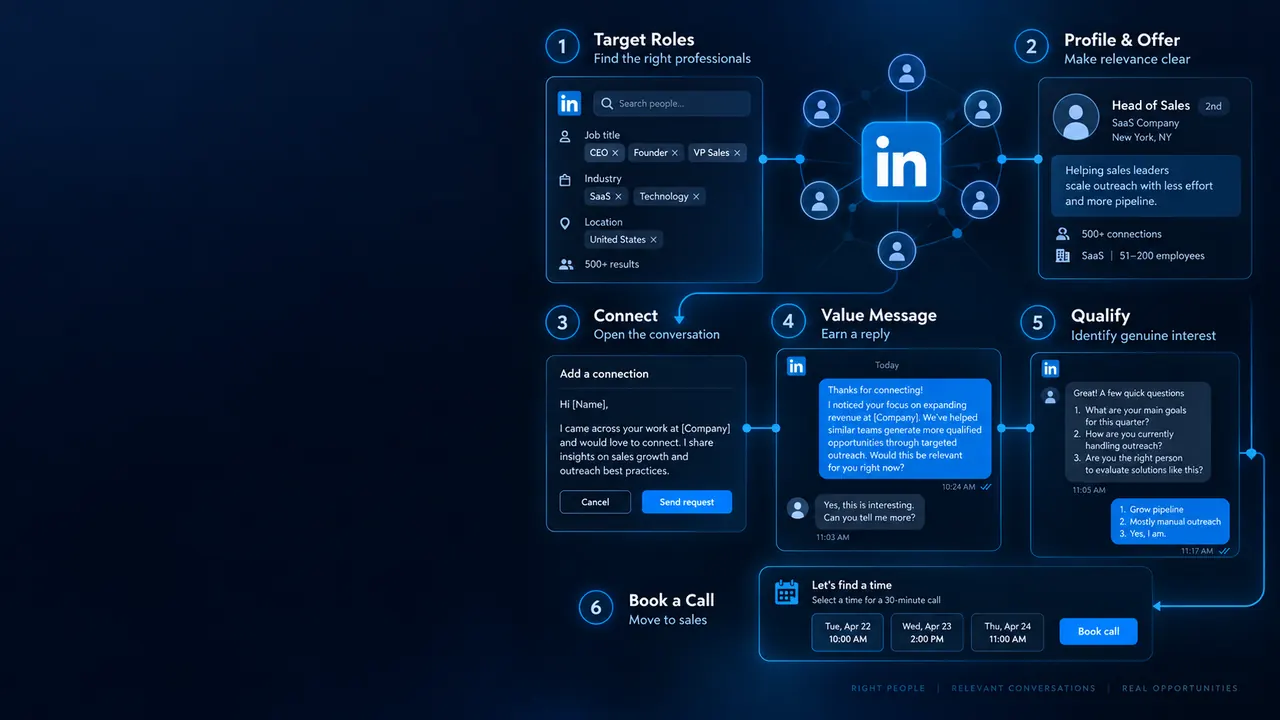
LinkedIn Lead Generation Services at a glance
Our LinkedIn lead generation services combine profile positioning, LinkedIn outreach and Sales Navigator lead generation to start real conversations with decision makers. As a LinkedIn marketing agency, we measure success on booked meetings, not connection counts.
Get a free audit →- Profile optimisation
- Sales Navigator targeting
- LinkedIn outreach
- Content & thought leadership
- Meeting booking
- Pipeline reporting
Connect, then pitch, is the fastest way to become invisible
The default LinkedIn playbook — mass connection requests followed by an immediate template pitch — has trained an entire professional audience to ignore InMail. Acceptance rates fall, reply rates fall further, and the personal profiles doing the sending get restricted. The channel still works extremely well; the standard approach to it does not.
Pitch on connect
A sales message within minutes of connecting reads as spam because it is. It also removes any chance of a second approach later.
Automation and scraping tools
Third-party automation breaches LinkedIn’s terms and gets accounts restricted. Restrictions land on the personal profile of whoever was sending.
Company page treated as the channel
Company page reach is a fraction of personal reach on LinkedIn. Programmes built on the company page alone reach almost nobody.
No reason to accept
A profile that says nothing useful and posts nothing gives a prospect no reason to connect. Outreach volume cannot compensate for that.
Be worth connecting with first.
The outreach works when the profile it comes from is already credible. We build that: positioning the profiles of the people who actually sell, publishing genuinely useful material on the topics your buyers care about, and letting a proportion of demand arrive inbound.
Then targeted outreach on top — researched, personal, and with no pitch in the first message. Slower per contact, several times the reply rate, and no risk to the accounts doing it.
- Mass connection requests
- Pitch in the first message
- Third-party automation
- Company page posting
- Scraped contact lists
- Outbound only
- Researched, targeted approaches
- No ask until there is a conversation
- Manual and compliant
- Personal profiles carry reach
- Sales Navigator filters
- Inbound from content plus outbound
would this person, looking at this profile, have any reason to accept? If the profile is a job title and an empty feed, the answer is no — and no amount of message volume changes it.
- Profile positioning
- The personal profiles of your founders and sales team rebuilt to read as credible experts rather than as job descriptions.
- Content-led inbound
- Posting that answers the questions your buyers actually have, so a proportion of conversations start with them approaching you.
- Sales Navigator targeting
- Properly built account and lead lists using firmographic and signal filters, not a scraped export.
- Two-step outreach
- Connect with context, converse before pitching. The first message never asks for anything.
- Paid where it earns it
- Lead Gen Forms and document ads where the economics work, run alongside organic rather than instead of it.
How the programme is built
Six stages. The first two happen before a single request is sent.
Profile rebuild
Headline, about section and featured work rewritten so a prospect can tell in five seconds why this person is worth knowing.
Content cadence
A publishing rhythm on the topics your buyers care about, written with your team’s actual expertise rather than generic thought leadership.
List building
Sales Navigator lists built on firmographics and buying signals — job changes, funding, hiring — rather than a bulk export.


Two-step outreach
A connection request with genuine context, then a conversation. The pitch comes only once there is something to pitch into.
Paid layer
Lead Gen Forms, document and conversation ads where deal value justifies LinkedIn’s cost per click, which is high.
Handover & nurture
Conversations routed into the CRM with context, and long-cycle prospects moved into nurture rather than dropped.


We will not risk your team's accounts
A restricted personal profile costs more than any campaign it was running.
No automation tools
Everything is sent within LinkedIn’s own limits. We will not put a founder’s profile at risk for a volume target.
Profiles before outreach
We rebuild the profiles first, because acceptance rate is decided by what the prospect sees, not by what the message says.
Content that earns inbound
A working programme should produce approaches as well as make them. That half is where the best conversations come from.
No pitch on connect
The first message never asks for anything. It is the single change that most improves reply rate.
Honest about paid economics
LinkedIn ads are expensive. We model them against your deal value and will tell you when organic alone is the better use of budget.
Signal-based targeting
Job changes, funding rounds and hiring patterns identify accounts with a reason to buy now rather than a matching industry code.
Why Businesses Choose SDM for LinkedIn Lead Generation
Same budget, very different outcomes. Point by point, here’s how a specialist partner compares to a typical agency or going it alone.
| What actually matters | With SDM | Typical Agency | In-House / DIY |
|---|---|---|---|
| Senior specialist on your account | Always | Often a junior | Stretched thin |
| Custom strategy built for your goals | Tailored | Templated | Guesswork |
| Funnel & CRM audit before any spend | ✓ | Surface-level | Skipped |
| Consented, GDPR-compliant data only | Always | Varies | Risky |
| Plain-English reporting tied to revenue | Monthly | Jargon PDFs | None |
| Direct access to your specialist | ✓ | Account-manager relay | N/A |
| Sent within LinkedIn's own limits | ✓ | Automation tools | Manual |
| Profiles positioned before outreach | ✓ | Skipped | Rarely |
| No pitch in the first message | ✓ | Immediate pitch | Varies |
| Inbound from content as well | ✓ | Outbound only | No |
| Paid modelled against deal value | ✓ | Sold by default | n/a |
| Ongoing competitor offer analysis | ✓ | One-off | Manual |
| Conversion paths fixed before buying traffic | ✓ | Traffic-first | Rarely |
| CRM, tracking & call analytics included | ✓ | Extra cost | Patchy |
| No long lock-in contracts | Flexible | 6–12 mo lock-in | N/A |
| Established agency, operating since 2017 | ✓ | Varies | Learning curve |
| Fast onboarding & early quick wins | ~2 weeks | Slow | Trial & error |
| Human-written offers & nurture copy | ✓ | Templated | Time-poor |
| Optimised to closed revenue, not volume | ✓ | Lead count | Unclear |
| Speed-to-lead process built in | ✓ | Rarely | Slow |
20 reasons growing brands make the switch. See the difference for yourself →
Reply rate tells you everything early
If replies are not improving, the targeting or the profile is wrong — and volume will not fix either.

Connection acceptance rate
Driven almost entirely by profile credibility and targeting relevance rather than by message wording.
Reply rate
The share of approaches that get a human response. The clearest early signal of whether the programme is working.
Conversations to meetings
How many replies become a genuine call. Tracked separately because a warm reply that goes nowhere is a different problem.
Inbound share
The proportion of conversations that started with them approaching you. Rising share means the content is doing its job.
Cost per meeting
Blended across organic effort and paid spend, compared against deal value.
Our LinkedIn Lead Generation process: four stages, run monthly
The economics improve substantially once content starts producing inbound.
Position
Profiles rebuilt for the people who actually sell, so outreach comes from somewhere credible.
A reason to acceptPublish
A content cadence on the topics your buyers care about, using your team’s real expertise.
Inbound startsReach out
Signal-based Sales Navigator lists, two-step approaches, no pitch on connect.
Real conversationsRoute & nurture
Conversations into the CRM with context; long-cycle prospects into nurture rather than dropped.
Pipeline over time
LinkedIn Lead Generation FAQs: the questions we get asked most
On outreach, automation, content and whether paid is worth it.
Further reading
Guides, terms and related services
Go deeper on the methods behind this service, with guides written by the specialists who run them, plain-English definitions and the services that usually work alongside it.
 Digital Marketing
Content That Converts: Copywriting That Sells
How to write content that converts: copywriting formulas, benefit-led messaging, specificity, social proof, microcopy and calls to action that work.
Read the guide Performance Marketing
The Omnichannel ROI Framework: Stop Burning Ad Spend
A digital marketing ROI framework for 2026: server-side tracking, MER, incrementality testing, marketing mix modelling, LTV:CAC and payback period.
Read the guide Digital Marketing
Email Marketing in 2026: Deliverability & ROI
Email marketing in 2026: sender authentication, Gmail and Yahoo rules, list health, automation flows, segmentation and measuring revenue, not opens.
Read the guide