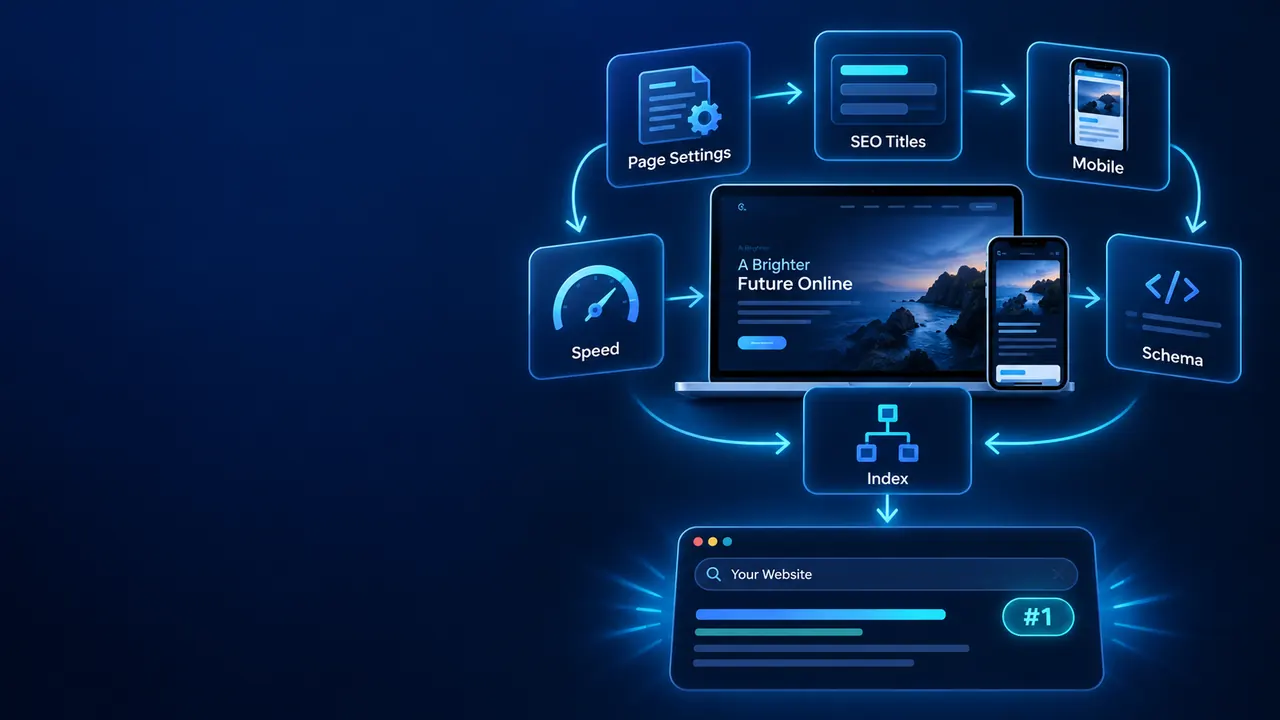
Wix SEO Services at a glance
Our Wix SEO services configure everything Wix exposes and engineer around what it does not — Wix website optimisation of titles, URLs and structured data, Wix speed improvements and Wix technical SEO fixes that get your Wix site ranking on Google.
Get a free audit →- Wix SEO settings
- Titles & meta tags
- Wix speed optimisation
- Structured data
- Wix technical SEO
- Local SEO
Configure everything Wix exposes. Engineer around what it does not.
Wix SEO is about knowing precisely where the platform’s controls end. A great deal is configurable — titles, metas, headings, alt text, canonicals, redirects, structured data, sitemap behaviour and robots directives.
Some things are not, and pretending otherwise wastes budget. Server-level caching, deep template restructuring and certain markup patterns are outside your control. We configure the former thoroughly, work around the latter with content and internal linking, and tell you plainly if a genuine ceiling means migration is the honest recommendation.
- Auto-generated titlesIntent-engineered titles
- Heavy uncompressed imagerySized, compressed, modern formats
- No internal linking planHub-and-spoke clusters
- Design-first thin pagesQuery-complete depth
- No structured dataValidated custom schema
- Animations on every sectionReduced for mobile vitals
Wix suits brochure sites, service businesses and small stores well. For large catalogues, complex international setups or heavy programmatic needs, the platform is a genuine constraint and we will recommend migration rather than bill you to fight it.
- Title and meta engineering
- Every page rewritten from auto-generated defaults to intent-carrying titles built for the query and the click.
- Heading and content depth
- H-structures that decompose the topic properly, with the subtopic coverage the query actually requires.
- Internal link architecture
- Deliberate hub-and-spoke clusters with descriptive anchors, since Wix sites almost never develop these organically.
- Performance within platform limits
- Image compression and sizing, animation reduction, font loading and template simplification — the levers Wix genuinely leaves open.
- Structured data
- Custom schema through Wix’s markup facility for the rich results your pages qualify for, validated properly rather than left to defaults.
How we get a Wix site ranking
Six stages working within the platform, sequenced so the fastest configuration wins land before content investment.
Audit & ceiling check
Full crawl, field performance data, index review and an honest assessment of whether Wix can support your goals. If it genuinely cannot, you hear that first rather than after six months of billing.
What’s included
- Technical SEO audit of your Wix site
- What the platform allows and where it limits rankings
- Quick wins separated from migration-level fixes
You receive: A Wix SEO audit with a clear ceiling verdict
Title & meta rebuild
Every page moved off auto-generated defaults to titles engineered for intent and click-through. This is consistently the fastest measurable win available on a Wix site.
What’s included
- Wix title tags and meta descriptions
- Keyword-led headings
- Click-through rate improvements
You receive: Rewritten titles and meta descriptions
Performance work
Image compression and correct sizing, animation reduction, font loading strategy and template simplification — targeting the mobile field metrics where Wix sites typically fail.
What’s included
- Wix speed settings and image optimisation
- Heavy apps and embeds reduced
- Mobile performance improvements
You receive: A faster Wix site
Internal link architecture
Hub pages, topical clusters and descriptive anchors built deliberately. Because Wix sites are assembled page-by-page, this is usually entirely absent and produces outsized gains.
What’s included
- Wix menus and internal links restructured
- Priority pages linked from strong pages
- Descriptive anchor text
You receive: An internal linking plan
Content depth
Pages rebuilt against SERP-derived specifications so they cover what the query requires. Visual polish stays; the substance that earns the ranking gets added underneath it.
What’s included
- Expanded pages that fully answer search intent
- Expert detail, examples and FAQs
- Keyword coverage without keyword stuffing
You receive: Refreshed content on priority pages
Schema & local signals
Custom structured data through Wix’s markup facility, plus Business Profile and local entity work where the business serves a defined area.
What’s included
- LocalBusiness schema on Wix
- NAP consistency and local citations
- Google Business Profile links
You receive: Local schema and citations
Get a free audit →We know exactly where the platform stops
The value in Wix SEO is knowing which recommendations are actionable and which are not — and being straightforward when the platform is genuinely the limit.
Only actionable recommendations
Every item we deliver can actually be implemented on Wix. Generic e-commerce SEO checklists are full of things the platform simply does not expose, and delivering those wastes your time.
Honest about migration
If Wix genuinely cannot support your goals, we say so during the audit and explain what migration would involve. Billing a retainer to fight a platform ceiling is not a service.
Performance within real limits
We optimise what Wix leaves open — images, animations, fonts, template complexity — and measure against mobile field data rather than desktop lab scores.
Internal linking as a discipline
The single most under-used lever on Wix sites, and one of the cheapest. We build a documented architecture rather than adding a few related links.
We train your team on the editor
Most Wix sites are owner-maintained. We document how to add pages without undoing the structure, so the work holds up after the engagement.
Local-first where it fits
Most Wix sites are local service businesses, so we prioritise local entity work that produces enquiries faster than organic rankings alone.
Report enquiries, explain them with rankings
Most Wix sites belong to owner-operated businesses. Reporting leads with what the business cares about and keeps the diagnostics behind it.
Enquiries by source
Calls, forms and messages attributed to organic and local search, separated from direct and referral traffic.
Priority query positions
The small set of queries that carry revenue, tracked honestly including the ones that moved backwards.
Mobile field vitals
Real-user LCP, INP and CLS on mobile devices, where Wix sites almost always have their performance problem.
Click-through rate
Impressions versus clicks per page, isolating title performance from ranking performance after the meta rebuild.
Crawl depth & orphans
How deep pages sit in the link architecture and whether any remain unlinked, tracked as clusters are built.
Our Wix SEO process: four stages, repeated every month
Configuration wins first because they are fastest, then content and links where the compounding happens.
Audit
Crawl, field performance data, index review, and an honest assessment of whether Wix supports your goals. You get a prioritised list of what is actionable on the platform and what is not.
DeliverableActionable audit + ceiling assessmentConfigure
Titles, metas, headings, alt text, canonicals, redirects and sitemap behaviour set properly across the site. Fast to implement and usually the first visible ranking movement.
DeliverableFull on-page configurationOptimise & build
Performance work within platform limits, internal link architecture, content depth against SERP specifications, and custom schema. This is where sustained gains come from.
DeliverablePassing vitals + linked clustersReport & maintain
Enquiries by source with ranking diagnostics behind them, plus editor guidance so your team can add pages without breaking the structure we built.
DeliverableEnquiry report + editor playbook
Proven results from real SEO clients
Published case studies from our clients — each with the starting point, the dates, the source and what the numbers don’t prove.
Local pack for “air conditioning repair murrieta”; organic is 75% of sessions.
Read the case study →HVAC & plumbing SEOIn Google’s local pack for “heater repair” across Fresno & Sacramento.
Read the case study →Plumbing SEOPlumbing, HVAC & electrical across 40+ Dallas–Fort Worth towns.
Read the case study →Wix SEO FAQs: the questions we get asked most
Practical answers on Wix settings, speed and what the platform can realistically achieve.
Further reading
Go deeper on this
The thinking behind the work. These guides go deeper on the methods this page describes — written by the team that runs them.