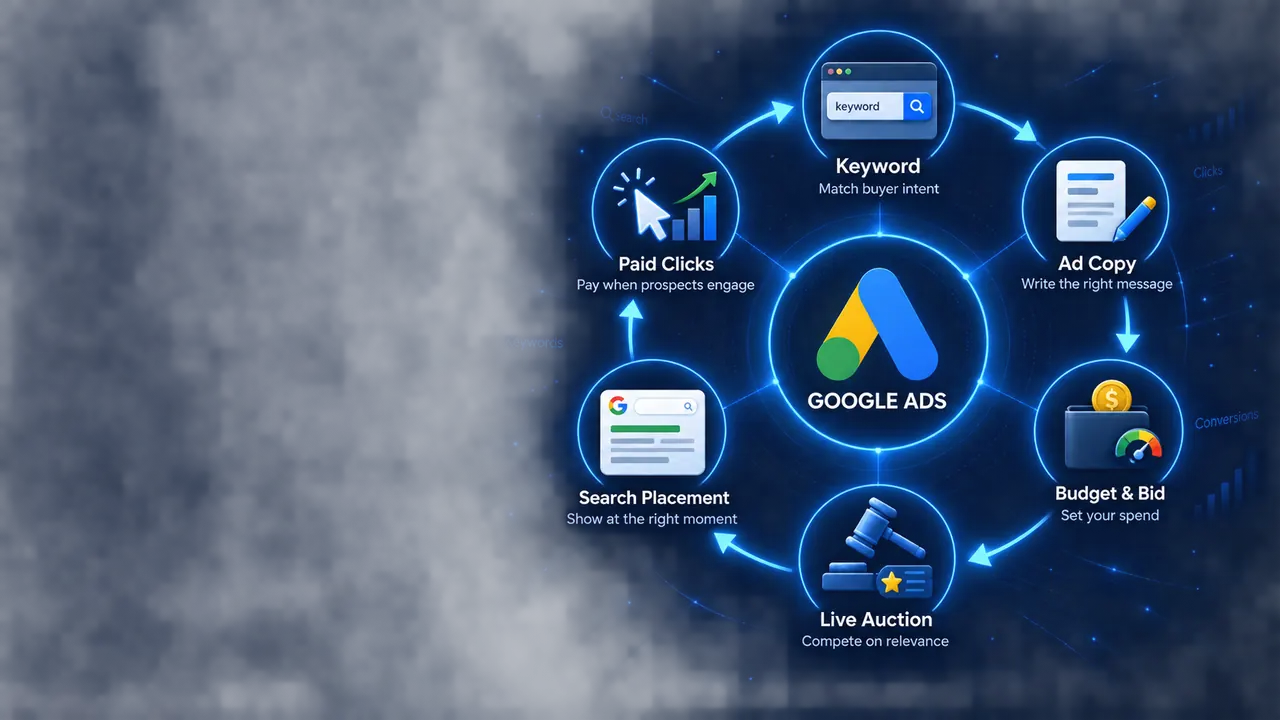


Automation replaced manual bidding
Smart Bidding outperforms manual management in most accounts. The skill moved to what you feed it — conversion values, audience signals and exclusions — rather than adjusting bids.
Our Google Ads management services cut wasted spend first, then scale what converts. As a Google Ads agency, our PPC management covers Search, Performance Max, Shopping and YouTube — PPC services built on clean conversion data and matched landing pages.
Get a free audit →Google's automation is genuinely good at bidding and placement. What it cannot do is decide what a good customer looks like, write a compelling offer, or fix a landing page that does not convert.
So that is where the work goes: feeding the system high-quality conversion signals, controlling where ads can appear, producing the ad and landing page variations it needs to optimise against, and removing spend that never had a chance of converting.
The first thing we check: the search terms report. In most accounts we audit, a substantial share of spend has gone to queries the business would never have chosen to bid on — and nobody had looked in months.
Every Google Ads account we run gets all five — so spend reaches real intent, bidding learns from real customers, and brand spend is proven, not assumed.
 Keyword & search term management
Negative lists maintained continuously so broad match reaches intent rather than adjacency.
Our Google Ads management starts with the search terms report. Every query that spent money is reviewed against intent, and negative keyword lists are built at account, campaign and ad group level so broad match and Performance Max reach buyers rather than browsers.
 Conversion tracking & offline data
CRM outcomes fed back so bidding optimises toward qualified customers, not raw form fills.
Smart Bidding is only as good as the conversions you feed it. We connect Google Ads to your CRM with offline conversion imports and enhanced conversions, so tCPA and tROAS bidding optimise toward qualified leads and real sales, not every form fill.
 PPC account structure
Brand, generic, competitor and Shopping separated so each can be budgeted and judged independently.
A clean Google Ads account structure makes budgets and results legible. Brand, non-brand, competitor, Shopping and Performance Max campaigns are separated with their own budgets, targets and bidding strategies.
 Ad copy & landing page optimisation
Message match between query, ad and page — usually the cheapest available conversion improvement.
Responsive search ads, sitelinks and assets are written to match the query, and the landing page is part of the job. Better message match raises Quality Score, lowers cost per click and improves conversion rate at the same time.
 Incrementality & ROI reporting
Holdout testing on branded search to establish how much of that spend is genuinely adding revenue.
Branded search often claims sales you would have won anyway. We run geo and holdout tests on brand and Performance Max, then report Google Ads ROI against your own revenue so budget goes where it genuinely adds customers.
Six workstreams, waste removal first — because it funds everything else and shows results fastest.
Every query that took spend, reviewed against intent. Negative lists rebuilt and match types adjusted. This is where the fastest savings almost always are.
CRM outcomes connected so bidding optimises toward customers who are actually worth acquiring rather than toward form-fill volume.
Brand, generic, competitor and Shopping separated with their own budgets and targets, so performance is legible rather than blended into one average.
Responsive assets tested properly, with landing pages aligned to the query so paid intent is not lost at the click.
Product feed titles, attributes and structure optimised, since feed quality determines Shopping performance more than bidding does.
Geo holdouts on branded search and automated campaigns, to establish what portion of the reported return is genuinely additional.
We cut spend going to irrelevant queries before optimising anything else. It funds the engagement and shows results inside the first month.
Bidding optimised toward qualified customers rather than form fills. In lead generation this is frequently the single biggest performance change available.
We run holdouts on branded search. If organic would have captured it anyway, we will tell you — even though it reduces managed spend.
There is no point winning the click and losing the visit. Message match and page speed are part of the engagement, not someone else's problem.
Asset groups, brand exclusions and feed control so automated campaigns cannot quietly harvest traffic you already had.
Paid and organic planned together, so you stop paying for terms where you already hold the top organic position.
Same budget, very different outcomes. Point by point, here’s how a specialist partner scores against a typical agency or running it in-house.
We report on qualified outcomes, not raw conversion counts, because that is what the bidding algorithm learns from.
CRM-verified, not raw form fills — the number that reflects what advertising actually delivered to sales.
Proportion of budget reaching queries outside target intent, tracked so it stays near zero rather than creeping back.
Split by budget and by rank, showing whether growth is constrained by money or by relevance.
Reported separately, since blending them hides poor prospecting behind excellent branded performance.
Holdout-tested revenue, so you know what the spend genuinely caused rather than what it was present for.
Cut waste, fix signals, restructure, then scale. Scaling first multiplies whatever was wrong.
Search terms, negatives, match types and non-converting segments reviewed. Waste removed immediately, which usually pays for the engagement within the first month.
✓ Same results, lower spendCRM outcomes connected so bidding optimises toward qualified customers. Conversion values set properly so the algorithm knows what is worth more.
✓ Automation aimed correctlyBrand, generic, competitor and Shopping separated, ads tested properly and landing pages matched to query intent.
✓ Legible, efficient accountIncrementality holdouts on brand and PMax, then budget expansion tracked against marginal CPA so scaling stops before efficiency collapses.
✓ Verified profitable growthPractical answers on PPC waste, automation and what Google Ads management should cost.
Further reading
The thinking behind the work. These guides go deeper on the methods this page describes — written by the team that runs them.