
SEO for Education Providers at a glance
Our education SEO helps colleges, schools and training providers fill courses from months of student research. SEO for schools, college marketing and course provider SEO target course, career and comparison searches that lead to applications — not just prospectus downloads.
Get a free audit →- Course page SEO
- Course provider SEO
- College marketing
- Career & comparison content
- Open day promotion
- Application tracking
Students research for months and apply to a handful
Education decisions are slow, high-stakes and heavily researched. Prospective students explore careers, compare qualifications, check funding and read outcomes long before applying. Providers absent from that research are absent from the shortlist.
What do I want to do?
Exploring careers and what qualifications they require. Months before any application, and almost entirely unowned by providers.
What do I need to study?
Understanding which qualification, level and route suits them. Comparison of pathways rather than institutions.
Where should I study?
Comparing providers on outcomes, cost, location, mode and reputation. This is where course page depth wins.
Cost and entry
Funding, entry requirements, start dates and application process. Practical clarity converts research into an application.
Why good courses go unfilled
Education has an unusually long research window and unusually high stakes. Providers who only appear when someone searches their institution by name are entering a decision that was largely made elsewhere.

Thin course pages
Course pages are often a title, a paragraph and a bullet list. That cannot rank against providers publishing genuine curriculum, outcome and progression detail.

No outcome transparency
Students want to know completion rates, employment outcomes and progression. Providers publishing nothing lose to those who publish it honestly.

Funding questions unanswered
Cost and funding eligibility are the biggest practical barriers. Unanswered, they stop applications from people who would have qualified for support.

No career-stage content
Career exploration happens months before course search and is owned entirely by careers publishers rather than the providers who deliver the training.
The education queries that produce applications
Course-plus-location queries sit closest to enrolment. Career and qualification queries capture students far earlier, when the shortlist is actually formed.
| Search term | Intent | Volume | Why it matters |
|---|---|---|---|
| “[course] courses near me” | Very high | High | Provider selection stage. Closest query to an application. |
| “how to become a [profession]” | Medium | Very high | Career discovery. Huge volume, publisher-owned, genuinely winnable. |
| “[qualification] entry requirements” | Very high | Medium | Late-stage practical query with strong application intent. |
| “[course] funding uk” | Very high | Medium | Removes the main barrier. Converts strongly when answered clearly. |
| “part time [subject] course” | Very high | Medium | Mode-specific. High intent, often under-targeted by providers. |
| “online [qualification]” | Very high | High | Remote delivery removes geographic limits on recruitment. |
| “[qualification a] vs [qualification b]” | High | Medium | Pathway comparison. Builds authority before provider choice. |
| “adult learning [subject] [city]” | Very high | Medium | Mature learner segment, high intent, light competition. |
Education search is strongly cyclical around application deadlines and term starts. Content must rank well before those windows, which means building several months ahead.
Who owns education search
Education search is dominated by comparison portals and careers publishers who sit between prospective students and the institutions actually delivering the courses.

Course comparison portals
UCAS, FindAMasters, Reed Courses and similar rank for nearly every course query, then charge providers for listings or leads.

Careers publishers
Careers advice sites own the discovery phase where students first explore professions and required qualifications.

Large institutions
Universities and national training providers with substantial marketing budgets and established brand recognition.
Our education SEO services: the work that fills courses
Course-level depth, honest outcome data and career-stage content that captures students months before they compare providers.
Course page depth
Genuine curriculum, assessment, progression and outcome detail per course, rather than a title and a bullet list.
- Full course pages with modules, entry and assessment
- Outcomes and progression routes detailed
- Course and educational schema on every page
Outcome transparency
Completion, employment and progression data published honestly, which is increasingly the deciding factor in provider comparison.
- Graduate outcomes and progression data published
- Student stories with real destinations
- Clear accreditation and recognition details
Funding & cost content
Clear funding eligibility, costs and payment options, removing the practical barrier that stops qualified applicants applying.
- Tuition, fees and funding routes explained per course
- Loan, grant and employer-funding guidance
- Cost comparisons that answer real questions
Career route content
Career and qualification guidance that captures students months before course search, currently owned entirely by publishers.
- Career pages linking jobs to the courses that lead there
- Salary and progression information by route
- Guides for career changers and returners

Local & mode visibility
Local visibility for campus-based courses plus national targeting for online delivery, since these recruit differently.
- Campus, online and part-time variants given their own pages
- Local profiles for each campus or teaching location
- Mode filters that search engines can actually crawl

Course schema
Structured course markup so your provision is eligible for rich results and readable by AI answer surfaces.
- Course, provider and offer schema on every course
- Start dates, duration and mode marked up
- Eligibility for course rich results monitored
Your first 90 days of education SEO
Course pages first because they sit closest to enrolment, then the career content that captures students earlier.
A training provider that filled its underfilled courses
A vocational training provider had strong outcomes but several persistently underfilled courses. Course pages were a paragraph each, no outcome or funding data was published, and comparison portals outranked the provider for every course it offered.
We rebuilt every priority course page with full curriculum, assessment and progression detail, published completion and employment outcome data, added clear funding eligibility guidance, and built career route content targeting discovery-stage searches.
Our outcomes were genuinely good and completely invisible. Publishing them honestly — including the ones that were only average — turned out to be the most persuasive thing on the whole website.
Education SEO FAQs: questions education providers ask
Practical answers on course pages, outcome data and competing with comparison portals.
Further reading
Guides, terms and related services
Go deeper on the methods behind this service, with guides written by the specialists who run them, plain-English definitions and the services that usually work alongside it.
 Content Marketing
Content Clusters & Topical Authority: 2026 Guide
How to build content clusters and topical authority in 2026: pillar pages, cluster research, internal linking, content briefs, updates and measuring results.
Read the guide SEO
SEOThe Complete Guide to SEO in 2026
The complete guide to SEO in 2026: how Google ranks pages, technical SEO, content, links, local and AI search, a 6-month roadmap and how to measure ROI.
Read the guide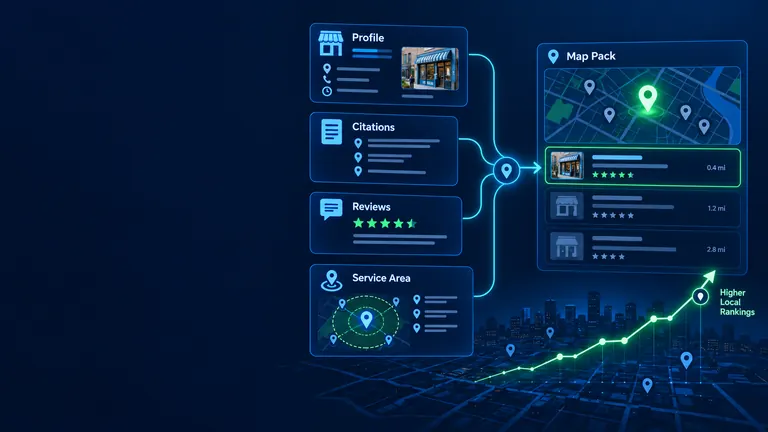 SEO
SEOLocal SEO Playbook: Dominate Your City in 90 Days
The local SEO playbook for 2026: win the Google Maps local pack with Google Business Profile, reviews, citations, location pages and local links.
Read the guide