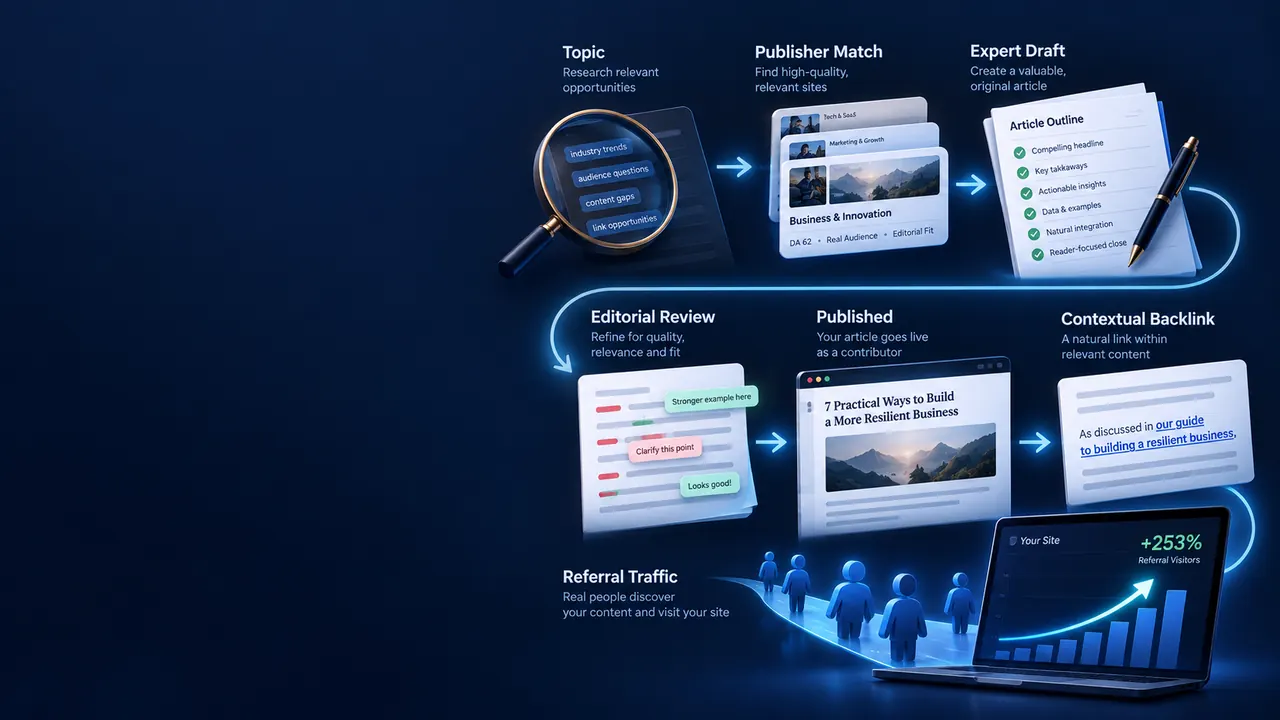
Guest Post Services at a glance
Our guest post services place expert articles on publications with real, verified readers. Unlike link farms and marketplaces that sell guest posting services by the batch, we work as an editorial guest post agency — guest blogging services pitched to editors, with sponsored placements disclosed properly.
Get a free audit →- Traffic-verified publishers
- Editorial pitching
- Expert-written articles
- Contextual backlinks
- Sponsored disclosure
- Placement reporting
The guest post market is mostly a market in worthless links
Search “buy guest posts” and you will find thousands of sites offering placement on “DA 50+” publications for a fixed fee. Almost all of them are selling the same inventory: sites built to host paid links, with no real readership, publishing forty unrelated articles a month. Google has been explicit that links exchanged for money without a rel attribute are a link scheme, and the pattern is trivial for them to detect at scale.
- Per-placement pricing
Priced per placement, not per outcome
A fixed price per link is a strong signal the inventory is pre-arranged. Genuine editorial placement cannot be priced that way because you do not control whether an editor says yes.
- Vanity metrics
Metrics that measure nothing
Domain Authority and Domain Rating are third-party scores, not Google signals, and both are straightforward to inflate. A DA 60 site with no organic traffic is a warning, not a credential.
- Off-topic sites
Topical mismatch
A link to a dental practice from a general ‘business and lifestyle’ blog that also covers casinos and crypto carries close to nothing, and sits you in bad company.
- Link footprints
Footprints that group your links together
Marketplaces sell the same sites to everyone. When a network is devalued, every client who bought from it loses their links at once — which is how agencies produce sudden unexplained drops.
Pitched to editors, written for readers.
A guest post earns its link when the publication would have wanted the article regardless. That means pitching an angle their audience needs, written by someone who genuinely knows the subject, to an editor who has a reason to say yes.
It is slower than buying placements and the acceptance rate is never 100%. What you get in exchange is a link that survives algorithm updates and sends actual referral traffic.
- Fixed price per placementPriced for the outreach effort
- Marketplace inventoryPublications we pitch directly
- Sold on DA/DRVerified on organic traffic
- Any topic acceptedTopically relevant only
- Guaranteed link countGuaranteed outreach volume
- Generic writerSubject-matter drafting
Ask to see the organic traffic of three sites they placed on last month. If they will not show it, or the traffic is near zero on a ‘DA 55’ domain, you are buying inventory rather than editorial placement.
- Publication research
- We build a target list from where your buyers already read, not from a vendor database. Trade press, industry publications and genuine niche blogs with real audiences.
- Three-gate vetting
- Organic traffic verified independently, publishing pattern checked for paid-link footprints, and outbound link profile reviewed for the company the site keeps.
- Angle development
- We pitch what the editor's audience is missing rather than what suits our anchor text. The article has to work as journalism first.
- Written by someone who knows it
- Subject-matter drafting with your team's input, not a generalist writing around a keyword. Editors reject the second kind, and readers ignore it.
- Honest disclosure
- Where a placement is sponsored we mark it sponsored. A nofollow link from a publication your buyers read is worth more than a followed link from a site nobody visits.
How a placement actually happens
Six steps. The slow parts are the ones that make the link durable.
Publication mapping
Where your buyers actually read — trade press, industry titles, genuine niche sites. Built from your market, not from a vendor list.
What’s included
- Relevant guest post sites in your niche
- Real traffic and audience checked
- Editorial standards reviewed
You receive: A guest post target list
Three-gate vetting
Independent organic traffic check, publishing-pattern review for paid-link footprints, and an outbound profile audit. Sites failing any gate are dropped.
What’s included
- Traffic, relevance and editorial quality checks
- Spam and link-farm sites rejected
- Only real publications approved
You receive: A vetted guest post site list
Angle development
What that publication's audience is missing, framed so the editor has a reason to publish it beyond the fact that you offered.
What’s included
- Story angles matched to each publication's readers
- Data or expert insight editors can use
- Headlines checked against what already ranks
You receive: An approved pitch angle for every placement
Personal pitch
To a named editor, referencing their actual coverage. Templated outreach is why acceptance rates across this industry sit in low single digits.
What’s included
- An individual pitch to each editor
- Topic ideas that suit the publication
- Follow-up without spamming
You receive: Approved guest post topics
Drafting & revision
Written with your subject expertise, then revised to the publication's standards. Editors ask for changes; that is a good sign, not a problem.
What’s included
- Guest post written to the publication's guidelines
- Natural, contextual backlink placement
- Revisions until the editor approves
You receive: A publish-ready guest article
Placement & routing
Link mapped to the commercial page it should support, with anchor text that reads naturally in the sentence rather than as an exact-match insertion.
What’s included
- Guest posts on relevant, authoritative sites
- Links pointed to the right target pages
- Natural anchor text
You receive: A guest post placement report
Get a free audit →We will tell you when a site is not worth a link
The discipline is in what we reject, not in how many placements we ship.
No networks, no marketplaces
We do not buy from link vendors, and we do not sell inventory we control. Every placement is a publication we pitched independently.
Traffic verified, not DA
We check whether real people read the site. You get the traffic figure for every placement, and we drop targets that fail regardless of their score.
Outbound profile checked
If a site links out to gambling, crypto and payday loans alongside legitimate businesses, it is selling to anyone. We do not place there.
Written by people who know it
Drafted with your team's expertise rather than around a keyword. That is what gets acceptance from editors worth being published by.
Relationships, not transactions
An editor who publishes you once will publish you again. Building that is slower than buying and compounds in a way purchases never do.
Priced on effort, not per link
You pay for outreach and production. We will not quote a guaranteed number of placements because nobody who pitches genuine publications can honestly promise one.
Why Businesses Choose SDM for Guest Posting
Same budget, very different outcomes. Point by point, here’s how a specialist partner compares to a typical agency or going it alone.
| What actually matters | With SDM | Typical Agency | In-House / DIY |
|---|---|---|---|
| Senior specialist on your account | Always | Often a junior | Stretched thin |
| Custom strategy built for your goals | Tailored | Templated | Guesswork |
| Deep audit before any work begins | ✓ | Surface-level | Skipped |
| White-hat, penalty-safe methods | Guaranteed | Varies | High risk |
| Plain-English reporting tied to revenue | Monthly | Jargon PDFs | None |
| Direct access to your specialist | ✓ | Account-manager relay | N/A |
| Placements pitched, not purchased | ✓ | Marketplace | n/a |
| Organic traffic verified per site | ✓ | DA/DR only | Guesswork |
| Outbound link profile checked | ✓ | Rarely | No |
| Sponsored placements disclosed | ✓ | Hidden | n/a |
| Topical relevance enforced | ✓ | Any niche | Random |
| Ongoing competitor gap analysis | ✓ | One-off | Manual |
| Conversion-focused, not just traffic | ✓ | Traffic-first | Unclear |
| Premium tools included (Ahrefs, SEMrush) | ✓ | Sometimes | Costly extra |
| No long lock-in contracts | Flexible | 6–12 mo lock-in | N/A |
| Established agency, operating since 2017 | ✓ | Varies | Learning curve |
| Fast onboarding & early quick wins | ~2 weeks | Slow | Trial & error |
| Human, SEO-led content (no AI spam) | ✓ | Outsourced / AI spam | Time-heavy |
| Focus on compounding, long-term ROI | Core promise | Short-term wins | Slow & ad-hoc |
| Recovery from Google penalties | ✓ | Sometimes | Very hard |
20 reasons growing brands make the switch. See the difference for yourself →
Placement quality, not placement count
A link count tells you what we did. These tell you whether it was worth doing.
Referring domain quality
Organic traffic and topical relevance of each linking site, not its third-party authority score.
Target page coverage
Whether links are reaching the commercial pages that need them rather than accumulating on the homepage.
Referral traffic earned
Real visits from placements. A link that sends nobody is a link on a site nobody reads.
Acceptance rate
The share of pitches that land. Rising acceptance means the relationships and angles are working.
Profile health
Anchor text distribution and the ratio of followed to nofollowed links, kept in a range that looks like it was earned.

Our Guest Posting process: four stages, run monthly
Outreach compounds — month six converts better than month one because the relationships exist.
Target list
Publications your buyers read, vetted through all three gates before a single pitch goes out.
DeliverableA list worth pitchingAngles & pitches
Personalised approaches to named editors, referencing their actual coverage rather than a mail merge.
DeliverableReplies from real peopleProduction
Drafted with your subject expertise, revised to the publication's standard until it is genuinely publishable.
DeliverableAccepted articlesPlacement & report
Link routed to the right commercial page, with the site's traffic figure reported alongside it.
DeliverableLinks you can justify
Proven results from real SEO clients
Published case studies from our clients — each with the starting point, the dates, the source and what the numbers don’t prove.
A home services franchise group — 34.1K ranking keywords and 1.8K AI mentions.
Read the case study →B2B SaaS SEO77.9K Google clicks in three months — organic is the top channel.
Read the case study →Home services SEOTop 3 for “emergency plumber”, cited on 218 pages in AI answers.
Read the case study →Guest Posting FAQs: the questions we get asked most
Straight answers on cost, risk and what actually gets accepted.
Further reading
Guides, terms and related services
Go deeper on the methods behind this service, with guides written by the specialists who run them, plain-English definitions and the services that usually work alongside it.
 Content Marketing
Content Clusters & Topical Authority: 2026 Guide
How to build content clusters and topical authority in 2026: pillar pages, cluster research, internal linking, content briefs, updates and measuring results.
Read the guide AI SEO
Generative Engine Optimization (GEO): 2026 Playbook
The generative engine optimization (GEO) playbook for 2026: how AI Overviews, ChatGPT and Perplexity choose sources, the GEO checklist and how to measure it.
Read the guide SEO
SEOThe Complete Guide to SEO in 2026
The complete guide to SEO in 2026: how Google ranks pages, technical SEO, content, links, local and AI search, a 6-month roadmap and how to measure ROI.
Read the guide