Week 1
Brand prompt list
We write down the questions people ask about you by name: whether you are any good, what you charge, what your reviews say and how you compare with a named rival. You approve the list.
You receive
A fixed brand prompt list.
AI assistants now describe your company to people before they ever reach your website. When that description is wrong, outdated or unfair, we trace it to its source and work to correct it.
AI reputation management is the work of checking what AI assistants say about your business and correcting what is wrong. People now ask ChatGPT, Gemini or Perplexity about a company before they visit its website, and they tend to believe the summary they are given.
People now ask an assistant about a company before they deal with it, and they tend to believe the summary they are given. If that summary quotes an old price, a closed branch or a one-sided reading of your reviews, you may never learn why the enquiry did not arrive. Checking is the first step, because you cannot correct what you have not seen.
AI brand reputation management is the work of checking how AI assistants describe a business and correcting what is inaccurate. An assistant cannot be edited directly. It repeats what it finds on review sites, directories, news pages and your own website, so the fix is made at those sources and then confirmed by testing the assistant again.
Is this company any good?
Watches review sites and search results.
Also tests what the assistants actually say about you, and fixes the sources behind it.
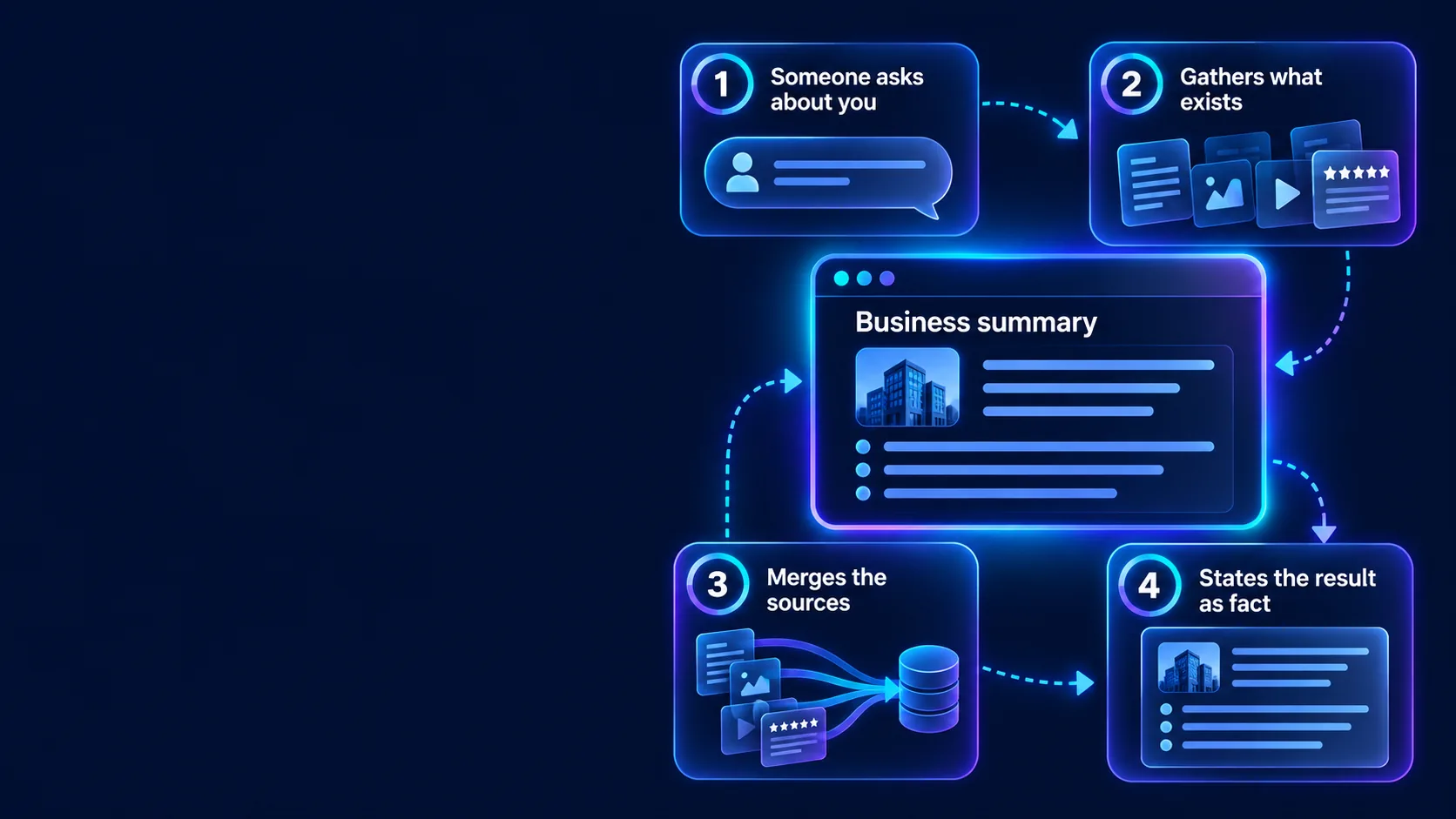
An assistant holds no file on your company. Each time it is asked, it builds a description from what it can find, in four steps.
Typical questions are whether you are reliable, what you charge and what customers say.
It draws on its training data and, in most tools, a live search: your site, listings, review platforms, news and forums.
Where the sources disagree, it may repeat the most common or most recent version, and that version can be the wrong one.
The person receives one confident summary and rarely opens the sources behind it.
A bad review is read by a few people. A wrong AI summary is given, with confidence, to everyone who asks about you.
A closed branch, a former price list or a service you no longer offer can stay in AI answers long after you changed it on your own site.
If the page an assistant relies on is a single complaint thread or an old article, the summary inherits its tone.
No alert is sent when an AI tool starts describing you badly. Most businesses find out from a customer.
If two or more of these sound familiar, this service is likely to pay back. If none do, tell us and we will say so.
Not sure where you stand? We will check for you.
Ask for the free auditAny organisation that people look up before they buy can be misdescribed. These are the ones that feel it first.
SDMAccuracy first, whatever the fieldPatients read a summary of treatments, clinicians and sites before they book.
A misquoted fee or licence status is a compliance problem, not only a marketing one.
Guest feedback gets condensed into one line that decides the reservation.
Former names and addresses keep surfacing long after the move.
Prospects vet you with a chatbot ahead of the first call.
Last year’s fees and course lists are still being quoted.
A single complaint thread can drown out years of good jobs.
Retired features and old pricing tiers resurface in comparisons.
Find the problem, fix the source, confirm the result.
Request a free auditWe ask the main assistants the questions people ask about you by name, and log exactly what each one says.
Every factual claim is checked with you and marked as correct, outdated, wrong or misleading.
We identify the pages each assistant cites or appears to draw on for the claims that need fixing.
Listings, profiles, directories and your own pages are updated, and publishers are asked to correct errors.
Clear About, pricing and policy pages with structured data, so assistants have an accurate version to use.
The same brand prompts are re-run each month and any new inaccuracy is flagged.
The differences that matter when you decide where to put time and budget.
| Aspect | The usual wayTraditional | What we doAI reputation management |
|---|---|---|
| What is monitored | Review sites and search results | What AI assistants say when asked about you |
| Main problem | Negative reviews and articles | Inaccurate or outdated summaries |
| Where the fix is made | On the review or result | At the source the assistant drew on |
| How success is checked | Ratings and rankings | Re-running the same prompts |
| Speed | Often immediate | Depends on sources being re-read |
Six stages. Recording, verifying and tracing take about three weeks. Corrections and monitoring then continue each month.
We write down the questions people ask about you by name: whether you are any good, what you charge, what your reviews say and how you compare with a named rival. You approve the list.
A fixed brand prompt list.
The prompts are run in the main assistants. Every answer is captured word for word, with the date and any sources shown.
A brand answer log.
We go through each factual claim with you, on a short call or in a shared sheet, and mark it as correct, outdated, wrong or misleading. Only you can confirm what is true about your business.
An accuracy report listing every claim that needs attention.
For each problem we find the page the assistant cites or appears to draw on. It may be an old listing, a news article, a review thread or a forgotten page on your own site.
A correction plan, split into fixes we make and requests we send to others.
We update the listings, profiles and pages within your control. For third-party pages we write to the publisher with evidence and follow up. Your About, pricing and policy pages are strengthened with structured data, so assistants have an accurate version to use.
A log of every correction made or requested, with its status.
The same prompts are run again. We report which answers now reflect the corrected facts and flag anything new.
A monthly monitoring report.
Timings are typical for a single website; your proposal sets out the exact schedule.
Sachkhand Digital Marketing has worked with businesses in 30 countries since 2017. The team is remote-first and keeps to your time zone, and the specialists who audit your site are the ones who do the work. This is how the work is shared on an AI reputation management engagement.
A brand answer log showing what each assistant says about you, word for word.
An accuracy report listing each wrong or outdated claim and where it comes from.
A correction plan split into fixes we make and requests we send to third parties.
Updated profiles and pages with consistent, current facts.
A monthly monitoring report on the same prompts.
We tell you this before you start, not after.
Request a free auditInaccurate AI answers cost enquiries you never hear about. This is what correcting them is worth.
Targets we plan against, for engagements of six months or more
A wrong price, a closed branch or a discontinued service turns people away before they reach you. Correcting the source closes a leak you could not see.
How we measure itInaccurate claims open against inaccurate claims resolved.
When the assistant describes you correctly, your team spends less time undoing a wrong first impression.
How we measure itThe answer log, and feedback from your sales team.
More genuine reviews and resolved complaints mean the summary reflects the typical customer experience, not one old thread.
How we measure itReview volume and rating on the platforms the assistants cite.
Monthly monitoring picks up a new inaccuracy soon after it appears, not after a customer mentions it or a deal is lost.
How we measure itA monthly report on the same brand prompts.
Published client results
We do not guarantee a ranking or a mention in an AI answer. The search engines and assistants decide that, and no agency controls them. We guarantee the work, the measurement and the honesty.
These come up in almost every first audit. Each one is avoidable.
Feedback buttons rarely change future answers. The source it read has to change.
Burying a source does not help if the assistant still reads it. Correct the facts where they are published.
Clear, dated facts on your own pages give assistants something authoritative to use.
Honest reviews are part of the record. The aim is accuracy and balance, not removal.
You do not need us for the first steps. These take under an hour and show you where you stand.
Want the full picture?
Request the free auditThree of our free tools cover the first checks we make. No signup is needed.
Straight answers to the 9 questions we are asked most.
Send it to us and you get a reply within one business day.
Ask your own questionIt is the work of checking how AI assistants such as ChatGPT, Gemini and Perplexity describe your business, and correcting inaccurate or outdated statements by fixing the sources those assistants rely on.
Not directly. No agency can edit an AI answer. What we can do is correct the listings, profiles and pages the assistant draws on, give it accurate first-party information to use, and re-test until the answer reflects the corrected facts.
It varies. Assistants with live search can reflect a corrected source within days or weeks. Information held in a model's training data changes only when the model is updated, which is outside anyone's control.
We do not remove genuine reviews. If a summary is one-sided because it relies on a single source, we work on resolving the underlying complaint, earning more real reviews and making sure accurate information is available.
Traditional reputation management focuses on review sites and search results. AI reputation management adds the step of testing what assistants actually say, because they combine many sources into one summary that people may never check.
Out-of-date prices and opening hours, closed locations still listed, services you no longer offer, confusion with similarly named businesses and summaries based on a small number of old reviews.
Monthly is enough for most businesses. After a rebrand, a move or a public issue, weekly checks for a period are sensible.
We strengthen clear, dated facts on your own site and trusted profiles so the assistant has reliable information to draw on, and report the error through the platform’s feedback route. Then we re-test.
It overlaps. Review and listing work is part of both. The difference is that we test what AI assistants actually say and trace each statement to its source.
Send us your business name and website. We will test the main assistants and show you exactly what they say, before you commit to anything.