Online Reputation Management ServicesYou cannot delete the internet.
You can change what it shows.
Online reputation management is not about removing criticism. It is about earning enough genuine positive signal that a fair picture is what people find — and about responding well when something goes wrong.
Online Reputation Management Services at a glance
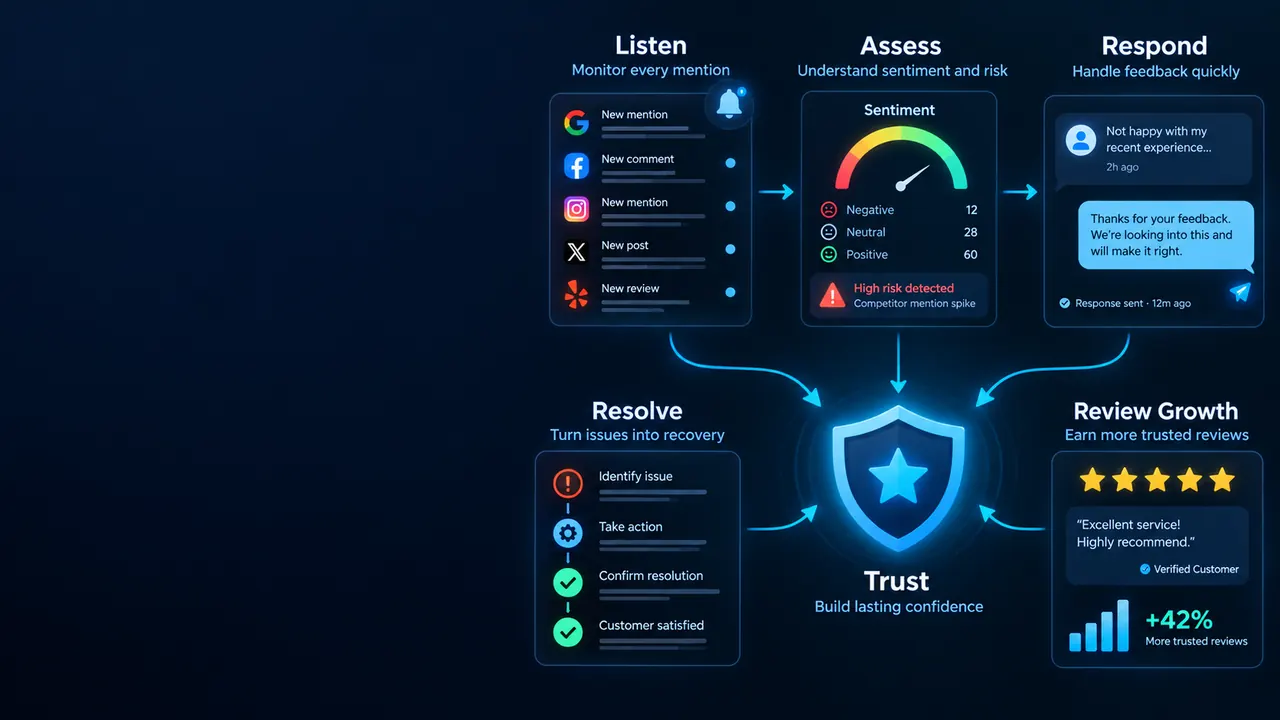
Our online reputation management services build the reviews and search results people see before they contact you. Review management, Google review management, response handling and search result clean-up — reputation management services built on genuine customer feedback.
Get a free audit →- Review generation
- Google review management
- Review response
- Search result monitoring
- Crisis response
- Reputation reporting
How we work, and what we refuse to do
This is the service where the temptation to cheat is strongest and the consequences of being caught are most public.
We never write, buy or incentivise reviews. Beyond being against platform terms and consumer protection law in most markets, detection now results in a visible warning on your profile — far more damaging than any review it was meant to hide.
Selectively asking only satisfied customers is review gating, which breaches platform policy. Asking everyone consistently produces a higher average anyway, because satisfied customers outnumber unhappy ones in most businesses.
Acknowledge, take it offline, resolve, and never argue publicly. Future customers read the response more closely than the complaint — a defensive reply does more damage than the review itself.
Recurring complaints are operational intelligence. We feed them back plainly, including when the honest conclusion is that the problem is not a reputation problem.
A good response within hours beats a perfect one next week. Templates and approval routes exist so responses are fast without being careless.
We build legitimate assets that deserve to rank. We do not spin up low-quality sites to push results down — it is transparent to anyone looking and rarely holds.
Four shifts in online reputation
Where reputation is formed, and how quickly it is judged, has moved considerably.
Assistants and search summaries increasingly generate a sentence about a business from aggregate review text. Recurring complaint themes get surfaced directly, which raises the cost of unresolved patterns.
Platforms and customers both weight recent reviews far above old ones. A strong historical average with nothing new reads as a business that has stopped caring.
Regulators in several markets now impose penalties directly, and platforms apply public warning labels. The risk calculation on buying reviews has changed completely.
Unanswered reviews are conspicuous, and answering is now read as a proxy for how a business treats customers generally — often more telling than the rating itself.
Only if it breaches platform policy — fake, defamatory, containing personal information, or posted by someone who was never a customer. We will flag those and pursue them. An honest negative review from a real customer will not be removed, and pursuing it wastes time better spent on generating genuine volume that puts it in proportion.
No. Writing, buying or incentivising reviews breaches platform terms and consumer protection law in most markets we operate in. Detection now results in a public warning label on your profile, which is considerably more damaging than the reviews you were trying to offset. We will decline this every time.
Response management and profile fixes show within thirty days. Rating movement depends on your customer volume — a business serving hundreds monthly shifts an average far faster than one serving a dozen. We model the realistic curve from your actual volume during the audit rather than quoting a generic timeframe.
Yes. Asking only customers you expect to be happy is review gating and breaches platform policy. It also tends to be unnecessary: in most businesses satisfied customers substantially outnumber unhappy ones, so asking everyone consistently produces a better average than filtering.
Respond once, briefly, without arguing. Acknowledge the experience, state any correction factually and without heat, and offer to resolve it directly. Future customers judge the response more than the complaint, and a calm reply to an unfair review often reads better than a positive review does.
Sometimes, legitimately — by building genuine assets that deserve to rank for your name. We will not create low-quality sites purely to displace results; it is transparent, rarely durable, and can itself become the story. If a result is factually wrong, the route is correction or legal action rather than suppression.
Then we will tell you plainly, and reputation management is the wrong purchase. Recurring complaint themes are operational feedback, and no review strategy fixes a service problem that keeps generating genuine dissatisfaction. We would rather lose the engagement than take a monthly fee to manage the symptom.
Want to know what people actually find?
We will audit your ratings across every platform, show you what ranks for your brand name, and theme what customers are actually complaining about.
Further reading
Guides, terms and related services
Go deeper on the methods behind this service, with guides written by the specialists who run them, plain-English definitions and the services that usually work alongside it.
 SEO
SEOGoogle Business Profile Optimization Checklist 2026
A complete Google Business Profile optimization checklist for 2026: categories, services, photos, reviews, posts, suspensions, multi-location tips and tracking.
Read the guide SEO
SEOLocal SEO Playbook: Dominate Your City in 90 Days
The local SEO playbook for 2026: win the Google Maps local pack with Google Business Profile, reviews, citations, location pages and local links.
Read the guide AI SEO
Generative Engine Optimization (GEO): 2026 Playbook
The generative engine optimization (GEO) playbook for 2026: how AI Overviews, ChatGPT and Perplexity choose sources, the GEO checklist and how to measure it.
Read the guide