Cross-platform closed the quality gap
React Native and Flutter now produce apps most users cannot distinguish from native, at meaningfully lower cost. Native still wins for heavy graphics, sustained background work or deep hardware access.
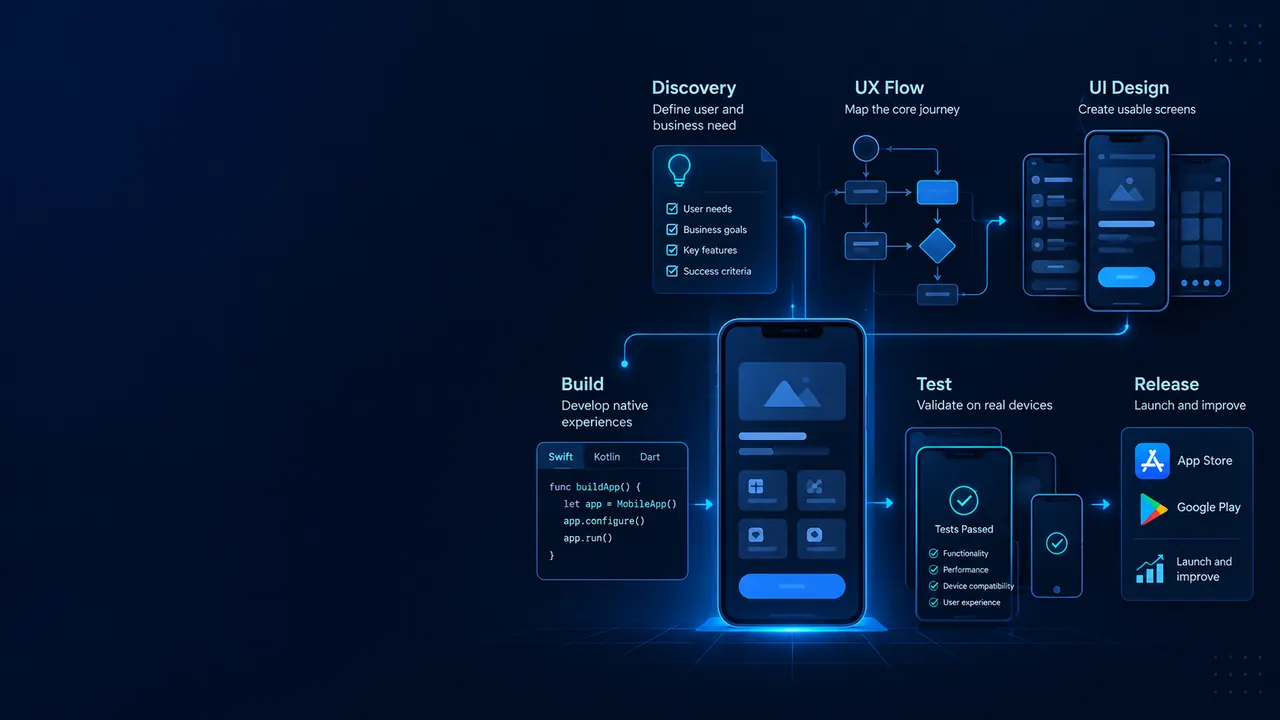
Apps do not fail because the engineering was poor. They fail because nobody validated that people wanted the thing, or because nobody planned how it would be found and kept alive after launch. Our mobile app development services build for both.
Our mobile app development services cover iOS app development, Android app development and cross platform app development with React Native and Flutter — from product scoping and UX to launch, analytics and App Store optimisation.
Get a free audit →One team from product discovery to store launch, so nothing gets lost between design, development and release.
User flows, scope and success metrics agreed before a line of code.
Components and screens designed for iOS and Android conventions.
Native Swift and Kotlin, or React Native where it genuinely fits.
Authentication, data and third-party services connected securely.
Event tracking, crash monitoring and notifications set up from day one.
App Store and Google Play listings, review and release handled.
Apps are judged publicly and permanently. A one-star review from a crash on launch week outlives almost everything else you do.
Monitored from day one with alerting. Store ranking, review scores and retention all degrade sharply with instability, and reviews left during a bad week are effectively permanent.
Measured on a mid-range device rather than the newest phone. Slow launch is the most common reason an installed app quietly stops being opened.
Offline states, retry logic and cached content designed in from the start. Apps that assume good connectivity fail exactly when people most need them to work.
Funnel and retention events instrumented before release. Adding analytics later permanently loses the data about your first and most informative cohort.
Title and keyword fields drive most organic installs. A listing written as marketing copy rather than for store search wastes the cheapest acquisition channel you have.
Developer accounts, signing certificates and source in your name. Apps published under an agency account are genuinely difficult to recover if the relationship ends.
The economics of apps have changed considerably. These shape what we recommend building.
React Native and Flutter now produce apps most users cannot distinguish from native, at meaningfully lower cost. Native still wins for heavy graphics, sustained background work or deep hardware access.
Organic browsing has largely collapsed. Installs come from store search, existing audience and paid acquisition, so a launch plan matters more than the build.
Attribution is far less precise than it was. Owned channels and store search have become more valuable relative to paid install campaigns, which are harder to measure honestly.
Progressive web apps now handle push, offline and installation. For content and booking use cases they frequently make more sense than a store app, and cost far less to maintain.
A typical first release takes three to four months, with a working build on your phone every fortnight.
Scope, user flows and technical approach agreed.
A clickable prototype tested with real users.
Two-week sprints with a new build on your device each time.
Store submission, monitoring and 30 days of launch support.
Honest answers on cost, platform choice and whether you need an app at all.
Often not. Apps make sense when people use you repeatedly, when you need device features like camera or location in the background, or when offline use matters. For occasional use, content or a single booking, a fast responsive site does the job with no install friction and no store approval. We will tell you if that is your situation before taking a build budget.
Cross-platform for most business apps — one codebase, meaningfully lower cost, and quality users generally cannot distinguish. Native when you need sustained background processing, heavy graphics or deep platform integration. The decision should follow the product, and we will explain the trade-off rather than defaulting to whichever we prefer.
It varies enormously with scope, which is exactly why we validate scope first. What inflates budgets is rarely the core feature; it is authentication, payments, integrations, admin tooling and the long list of features added because they seemed cheap. Narrowing the first release is the single most effective way to control cost.
Twelve to twenty-four weeks for a focused first release. Store review adds days, not weeks, but rejections happen and are usually about privacy declarations or incomplete listings, so we prepare submission materials well before the build finishes.
Mostly store search and your existing audience. Organic browsing has largely disappeared, so the store listing matters more than most teams expect — title and keyword field especially. We treat the listing as a search problem, and it is included rather than being an extra.
You do. Developer accounts are created in your name, signing certificates are yours, and source is handed over with documentation. Apps published under an agency account are genuinely hard to recover, and we consider that arrangement unacceptable regardless of how the relationship ends.
Both platforms release annual updates that break things, so an unmaintained app degrades within a year or two. We monitor crashes and performance, and scope iterations against real retention data. If you would rather maintain it in-house, the handover is built to make that genuinely possible.
Tell us what you want it to do. We will tell you honestly whether it needs to be an app, what a validated first release looks like, and what it would cost.
Further reading
Go deeper on the methods behind this service, with guides written by the specialists who run them, plain-English definitions and the services that usually work alongside it.
 Technical SEO
Core Web Vitals in 2026: LCP, INP and CLS thresholds, whether they affect rankings, how to diagnose and fix each metric, WordPress tips and measurement.
Read the guide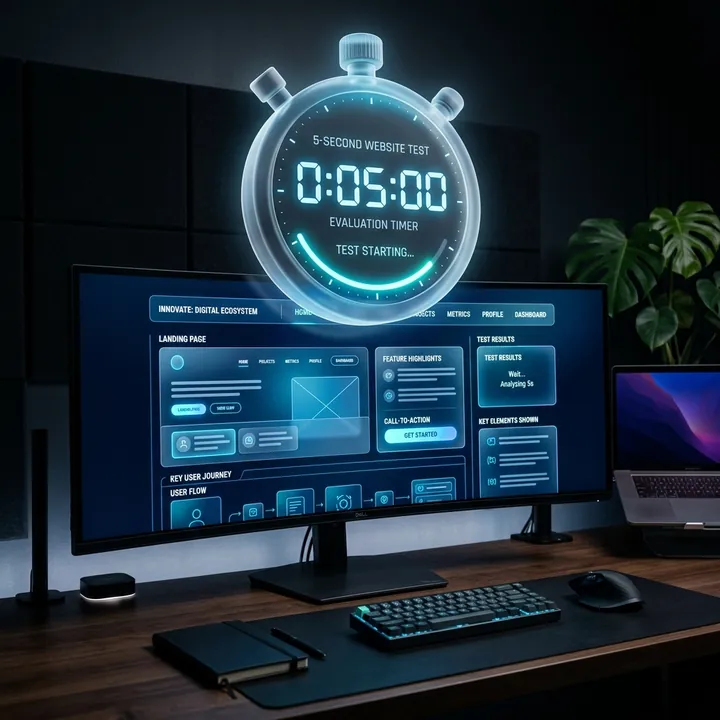 Web Design
The 5-second website test: how to check if visitors instantly understand what you do, how to run it, the questions to ask and fixes that improve conversions.
Read the guide Web Design
The 2026 conversion rate optimization guide: research, value proposition, friction, trust, forms, A/B testing and prioritisation to turn traffic into revenue.
Read the guide