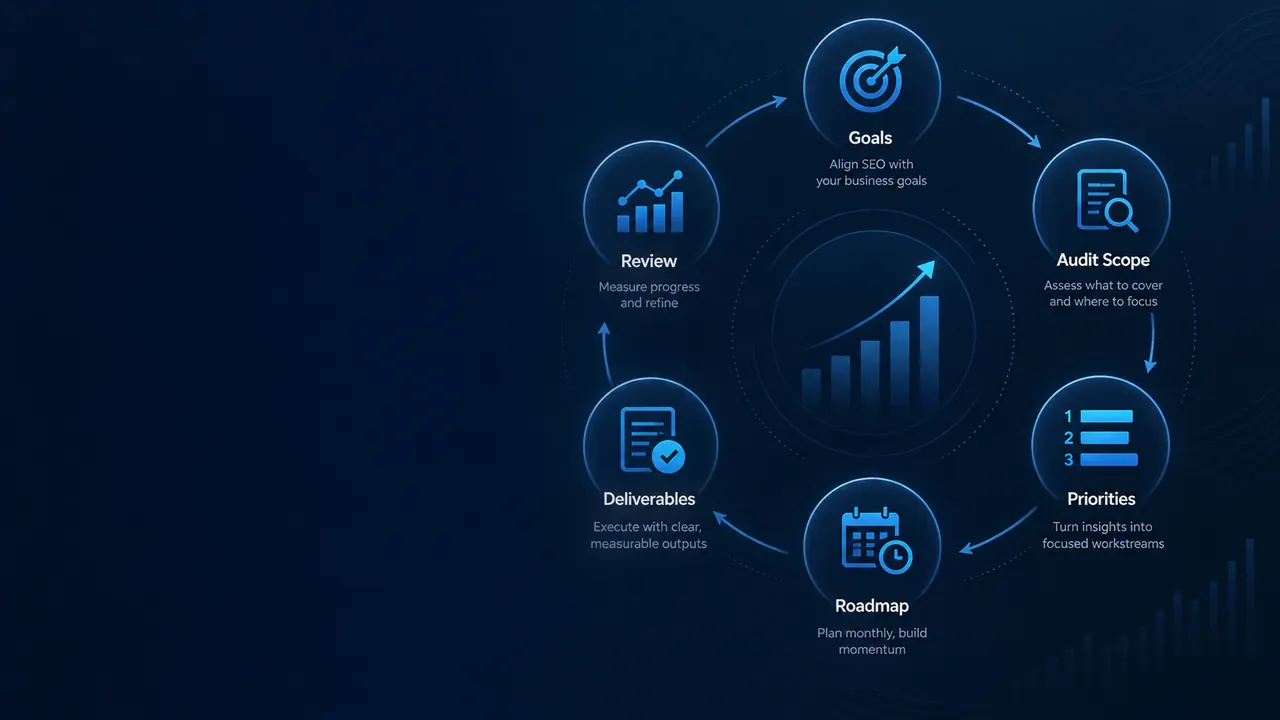
SEO Pricing & Packages at a glance
How much does SEO cost? SEO pricing depends on three variables: how competitive your market is, how much needs fixing, and how fast you want to move. This page explains SEO cost ranges, what good SEO packages include, and how to tell whether your spend is working.
Get a free audit →- Monthly SEO packages
- One-off SEO audits
- Project pricing
- Local SEO pricing
- Ecommerce SEO pricing
- No lock-in contracts
“It depends” is true, and it is also how buyers get exploited
SEO genuinely cannot be priced from a menu — a five-page local site and a 40,000-URL store need different work. But the industry uses that as cover for quotes with no scope attached, which is how businesses end up paying a monthly fee with no way to tell whether they are getting anything for it.
- Undefined scope
Retainers with no defined scope
A monthly figure with no stated deliverables means you cannot judge value or hold anyone to anything. It is the single most common way SEO budgets get wasted.
- Activity-based pricing
Deliverables priced as activity
“Four blog posts and 10 links a month” prices output, not outcome. It is easy to hit and tells you nothing about whether it moved the business.
- Ranking guarantees
Guaranteed ranking packages
Nobody can guarantee position — whoever offers it is either buying links or targeting terms with no competition. Both cost more than they appear to.
- Underpriced retainers
Cheap retainers that cannot work
Below a certain level there is not enough time in the budget to do anything meaningful. The work becomes reporting on itself, and the honest move is to say so rather than take it.
Three variables, and nothing else.
Every honest SEO quote comes down to the same three things. If a proposal does not make these explicit, you have no basis to compare it with another.
We quote against them openly, and will tell you when a smaller scope would serve you better than the one you asked about.
- Monthly fee, no scopeFixed scope in writing
- Priced on activityPriced on the work required
- 12-month lock-inMonth to month after ramp-up
- Quoted before seeing the siteQuoted after a free audit
- Ranking guaranteesTargets agreed from your baseline
- Upsells mid-engagementScope changes agreed first
“what exactly will you do in month one, and how will I know it happened?” If the answer is a list of activities rather than deliverables you can verify, the price is unknowable regardless of the number attached to it.
- Competitiveness of your market
- How much authority the sites currently ranking hold. This is the largest single factor, and it varies enormously between a local trade and a national finance term.
- Size and state of your site
- A five-page site needs a fraction of the technical work a neglected 4,000-page catalogue does. Starting condition matters as much as size.
- How much content is needed
- Whether you already have substantial content that needs restructuring, or genuinely need it written. Content is usually the largest ongoing line.
- How many markets
- One country and one language is a different engagement from five markets with hreflang and localised content.
- What you handle in-house
- Clients with their own developer or writer pay less, because we scope around what your team already covers.
From enquiry to a fixed number
Six steps, and you get a price only after we have seen enough to stand behind it.
Free audit first
We look at the site, the analytics and the competitive set before quoting. Quoting blind is how scope gets wrong and relationships sour in month three.
What’s included
- Free SEO audit before any commitment
- Technical, content and backlink review
- An honest view of the budget needed
You receive: A free SEO audit report
Define the target
What a customer is worth to you and what a result needs to look like commercially, so the budget can be judged against something real.
What’s included
- Agreed keywords, pages and markets
- Realistic ranking and lead goals
- SEO KPIs tied to business outcomes
You receive: A written SEO target brief
Size the gap
The distance between where you are and where you need to be, in content, authority and technical work. This is where the number comes from.
What’s included
- Where you rank today against competitors
- The traffic and revenue gap
- Effort needed to close it
You receive: A gap sizing summary
Scope in writing
Specific deliverables per month, not activity counts, so you can verify what you paid for without taking anyone’s word.
What’s included
- Every deliverable listed in writing
- Clear timelines and responsibilities
- No vague 'SEO activity'
You receive: A written SEO scope of work
Fixed price
One figure for that scope. Scope changes are agreed and priced before anything happens, never applied retrospectively.
What’s included
- One fixed monthly SEO fee
- No hidden charges or surprise add-ons
- Price agreed before any work starts
You receive: A fixed-price SEO proposal
Quarterly review
We revisit whether the scope is still right. If part of it is not earning its place we will recommend cutting it, including our own.
What’s included
- Quarterly SEO performance review
- Rankings, traffic and leads against targets
- Plan adjusted for the next quarter
You receive: A quarterly SEO report
Get a free audit →We will tell you when not to spend
The fastest way to lose a client is to take a budget that was never going to work.
Scope in writing, always
Specific deliverables you can verify, not activity counts. If you cannot check whether you got what you paid for, the price is meaningless.
Quoted after looking
We audit before quoting. A number given before seeing the site is a guess, and guesses get corrected upward later.
No lock-in
Month to month after an initial ramp-up period. We would rather earn the next month than rely on a contract to keep the account.
Honest about small budgets
If your budget cannot move your market we will say so and tell you what the realistic entry point is, rather than taking it and reporting activity.
Scope reviewed quarterly
If a line is not producing return we recommend cutting it. That shrinks our invoice, which is exactly why it is worth saying.
Priced from your margin
What a customer is worth to you sets what acquisition can cost. The budget follows from that rather than from a package tier.
Why Businesses Choose SDM for SEO
Same budget, very different outcomes. Point by point, here’s how a specialist partner compares to a typical agency or going it alone.
| What actually matters | With SDM | Typical Agency | In-House / DIY |
|---|---|---|---|
| Senior specialist on your account | Always | Often a junior | Stretched thin |
| Custom strategy built for your goals | Tailored | Templated | Guesswork |
| Deep audit before any work begins | ✓ | Surface-level | Skipped |
| White-hat, penalty-safe methods | Guaranteed | Varies | High risk |
| Plain-English reporting tied to revenue | Monthly | Jargon PDFs | None |
| Direct access to your specialist | ✓ | Account-manager relay | N/A |
| Fixed scope agreed in writing | ✓ | Vague retainer | n/a |
| Quoted only after an audit | ✓ | Quoted blind | n/a |
| Month-to-month, no lock-in | ✓ | 12-month tie-in | n/a |
| Told when the budget is too small | ✓ | Rarely | n/a |
| Scope cut when it stops earning | ✓ | Never | n/a |
| Ongoing competitor gap analysis | ✓ | One-off | Manual |
| Conversion-focused, not just traffic | ✓ | Traffic-first | Unclear |
| Premium tools included (Ahrefs, SEMrush) | ✓ | Sometimes | Costly extra |
| No long lock-in contracts | Flexible | 6–12 mo lock-in | N/A |
| Established agency, operating since 2017 | ✓ | Varies | Learning curve |
| Fast onboarding & early quick wins | ~2 weeks | Slow | Trial & error |
| Human, SEO-led content (no AI spam) | ✓ | Outsourced / AI spam | Time-heavy |
| Focus on compounding, long-term ROI | Core promise | Short-term wins | Slow & ad-hoc |
| Recovery from Google penalties | ✓ | Sometimes | Very hard |
20 reasons growing brands make the switch. See the difference for yourself →
How to tell whether SEO spend is working
Judge the spend on these rather than on rankings, which can improve while the business sees nothing.
Cost per qualified enquiry
Total spend divided by enquiries your sales team would actually accept — the number that decides whether to continue.
Organic revenue
Attributed in your own systems, not platform-reported, and compared against the pre-engagement baseline.
Share of commercial queries
Coverage of the terms that produce buyers, rather than total keyword count.
Blended CAC
What acquisition costs across all channels, so SEO can be judged against the paid alternative rather than in isolation.
Deliverables shipped
Whether the scope you paid for actually happened, checkable without taking anyone’s word for it.

Our SEO process: four stages before you pay anything
You see the findings and the scope before any money is discussed seriously.
Free audit
We look at the site, analytics and competitive set. You get the findings whether or not anything follows.
DeliverableNo cost, no obligationCommercial target
What a customer is worth and what a result needs to look like, so the budget is judged against your economics rather than a package.
DeliverableA number that means somethingScoped proposal
Specific monthly deliverables and one fixed price, with the reasoning behind the scope shown rather than asserted.
DeliverableVerifiable scopeStart, then review
Month to month after ramp-up, reviewed quarterly against what is actually producing return.
DeliverableAdjust rather than assume
Proven results from real SEO clients
Published case studies from our clients — each with the starting point, the dates, the source and what the numbers don’t prove.
A home services franchise group — 34.1K ranking keywords and 1.8K AI mentions.
Read the case study →Home services SEOTop 3 for “emergency plumber”, cited on 218 pages in AI answers.
Read the case study →B2B SaaS SEO77.9K Google clicks in three months — organic is the top channel.
Read the case study →SEO FAQs: the questions we get asked most
Direct answers on cost, contracts and how to judge a quote.
Further reading
Go deeper on this
The thinking behind the work. These guides go deeper on the methods this page describes — written by the team that runs them.