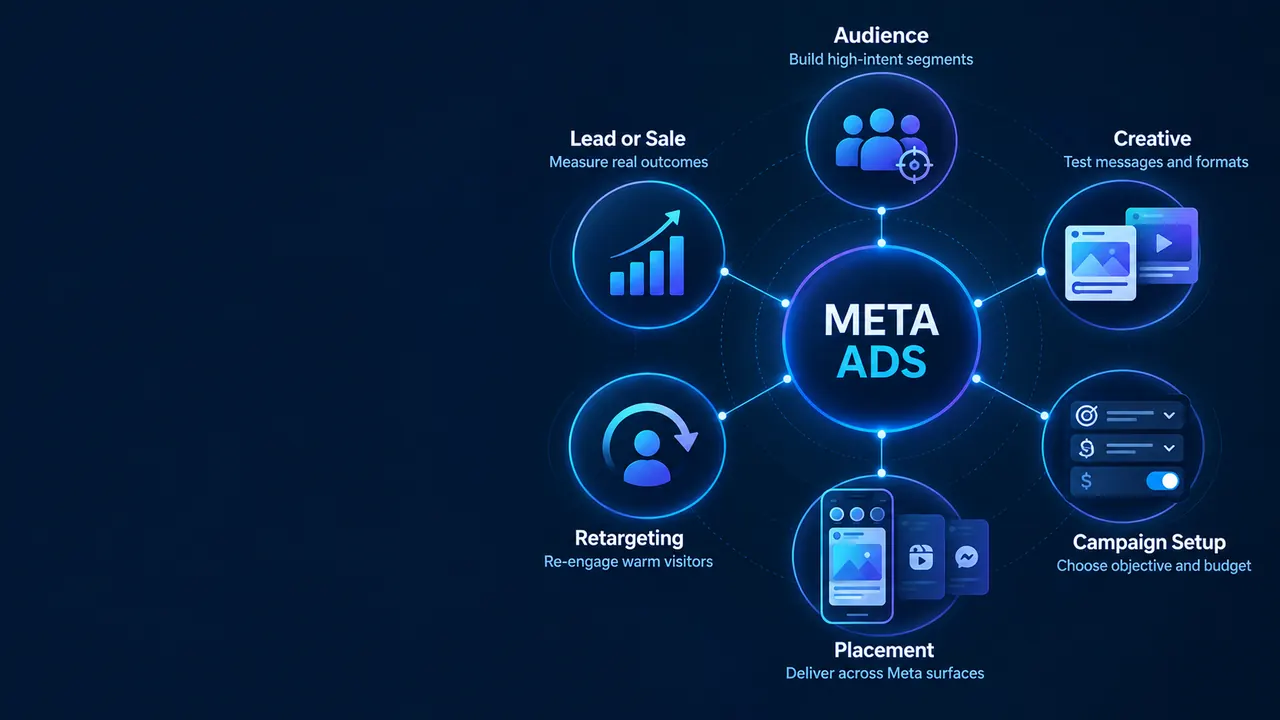


Creative became the targeting
Broad audiences and Advantage+ now outperform most interest stacks. Which people see an ad is decided largely by the creative itself — so creative volume and variety are the main growth lever.
Our Facebook & Instagram ads management treats creative as the targeting. As a Facebook Ads agency, we run Meta Ads with Advantage+, conversions API tracking and a steady creative testing cadence — Facebook Ads and Instagram Ads measured on profit, not platform ROAS.
Get a free audit →Broad targeting with strong conversion signals now outperforms hand-built interest stacks in most accounts. That frees the work to go where it matters — producing enough creative variety for the algorithm to optimise against.
We run a standing production and testing calendar rather than commissioning assets when performance dips. By then you have already paid for weeks of decay.
The uncomfortable finding: in most incrementality tests we run, retargeting produces far less additional revenue than its reported ROAS suggests. Those people were coming back anyway. The spend was buying credit, not customers.
Every Meta account we run gets all five — consolidated structure, creative in volume, complete data, fatigue control and honest measurement of what the spend caused.
 Facebook & Instagram campaign structure
Fewer, larger ad sets so budget concentrates and campaigns exit the learning phase quickly.
Our Facebook ads management consolidates fragmented accounts into fewer, larger campaigns and ad sets. Budget concentrates, Meta’s algorithm exits the learning phase faster and Instagram and Facebook placements work together instead of competing.
 Creative production & testing
Modular assets in volume — hooks, formats and angles varied systematically rather than one polished hero video.
On Meta, creative is the targeting. We produce Facebook and Instagram ad creative in volume — Reels, Stories, carousel and static formats — with a standing test calendar for hooks, angles and offers.
 Meta Pixel & Conversions API
Server-side events so the algorithm optimises on complete data rather than what survives browser restrictions.
Browser restrictions hide a large share of conversions from the Meta Pixel. We set up the Conversions API server-side, deduplicate events and raise event match quality so Facebook ads optimise on complete data.
 Creative fatigue & frequency control
Frequency and creative decay tracked with retirement rules, so assets are replaced before costs climb.
Facebook and Instagram ads decay as frequency rises. We track creative fatigue, set retirement rules and refresh winning concepts before cost per acquisition climbs.
 Incrementality & blended reporting
Geo tests establishing what Meta spend genuinely caused, separating real lift from claimed credit.
Meta’s reported ROAS is a claim, not a result. Geo holdout tests show what your Facebook and Instagram advertising genuinely caused, reported as blended CPA and MER against your own revenue.
Six workstreams, signal quality first — because the algorithm can only optimise toward what it is told a good customer looks like.
Pixel and Conversions API deduplicated, events prioritised and match quality raised, so Meta learns from real purchases and qualified leads rather than page views.
Fragmented ad sets merged so each campaign exits the learning phase with enough conversions to optimise on, instead of splitting budget ten ways.
A steady cadence of new concepts — hooks, formats and angles — tested against clear kill rules, because creative now does most of the targeting.
Advantage+ Shopping and audience campaigns set up with existing-customer caps and exclusions, so automation finds new buyers rather than recycling old ones.
Landing pages, offers and lead forms matched to each ad angle, so the promise in the ad is the one the visitor sees after the click.
Conversion lift and geo holdout tests to establish what Meta genuinely adds, rather than trusting in-platform attributed ROAS.
Pixel and Conversions API rebuilt and deduplicated before we optimise anything, so every later decision rests on accurate data.
Our designers sit with the paid media team and ship fresh variants every week, rather than waiting on a monthly creative cycle.
We cap and measure retargeting and existing-customer spend, so reported ROAS is not inflated by people who would have bought anyway.
For lead generation we optimise toward CRM-qualified leads, not cheap form fills that sales never converts.
Existing-customer caps, exclusions and clear campaign roles so automation finds new customers instead of harvesting old ones.
Meta and Google planned together, so social builds the demand that search then captures — and neither takes credit for the other.
Same budget, very different outcomes. Point by point, here’s how a specialist partner scores against a typical agency or running it in-house.
We report on what Meta genuinely adds to your business, because in-platform attribution routinely takes credit for sales that would have happened anyway.
Total marketing spend against total new customers — the number that shows whether Meta is actually growing the business.
Share of new concepts that beat the current control, tracked so the testing system keeps producing winners.
Reported separately, since blending them hides weak new-customer acquisition behind cheap retargeting sales.
How well Conversions API data matches real users — the input that decides how well the algorithm can learn.
Lift- and holdout-tested revenue, so you know what the spend genuinely caused rather than what it was present for.
Fix signal, consolidate structure, then run creative as a production line.
Conversions API implemented with proper deduplication, then narrow ad sets consolidated so budget concentrates and campaigns exit the learning phase.
✓ Delivery optimising on real dataCurrent assets audited for fatigue, winning angles identified and a modular production system built so variations can ship weekly.
✓ A production line, not a shootHooks, formats and angles tested with defined win conditions. Losers retired, winners varied further, learnings documented rather than remembered.
✓ Compounding creative libraryGeo holdouts on prospecting and retargeting to establish real incrementality, then budget scaled against marginal CPA.
✓ Growth verified, not assumedStraight answers on creative, targeting and what Meta reporting actually means.
Further reading
The thinking behind the work. These guides go deeper on the methods this page describes — written by the team that runs them.
 Social Media
How the Meta Ads algorithm works in 2026: Advantage+ campaigns, why creative is the new targeting, Conversions API, creative testing and the learning phase.
Read the guide Social Media
Meta Advantage+ vs manual campaigns in 2026: how Advantage+ works, when it wins, when manual control is still better and how to structure and test both.
Read the guide

