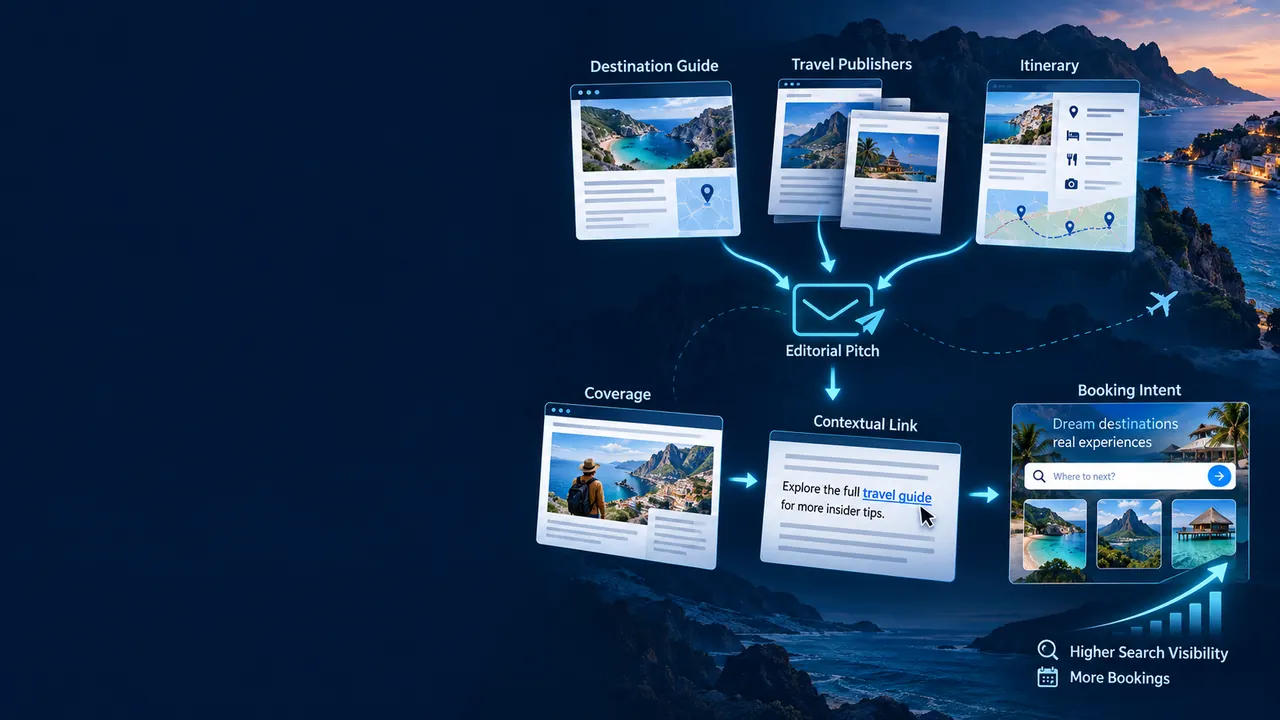
Travel Link Building Services at a glance
Our travel link building services earn travel backlinks where the booking platforms are weak — destination expertise, tourism boards and travel media. Hotel backlinks and tourism link building are routed to your direct booking pages, so authority turns into commission-free bookings.
Get a free audit →- Travel publisher outreach
- Tourism board links
- Destination guides
- Hotel backlinks
- Travel digital PR
- Direct-booking reporting
You are not competing with other hotels. You are competing with Booking.com.
In most travel categories the entire first page belongs to online travel agencies, review platforms and a handful of large publishers. Their domain authority is beyond anything an individual operator can build, and every booking they capture costs you fifteen to twenty-five percent in commission. Link building that ignores this structural reality burns budget on terms that were never available.
- OTAs own head terms
OTAs hold the head terms
‘Hotels in [city]’ is settled. Competing directly for it is the most common and most expensive mistake in travel SEO.
- Commission squeeze
Commission erodes the win
Traffic that converts through an OTA costs you a fifth of the booking value. Links that drive direct bookings are worth several times a link that drives platform traffic.
- Undisclosed press trips
Press trips without disclosure
Hosted stays and comped travel are paid arrangements. Coverage that does not disclose them breaches advertising rules, and followed links from them breach Google's policies.
- Seasonality ignored
Seasonality ignored
Travel research happens months before travel. A campaign pitched during the season it promotes has missed the booking window entirely.
Win where platforms structurally cannot.
OTAs are excellent at inventory and pricing and poor at everything requiring genuine local knowledge. They cannot tell you which beach is sheltered in a westerly, when the festival actually gets busy, or which route is passable in March. That gap is where a real operator earns links and rankings.
We build destination authority around that knowledge, then route it toward the pages that produce direct bookings rather than platform referrals.
- Competes with OTAs head-onTargets where they are thin
- Generic destination contentKnowledge only locals have
- Press trips undisclosedDisclosed and attributed
- Pitched in seasonPitched to the research window
- Traffic as the goalDirect bookings as the goal
- Ignores tourism bodiesDMO partnerships built
Could Booking.com have written this? If yes, it will not earn links and will not rank, because they have already written it with more authority than you. If no — because it needs someone who has actually been there through a winter — you have something.
- OTA gap analysis
- Which queries platforms genuinely own and which they cover thinly. We do not spend budget on the first group.
- Destination expertise assets
- Genuinely useful local guidance that only someone based there could write — the single most linkable thing a travel business owns.
- Tourism board and DMO relationships
- Destination marketing organisations, regional tourism bodies and official partners carry strong authority and are reachable in a way national press is not.
- Press trips, disclosed properly
- Hosted stays declared and links attributed correctly. The coverage still drives bookings; the shortcut is not worth the exposure.
- Seasonal campaign timing
- Pitched to the research window rather than the travel window, which for most destinations means six months ahead.
How the programme is built
Six stages, starting with an honest read of what is winnable.
OTA gap analysis
Which queries the platforms own outright, and which they cover with thin generic content. Budget goes only to the second group.
What’s included
- Keywords Booking.com and Expedia dominate
- Terms where direct sites can still rank
- Content gaps against the OTAs
You receive: An OTA keyword gap report
Local knowledge extraction
What your team knows that no platform can replicate. This is the raw material and it is usually sitting unwritten in people's heads.
What’s included
- Insider travel insight from your team
- Local tips and experiences turned into content
- Unique detail competitors cannot copy
You receive: Expert-led destination content
Destination asset build
Guides, seasonal advice and practical resources built around that knowledge and structured so publications can cite them.
What’s included
- Destination guides and travel resources
- Content travel journalists and bloggers link to
- Optimised for high-intent travel keywords
You receive: A linkable destination guide
DMO & partner outreach
Tourism boards, regional bodies and complementary local operators — high-authority, genuinely reachable, and routinely ignored.
What’s included
- Tourism boards and destination marketing organisations
- Local partner and supplier links
- Event and attraction listings
You receive: A travel partner link list
Press & creator hosting
Hosted visits arranged with disclosure and link attribution agreed in advance, so coverage is compliant on publication.
What’s included
- Press trips and creator visits
- Clear disclosure and editorial standards
- Coverage that earns travel backlinks
You receive: A press and creator programme
Direct booking routing
Authority aimed at the pages that take bookings directly, because that is where the commission saving actually lands.
What’s included
- Backlinks pointed at direct booking pages
- Less reliance on OTA commission
- Bookings from organic traffic tracked
You receive: A direct booking SEO plan
Get a free audit →We will tell you which terms you cannot win
Most of the value in travel SEO comes from not spending on the unwinnable half.
Honest OTA assessment
We identify the queries platforms genuinely own and say so, rather than taking budget to chase them for a year.
Local knowledge as the asset
We extract what your team actually knows and turn it into the thing platforms cannot produce. It is the durable advantage in this sector.
DMO relationships built
Tourism boards and regional bodies carry real authority and are reachable. Most operators never approach them.
Press trips handled compliantly
Disclosure and attribution agreed before the visit, so coverage does not create a regulatory problem or a policy breach.
Direct bookings, not sessions
Routing aimed at booking pages, measured on commission avoided rather than on traffic that ends up back on a platform.
Timed to the research window
Campaigns pitched months ahead of the season they promote, because that is when the audience is deciding.
Why Businesses Choose SDM for Travel Link Building
Same budget, very different outcomes. Point by point, here’s how a specialist partner compares to a typical agency or going it alone.
| What actually matters | With SDM | Typical Agency | In-House / DIY |
|---|---|---|---|
| Senior specialist on your account | Always | Often a junior | Stretched thin |
| Custom strategy built for your goals | Tailored | Templated | Guesswork |
| Deep audit before any work begins | ✓ | Surface-level | Skipped |
| White-hat, penalty-safe methods | Guaranteed | Varies | High risk |
| Plain-English reporting tied to revenue | Monthly | Jargon PDFs | None |
| Direct access to your specialist | ✓ | Account-manager relay | N/A |
| Unwinnable OTA terms identified upfront | ✓ | Chased anyway | Guesswork |
| Local knowledge turned into assets | ✓ | Generic guides | Rarely |
| Tourism board relationships | ✓ | Ignored | No |
| Press trips disclosed and attributed | ✓ | Often hidden | n/a |
| Measured on direct bookings | ✓ | Sessions | Unclear |
| Ongoing competitor gap analysis | ✓ | One-off | Manual |
| Conversion-focused, not just traffic | ✓ | Traffic-first | Unclear |
| Premium tools included (Ahrefs, SEMrush) | ✓ | Sometimes | Costly extra |
| No long lock-in contracts | Flexible | 6–12 mo lock-in | N/A |
| Established agency, operating since 2017 | ✓ | Varies | Learning curve |
| Fast onboarding & early quick wins | ~2 weeks | Slow | Trial & error |
| Human, SEO-led content (no AI spam) | ✓ | Outsourced / AI spam | Time-heavy |
| Focus on compounding, long-term ROI | Core promise | Short-term wins | Slow & ad-hoc |
| Recovery from Google penalties | ✓ | Sometimes | Very hard |
20 reasons growing brands make the switch. See the difference for yourself →
Direct bookings and commission avoided
The only travel metric that reflects what the work is actually for.
Direct booking share
Proportion of bookings arriving without a platform intermediary, and the commission that represents.
Destination query visibility
Rankings on the guidance and planning queries where OTAs are thin, rather than on the head terms they own.
Referring domains to booking pages
Authority reaching the pages that convert, not just the blog and homepage.
DMO and partner links
Links from tourism bodies and official regional partners, which carry disproportionate trust in this sector.
Research-window traffic
Whether visits are arriving in the planning window rather than after the booking decision is already made.

Our Travel Link Building process: four stages, on the travel calendar
Planning runs six months ahead of the season being targeted.
Winnable set
OTA gap analysis to establish what is genuinely available before any budget is committed.
DeliverableNo wasted spendKnowledge to assets
Your team's local expertise turned into guides and resources publications will cite.
DeliverableSomething platforms cannot copyOutreach & hosting
Tourism bodies, partners, press and creators — with disclosure agreed before anyone visits.
DeliverableCompliant coverageRoute & measure
Authority aimed at booking pages, reported on direct share and commission avoided.
DeliverableMargin, not just traffic
Proven results from real SEO clients
Published case studies from our clients — each with the starting point, the dates, the source and what the numbers don’t prove.
A home services franchise group — 34.1K ranking keywords and 1.8K AI mentions.
Read the case study →B2B SaaS SEO77.9K Google clicks in three months — organic is the top channel.
Read the case study →Home services SEOTop 3 for “emergency plumber”, cited on 218 pages in AI answers.
Read the case study →Travel Link Building FAQs: the questions we get asked most
On OTAs, press trips and what actually drives direct bookings.
Further reading
Guides, terms and related services
Go deeper on the methods behind this service, with guides written by the specialists who run them, plain-English definitions and the services that usually work alongside it.
 Content Marketing
Content Clusters & Topical Authority: 2026 Guide
How to build content clusters and topical authority in 2026: pillar pages, cluster research, internal linking, content briefs, updates and measuring results.
Read the guide SEO
SEOThe Complete Guide to SEO in 2026
The complete guide to SEO in 2026: how Google ranks pages, technical SEO, content, links, local and AI search, a 6-month roadmap and how to measure ROI.
Read the guide AI SEO
Generative Engine Optimization (GEO): 2026 Playbook
The generative engine optimization (GEO) playbook for 2026: how AI Overviews, ChatGPT and Perplexity choose sources, the GEO checklist and how to measure it.
Read the guide