Week 1
Spoken-question research
We collect the full questions people ask aloud about your services, from search data and from the calls your team takes. They are grouped by service.
You receive
A spoken-question list grouped by service.
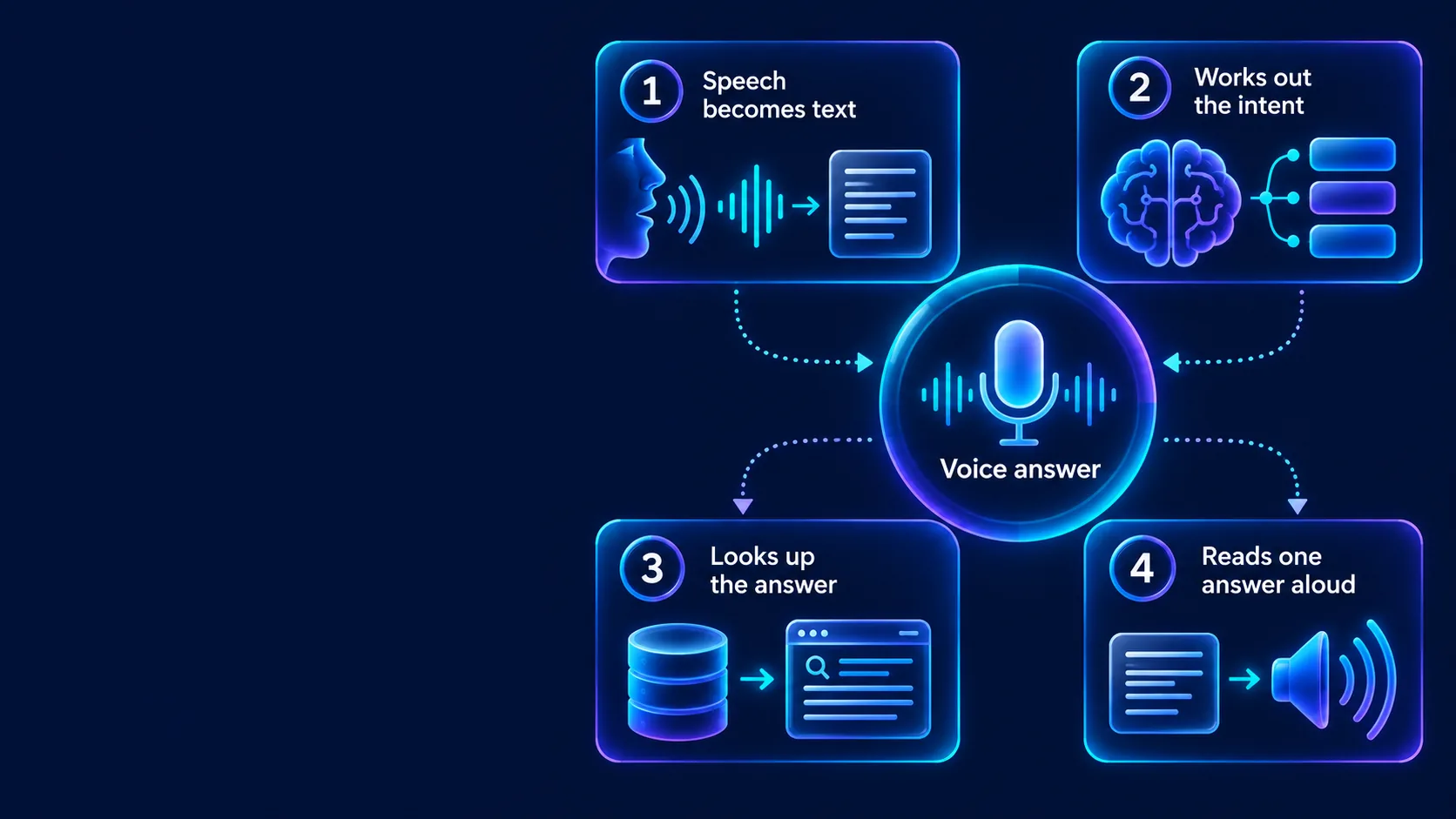
A voice assistant reads out one answer, not a page of results. We prepare your content and listings so that when someone asks Siri, Alexa or Google Assistant, the answer comes from you.
Voice search optimisation is the work of making your business the answer a voice assistant reads out. When someone asks Siri, Alexa or Google Assistant a question, one answer is spoken. There is no list.
A voice assistant gives one answer, not ten. On a phone, in a car or through a smart speaker there is no list to scan, so the business that is read out gets the call. Most spoken searches that matter commercially are local and immediate: who is open, who is nearest, who can help now.
Voice search optimisation prepares a business to be the single spoken answer a voice assistant gives. Spoken questions are longer and more conversational than typed ones, and many are local. Assistants answer them from business listings, featured snippets and structured data, so the work is on accurate listings and content written as short, direct answers.
Is there a pharmacy open near me right now?
Competes for a place on a page of results.
Your pharmacy on High Street is open until 10pm and is four minutes away.
Competes for the single answer read aloud, taken mostly from listings and featured snippets.
A spoken question is handled differently from a typed one, and only one answer comes back. It takes four steps.
The assistant transcribes what was said.
It decides whether this is a local request, a factual question or an instruction.
Local requests are answered from business listings. Factual ones come from featured snippets and reference sources.
There is no list to choose from, so the first source is the only one heard.
There is no second result in a spoken answer.
People ask who, what, where and how in natural language. Pages written around short keywords do not match.
Opening hours, directions and nearby services are common requests, and they are answered straight from business listings.
Siri, Alexa and Google Assistant draw on different business data, so being correct on one platform is not enough.
If two or more of these sound familiar, this service is likely to pay back. If none do, tell us and we will say so.
Not sure where you stand? We will check for you.
Ask for the free auditSpoken questions come from people who are driving, cooking or in a hurry. One reply is read out, and these businesses depend on it.
SDMReady for the spoken answer“Who delivers near me?” is settled by a single listing.
Late-night hours need to be right the first time.
A locked-out caller rings the first number spoken.
Stock, parking and closing time are asked on the way there.
Hands-free requests from the roadside leave no room to scroll.
Tonight’s stay is often arranged from the passenger seat.
Out-of-hours cover is the usual query.
Ticket prices and last entry are checked en route.
Content, listings and markup.
Request a free auditWe find the full questions people ask aloud about your services.
Short answers of one or two sentences placed where assistants and snippets can lift them.
Google Business Profile, Apple Business Connect and Bing Places completed and kept consistent.
Question-and-answer sections with matching structured data.
Voice results favour pages that load quickly on phones, so key pages are tuned.
We ask the assistants your priority questions and record the answers.
The differences that matter when you decide where to put time and budget.
| Aspect | The usual wayTyped search | What we doVoice search |
|---|---|---|
| Query style | Short keywords | Full spoken questions |
| Results | A page of options | One spoken answer |
| Typical intent | Research and comparison | Immediate and often local |
| Main sources | Ranked web pages | Business listings, featured snippets and structured data |
| What wins | Relevance and authority | Accurate listings and concise direct answers |
Five stages. Listings, content and speed are handled in the first month. Testing then repeats each quarter.
We collect the full questions people ask aloud about your services, from search data and from the calls your team takes. They are grouped by service.
A spoken-question list grouped by service.
Google Business Profile, Apple Business Connect and Bing Places are completed and made identical, because Siri, Alexa and Google Assistant each read from different ones.
Completed listings on each platform.
Answers of one or two sentences are written into your key pages, with question-and-answer sections and matching structured data. You approve the wording.
Direct-answer sections and validated FAQ structured data.
Your key pages are tuned to load quickly on phones.
Before-and-after speed results.
We ask Siri, Alexa and Google Assistant your priority questions and record what each one says.
A voice test report each quarter.
Timings are typical for a single website; your proposal sets out the exact schedule.
Sachkhand Digital Marketing has worked with businesses in 30 countries since 2017. The team is remote-first and keeps to your time zone, and the specialists who audit your site are the ones who do the work. This is how the work is shared on a voice search optimisation engagement.
A spoken-question list grouped by service.
Completed listings on the platforms each assistant uses.
Direct-answer sections on your key pages.
FAQ structured data, validated.
A voice test report each quarter.
We tell you this before you start, not after.
Request a free auditVoice assistants give no reports, so we are careful about what we claim. These are the results that can be checked.
Targets we plan against, for engagements of six months or more
Local voice questions often lead straight to a call or a request for directions.
How we measure itCalls and direction requests from your listings.
The wrong opening hours read aloud cost a visit and some of the customer's trust.
How we measure itListing accuracy across the three platforms.
The short answers written for voice are the format Google uses for featured snippets.
How we measure itSnippets held for the tracked questions.
The speed work helps everyone who opens your site on a phone, however they found it.
How we measure itCore Web Vitals on your key pages.
Published client results
We do not guarantee a ranking or a mention in an AI answer. The search engines and assistants decide that, and no agency controls them. We guarantee the work, the measurement and the honesty.
These come up in almost every first audit. Each one is avoidable.
Siri uses Apple’s data and Alexa and Copilot draw on Bing and others. Each needs correct listings.
“Open now” answers depend on them, including holiday hours.
Assistants read out short passages. A clear answer in a sentence or two is what gets used.
Most voice searches happen on phones. A slow page loses the visit that follows.
You do not need us for the first steps. These take under an hour and show you where you stand.
Want the full picture?
Request the free auditThree of our free tools cover the first checks we make. No signup is needed.
Straight answers to the 9 questions we are asked most.
Send it to us and you get a reply within one business day.
Ask your own questionIt is the work of preparing a business to be the answer a voice assistant reads out, through accurate listings, content written as direct answers to spoken questions, and structured data.
Siri, Alexa and Google Assistant, along with the voice modes of newer AI assistants. Each uses different sources, so we work across the listings and content all of them rely on.
Spoken questions are longer, phrased as full sentences and more often local. The assistant gives a single answer, so being second is the same as being absent.
Local businesses benefit most, because so many spoken questions are about nearby services and opening hours. Publishers and brands also benefit for how-to and definition questions.
Not directly. Assistants do not report it. We measure by asking the priority questions and recording the answers, and by tracking the related featured snippets and listing actions.
Voice is becoming the way many people talk to AI assistants on phones, in cars and at home. The same foundations, accurate listings and direct answers, serve both.
No. Voice assistants draw on your existing listings, website and structured data. The work is making those accurate and easy to read out.
Siri relies mainly on Apple’s own business data and partners such as Yelp. Alexa draws on Bing and other data providers. That is why listings beyond Google matter.
Voice assistants generally give organic answers and paid placement is very limited. Accurate listings and clear content are the reliable route.
Send us your business and five questions customers ask. We will ask the assistants and tell you what they answered.