Agency Partnership ProgrammeA delivery team you do not employ.
Working the way yours does.
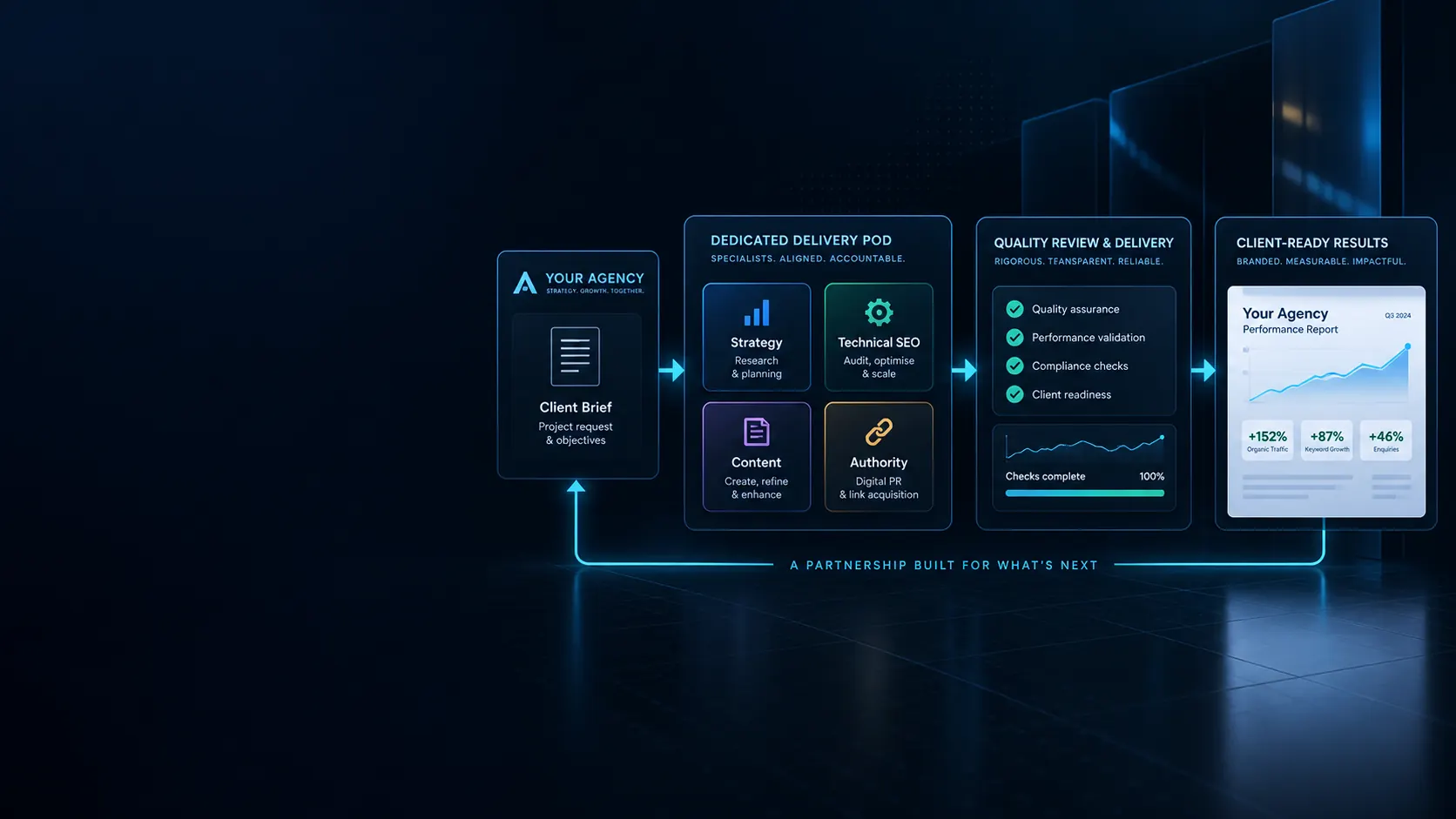
Our agency partnership programme is for agencies past the reseller stage: a dedicated pod that learns your process, joins your tooling, and delivers at volume under your brand — without the fixed cost, recruitment risk or idle capacity of building it in-house.
Agency Partnership Programme at a glance
Our agency partnership gives your agency a white label agency partner for SEO, paid media and content. You get a dedicated delivery pod — an outsourced SEO team for agencies that works under your brand — so you can sell more without hiring, with us as your agency delivery partner behind the scenes.
Get a free audit →- Dedicated delivery pod
- White label delivery
- Outsourced SEO team
- Branded reporting
- Partner pricing
- Senior account support
The point where per-client reselling stops making sense
Reselling is the right model early: cost moves with your book and nothing is fixed. Past a certain volume the calculation changes, because per-client pricing stops reflecting the efficiency of a team that already knows your process.
There is no single crossover point — it depends on how similar your clients are, how much strategy you keep in-house, and how predictable your pipeline is. If reselling is still working well for you, we will tell you to stay on it rather than sell you a commitment you do not need yet.
An extension of your team, behind your brand
A pod is different from a reseller queue: the same people, on your tooling, familiar with your clients and your standards. What does not change is the line — the client is always yours.
What a pod is not: it is not exclusive staff you have hired, and we will not pretend otherwise. A pod is committed capacity with named people who know your account. If you need genuinely dedicated full-time employees under your control, you need to hire — and we will say so rather than sell a partnership that will not satisfy you.
Three ways to structure a partnership
Most agencies start with overflow, and roughly half move to a pod within a year. Some never do, and that is a perfectly good outcome.
- Work sent as it arrives
- Wholesale per-client rates
- No monthly commitment
- Capacity confirmed before you sell
- Standard turnaround
- Full brand invisibility
- Named specialists on your account
- Works in your tools and process
- Reserved capacity, priority turnaround
- Joins your internal calls
- Quarterly planning with your leads
- Scales with notice
- Client-facing on request as your team
- Co-branded or fully white label
- Shared commercial risk
- Joint pitching support
- New service line without hiring
- Defined term and exit
- Bespoke commercial terms
Structures can change as you grow — several partners moved from overflow to a pod and one moved back when their pipeline became less predictable. We would rather adjust the arrangement than hold you to one that no longer fits.
Who does what, and where the line sits
Where responsibility sits in a partnership: you keep the client, the pricing and the brand; we stay entirely behind the line.
- Owns the client relationship
- Runs strategy conversations
- Presents the reporting
- Decides scope with client
- Keeps 100% of the brand
- Executes the delivery work
- Quotes wholesale only
- Never contacts your client
- Builds reports in your brand
- Flags scope risk to you
- Stays completely invisible
How a partnership is established
Longer than a reseller start, because a pod has to learn your process before it can be useful.
Your pipeline, service mix and standards reviewed against our capacity. Mutual NDA and non-solicitation signed. Honest conversation about whether a pod is premature.
We learn your delivery process, templates, tone and quality bar, and get access to your project tooling rather than asking you to adopt ours.
One live client run end to end so both sides can test the working relationship on something real before capacity is committed.
Committed capacity begins with named specialists, agreed communication rhythm and a quarterly planning cycle with your leads.
The terms we sign up to
A partnership involves more exposure than reselling — shared tooling, internal access, sometimes client contact. The protections have to be correspondingly firmer.
We will not approach your clients or recruit your people, during the partnership or after. With shared tooling and internal visibility, this needs to be contractual on both sides rather than assumed.
Your pricing, margins, pipeline and client list stay confidential and are never used competitively. In a pod arrangement we see more of your business than a reseller ever would.
The people on your account will not simultaneously work on a direct competitor of one of your clients. We will tell you if a conflict arises rather than quietly managing it.
You know who is on your account. If someone leaves the pod you are told in advance, with a handover, rather than discovering it through a change in work quality.
Committed capacity is reserved. If we cannot meet it in a given period we tell you at the start of the cycle and reduce the retainer accordingly rather than quietly under-delivering.
On exit you receive all work, documentation, access and reporting history. Notice periods are mutual and defined so neither side can strand the other mid-cycle.
What agency owners ask first
The concerns are different from reselling — deeper integration means more to lose if it goes wrong.
You avoid recruitment risk, employer costs, training and idle capacity when a client pauses, and you get a group covering technical, content and links rather than one generalist. What you give up is direct employment control and exclusivity. If those matter more than flexibility, hiring is genuinely the better answer and we will tell you so.
Committed capacity with named people who know your accounts — not a queue. But we will not claim they work only on you unless you are buying enough capacity for that to be true. Providers who promise exclusive teams at shared-team pricing are describing something that does not exist.
Defined mutual notice, then a handover of all work, documentation and access. We would rather end cleanly than hold deliverables to force a renewal. Partnerships that end well quite often come back later, and ones that end badly cost far more than the retainer was worth.
Yes, and we prefer it. Asking a partner to adopt your tooling is what makes a pod feel like your team rather than an external supplier. We work in your systems, follow your ticket conventions and attend your stand-ups if that helps.
They can, as named members of your team using your email domain and briefed on your positioning. Some partners use this routinely for technical calls; others never do. It is entirely your decision and never happens without your explicit request.
Ask, and we confirm before you go to the client. We would rather decline a pitch than accept work we cannot resource properly, because the reputational cost of missing delivery lands on you, not us.
Four shifts in how agencies deliver
The pressures pushing mid-sized agencies toward partnership rather than headcount.
Clients increasingly want one agency across SEO, paid, content and creative while still expecting specialist-grade work in each. Building genuine depth in every discipline is unrealistic below significant scale.
A mis-hire in a small agency is expensive and slow to correct. Committed external capacity converts that fixed risk into a variable cost that can be adjusted with notice.
Procurement processes increasingly ask about delivery structure. Partnerships that are documented and contractually clean survive that scrutiny; informal freelancer networks frequently do not.
Routine production got cheaper and more abundant, which moved agency value toward strategy, client relationships and judgement — exactly the parts you should keep rather than outsource.
The service levels we commit to
A pod is judged on predictability more than anything else, so these are the commitments that matter most.
These are planning targets rather than a record of past client averages; we agree a realistic range against your own baseline before an engagement starts. Pod throughput depends on how clearly work is briefed and how quickly approvals return — the partnerships that run smoothly are the ones with a single decision-maker on your side.
Partnership questions, answered plainly
Commercial and operational detail on structures, terms and how a pod actually runs.
Should we start with reselling or a partnership?
Almost always reselling. It has no commitment, tests the working relationship on real accounts, and costs nothing when your pipeline is quiet. A pod only makes sense once your volume is steady enough that reserved capacity is cheaper than per-client pricing. If you are not there yet we will say so rather than sell the larger arrangement.
How is a pod priced?
A monthly retainer for committed capacity rather than per client, which is what makes it cheaper at volume and more expensive at low volume. The retainer is sized to the throughput you actually need, and we would rather start smaller and grow it than oversell capacity you will not use.
Can we white label the pod entirely?
Yes. Deliverables carry your brand, communication runs through you, and our name appears nowhere including in file metadata. Some partners choose co-branding for credibility in technical pitches, but full invisibility is the default.
What if our clients are in the same sector as another partner's?
We will not put people on your account who are simultaneously working on a direct competitor of one of your clients. If a genuine conflict arises we raise it with you and resolve it rather than managing it quietly, which is the sort of thing that destroys trust when it surfaces later.
Do you work with agencies outside your existing markets?
Yes. We work remotely across 30 countries, and delivery is not constrained by where your clients are. Time-zone overlap is worth discussing honestly upfront, because a pod that is only reachable for two hours a day is less useful than the retainer suggests.
What reporting do we get on the pod itself?
Throughput, capacity used against committed, and delivery timelines — separate from client-facing reporting. You should be able to see whether you are getting what you are paying for without having to reconstruct it from individual accounts.
Can the partnership end?
Yes, with defined mutual notice, and everything is handed over: work, documentation, access, reporting history. We do not use withheld deliverables as leverage. Notice periods exist so client delivery is not disrupted mid-cycle, which protects your relationships rather than ours.
Wondering whether a pod makes sense yet?
Tell us your client volume and service mix. We will model whether reselling or committed capacity is genuinely cheaper for you — and say so if the answer is to stay where you are.
Further reading
Guides, terms and related services
Go deeper on the methods behind this service, with guides written by the specialists who run them, plain-English definitions and the services that usually work alongside it.
 SEO
SEOThe Complete Guide to SEO in 2026
The complete guide to SEO in 2026: how Google ranks pages, technical SEO, content, links, local and AI search, a 6-month roadmap and how to measure ROI.
Read the guide Performance Marketing
The Omnichannel ROI Framework: Stop Burning Ad Spend
A digital marketing ROI framework for 2026: server-side tracking, MER, incrementality testing, marketing mix modelling, LTV:CAC and payback period.
Read the guide Technical SEO
The Technical SEO Audit Playbook for 2026
A step-by-step technical SEO audit playbook for 2026: crawling, indexing, site architecture, JavaScript, Core Web Vitals, structured data and prioritisation.
Read the guide