
SEO for Hotels & Hospitality at a glance
Our hotel SEO shifts bookings from OTAs to your own site. Hospitality SEO and SEO for hotels cover destination and room pages, Google Hotel listings and reviews — a direct booking strategy measured on commission saved, not just traffic.
Get a free audit →- Room & offer pages
- Destination content
- Google Business & Hotel listings
- Direct booking strategy
- Review management
- Booking engine tracking
Guests discover on an OTA and book wherever is cheapest
The critical moment in hotel booking is not discovery — it is the point where a guest who has found you on an OTA checks whether booking direct is better. Most hotels lose that moment by default, because they never made the case.
Where shall we go?
Destination-led research, often months ahead. Content about the area, events and things to do captures this stage entirely.
Which hotel?
Now comparing properties on OTAs and maps, filtering by price, rating and location. Most hotels are discovered here.
Is this place good?
They search the hotel by name to read reviews, see real photographs and check the official site before committing.
Direct or OTA?
The decisive moment. If your direct rate and benefits are not obviously better, they book through the OTA and you pay commission.
What commission is really costing you
OTA commission is charged on gross booking value, not on profit, which means it consumes a disproportionate share of actual margin. Shifting even a modest percentage of bookings to direct changes the economics of the whole property.

Commission on every OTA booking
Between 15% and 25% of gross booking value on bookings from guests who, in many cases, would have booked directly had your site been visible and the case for it been made.

Losing your own brand searches
OTAs bid on and rank for your hotel name. Guests searching for you directly land on an OTA listing and book there — and you pay commission for a guest who was already yours.

No destination content
The research phase happens months before booking and is entirely won by content about the area. Hotels that publish none of it are invisible until the comparison stage.

A booking engine that loses people
A slow, clunky or non-mobile booking flow sends guests back to the OTA experience they already trust. Direct visibility is wasted if the booking path is worse.
The queries that produce direct bookings
We prioritise queries where a direct booking is realistically winnable — brand searches, location-specific stays and destination research — rather than competing head-on with OTAs on generic terms.
| Search term | Intent | Volume | Why it matters |
|---|---|---|---|
| “[hotel name]” | Very high | Medium | Your own brand. Must be defended against OTA bidding — highest-value query you have. |
| “hotels near [landmark]” | Very high | High | Location-led with strong booking intent. Winnable with proper local work. |
| “[city] hotel with parking” | Very high | Medium | Amenity-specific. Long tail, low competition, converts strongly. |
| “best hotels in [area]” | High | High | Comparison phase, dominated by OTAs and lists. Worth contesting selectively. |
| “things to do in [city]” | Medium | Very high | Dream phase. Builds visibility months ahead of a booking decision. |
| “dog friendly hotel [area]” | Very high | Medium | Filter-led search with very high conversion and light competition. |
| “[city] hotel deals” | High | High | Price-led. Where a best-rate guarantee wins the direct booking. |
| “wedding venue [area]” | Very high | Medium | Very high value per booking if you host events. Frequently under-targeted. |
Volume bands vary sharply by destination and season. We build the keyword map around your actual room types, amenities and event capability rather than generic hotel terms.
Who sits between you and your guests
Hotel search is one of the most intermediated categories online. Understanding exactly who occupies the space between a guest and your booking engine is the first step to bypassing them.

OTAs and metasearch
Booking.com, Expedia and metasearch platforms dominate nearly every generic hotel query and bid aggressively on individual hotel brand names.

Hotel chains
Large groups with substantial marketing budgets, loyalty programmes and extensive destination content across every market they operate in.

Travel publishers
Guides, listicles and travel media own the dream-phase queries where guests first decide where to stay, months before they book.
Our hotel SEO services: the work that shifts bookings direct
Every element below is aimed at one outcome: increasing the share of bookings that arrive through your own booking engine rather than through a commissioned channel.

Brand search defence
Ensuring your own hotel name resolves to your site rather than an OTA listing, which is the single fastest commission saving available.
- Own every result on the first page for your brand name
- Sitelinks, profiles and FAQs structured for brand searches
- OTA and reseller ads monitored on branded terms

Local & map visibility
Business Profile, map pack and location work so you appear for “hotels near” searches with photography, amenities and direct booking links.
- Business Profile optimised for every location you operate
- Neighbourhood content tied to landmarks and transport links
- Citation consistency across travel and local directories
Destination content
Genuinely useful area, events and things-to-do content that captures the dream phase months before a booking decision is made.
- Destination guides written from real local knowledge
- Itinerary and seasonal content that answers planning searches
- Internal links from guides to bookable products
Best-rate messaging
Clear, credible direct-booking benefits and rate transparency at the exact moment a guest is deciding between you and the OTA.
- Best-rate guarantee shown on every rate display
- Direct-booking perks listed clearly
- Price comparison with OTAs where it favours you
Booking engine conversion
Fast, mobile-first booking flow work, because direct visibility is wasted if the booking path is worse than the OTA experience.
- Rate calendar and availability visible from landing pages
- Booking engine speed and mobile experience improved
- Direct-booking perks shown at the point of decision
Review & reputation
Guest review growth and response handling across the platforms that feed both local ranking and guest decision-making.
- Review collection built into the post-stay or post-rental email
- Fast, public responses to every complaint
- Monitoring across Google, Tripadvisor and comparison platforms
Your first 90 days of hotel SEO
Brand defence first because it produces immediate commission savings, then discovery and destination visibility.
An independent hotel that halved its OTA dependence
A 40-room independent hotel took roughly 80% of bookings through OTAs, paying substantial commission on each. Guests searching the hotel by name were landing on OTA listings, and the property had no destination content at all.
We defended brand search so the hotel’s own name resolved to its site, rebuilt the Business Profile with proper photography and direct booking links, added clear best-rate messaging at the decision point, and published genuine destination and events content.
The commission we saved in the first six months paid for the work several times over. We are still on the OTAs — we just are not dependent on them any more.
Hotel SEO FAQs: questions hoteliers ask
Practical answers on OTAs, commission and what direct booking growth realistically looks like.
Further reading
Guides, terms and related services
Go deeper on the methods behind this service, with guides written by the specialists who run them, plain-English definitions and the services that usually work alongside it.
 SEO
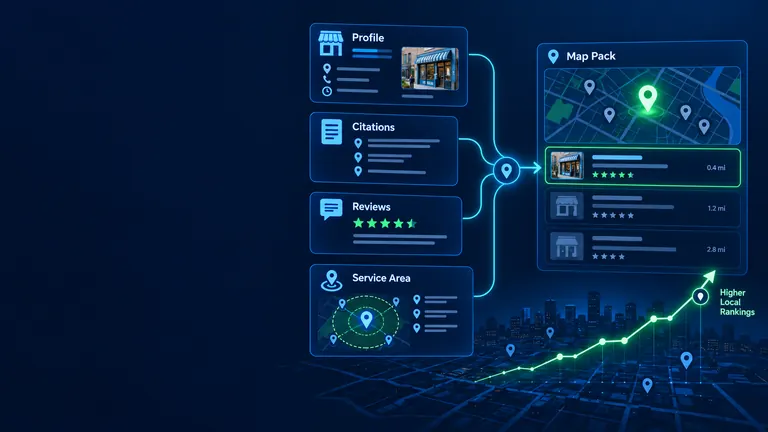
SEOLocal SEO Playbook: Dominate Your City in 90 Days
The local SEO playbook for 2026: win the Google Maps local pack with Google Business Profile, reviews, citations, location pages and local links.
Read the guide SEO
SEOGoogle Business Profile Optimization Checklist 2026
A complete Google Business Profile optimization checklist for 2026: categories, services, photos, reviews, posts, suspensions, multi-location tips and tracking.
Read the guide AI SEO
Generative Engine Optimization (GEO): 2026 Playbook
The generative engine optimization (GEO) playbook for 2026: how AI Overviews, ChatGPT and Perplexity choose sources, the GEO checklist and how to measure it.
Read the guide