
SEO for Home Services at a glance
Our home services SEO wins emergency and planned jobs for trades. Trade SEO and SEO for tradesmen combine the map pack, service-area pages and reviews, with emergency callout SEO for the jobs decided in under two minutes — contractor SEO measured on booked work.
Get a free audit →- Google Business Profile
- Service-area pages
- Emergency callout SEO
- Review generation
- Contractor SEO
- Call & booking tracking
Emergency jobs are decided in under two minutes
Home services search splits sharply. Emergency work converts almost instantly and rewards whoever is visible and answers. Planned work — a bathroom, a rewire, a new boiler — is researched for weeks and rewards proof, reviews and clear pricing.
Something has broken
Water is coming through a ceiling or there is no heating. They search on a phone and call the first credible result.
Are they legitimate?
A quick check of reviews and rating before dialling. Anything below roughly four stars gets skipped entirely.
Researching bigger work
For planned jobs they compare several firms, look at previous work, and try to understand likely cost before enquiring.
Call or move on
They call. An unanswered phone, no out-of-hours option or a slow mobile site sends them straight to the next result.
What poor local visibility costs a trade business
Home services is almost entirely a local visibility game. The difference between appearing in the map pack and not appearing is, for most trades, the difference between a full diary and a quiet week.

Only ranking near your depot
Most trades appear in the map pack only within a couple of miles of their registered address, despite genuinely covering a much wider area. Every other area is invisible.

Thin or stale reviews
Customers filter hard on rating before calling, and a dormant review profile also suppresses map position. It works against you in both directions simultaneously.

Losing the emergency call
Emergency search is overwhelmingly mobile and immediate. A slow site, buried phone number or unanswered out-of-hours line hands the job to a competitor within seconds.

Directories taking your leads
Checkatrade, MyBuilder and similar platforms outrank individual trades on nearly every query, then charge you for the leads they capture using your own market.
The queries that turn into booked jobs
Emergency queries convert fastest; planned-work queries carry higher job values. A working home services strategy targets both deliberately rather than defaulting to whichever is easier.
| Search term | Intent | Volume | Why it matters |
|---|---|---|---|
| “emergency plumber near me” | Very high | High | Calls within minutes. Premium rates, minimal price sensitivity. |
| “[trade] near me” | Very high | Very high | Core map pack query across every trade and every area. |
| “boiler replacement cost” | High | High | High-value planned work. Pricing content captures them early. |
| “24 hour electrician [city]” | Very high | Medium | Out-of-hours premium work, low competition if properly marked up. |
| “[trade] in [town]” | Very high | Medium | Area-specific. Requires genuine location pages to win. |
| “bathroom fitters near me” | High | Medium | Large planned job. Portfolio and reviews decide it. |
| “how much does [job] cost” | Medium | High | Research phase. Transparent pricing wins the later enquiry. |
| “gas safe engineer near me” | Very high | Medium | Accreditation-led search. Easy win if certifications are marked up. |
Volume varies heavily by trade and area. Emergency queries spike seasonally — heating in winter, drainage after heavy rain — and we build seasonal capacity into the plan.
Who you are really up against
Rarely the trade down the road. In home services your competition is usually a lead-generation platform, a national franchise, and a handful of local firms who have taken local SEO seriously.
Lead generation platforms
Checkatrade, MyBuilder, Bark and similar rank above individual trades for almost every query, then sell you leads generated from your own local market.

National franchises
Franchised trade networks with central marketing budgets, consistent branding and profiles built properly across every territory they operate in.

Local firms doing it properly
In most areas one or two competitors have built out their profile, reviews and location pages. They take a disproportionate share of local enquiries.
Our home services SEO programme: the work that fills a trade diary
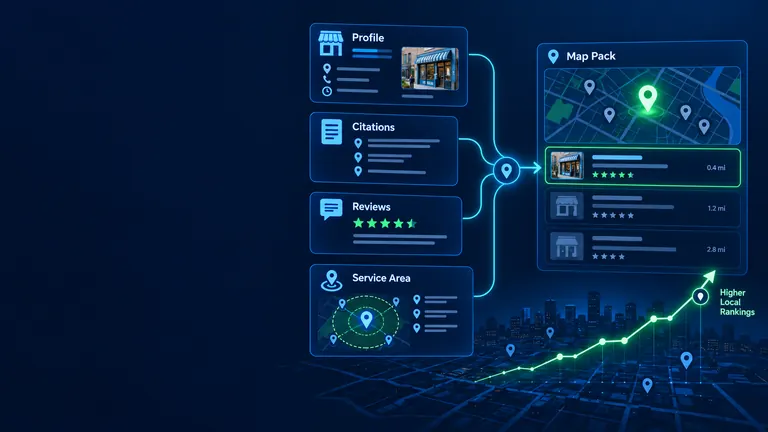
Home services SEO is won on local entity strength, review velocity and genuine area coverage. Everything below runs as one programme.
Google Business Profile
Categories, full service lists, real job photography on a publishing cadence and managed Q&A — the biggest single lever on map pack position.
- Primary and secondary categories audited against the top-ranking home services businesss
- Services, attributes, hours and booking links completed in full
- Weekly posts, geotagged photos and a managed Q&A section
Review engine
Automated requests timed to job completion, producing steady monthly velocity with natural service and area language, plus response handling.
- Automated review requests timed to the moment of delivery
- Response templates that stay personal and compliant
- Review velocity tracked against the home services businesss ranking above you
Service area pages
Genuinely differentiated pages per area you cover, with real local project proof so you rank well beyond your depot postcode.
- A genuine page for each town or district you serve
- Local proof: jobs completed, photos and reviews from that area
- Internal linking that passes authority between areas

Pricing & quote content
Transparent guide pricing for common jobs, which captures planned-work research and pre-qualifies enquiries before they call.
- Price ranges for the jobs people search for most
- What affects cost, explained plainly
- Quote request routes on every pricing page
Emergency conversion
Fast mobile pages, prominent click-to-call, out-of-hours capture and call tracking — because emergency jobs go to whoever answers.
- Click-to-call and callback above the fold on mobile
- Clear response times and out-of-hours availability
- Call tracking to see which pages drive urgent jobs
Accreditation signals
Gas Safe, NICEIC, insurance and guarantee details marked up properly, since these are what customers verify before dialling.
- Trade body memberships and guarantees shown on every page
- Insurance and certification details visible
- Accreditations marked up so search engines understand them
Your first 90 days of home services SEO
Local visibility first because it produces calls fastest, then area expansion and planned-work content.
A plumbing firm that went from one suburb to fourteen
An established plumbing and heating firm ranked in the map pack only within about two miles of its yard, despite covering fourteen areas. It was buying leads from a national platform at a rising cost per job and competing against its own leads.
We rebuilt the Business Profile with correct categories, corrected 41 conflicting citations at aggregator level, deployed a review engine that produced steady monthly velocity, and published genuinely differentiated area pages with real local job photography.
We stopped paying for leads that were being sold to two other firms at the same time. The phone rings directly now, and it rings from areas we had never had a job from before.
Proven results from real SEO clients
Published case studies from our clients — each with the starting point, the dates, the source and what the numbers don’t prove.
Top 3 for “emergency plumber”, cited on 218 pages in AI answers.
Read the case study →Franchise SEOA home services franchise group — 34.1K ranking keywords and 1.8K AI mentions.
Read the case study →Plumbing SEOPlumbing, HVAC & electrical across 40+ Dallas–Fort Worth towns.
Read the case study →Home services SEO FAQs: questions trades ask
Practical answers on coverage, reviews and what local SEO actually delivers for a trade business.
Further reading
Guides, terms and related services
Go deeper on the methods behind this service, with guides written by the specialists who run them, plain-English definitions and the services that usually work alongside it.
 SEO
SEOLocal SEO Playbook: Dominate Your City in 90 Days
The local SEO playbook for 2026: win the Google Maps local pack with Google Business Profile, reviews, citations, location pages and local links.
Read the guide SEO
SEOGoogle Business Profile Optimization Checklist 2026
A complete Google Business Profile optimization checklist for 2026: categories, services, photos, reviews, posts, suspensions, multi-location tips and tracking.
Read the guide SEO
SEOBest HVAC SEO Company: How to Choose One in 2026
How to choose the best HVAC SEO company in 2026: what they should do, questions to ask, red flags, what affordable HVAC SEO costs and results to expect.
Read the guide