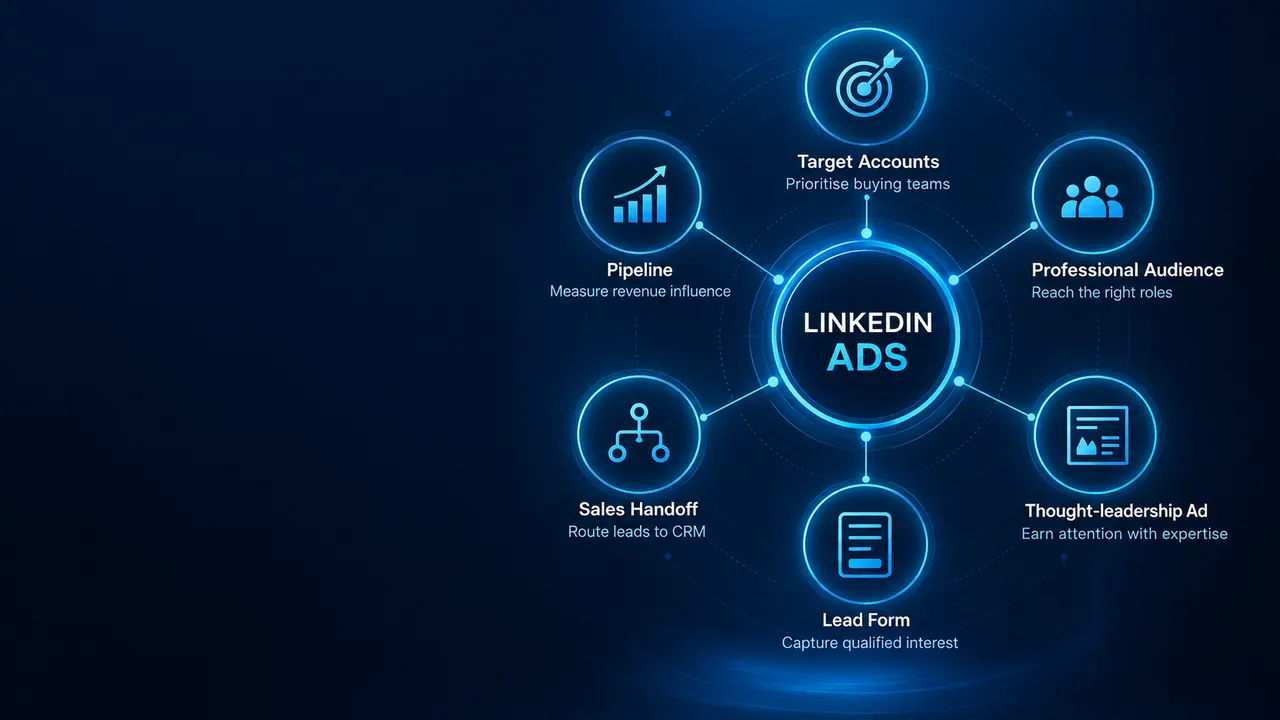
LinkedIn Ads

Expensive clicks.
Worth it, if the pipeline works.

LinkedIn costs several times what other platforms charge per click, and for complex B2B sales it is frequently still the cheapest route to a qualified opportunity. The difference lies entirely in whether you measure leads or revenue.

inDownload GuideJob title match94%Company size88%Seniority76%MQL COST−36%
ABM targeting
Pipeline attribution
B2B creative
CRM integration
01
Why LinkedIn budgets get cut

Judged on cost per lead, LinkedIn will always look expensive

LinkedIn clicks cost multiples of other platforms, so cost-per-lead comparisons make it look indefensible. But in complex B2B sales, a lead from LinkedIn that reaches the right title at the right company converts to pipeline at rates other channels rarely match. Businesses that measure to revenue keep investing; businesses that measure to lead volume cut it and wonder why pipeline dried up.

Cost per lead as the KPI

The wrong measure for a channel whose advantage is quality. It systematically undervalues precision targeting and defunds the channel producing your best opportunities.

Lead gen forms with no follow-through

In-platform forms convert well and produce leads nobody calls quickly enough. Speed to first contact matters more here than almost any campaign setting.

Targeting far too broad

Paying LinkedIn rates for undifferentiated reach wastes its only real advantage. If you are not filtering hard by title, function, seniority and account, use a cheaper platform.

Consumer creative in a professional feed

Urgency tactics and discount framing read badly to buyers evaluating a considered purchase. Credibility and specificity outperform persuasion here.

+143%
Target pipeline growth
−34%
Cost per opportunity
3.2×
SQL conversion vs other paid
8+
Years running B2B campaigns
02
What we actually do

Target precisely. Measure to revenue. Nurture patiently.

LinkedIn works when it is used for what only LinkedIn can do: reaching a defined set of job titles at a defined set of companies, repeatedly, over a buying cycle measured in months rather than days.

That means account-based targeting, creative built for considered purchases, and attribution that follows a lead through the CRM to closed revenue instead of stopping at the form submission.

  • Account-based targeting — matched account lists combined with title, function and seniority filters, so budget reaches the buying committee rather than the industry.
  • Full-funnel sequencing — thought leadership first, then case evidence, then demo — because complex purchases rarely convert on first exposure.
  • CRM-connected attribution — leads tracked through to opportunity and closed revenue, which is the only basis on which LinkedIn can be judged fairly.
  • B2B creative — specific, credible and evidence-led, written for buyers evaluating rather than impulse-buying.
  • Speed-to-lead process — form submissions routed into your CRM immediately, since response time drives conversion more than most campaign settings.
LinkedIn done badly
LinkedIn done properly
Judged on cost per lead
Judged on pipeline
Broad industry targeting
Named account lists
Demo request on first touch
Sequenced by stage
Leads sit in a spreadsheet
Routed to CRM instantly
Consumer-style urgency
Evidence and specificity
Attribution stops at form
Tracked to closed revenue

The honest test: if your average deal is small, your sales cycle is short, and your buyer is not identifiable by job title, LinkedIn is probably the wrong platform. We will tell you that before you spend, not after.

03
The Sachkhand blueprint

How we build a LinkedIn programme that produces pipeline

Six workstreams, attribution first — because without revenue tracking the channel gets cut before it has a chance to work.

01

Revenue attribution

CRM integration so leads are tracked to opportunity and closed revenue. Without it LinkedIn is judged on cost per lead and loses that comparison every time.

02

Account & persona definition

The named companies worth reaching and the titles inside them who influence the decision, built into matched audiences rather than broad filters.

03

Funnel sequencing

Awareness, consideration and conversion campaigns with distinct offers, so buyers are not asked for a demo before they know who you are.

04

B2B creative

Specific, evidence-led assets written for people evaluating a considered purchase, tested for credibility rather than click-through alone.

05

Lead routing & speed

Form submissions delivered into your CRM in real time with alerting, because response within minutes converts far better than response within days.

06

Budget efficiency

Bid strategy, audience overlap control and frequency management, since LinkedIn CPMs punish waste harder than any other platform.

04
What is changing through 2026

Four shifts in B2B advertising

Buying committees grew, cycles lengthened, and self-serve research now happens long before anyone contacts sales.

01

Buying committees keep growing

Complex purchases now involve multiple stakeholders across functions. Targeting a single decision-maker misses the people who can quietly block the deal.

02

Most research happens before contact

Buyers self-educate extensively before speaking to anyone. Advertising that only offers a demo misses the long period when the shortlist is actually formed.

03

Attribution is moving to pipeline

B2B teams increasingly judge channels on opportunities and revenue rather than MQLs, which finally values precision targeting correctly.

04

Video and document ads are outperforming

Formats that deliver substance in-feed — carousels, documents, short video — consistently outperform single-image ads pushing straight to a landing page.

05
Why Sachkhand

We will tell you if LinkedIn is the wrong channel

It is expensive and it is not right for every business. Knowing that before the budget is committed is worth more than a campaign that was never going to work.

Measured to revenue

CRM-connected attribution from click to closed deal, so LinkedIn is judged on what it produces rather than on what a click costs.

Account-based by default

Named account lists and buying-committee targeting, because paying LinkedIn CPMs for broad reach wastes the only advantage it has.

Speed-to-lead built in

Real-time CRM routing and alerting. Response time affects conversion more than most campaign optimisations ever will.

Creative for considered purchases

Evidence, specificity and credibility rather than urgency tactics that read badly to professional buyers evaluating options.

Honest channel assessment

If your deal size or sales cycle does not justify LinkedIn rates, we say so upfront rather than taking the budget and reporting activity.

Integrated with content and email

Advertising sequenced with content and nurture, because a single ad rarely closes a purchase that takes months to decide.

06
The Honest Comparison

Why Businesses Choose SDM for LinkedIn Ads

Same budget, very different outcomes. Point by point, here’s how a specialist partner compares to a typical agency or going it alone.

What actually matters With SDM Typical Agency In-House / DIY
Senior specialist on your accountAlwaysOften a juniorStretched thin
Custom strategy built for your goalsTailoredTemplatedGuesswork
Deep audit before any work beginsSurface-levelSkipped
White-hat, penalty-safe methodsGuaranteedVariesHigh risk
Plain-English reporting tied to revenueMonthlyJargon PDFsNone
Direct access to your specialistAccount-manager relayN/A
Measured to pipeline and revenueCost per leadForm fills
Named account targetingIndustry filtersBroad
Funnel sequenced by stageDemo-onlyDemo-only
Real-time CRM lead routingCSV exportManual
Told when it is the wrong channelRarelyn/a
Ongoing competitor gap analysisOne-offManual
Conversion-focused, not just trafficTraffic-firstUnclear
Premium tools included (Ahrefs, SEMrush)SometimesCostly extra
No long lock-in contractsFlexible6–12 mo lock-inN/A
Established agency, operating since 2017VariesLearning curve
Fast onboarding & early quick wins~2 weeksSlowTrial & error
Human, SEO-led content (no AI spam)Outsourced / AI spamTime-heavy
Focus on compounding, long-term ROICore promiseShort-term winsSlow & ad-hoc
Recovery from Google penaltiesSometimesVery hard

20 reasons growing brands make the switch. See the difference for yourself →

07
Measurement

Pipeline, not leads

Every number is tracked through your CRM to opportunity and revenue. Cost per lead is reported, but it never drives decisions.

Cost per opportunity

CRM-verified qualified opportunities, which is the only cost figure that reflects LinkedIn’s actual advantage.

Pipeline influenced

Value of opportunities where LinkedIn touched the buying committee, tracked across a full cycle.

Target account reach

Share of your named account list genuinely reached, and how many people per account — committee coverage, not impressions.

Lead-to-SQL rate

Compared against other paid channels, which is where LinkedIn typically justifies its higher click cost.

Speed to first contact

Time from form submission to sales response, one of the strongest predictors of conversion in B2B.

LinkedIn Ads performance
Pipeline attribution — rolling 90 days
LIVE
Pipeline
+143%
Cost/opp
−34%
SQL rate
3.2x
Acct reach
68%
Speed
<5 min
↑ 143% pipeline at 34% lower cost per opportunity
08
The engagement

Four stages, repeated every month

Attribution first, then targeting, then sequencing. Scale only what is proven to reach pipeline.

01

Attribution & fit

CRM integration built and the honest fit question answered: does your deal size and cycle justify LinkedIn rates? We answer before you commit budget.

→ Revenue visibility from day one
02

Accounts & personas

Named target accounts and buying-committee titles built into matched audiences, replacing broad industry and seniority filters.

→ Precision worth paying for
03

Sequence & route

Awareness, consideration and conversion campaigns with distinct offers, plus real-time lead routing into your CRM with alerting.

→ Full-funnel, fast follow-up
04

Optimise to pipeline

Audiences, creative and budget adjusted against cost per opportunity rather than cost per lead, with frequency managed to control CPM waste.

→ Revenue-led optimisation
09
Outcomes

The targets we set for LinkedIn engagements

Targets we plan against for SaaS, professional services and B2B manufacturing clients after two full sales cycles.

+143%
Qualified pipeline
CRM-attributed
−34%
Cost per opportunity
Not cost per lead
3.2×
Lead-to-SQL rate
Versus other paid channels
68%
Target account reach
Of named account list

Targets measured over two sales cycles rather than ninety days, because B2B purchases take months and shorter windows systematically understate the channel. Cost per lead usually rises during these engagements while cost per opportunity falls. These are planning targets rather than a record of past client averages; we agree a realistic range against your own baseline before an engagement starts.

10
Scenarios

LinkedIn Ads in action — three sectors

Different B2B models, the same principle: measure to revenue, target to the committee. The scenarios below are composites drawn from situations we encounter repeatedly — they illustrate method, not the account of any single named client.

B2B SaaS

About to cut the best-performing channel

Challenge

LinkedIn had the highest cost per lead of any channel and was scheduled for removal. Nobody had tracked those leads through to closed revenue.

What we did

Built CRM attribution first. LinkedIn leads converted to opportunity at several times the rate of other paid channels, so budget was increased and targeting narrowed to named accounts.

+167%
Pipeline
−38%
Cost per opp
Professional services

Asking for a demo far too early

Challenge

Every campaign pushed a consultation booking on first exposure to a buyer with a nine-month decision cycle. Conversion was negligible.

What we did

Sequenced the funnel: research content first, case evidence second, consultation third, with retargeting by engagement depth.

+118%
Qualified enquiries
−29%
Cost per enquiry
B2B manufacturing

Reaching one person on a six-person committee

Challenge

Targeting focused solely on procurement, while engineering and operations influenced the decision and had never heard of the company.

What we did

Expanded to full buying-committee targeting within the same named accounts, with role-specific creative for each function.

+94%
Opportunities
68%
Committee reach
11
Questions

The questions we get asked most

Honest answers on cost, fit and how LinkedIn should be judged.

Why is LinkedIn so much more expensive than other platforms?+

Because you are paying for professional targeting data no other platform has — job title, company, seniority, function. Whether that premium is worth paying depends entirely on your deal value. For a high-value B2B sale it usually is. For a low-value transactional product it usually is not, and we will say so.

Is LinkedIn right for our business?+

It works when your buyer is identifiable by job title and company, your deal value supports a higher acquisition cost, and your sales cycle involves multiple stakeholders. If your average deal is small or your buyer is not defined by their professional role, another channel will serve you better and we will recommend it.

Should we use LinkedIn lead gen forms or send to a landing page?+

Forms convert at higher rates because they pre-fill from the profile, but the leads are less qualified since friction is lower. We usually run both, measure through to opportunity rather than lead volume, and let the pipeline data decide. Whichever you choose, real-time CRM routing matters more than the format.

What budget do we need?+

Enough to reach your target accounts repeatedly across a buying cycle. Spreading a small budget across a large audience produces reach too thin to influence anyone. If budget is limited we narrow the account list rather than accept shallow coverage of a broad one.

How long before we see pipeline?+

Leads appear within weeks; opportunities follow the length of your sales cycle. For a six-month cycle, judging LinkedIn at ninety days measures almost nothing useful. We set reporting windows to your actual cycle and report leading indicators in the meantime.

Can you target specific companies?+

Yes, through matched account lists uploaded from your CRM or built to your ideal-customer profile, combined with title and function filters so you reach the whole buying committee within those accounts rather than a single contact.

Our cost per lead went up after you took over. Is that bad?+

Usually it is the intended outcome. Narrowing targeting to the right accounts and titles raises cost per lead and lowers cost per opportunity, because you stop paying for responses that were never going to buy. We flag this at the start so the metric moving in the wrong direction is not mistaken for a problem.

Next step

Ready to judge LinkedIn on pipeline instead of leads?

We will review your targeting, funnel structure and attribution setup — and tell you honestly whether LinkedIn is the right channel for your deal size and sales cycle.

Free LinkedIn Ads audit
Channel fit assessment
Pipeline attribution review
Account targeting plan
QUALIFIED PIPELINE+143%
Chat With Us
🚀 Book Free Audit & consultation!
45 min · Free audit + strategy + consultation · No obligation