
High-value automation
Cart recovery, back-in-stock, appointment reminders and delivery updates — the moments where immediacy genuinely matters.
- Welcome offer
- Abandoned cart
- Back in stock
- Appointment reminder
- Delivery update
- Win-back
Our SMS marketing services run text message marketing that customers actually want — opt-in flows, conversational SMS, abandoned-cart and appointment reminders, plus RCS marketing for richer messages. As an SMS marketing agency, we measure revenue per message.
Get a free audit →SMS marketing done properly is a restraint exercise. The technical setup is straightforward; the discipline is deciding what genuinely deserves an interruption.
We build the consent infrastructure that keeps you compliant, the segmentation that makes each send relevant, and the automation that handles the moments where SMS genuinely outperforms every other channel — cart recovery, delivery updates, appointment reminders and time-boxed offers.
The scarcity principle: SMS permission is finite and non-renewable. Every send spends a little of it. Programmes that send less, better, keep producing for years; programmes that maximise volume burn the list inside two quarters.
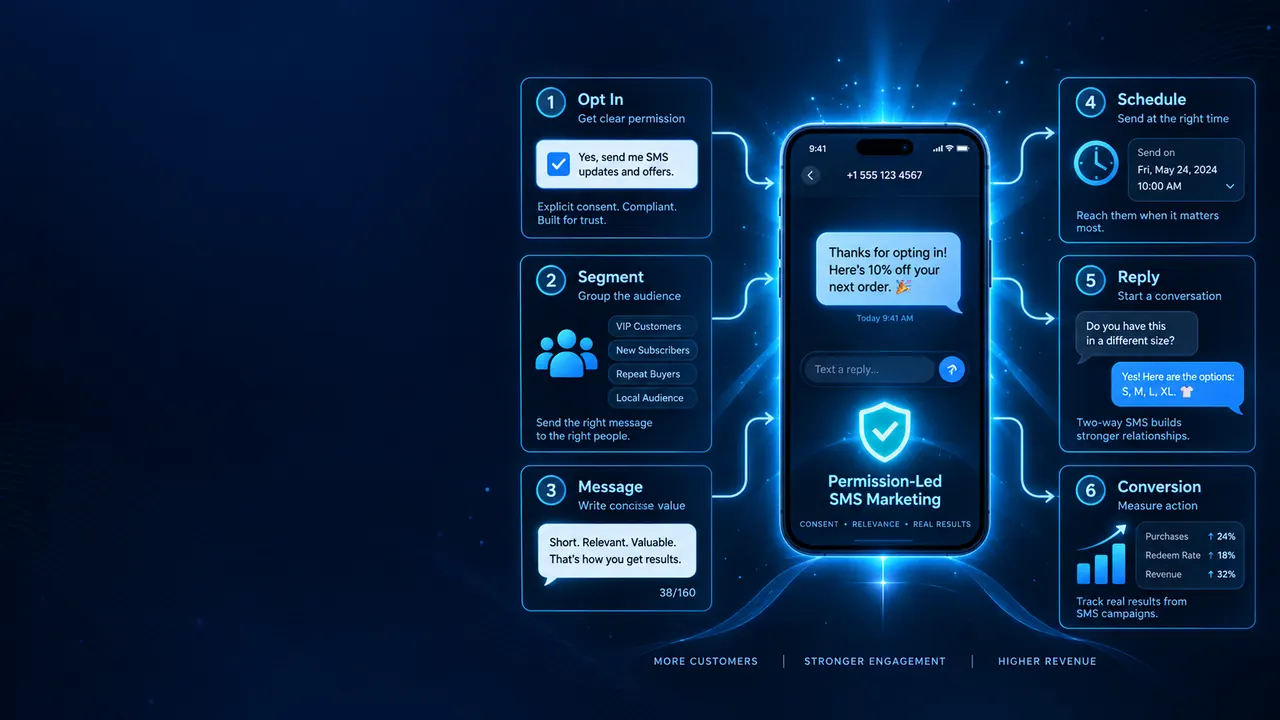
Every engagement covers all five. Automated, behaviour-triggered messages sit at the centre — the rest keep your list compliant, relevant and profitable.
Cart recovery, back-in-stock, appointment reminders and delivery updates — the moments where immediacy genuinely matters.

Explicit, unbundled SMS opt-in with records kept, plus clear opt-out handling on every send.

Sends targeted by purchase history, engagement and lifecycle stage rather than blasted to the full list.

Caps and quiet hours enforced at platform level so no customer receives more than the programme intends.

Unique tracked links per campaign so SMS revenue is provable rather than absorbed into direct traffic.
Six workstreams, compliance first — because a consent problem discovered later invalidates the whole list.
How permission was collected, whether records exist, and whether it meets the standard in each market you send to. This comes first because everything downstream depends on the list being lawful.
Lists split by lifecycle stage, purchase behaviour and engagement so a send is relevant to the person receiving it rather than to the average of your database.
Cart recovery, back-in-stock alerts, appointment reminders and delivery updates — triggered by behaviour, and the messages customers actively want.
Send caps, quiet hours and cross-channel coordination so SMS and email are not both firing at the same person on the same day.
160 characters, one clear action, no ambiguity about who is messaging. Long, chatty SMS gets opted out of.
Revenue per send, opt-out rate per campaign, and list health trended monthly so decline is visible before the list is damaged.
ⓘ Consent is audited before a single message is sent — each phase starts only when the one before it is healthy.
We audit consent before sending anything. A list collected improperly is a liability rather than an asset, and no amount of revenue justifies that exposure.
Set at platform level, not left to whoever schedules the campaign. Opt-out rate is a KPI we manage down rather than accept.
The highest-returning SMS is triggered by behaviour the customer just took. Broadcast is the fallback, not the strategy.
Unique tracked links per campaign so SMS revenue is attributable. Programmes without attribution get cut in the first budget review.
SMS and email planned together so a customer is not receiving both on the same day about the same thing.
We track opt-out rate weekly. A shrinking, engaged list outperforms a large, resentful one every time.
Same budget, very different outcomes. Point by point, here’s how a specialist partner compares to a typical agency or doing it in-house.
| What actually matters | RecommendedSachkhandSMS specialists | Typical agencyGeneralist team | In-house / DIYStretched team |
|---|---|---|---|
| Senior SMS specialist on your account | Always | Often a junior | Stretched thin |
| Consent audited before any send | ✓ | Rarely | Unknown |
| TCPA, GDPR & PECR compliance | Built in | Varies | Risky |
| Frequency caps enforced | ✓ | Blast when needed | None |
| Behaviour-triggered automation | ✓ | Broadcasts only | Ad-hoc |
| Segmented by behaviour & value | ✓ | Whole list | Whole list |
| Copy written for 160 characters | ✓ | Email copy shortened | Guesswork |
| Revenue attributed per send | Monthly | Clicks only | Sends |
| Opt-out rate tracked per campaign | ✓ | Rarely | Never |
| Coordinated with your email calendar | ✓ | Separate teams | Clashing sends |
| Works in your existing platform | Klaviyo, Attentive & more | Pushes a migration | N/A |
| No long lock-in contracts | Monthly | 6–12 mo lock-in | N/A |
| Get a free SMS audit → |
12 reasons growing brands move their SMS to a specialist. See the difference for yourself →
A campaign that makes money and costs you 4% of the list is not a success. We report both together.
Attributed revenue divided by messages delivered, net of send cost — the true return on each interruption.
Tracked per send so the messages that damage the list are identified and not repeated.
How much revenue comes from behaviour-triggered messages versus scheduled broadcasts.
What happens after the tap, since SMS click rates flatter programmes that convert poorly.
Opt-ins minus opt-outs, so growth is not overstated by counting only new subscribers.
Compliance, then automation, then volume — in that order, always.
How permission was captured, whether records exist and whether it meets the standard in each market. Any list segment that fails is suppressed before we send.
Compliant, defensible listCart recovery, back-in-stock, reminders and delivery updates — the triggered messages customers want, which produce most of the revenue.
Always-on SMS revenueCaps, quiet hours and coordination with the email calendar so no customer is over-messaged across channels.
Opt-out rate under controlCopy, timing and offer testing with attribution per campaign, reported alongside opt-out rate so revenue is never celebrated in isolation.
Provable, sustainable growthDirect answers on compliance, frequency and what SMS should actually be used for.
Further reading
Go deeper on the methods behind this service, with guides written by the specialists who run them, plain-English definitions and the services that usually work alongside it.
 Digital Marketing
Email marketing in 2026: sender authentication, Gmail and Yahoo rules, list health, automation flows, segmentation and measuring revenue, not opens.
Read the guide Performance Marketing
A digital marketing ROI framework for 2026: server-side tracking, MER, incrementality testing, marketing mix modelling, LTV:CAC and payback period.
Read the guide Digital Marketing
How to write content that converts: copywriting formulas, benefit-led messaging, specificity, social proof, microcopy and calls to action that work.
Read the guide


