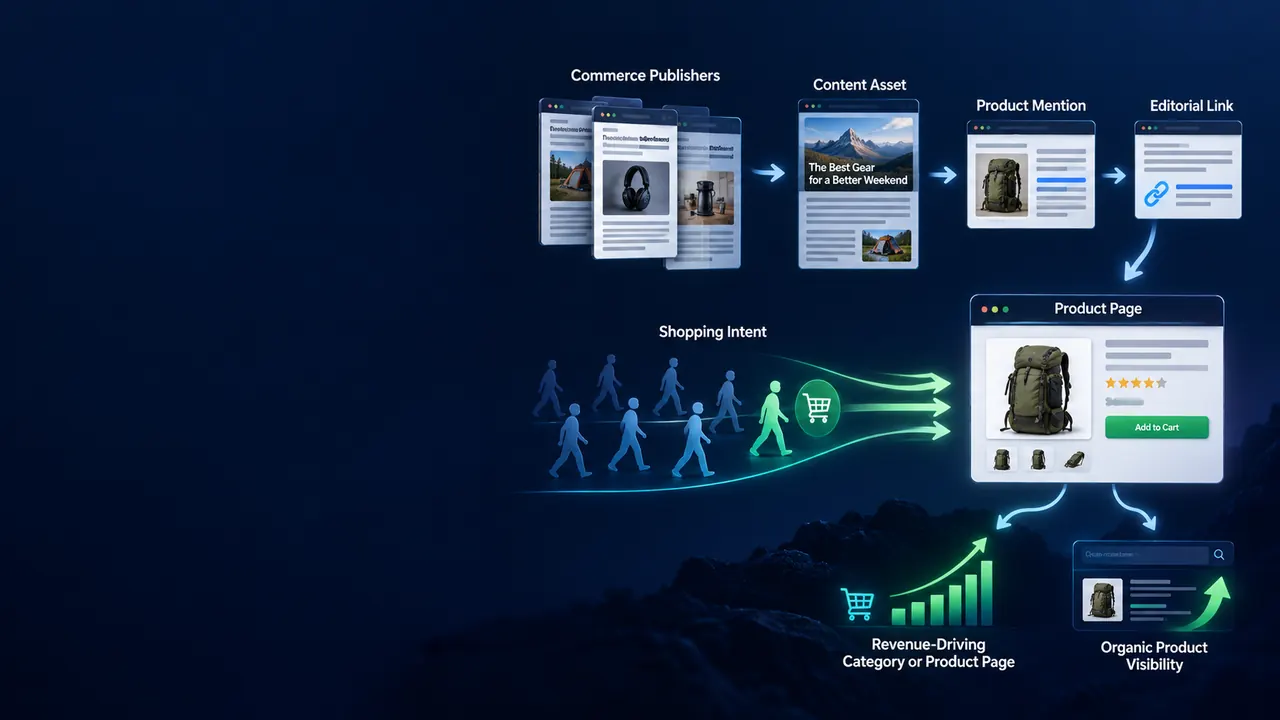
Ecommerce Link Building Services at a glance
Our ecommerce link building services earn ecommerce backlinks that point at the category and product pages carrying revenue. Whether you need backlinks for an online store on WooCommerce or Shopify backlinks, we plan the destination first, then acquire the link.
Get a free audit →- Category page links
- Product roundups
- Shopify backlinks
- Digital PR for retail
- Redirect & link equity audit
- Revenue-led reporting
The links land on the homepage. The money is on the category page.
Almost every ecommerce link building programme accumulates authority on the homepage and a handful of blog posts, because those are the easiest things to earn links to. Meanwhile the category pages that capture buyers comparing options — the highest-value commercial real estate a store owns — sit with almost no external authority and cannot outrank marketplaces.
- Homepage-only links
Everything points at the homepage
Homepage authority helps the whole site a little. Category authority helps the page that converts, a lot. The distribution is almost always wrong.
- Marketplace-owned SERPs
Marketplaces occupy the results
Amazon, Bol, Trendyol, Takealot and their equivalents hold the top of most product SERPs with authority no store will match. Competing head-on is the wrong plan.
- Product page churn
Product pages churn
Links earned to products that go out of stock or get discontinued lose their value. Category-level routing survives catalogue change; product-level routing frequently does not.
- Affiliate links as SEO
Affiliate links treated as SEO
Affiliate and referral links should carry rel="sponsored" and do not pass ranking value. Programmes counting them as SEO wins are reporting numbers that do nothing.
Route first, acquire second.
We start by mapping which pages actually produce revenue and which of those have no external authority. That gap is the brief. Acquisition follows the routing plan rather than the other way round.
Then we build reasons to link that suit retail specifically — buying guides worth citing, price and trend data, seasonal research, and product coverage that gives a publication something its readers want rather than a press release.
- Links to homepage and blogLinks to revenue categories
- Acquire, then hopeRoute, then acquire
- Affiliate links countedSponsored links separated
- Ignores catalogue churnRedirect discipline built in
- Competes with marketplacesTargets where they are thin
- Same plan year-roundSeasonal windows planned
List your top ten categories by revenue, then check referring domains for each. If the homepage has hundreds and your best category has three, you have found the problem — and it is not a shortage of links.
- Revenue-weighted page mapping
- Which categories drive margin, which have authority, and where the gap between the two is largest. That gap is the target list.
- Category-level linkable assets
- Buying guides, comparison resources and sizing or specification tools that sit on or beside the category page and give people a reason to cite it.
- Retail digital PR
- Price analysis, trend data and seasonal research — the categories of story retail journalists actually run, timed to their planning calendar.
- Product coverage, correctly attributed
- Gifted and paid placements marked sponsored. Editorial round-ups and reviews earned properly are where the followed links come from.
- Catalogue-change protection
- Routing that survives products going out of stock, with redirect discipline so authority earned is not thrown away at the next range change.
How the programme is built
Six stages, starting with where authority needs to land.
Revenue mapping
Categories ranked by margin contribution, cross-referenced against current referring domains. The gap defines the whole programme.
What’s included
- Pages and products that drive revenue
- Link targets ranked by commercial value
- Revenue from organic search tracked
You receive: A revenue-weighted link plan
Competitive gap analysis
Where retailers outranking you earn links, and which of those sources are reachable. Marketplace positions are excluded as unwinnable.
What’s included
- Competitor backlink profiles compared with yours
- Link sources you can realistically win
- Content types attracting links in your niche
You receive: A link gap report
Asset creation
Buying guides, comparison tools and specification resources built to sit with the category rather than on a disconnected blog.
What’s included
- Linkable assets such as guides, tools and data studies
- Built to earn backlinks to category pages
- Promotion plan agreed before production
You receive: A published linkable asset with an outreach list
Retail PR & outreach
Price analysis, trend data and seasonal research pitched to retail desks on their planning calendar, not ours.
What’s included
- Product-led stories for retail press
- Gift guides and product roundups
- Links pointed to category pages
You receive: Retail PR coverage with backlinks
Attribution hygiene
Affiliate and gifted placements marked sponsored, kept separate from editorial links in every report.
What’s included
- Tracking of which links move rankings and revenue
- Analytics and UTM set-up for referral traffic
- Vanity metrics removed from link reporting
You receive: A link attribution dashboard
Catalogue protection
Redirect rules so authority survives products being discontinued and categories being restructured.
What’s included
- Redirect rules for discontinued products
- Backlinks preserved when products go out of stock
- Canonical handling for product variants
You receive: A product lifecycle SEO policy
Get a free audit →We plan the destination before the acquisition
Most programmes earn links and then wonder why revenue did not move. The routing is the part that decides it.
Revenue-weighted targeting
Links are aimed at the categories that carry margin, not at whatever was easiest to earn a link to.
Marketplace-aware planning
We identify where Amazon and its regional equivalents are genuinely beatable and concentrate there instead of burning budget on terms they own.
Affiliate links reported separately
Sponsored placements are marked and counted apart from editorial links. Mixing them produces a report that overstates what was achieved.
Built for catalogue churn
Redirect discipline so a discontinued product does not silently discard the authority it earned.
Assets that sit with the category
Buying guides placed and linked so they support the commercial page rather than living on an isolated blog.
Seasonal calendar respected
Retail stories pitched when desks are planning them, which is months earlier than most brands assume.
Why Businesses Choose SDM for Ecommerce Link Building
Same budget, very different outcomes. Point by point, here’s how a specialist partner compares to a typical agency or going it alone.
| What actually matters | With SDM | Typical Agency | In-House / DIY |
|---|---|---|---|
| Senior specialist on your account | Always | Often a junior | Stretched thin |
| Custom strategy built for your goals | Tailored | Templated | Guesswork |
| Deep audit before any work begins | ✓ | Surface-level | Skipped |
| White-hat, penalty-safe methods | Guaranteed | Varies | High risk |
| Plain-English reporting tied to revenue | Monthly | Jargon PDFs | None |
| Direct access to your specialist | ✓ | Account-manager relay | N/A |
| Links routed to revenue categories | ✓ | Homepage | Random |
| Marketplace positions assessed honestly | ✓ | Ignored | No |
| Affiliate links reported separately | ✓ | Counted as SEO | n/a |
| Redirect discipline on catalogue change | ✓ | Rarely | No |
| Seasonal pitching calendar | ✓ | Too late | n/a |
| Ongoing competitor gap analysis | ✓ | One-off | Manual |
| Conversion-focused, not just traffic | ✓ | Traffic-first | Unclear |
| Premium tools included (Ahrefs, SEMrush) | ✓ | Sometimes | Costly extra |
| No long lock-in contracts | Flexible | 6–12 mo lock-in | N/A |
| Established agency, operating since 2017 | ✓ | Varies | Learning curve |
| Fast onboarding & early quick wins | ~2 weeks | Slow | Trial & error |
| Human, SEO-led content (no AI spam) | ✓ | Outsourced / AI spam | Time-heavy |
| Focus on compounding, long-term ROI | Core promise | Short-term wins | Slow & ad-hoc |
| Recovery from Google penalties | ✓ | Sometimes | Very hard |
20 reasons growing brands make the switch. See the difference for yourself →
Category authority and category revenue
Both, side by side. Authority that does not move revenue means the routing was wrong.
Referring domains per category
Distribution across revenue-weighted categories rather than a site-wide total that hides the imbalance.
Organic revenue by category
Attributed in your own analytics and compared with the referring-domain gain for the same category.
Money page link share
The proportion of new links reaching commercial pages rather than the homepage or blog.
Editorial vs sponsored split
Followed editorial links separated from correctly attributed affiliate and gifted placements.
Non-branded category visibility
Whether you are winning comparison and buying-guidance queries where marketplaces are weakest.

Our Ecommerce Link Building process: four stages, run monthly
Routing is set once and revisited quarterly; acquisition runs continuously against it.
Map the gap
Revenue by category against referring domains by category. The largest gaps become the target list.
DeliverableA routing planBuild the reason
Buying guides, comparison resources and retail data that give people something to cite.
DeliverableAssets worth linking toEarn and route
Outreach and retail PR, with every placement aimed at the category it should support.
DeliverableAuthority where it paysProtect and review
Redirects maintained through catalogue change, routing revisited as the revenue mix shifts.
DeliverableNothing thrown away
Proven results from real SEO clients
Published case studies from our clients — each with the starting point, the dates, the source and what the numbers don’t prove.
A home services franchise group — 34.1K ranking keywords and 1.8K AI mentions.
Read the case study →B2B SaaS SEO77.9K Google clicks in three months — organic is the top channel.
Read the case study →Home services SEOTop 3 for “emergency plumber”, cited on 218 pages in AI answers.
Read the case study →Ecommerce Link Building FAQs: the questions we get asked most
On routing, marketplaces and what actually moves store revenue.
Further reading
Guides, terms and related services
Go deeper on the methods behind this service, with guides written by the specialists who run them, plain-English definitions and the services that usually work alongside it.
 SEO
SEOEcommerce SEO: The Complete 2026 Playbook
The complete ecommerce SEO playbook for 2026: keyword research, category and product pages, faceted navigation, product schema, speed and measuring revenue.
Read the guide SEO
SEOThe Complete Guide to SEO in 2026
The complete guide to SEO in 2026: how Google ranks pages, technical SEO, content, links, local and AI search, a 6-month roadmap and how to measure ROI.
Read the guide Content Marketing
Content Clusters & Topical Authority: 2026 Guide
How to build content clusters and topical authority in 2026: pillar pages, cluster research, internal linking, content briefs, updates and measuring results.
Read the guide