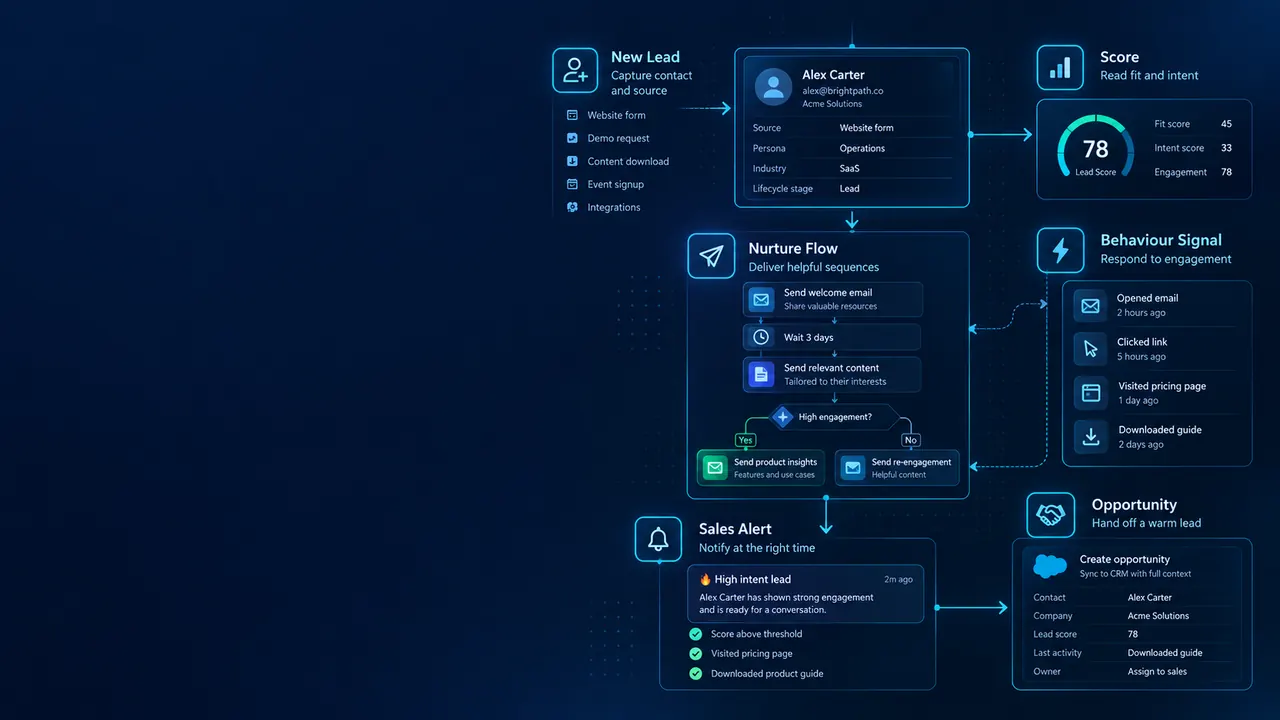
Lead Nurturing & Marketing Automation Services at a glance
Our marketing automation services and lead nurturing services turn leads that are not ready yet into sales conversations. Lead nurturing sequences, scoring and CRM workflows on HubSpot, Klaviyo and ActiveCampaign — marketing automation measured on conversion to opportunity.
Get a free audit →- Lead scoring
- Nurture sequences
- CRM workflows
- HubSpot & ActiveCampaign
- Sales hand-off
- Pipeline reporting
“Not interested” usually means “not now”
A lead that says no in March may buy in November. Sales chases twice, marks it dead and moves on, and the record sits in the CRM until a competitor picks the customer up eight months later. The single largest source of wasted marketing spend in most businesses is not bad leads — it is good leads contacted at the wrong moment and never contacted again.
Leads marked dead too early
Two attempts and a closure is standard practice and it discards most of the value. Timing, not interest, is usually what failed.
Newsletter treated as nurture
A monthly round-up sent to everyone is not nurturing. It ignores where each person is in their decision and what they were actually looking at.
Automation that only sends email
Real automation routes, scores, notifies and updates records. Tools bought for nurturing are usually used as a mailing list.
No lifecycle definition
Without agreed stages, nobody can say whether a contact is progressing or stuck — so nothing gets triggered at the right moment.
Sequences that respond to behaviour, not to a calendar.
We map the lifecycle first — the stages a buyer genuinely moves through in your business, and what a person does that signals movement between them. Content and timing are then built against those signals rather than against a fixed drip schedule.
The automation carries it: scoring updates, alerts to sales when a dormant lead re-engages, re-entry rules so nobody gets stuck in a loop, and clean two-way sync so the CRM and the marketing platform agree.
- Monthly newsletter to all
- Fixed drip schedule
- Score only increases
- Dead leads deleted
- One-way sync
- Email only
- Sequences by lifecycle stage
- Triggered by behaviour
- Score decays with inactivity
- Dormant leads re-engaged
- Two-way CRM integration
- Email, SMS and sales alerts
the leads already in your CRM marked closed-lost. They know who you are, they had a real need once, and almost nobody has contacted them since. Re-engagement routinely outperforms new acquisition on cost per opportunity.
- Lifecycle mapping
- The stages that exist in your business, with entry and exit criteria written down so progression is measurable.
- Behaviour-triggered sequences
- Sent because someone did something, not because a week passed. Pricing page visits and repeat sessions are the signals worth acting on.
- Lead scoring that decays
- Scores that fall with inactivity, so a hot score from March does not send sales after someone who has gone quiet.
- Re-engagement of dormant records
- Systematic reactivation of the leads already sitting in the CRM — almost always the cheapest pipeline available.
- Two-way CRM sync
- So sales sees marketing activity, marketing sees deal outcomes, and neither is working from a stale record.
How a nurture system is put together
Six components. Most businesses already own the tooling and use a fraction of it.
Lifecycle definition
The stages a buyer actually moves through here, with written entry and exit criteria agreed with sales.
Data & sync audit
What is in the CRM, how clean it is, and whether the marketing platform and CRM currently agree with each other.
Scoring model
Fit and behaviour weighted separately, with decay, and a threshold agreed for when sales should be alerted.


Sequence build
Behaviour-triggered journeys per stage, with content that answers what someone at that point actually needs.
Dormant reactivation
A campaign against the existing closed-lost and cold records, usually the fastest return in the whole programme.
Sales alerting
Real-time notification when a dormant contact re-engages, so the follow-up happens while the intent is live.


We start with the leads you already have
Before spending on acquisition, we look at what is sitting unworked in the CRM. It is usually a lot.
Dormant records first
Reactivating existing contacts is almost always cheaper per opportunity than new acquisition, and it is the first thing we test.
Scores that decay
Without decay, a contact who was interested in March still looks hot in November. Sales stops trusting the score, and rightly.
Deliverability protected
Authentication, list hygiene and suppression handled properly, because a nurture programme that lands in spam is worse than none.
Automation beyond email
Routing, scoring, alerting and record updates — the parts most businesses paid for and never switched on.
Consent checked before sending
Particularly on reactivation, where old records frequently have no defensible lawful basis. We check before, not after.
Stages agreed with sales
If sales did not agree the lifecycle definition, the alerts will be ignored within a fortnight.
Why Businesses Choose SDM for Marketing Automation
Same budget, very different outcomes. Point by point, here’s how a specialist partner compares to a typical agency or going it alone.
| What actually matters | With SDM | Typical Agency | In-House / DIY |
|---|---|---|---|
| Senior specialist on your account | Always | Often a junior | Stretched thin |
| Custom strategy built for your goals | Tailored | Templated | Guesswork |
| Funnel & CRM audit before any spend | ✓ | Surface-level | Skipped |
| Consented, GDPR-compliant data only | Always | Varies | Risky |
| Plain-English reporting tied to revenue | Monthly | Jargon PDFs | None |
| Direct access to your specialist | ✓ | Account-manager relay | N/A |
| Lifecycle stages agreed with sales | ✓ | Assumed | None |
| Behaviour-triggered, not scheduled | ✓ | Fixed drip | Newsletter |
| Lead score decays with inactivity | ✓ | Only increases | No scoring |
| Dormant records reactivated | ✓ | Deleted | Ignored |
| Consent verified before send | ✓ | Assumed | Risky |
| Ongoing competitor offer analysis | ✓ | One-off | Manual |
| Conversion paths fixed before buying traffic | ✓ | Traffic-first | Rarely |
| CRM, tracking & call analytics included | ✓ | Extra cost | Patchy |
| No long lock-in contracts | Flexible | 6–12 mo lock-in | N/A |
| Established agency, operating since 2017 | ✓ | Varies | Learning curve |
| Fast onboarding & early quick wins | ~2 weeks | Slow | Trial & error |
| Human-written offers & nurture copy | ✓ | Templated | Time-poor |
| Optimised to closed revenue, not volume | ✓ | Lead count | Unclear |
| Speed-to-lead process built in | ✓ | Rarely | Slow |
20 reasons growing brands make the switch. See the difference for yourself →
Movement between stages, and revenue from the dormant
A nurture programme is working when contacts progress, not when emails send.
Stage progression rate
The share of contacts moving forward a lifecycle stage each month. The core measure of whether nurturing works.
Revenue from reactivation
Pipeline generated from records that were already closed-lost or cold, tracked separately from new acquisition.
MQL to SQL conversion
Whether scoring is sending sales the right people at the right moment.
Deliverability health
Authentication status, complaint rate and inbox placement — the foundation everything else sits on.
Speed to follow-up
How quickly sales acts on a re-engagement alert. Intent decays fast once someone comes back.

Our Marketing Automation process: four stages, quick early return
The reactivation campaign usually pays for the build.
Map & audit
Lifecycle stages agreed with sales, CRM data and sync quality assessed, consent position checked.
A defensible starting pointReactivate
Campaign against dormant and closed-lost records — the fastest return available and a live test of the messaging.
Pipeline from existing dataBuild sequences
Behaviour-triggered journeys per stage with scoring, decay and sales alerting wired in.
Contacts progressingTune
Reviewed monthly on stage progression and deliverability, with sequences adjusted rather than left running.
Compounding pipeline
Marketing Automation FAQs: the questions we get asked most
On sequences, scoring, deliverability and reactivating old data.
Further reading
Guides, terms and related services
Go deeper on the methods behind this service, with guides written by the specialists who run them, plain-English definitions and the services that usually work alongside it.
 Digital Marketing
Email Marketing in 2026: Deliverability & ROI
Email marketing in 2026: sender authentication, Gmail and Yahoo rules, list health, automation flows, segmentation and measuring revenue, not opens.
Read the guide Performance Marketing
The Omnichannel ROI Framework: Stop Burning Ad Spend
A digital marketing ROI framework for 2026: server-side tracking, MER, incrementality testing, marketing mix modelling, LTV:CAC and payback period.
Read the guide Digital Marketing
Content That Converts: Copywriting That Sells
How to write content that converts: copywriting formulas, benefit-led messaging, specificity, social proof, microcopy and calls to action that work.
Read the guide