B2B lead nurturing keeps leads engaged with useful, relevant content until they are ready to talk to sales. Lead scoring decides when that is, by giving points for fit (job title, company size, industry) and behaviour (pricing page visits, demo requests, email clicks). Together they let marketing pass sales only the leads worth calling — with a clear MQL to SQL handoff, agreed definitions and fast follow-up.
On this page
- What is lead nurturing?
- A lead nurturing email sequence
- Lead nurturing best practices
- Lead scoring: how to score leads
- MQL to SQL: the sales handoff
- CRM automation and platforms
- Lead nurturing metrics
- Lead nurturing by business type
- A simple lead scoring template
- Lead lifecycle stages and pipeline velocity
- Frequently asked questions
Most B2B leads convert long before they are ready to buy. Without nurturing, they go cold; without scoring, sales wastes time calling people who only downloaded a checklist. This guide covers both. It is part of our B2B lead generation guide.
What is lead nurturing?
Lead nurturing is a planned series of touchpoints — email, retargeting, content, LinkedIn and sales outreach — that helps a prospect move from interest to readiness. A lead nurturing strategy maps content to the questions buyers have at each stage.
A lead nurturing email sequence
| Timing | Content | |
|---|---|---|
| 1 | Immediately | Deliver what they asked for; one related resource |
| 2 | Day 3–4 | The core problem and a common mistake |
| 3 | Day 7–10 | A case study from a similar company |
| 4 | Day 14 | How to evaluate solutions (and where you fit) |
| 5 | Day 21 | A low-friction next step: assessment, demo or call |
This lead nurturing email sequence — a classic drip campaign — works best when branched by role or interest. A B2B email nurture for a finance director should talk ROI; for an IT lead, integration and security.
Lead nurturing best practices
- Send from a person, not “noreply”.
- Teach first; sell in the minority of emails.
- Combine email with LinkedIn and retargeting for multichannel nurture.
- Exit people from the nurture campaign as soon as they talk to sales.
- Refresh content quarterly.
Lead nurturing examples that work: a benchmark report followed by a short video walkthrough; a webinar recording followed by a tailored case study; a pricing-page visit followed by a short note from a named consultant.
Lead scoring: how to score leads
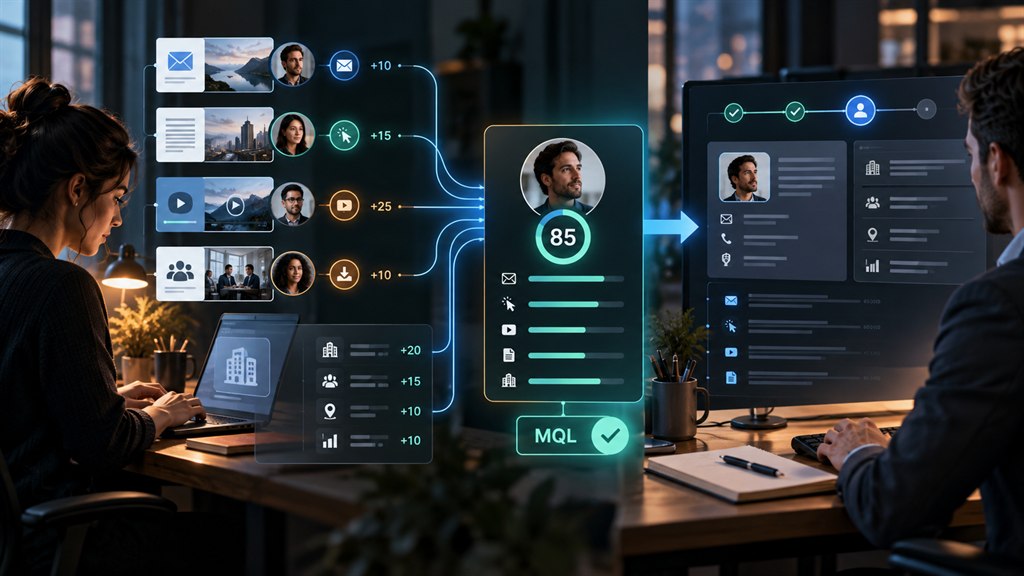
A lead scoring model combines two types of points:
| Type | Examples | Points (example) |
|---|---|---|
| Demographic scoring (fit) | Target job title, company size, industry, region | +5 to +20 |
| Behavioral scoring (intent) | Pricing page visit, demo request, webinar attendance, email clicks | +5 to +40 |
| Negative scoring | Student or competitor email, careers page visits, unsubscribes | −10 to −50 |
Set a threshold that defines an MQL, then review scores against closed deals every quarter. Fit and intent scoring is the foundation of B2B lead scoring. Predictive lead scoring uses machine learning on your CRM history and works once you have enough closed deals to learn from. That is how to score leads in practice.
MQL to SQL: the sales handoff
- Agree definitions and a service level agreement sales marketing (SLA) — for example, sales contacts every MQL within one working day.
- Use lead routing to assign leads to the right rep by region, segment or account.
- Prioritise speed to lead: the sooner a hand-raiser hears back, the more likely a conversation.
- Sales qualifies using a framework such as BANT (budget, authority, need, timing) or MEDDIC for complex deals.
- Feed outcomes back to marketing so scoring improves.
Clear lead handoff rules are the core of sales and marketing alignment.
We build sequences, scoring and handoff in your CRM.
CRM automation and platforms
CRM automation runs nurture sequences, updates scores and routes leads. Common choices: HubSpot lead scoring and workflows, Salesforce lead scoring with Account Engagement, or another marketing automation platform such as ActiveCampaign or Zoho. Choose the one your sales team will actually use.
Lead nurturing metrics
- MQL-to-SQL and SQL-to-opportunity conversion rates.
- Sales cycle length for nurtured vs non-nurtured leads.
- Lead velocity rate — month-on-month growth in qualified leads.
- Pipeline and revenue influenced by nurture.
Track these lead nurturing metrics rather than open rates. If you would rather hand it over, lead nurturing services from a marketing automation agency can build and run it — see our lead nurturing & automation service.
Lead nurturing by business type
- Lead nurturing for SaaS: product education, onboarding-style emails for trials, use-case stories and in-app prompts.
- Lead nurturing for B2B services: case studies, expert insights, invitations to events and personal follow-ups.
- Account based nurturing: coordinated content for several contacts at one target company, plus retargeting for lead nurturing on LinkedIn and display.
Strong lead nurturing content answers the next question the buyer will have. Nurture emails examples: “3 mistakes we see in [process]”, “How [similar company] cut [cost]”, “What to ask any [category] vendor”.
A simple lead scoring template
A starting lead scoring template with common lead scoring criteria:
- Target job title: +15; target company size: +10; target industry: +10.
- Demo or pricing request: +40; pricing page visit: +15; webinar attendance: +10; email click: +3.
- Competitor or student email: −50; no activity for 60 days: −10.
These lead scoring examples should be adjusted against your own closed deals. Build in lead decay — scores fall when activity stops — and a process for recycled leads that sales returns to nurture.
Lead lifecycle stages and pipeline velocity
Define lead lifecycle stages in your CRM — subscriber, lead, MQL, SQL, opportunity, customer — so reporting is consistent. Pipeline velocity (opportunities × win rate × deal size ÷ sales cycle length) shows whether nurturing is speeding revenue up. Sales teams then run their own sales sequences for SQLs, separate from marketing nurture.
Lead nurturing and scoring: frequently asked questions
What is B2B lead nurturing?
A planned series of useful touchpoints, usually led by email, that keeps leads engaged until they are ready to talk to sales.
What is lead scoring?
A points system that ranks leads by how well they fit your ideal customer and how strongly they show buying intent, used to decide when to pass them to sales.
How many emails should a nurture sequence have?
Commonly five to eight over several weeks, branched by role or interest, with people removed as soon as they engage with sales.
What is the difference between BANT and MEDDIC?
BANT checks budget, authority, need and timing; MEDDIC is a more detailed framework for complex deals covering metrics, economic buyer, decision criteria, decision process, pain and champion.
What is speed to lead?
How quickly a new lead is contacted after they raise their hand. Faster follow-up generally leads to more conversations.
When should I use predictive lead scoring?
Once you have enough historical closed-won and closed-lost deals in your CRM for the model to learn from; until then, a simple rules-based model works well.
What is lead decay?
Reducing a lead’s score when they stop engaging, so old activity does not keep them marked as sales-ready.
What are recycled leads?
Leads sales has contacted but who are not ready yet, returned to marketing nurture until they show new buying signals.
What is pipeline velocity?
A measure of how quickly pipeline turns into revenue: number of opportunities times win rate times average deal size, divided by sales cycle length.