Digital marketing is the promotion of a business, product or service through digital channels — search engines, websites, social media, email, online ads and mobile apps. Unlike traditional marketing, almost everything in digital marketing can be targeted, measured and improved. The core channels are SEO, paid search (PPC), social media marketing, content marketing and email, and the best results come from a clear strategy that connects those channels to one goal: more customers at a profitable cost.
On this page
- What is digital marketing? A simple definition
- How digital marketing works: the digital marketing funnel
- The main types of digital marketing channels
- Digital marketing vs traditional marketing
- Digital marketing strategies that work in 2026
- How to create a digital marketing plan, step by step
- Digital marketing for small business
- Digital marketing tools and platforms
- Measuring digital marketing: metrics, analytics and ROI
- How much does digital marketing cost?
- Doing it yourself vs hiring a digital marketing agency
- The future of digital marketing
- Common digital marketing mistakes
- Getting started with digital marketing
- Guides in this series
- Frequently asked questions
Ask ten people what is digital marketing and you will get ten answers: posting on Instagram, running Google Ads, ranking on Google, sending newsletters. All of those are part of it, but none of them is the whole picture. This guide is our plain-English answer — written by the team that runs digital marketing for clients in 30 countries — covering what digital marketing means, how it works, the main channels, the marketing strategies that work in 2026, the tools worth using, what it costs, and how to get started whether you do it yourself or hire a digital marketing agency.
What is digital marketing? A simple definition
Here is the simplest way to define digital marketing: it is any marketing activity that uses the internet or electronic devices to reach, persuade and keep customers. The digital marketing meaning has widened over the years. In the early 2000s it mostly meant a website and banner ads; today it includes search engines, AI assistants, social platforms, marketplaces, email, messaging apps and connected TV.
You will also see older or alternative terms: online marketing, internet marketing, web marketing, e marketing or electronic marketing. They overlap heavily. Strictly speaking, online marketing only covers activity on the internet, while digital marketing also includes offline digital channels such as SMS and in-app messages — but in practice most people use the terms interchangeably.
Digital marketing is finding the people who need what you sell, wherever they spend time online, and giving them a reason to choose you — then measuring what worked so you can do more of it.
How digital marketing works: the digital marketing funnel
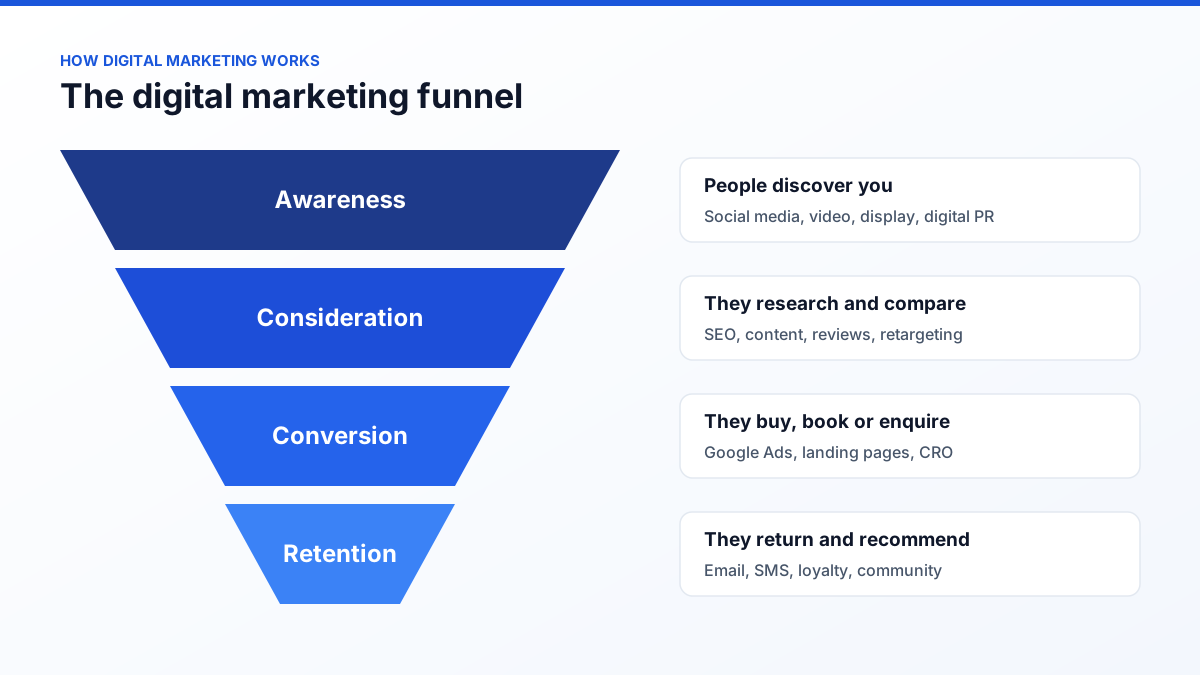
To understand how digital marketing works, think of the journey a buyer takes. Marketers call this the marketing funnel, and the marketing funnel in digital marketing usually has four stages:
- Awareness: people discover you — through social media, a blog post, a video or a display ad.
- Consideration: they research options, compare reviews and read content. SEO, content and retargeting do the heavy lifting here.
- Conversion: they buy, book or enquire. Paid search, landing pages and conversion rate optimisation matter most.
- Retention and advocacy: they buy again and recommend you. Email, SMS, loyalty and community keep them coming back.
A digital funnel is not a straight line — people jump between stages and devices. But mapping each channel to a stage stops the most common mistake in digital marketing: judging an awareness channel on last-click sales, or expecting a bottom-of-funnel ad to create demand that does not exist yet.
The main types of digital marketing channels
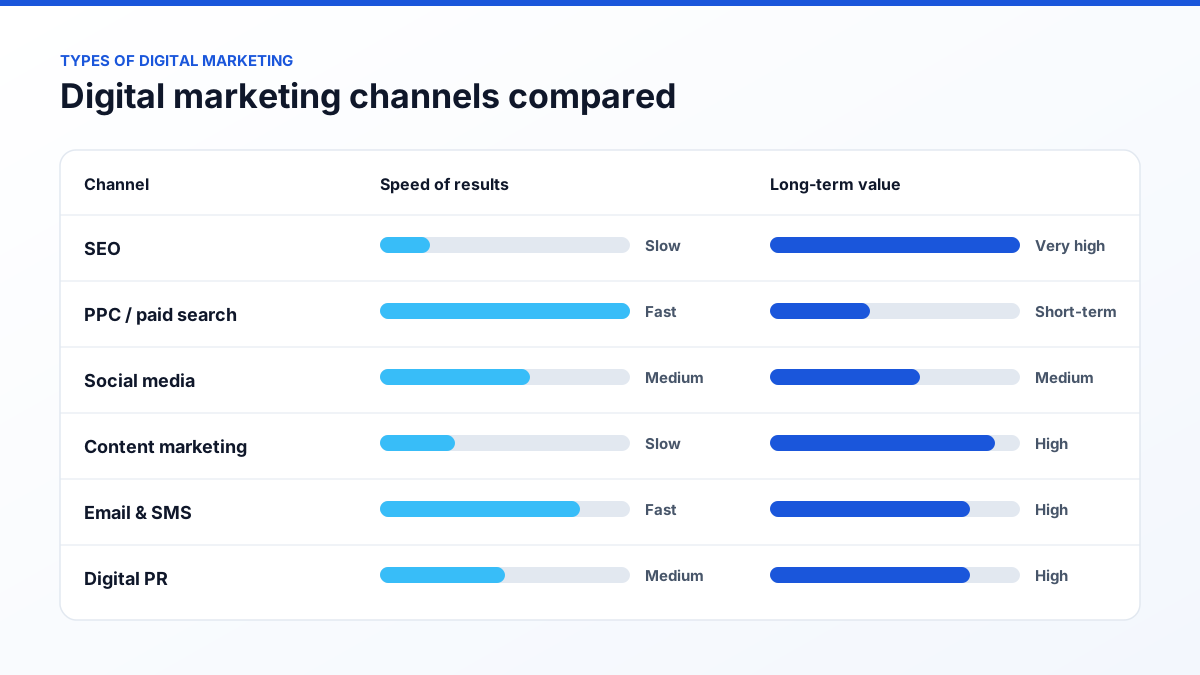
There are many digital marketing channels, but most budgets go into seven. Here is what each one does and when it fits.
| Channel | What it is | Best for |
|---|---|---|
| Search engine optimisation (SEO) | Earning unpaid visibility in Google, Bing and AI search | Compounding, low-cost traffic over months and years |
| Pay-per-click (PPC) advertising | Paid ads on Google, Bing and shopping results, charged per click | Capturing high-intent demand immediately |
| Social media marketing | Organic content and paid ads on Instagram, Facebook, LinkedIn, TikTok and YouTube | Creating demand and building brand |
| Content marketing | Articles, guides, video and tools that answer buyers' questions | Trust, SEO and AI-search citations |
| Email and SMS marketing | Owned messages to people who opted in | Repeat sales and lead nurturing |
| Digital PR and influencer marketing | Coverage, links and mentions on other people's platforms | Authority, backlinks and reach |
| Website and conversion optimisation | The site and landing pages every channel sends people to | Turning more visitors into customers |
Other channels — affiliate marketing, marketplace advertising, app store optimisation, WhatsApp marketing and connected TV — matter for specific businesses. The point is not to use every channel; it is to choose the few that match where your buyers already are.
Search engine optimisation (SEO)
SEO is the work of making your site the best answer for the searches your customers make. It covers technical health, content and authority (links and mentions from trusted sites). In 2026 it also includes visibility in Google's AI Overviews and answer engines such as ChatGPT and Perplexity. SEO is usually the highest-return channel over time, but it takes months to build. Our complete guide to SEO goes deeper.
Pay-per-click and paid search
Paid search marketing puts your ad at the top of results the moment someone searches. You pay only when they click, which is why it is called pay per click in digital marketing. It is the fastest way to test demand and win customers who are ready to buy. Read our complete Google Ads guide for the details.
Social media marketing
Marketing through social media combines organic content, community and paid ads. Social media and marketing work best together when organic posts test which messages resonate and paid budget scales the winners. Social networking in marketing is about attention and trust: few people buy on the first view, so social is strongest at creating demand that search and email later convert.
Content marketing and email marketing
Content marketing earns attention by being genuinely useful — guides, comparisons, calculators, videos. Email turns that attention into an owned relationship you do not have to rent from an algorithm. Email marketing in digital marketing consistently delivers some of the strongest returns because the audience has already opted in. See our email marketing guide.
Digital marketing vs traditional marketing
| Traditional marketing | Digital marketing | |
|---|---|---|
| Targeting | Broad — by publication, area or time slot | Precise — by intent, interest, location and behaviour |
| Measurement | Estimated reach | Clicks, leads, sales and revenue tracked |
| Cost to start | High minimum spend | Can start with a small budget |
| Speed of change | Weeks to change a campaign | Minutes to pause, edit or scale |
| Interaction | One-way | Two-way — comments, messages, reviews |
Traditional marketing still has a place — TV, outdoor and print can build reach quickly for large brands. But for most businesses, marketing and digital marketing are now effectively the same conversation, because that is where buyers research, compare and decide.
Digital marketing strategies that work in 2026
A tactic is "post three times a week". A strategy is "win the shortlist for buyers comparing accounting software in the UK". Here are the marketing strategies we see working most consistently — the best marketing strategies are rarely clever, they are focused.
- Intent-first search: win the searches closest to purchase with SEO and Google Ads before chasing broad awareness.
- Content that earns citations: publish original, useful content that AI Overviews and answer engines quote. See our GEO playbook.
- Creative-led paid social: on Meta and TikTok, creative now does the targeting. Test hooks, not audiences.
- Full-funnel measurement: judge each channel on its job, and measure overall efficiency with blended metrics. Our ROI framework explains how.
- Owned audiences: grow email, SMS and community lists so you are less dependent on rising ad costs.
- Conversion first: doubling your conversion rate halves your cost per customer across every channel at once.
- Growth marketing strategy: run small, fast experiments across the whole customer journey, keep what works and kill what does not.
There are different marketing strategies for different businesses: a local plumber, a B2B SaaS company and a fashion brand should not have the same plan. That is why the next step — building your own plan — matters more than copying anyone else's online marketing strategy.
How to create a digital marketing plan, step by step
If you want to create a marketing strategy from scratch, this digital marketing roadmap is the step by step digital marketing process we use with new clients.
- Set one commercial goal. Revenue, qualified leads or bookings — with a number and a date. "More followers" is not a goal.
- Know your numbers. What is a customer worth? What can you afford to pay to acquire one? This sets every budget decision.
- Define your audience. Who buys, what problem they are solving, what they search for and where they spend time online.
- Audit what you have. Website speed and conversion, current rankings, ad accounts, social profiles, email list and tracking.
- Choose two or three channels. Pick the channels closest to your buyers' intent first. Add more only when those are working.
- Build the foundations. Conversion tracking, a fast website, clear landing pages and a Google Business Profile if you serve a local area.
- Launch your first digital marketing campaign. Start small, with a clear hypothesis and success metric.
- Measure, learn and reallocate. Review weekly, report monthly, and move budget from what does not work to what does.
When creating a marketing campaign, write down the audience, offer, channel, budget, creative and the metric that decides success before you launch. That one habit separates a digital marketing plan from a list of activities.
Get a prioritised action plan from our specialists, free.
Digital marketing for small business
Small businesses often ask us: what is the best way to market my business with a limited budget? The answer is to start where people are already looking for you.
- Claim and optimise your Google Business Profile. For local businesses it is often the single highest-return action. See our Google Business Profile checklist.
- Get reviews, consistently. Reviews influence both rankings and conversion.
- Fix your website basics. Fast, mobile-friendly, clear phone number and call to action on every page.
- Run a tightly focused Google Ads campaign on your most profitable service and area.
- Build an email list from day one, even if it is small.
There are free ways to market your business online — Google Business Profile, organic social, email and SEO cost time rather than money — but "free" is never truly free. If your time is worth more spent running the business, small business digital marketing services are usually the better investment.
Digital marketing tools and platforms
You do not need dozens of subscriptions. These are the categories of digital marketing tools every business should cover, with examples of the best digital marketing tools in each.
| Job | Examples | Free option? |
|---|---|---|
| Analytics and tracking | Google Analytics 4, Google Tag Manager, Microsoft Clarity | Yes |
| Search performance | Google Search Console, Bing Webmaster Tools | Yes |
| SEO research | Semrush, Ahrefs, Screaming Frog | Limited |
| Advertising platforms | Google Ads, Meta Ads Manager, LinkedIn Campaign Manager, Microsoft Ads | Free to use; you pay for ads |
| Email and automation | Klaviyo, Mailchimp, HubSpot | Small lists |
| CRM | HubSpot, Zoho, Pipedrive, Salesforce | Some |
| Design and content | Canva, Figma, CapCut, AI writing and image tools | Yes |
The most important digital marketing software is the boring kind: accurate tracking and a CRM software for digital marketing that connects leads to revenue. Without that, every other digital marketing platform is optimising blind. Our best SEO tools guide compares the search tools in more detail, and our free tools include quick audits you can run today.
Measuring digital marketing: metrics, analytics and ROI
The big advantage of digital marketing is measurement — but only if you measure the right things. These are the digital marketing metrics we put in every client's digital marketing report:
- Revenue and leads by channel, from your CRM or ecommerce platform rather than ad dashboards alone.
- Cost per lead and customer acquisition cost (CAC).
- Return on ad spend (ROAS) and blended marketing efficiency ratio (MER).
- Conversion rate of key pages and campaigns.
- Organic visibility: rankings, search impressions and AI-search citations.
- Customer lifetime value and repeat purchase rate.
Good digital marketing analytics tells you what to do next, not just what happened. To calculate ROI digital marketing accurately you need first-party tracking and a single source of truth for revenue — our digital marketing ROI framework walks through it.
How much does digital marketing cost?
Digital marketing cost has two parts: the media you pay platforms for (ad spend) and the expertise to plan, create and manage it (people, an agency or freelancers). Ranges vary widely by country, industry and competition, but as a rough guide:
| Business stage | Typical focus | What drives the cost |
|---|---|---|
| Small local business | Google Business Profile, local SEO, small Google Ads budget | Number of locations and how competitive your area is |
| Growing business | SEO, paid search, paid social, email | Number of channels and content volume |
| Multi-market or ecommerce brand | Full-funnel programme across several countries | Markets, languages, ad spend and creative production |
Treat it as a digital marketing investment, not a cost: the right question is not "how cheap can this be?" but "what return will each pound, dollar or rupee earn?" Our pricing page shows what our own packages include.
Doing it yourself vs hiring a digital marketing agency
Many businesses start doing digital marketing themselves, then hire a digital marketing agency when the work outgrows their time or skills. Here is how the options compare.
| Option | Strengths | Watch out for |
|---|---|---|
| Do it yourself | Lowest cash cost, you know the business best | Time, learning curve, expensive mistakes in ad accounts |
| Freelancer or specialist | Affordable expertise in one channel | Gaps between channels, single point of failure |
| In-house team | Deep focus and brand knowledge | Hiring cost, hard to cover every specialism |
| Digital marketing agency | Specialists across every channel, tools included, fast to start | Choosing an agency that reports on revenue, not vanity metrics |
What does a digital marketing agency do?
A digital marketing agency plans and runs your online marketing: strategy, SEO, paid ads, social media, content, email, websites and reporting. Digital marketing agency services range from a single channel to a full-service partnership that owns your growth targets. See our full list of digital marketing services.
How to find a marketing agency you can trust
If you are looking for a digital marketing agency, ask every shortlisted agency these questions:
- Can you show published case studies with real numbers in my industry?
- Who will actually work on my account, and what is their experience?
- What will you report on each month — and how does it connect to revenue?
- Do I own my ad accounts, analytics and content?
- What is the minimum contract, and what happens if results do not come?
The best agency for you is the one that understands your numbers and is honest about what is realistic. We publish our case studies for exactly that reason.
The future of digital marketing
The future of digital marketing is being shaped by three shifts:
- AI search. Google's AI Overviews and assistants such as ChatGPT, Gemini and Perplexity now answer many questions directly. Brands need to be the source those answers cite. Read the future of AI SEO.
- Automation in advertising. Performance Max and Advantage+ campaigns hand targeting and bidding to algorithms. The marketer's edge moves to data quality, creative and offers. See AI PPC automation.
- Privacy and first-party data. As third-party tracking fades, businesses that own their customer relationships — email, CRM, community — will market more efficiently.
Using ChatGPT for marketing and other AI tools is now normal for research, drafts and analysis. It speeds up the work, but it does not replace strategy, original expertise or knowing your customer — which is what AI search increasingly rewards.
Common digital marketing mistakes
- Starting with tactics before setting a commercial goal.
- Spreading a small budget across too many channels.
- Sending paid traffic to a slow or confusing homepage instead of a focused landing page.
- Trusting ad platform dashboards without checking real sales.
- Stopping SEO or content after three months, just before it compounds.
- Measuring likes, impressions and traffic instead of leads and revenue.
Getting started with digital marketing
If you are getting started with digital marketing, keep it simple: set up tracking, claim your Google Business Profile, make sure your website converts, and pick one channel closest to your buyers' intent. Get that working, then add the next. That is the whole of how to start: one goal, one channel, measured properly — then scale.
If you would rather have specialists do it, book a free consultation and we will show you where your biggest opportunity is.
Guides in this series
Each part of this guide has its own in-depth article:
- The Complete Guide to SEO in 2026
- The Complete Google Ads Guide for 2026
- Email Marketing in 2026: Deliverability & ROI
- Digital Marketing ROI: The Omnichannel Framework
- SEO vs PPC vs Social Media: Where to Spend in 2026
- Online Reputation Management: The 2026 Guide for Businesses
- B2B Lead Generation: The 2026 Guide to Strategies That Work
- Social Media Marketing: The 2026 Guide to a Strategy That Works
What is digital marketing: frequently asked questions
What is digital marketing in simple words?
Digital marketing is promoting a business through digital channels such as search engines, websites, social media, email and online ads. Its advantage over traditional marketing is that it can be precisely targeted and measured.
What are the main types of digital marketing?
The main types are search engine optimisation (SEO), pay-per-click advertising (PPC), social media marketing, content marketing, email and SMS marketing, digital PR and influencer marketing, and website conversion optimisation.
Is digital marketing the same as online marketing?
Almost. Online marketing covers activity on the internet, while digital marketing also includes digital channels that are not strictly online, such as SMS and in-app messages. Most people use the terms interchangeably.
How does digital marketing work?
Digital marketing works by reaching people at each stage of the buying journey — awareness, consideration, conversion and retention — with the right channel, then measuring results and moving budget to what performs best.
What is the best digital marketing strategy for a small business?
Start where buyers already search: optimise your Google Business Profile, collect reviews, make your website fast and clear, run a focused Google Ads campaign on your most profitable service and build an email list. Add more channels once those work.
How much does digital marketing cost?
It depends on your market, competition and number of channels. Costs combine ad spend paid to platforms and the fee for the expertise to manage it. Judge it on return: what each unit of spend earns in revenue.
How long does digital marketing take to work?
Paid search and paid social can produce results within days. SEO and content usually take three to six months to show meaningful growth, then compound. Most strategies combine both so you get short-term results while long-term channels build.
What does a digital marketing agency do?
A digital marketing agency plans and runs a business's online marketing — strategy, SEO, paid ads, social media, content, email, websites and reporting — either for a single channel or as a full-service growth partner.