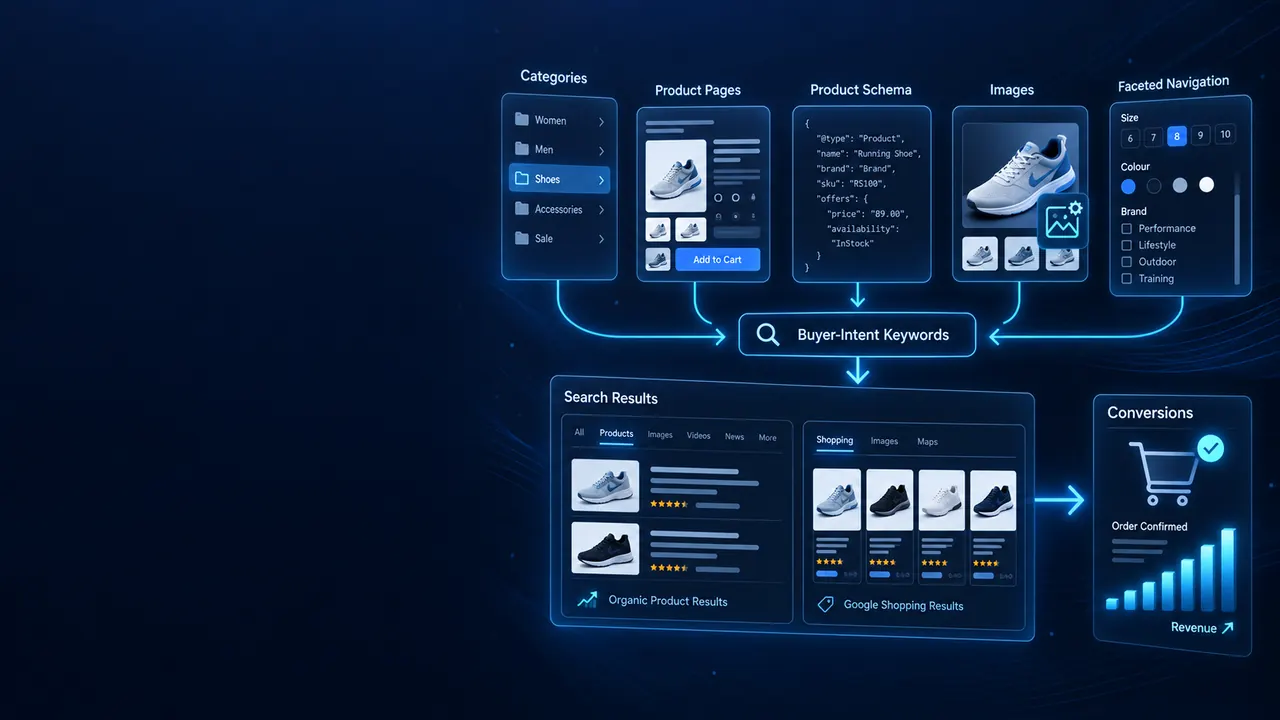
Ecommerce SEO Services at a glance
Our ecommerce SEO services grow organic revenue for Shopify, WooCommerce SEO and custom stores — from faceted-navigation crawl control and product page SEO to category content and product schema. As an ecommerce SEO agency, we measure success on revenue per session, not sessions alone.
Get a free audit →- Category page SEO
- Product page SEO
- Faceted navigation fixes
- Product schema
- Shopify SEO
- WooCommerce SEO
Marketplaces took the product queries. The winnable ground moved — most stores did not.
Commercial SERPs have become crowded with marketplace listings, shopping ads and now AI shopping surfaces. Competing on bare product-name queries against major marketplaces is no longer realistic in most categories. What remains genuinely winnable — category, comparison, buying-guide and use-case queries — is exactly where most stores have invested nothing, leaving category pages as empty product grids.
- Empty category pages
Category pages with no content
Category pages target the highest-volume commercial queries and are where marketplaces compete weakest. Most stores render them as bare grids, forfeiting the single largest organic opportunity they have.
- Facet crawl waste
Faceted navigation eating crawl budget
Filter and sort parameters generate enormous numbers of crawlable URL combinations. Left unmanaged, crawlers spend their budget on permutations while new products wait weeks to be indexed.
- Supplier copy
Supplier copy on every product
Stores selling the same catalogue as competitors use identical manufacturer descriptions. With nothing differentiating, there is no reason for an engine to prefer your page over anyone else’s.
- Broken product schema
Missing or invalid product schema
Without validated price, availability and rating markup you are absent from the rich results that dominate commercial SERPs — and increasingly invisible to AI shopping surfaces that read structured data directly.
Stop the crawl waste. Then win on the depth marketplaces cannot match.
E-commerce SEO is two jobs: containing the technical waste that large catalogues generate by default, and building commercial content depth that differentiates you from every other store selling the same products.
The technical work is largely containment — canonical discipline, crawl control, clean internal linking, performance. The content work is where stores actually win, because category-level depth and genuinely original product content are precisely what marketplaces cannot replicate at scale.
- Bare category gridsBuying-guide depth
- Filters crawled freelyCrawl directives applied
- Supplier product copyOriginal differentiated copy
- No structured dataValidated product schema
- Chasing product-name queriesOwning comparison & guides
- Reports sessionsReports revenue per session
Category pages, not product pages. They target higher-volume commercial queries and are the ground marketplaces contest weakly — and most stores leave them completely empty.
- Category page depth
- Buying guides, comparison content, FAQs and internal linking on the pages carrying the highest commercial volume — usually the emptiest pages in the store.
- Crawl & index control
- Canonical rules and directives for filters and sort parameters so budget reaches products rather than permutations.
- Original product content
- Differentiated descriptions, specifications and genuine usage detail, prioritised by margin so effort goes where it pays back.
- Product & review schema
- Validated markup for price, availability, ratings and shipping so you compete for rich results and remain visible to AI shopping surfaces.
- Commercial performance
- Speed and Core Web Vitals work measured against revenue per session, not just lab scores.
How we grow an online store in search
Six workstreams, sequenced so crawl waste stops before content investment begins.
Store & crawl audit
Full crawl exposing duplicate paths, filter permutations, orphaned products and index bloat, plus collection-level revenue analysis so priorities are set by contribution rather than traffic.
What’s included
- Ecommerce technical SEO audit
- Crawl budget and duplicate products
- Category and product page issues
You receive: An ecommerce SEO audit
Crawl & index control
Canonical discipline, internal linking standardised to one product path, and directives for filters and sort parameters — usually reclaiming most wasted crawl budget within weeks.
What’s included
- Robots.txt, canonical tags and noindex rules
- Faceted navigation kept out of the index
- XML sitemaps for products and categories
You receive: An ecommerce crawl control plan
Category page build
Buying guides, comparison tables, FAQs and internal linking added to category pages. This is the highest-value untapped headroom in almost every store we audit.
What’s included
- Unique category copy targeting commercial keywords
- FAQs and buying guidance for long-tail searches
- Internal links from products and blog content
You receive: Optimised ecommerce category templates
Product content
Original descriptions, specifications and usage detail on highest-margin products first. We prioritise by contribution rather than attempting an entire catalogue at once.
What’s included
- Unique product descriptions, not supplier copy
- Specs, FAQs and reviews for long-tail keywords
- Product schema for rich results
You receive: Optimised product page content
Schema & rich results
Validated product, offer, review and breadcrumb markup so you appear with pricing, availability and ratings — which materially lifts commercial click-through.
What’s included
- Product, review and breadcrumb schema
- Rich snippet eligibility checked
- Merchant listing optimisation
You receive: Ecommerce schema markup
Performance & CRO
Core Web Vitals and page speed measured against revenue per session, plus conversion work so the rankings you win translate into orders.
What’s included
- Page speed and Core Web Vitals
- Conversion rate optimisation on category and product pages
- Checkout and UX friction fixed
You receive: A performance and CRO plan
Get a free audit →Measured on revenue per session, not sessions
E-commerce SEO is measurable end to end. We report at category and product level so investment goes where contribution is.
Category-first focus
We invest where commercial volume actually is. Most agencies optimise product pages and ignore categories, which is backwards for the queries that carry revenue.
Margin-prioritised catalogue work
Content investment sequenced by product contribution rather than alphabetically or by traffic. Ranking a low-margin product well is a poor use of budget.
Revenue-level reporting
Organic revenue, revenue per session and non-branded share by category — so decisions are made on contribution rather than traffic charts.
Platform-literate implementation
Shopify, WooCommerce, Magento and headless builds each impose different constraints. We work inside them rather than issuing recommendations you cannot implement.
Multi-market storefronts
Hreflang, currency and regional duplication handled correctly — a frequent source of silent cannibalisation across international stores.
CRO alongside SEO
Rankings that do not convert are a vanity metric. Conversion work runs alongside so traffic gains show up in orders.
Why Businesses Choose SDM for Ecommerce SEO
Same budget, very different outcomes. Point by point, here’s how a specialist partner compares to a typical agency or going it alone.
| What actually matters | With SDM | Typical Agency | In-House / DIY |
|---|---|---|---|
| Senior specialist on your account | Always | Often a junior | Stretched thin |
| Custom strategy built for your goals | Tailored | Templated | Guesswork |
| Deep audit before any work begins | ✓ | Surface-level | Skipped |
| White-hat, penalty-safe methods | Guaranteed | Varies | High risk |
| Plain-English reporting tied to revenue | Monthly | Jargon PDFs | None |
| Direct access to your specialist | ✓ | Account-manager relay | N/A |
| Category pages built for search | ✓ | Product-only focus | Bare grids |
| Faceted crawl waste controlled | ✓ | Overlooked | Unmanaged |
| Original product content by margin | ✓ | Supplier copy | Supplier copy |
| Validated product & review schema | ✓ | Plugin defaults | None |
| Revenue-per-session reporting | ✓ | Sessions only | Unclear |
| Ongoing competitor gap analysis | ✓ | One-off | Manual |
| Conversion-focused, not just traffic | ✓ | Traffic-first | Unclear |
| Premium tools included (Ahrefs, SEMrush) | ✓ | Sometimes | Costly extra |
| No long lock-in contracts | Flexible | 6–12 mo lock-in | N/A |
| Established agency, operating since 2017 | ✓ | Varies | Learning curve |
| Fast onboarding & early quick wins | ~2 weeks | Slow | Trial & error |
| Human, SEO-led content (no AI spam) | ✓ | Outsourced / AI spam | Time-heavy |
| Focus on compounding, long-term ROI | Core promise | Short-term wins | Slow & ad-hoc |
| Recovery from Google penalties | ✓ | Sometimes | Very hard |
20 reasons growing brands make the switch. See the difference for yourself →
Sessions are not the metric. Revenue per session is.
We report at category and product level so you can see exactly which investments returned and which did not.
Organic revenue by category
Revenue attributed to organic per category, so content investment is directed at what actually contributes.
Revenue per session
Whether traffic gained is commercially qualified — the metric that separates useful rankings from vanity ones.
Non-branded share
Proportion of organic revenue from non-branded queries, the honest measure of whether SEO is finding new customers.
Index health
Valid indexed products and categories versus filter and duplicate URLs, tracked as crawl control takes effect.
Rich result coverage
Share of products showing price, availability and rating in results, which materially affects commercial click-through.
Our Ecommerce SEO process: four stages, repeated every month
Crawl waste first, then depth where the margin is. Sequencing matters more than volume in e-commerce.
Audit
Full crawl exposing duplication and filter bloat, catalogue data quality review, and category-level revenue analysis. You get a plan ranked by revenue impact rather than traffic potential.
DeliverableCrawl report + revenue-ranked planContain
Canonical discipline, internal linking standardised, crawl directives for filters, and performance work. This stops budget being wasted before we invest in content that needs crawling.
DeliverableClean crawl + faster storeBuild
Category depth first, then original product content on highest-margin lines, then validated schema across the catalogue. Shipped in batches so revenue impact stays attributable.
DeliverableCategory depth + product contentMeasure & expand
Revenue by category, revenue per session and non-branded share. Winners deepened, underperformers re-specified, next catalogue tranche queued.
DeliverableRevenue report + next tranche
Proven results from real SEO clients
Published case studies from our clients — each with the starting point, the dates, the source and what the numbers don’t prove.
A home services franchise group — 34.1K ranking keywords and 1.8K AI mentions.
Read the case study →Home services SEOTop 3 for “emergency plumber”, cited on 218 pages in AI answers.
Read the case study →B2B SaaS SEO77.9K Google clicks in three months — organic is the top channel.
Read the case study →Ecommerce SEO FAQs: the questions we get asked most
Practical answers on where online stores actually win in search.
Further reading
Go deeper on this
The thinking behind the work. These guides go deeper on the methods this page describes — written by the team that runs them.
 SEO
SEOEcommerce SEO: The Complete 2026 Playbook
The complete ecommerce SEO playbook for 2026: keyword research, category and product pages, faceted navigation, product schema, speed and measuring revenue.
Read the guide SEO
SEOThe Complete Guide to SEO in 2026
The complete guide to SEO in 2026: how Google ranks pages, technical SEO, content, links, local and AI search, a 6-month roadmap and how to measure ROI.
Read the guide