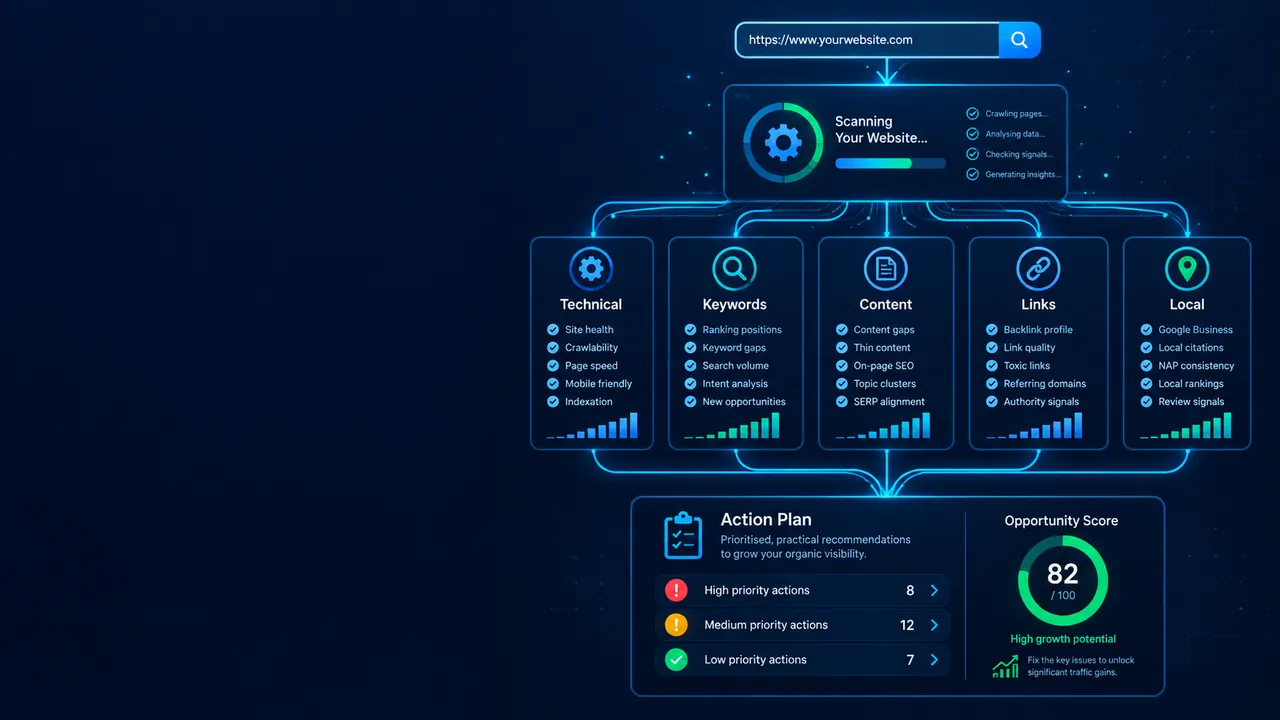
Free SEO Audit at a glance
Our free SEO audit is a full website SEO audit — a technical SEO audit of crawl, indexation and Core Web Vitals, plus content, intent coverage and authority gaps. Unlike most SEO audit services, every finding is prioritised by commercial impact, and the report is yours to keep.
Get a free audit →- Technical SEO audit
- Crawl & indexation
- Core Web Vitals
- Content & intent gaps
- Backlink profile
- Prioritised action plan
Most SEO audits are a list of problems nobody can act on
The typical audit is a 90-page export from a crawler, sorted by tool severity rather than commercial impact. It tells you there are 4,000 issues and nothing about which three are costing you money. Handed to a developer, it produces either paralysis or a month of work on things that changed nothing.
- Raw tool output
Tool output, not analysis
A crawler flags every missing alt tag with the same urgency as a noindex on your money page. Severity in the tool has almost no relationship to revenue impact.
- No priority order
No priority order
Without sequencing you cannot brief a developer. The most common outcome of an unprioritised audit is that nothing gets fixed at all.
- No commercial case
No commercial framing
“312 pages have duplicate titles” means nothing. Which of them earn traffic, and what is the gap worth in enquiries, is the part that decides whether to act.
- Sales-led findings
Written to sell, not to inform
Audits designed as sales documents overstate severity to manufacture urgency. You can usually spot them: everything is critical and the only remedy is a retainer.
Five layers, in the order they block each other.
There is no point optimising content on a site engines cannot crawl, and no point chasing links to a page that does not match intent. The audit follows the dependency order, so the fixes come out sequenced rather than listed.
Everything is checked against live data from your own analytics and Search Console, not estimated from third-party tools alone.
- 90-page crawler exportThree prioritised fixes
- Sorted by tool severitySorted by commercial impact
- Estimated third-party dataYour analytics and Search Console
- Everything marked criticalHonest severity
- Requires a retainer to readYours to keep either way
- No implementation detailBriefed so a developer can act
You should be able to hand page one to a developer and have work start that morning, without a follow-up call to explain what any of it means.
- Crawl & index
- What engines can reach, what they choose to keep, and where budget is being spent on pages that will never earn anything.
- Rendering & performance
- Whether content exists without JavaScript, and whether Core Web Vitals pass on real field data rather than a lab score.
- Intent coverage
- Which commercial queries you cover, which you half-cover with the wrong page type, and which you have missed entirely.
- Authority profile
- The gap between your link profile and the sites currently outranking you, with the realistic cost of closing it.
- Conversion path
- Whether the traffic you already earn is being wasted by page speed, weak calls to action or broken tracking.
What happens after you request the audit
Six steps, most of which happen without needing anything from you beyond read access.
Full crawl
Every reachable URL, status codes, redirect chains, canonical logic and index directives — the map before any judgement.
What’s included
- Complete technical SEO crawl of the site
- Broken links, redirects and indexation issues
- Duplicate and thin content flagged
You receive: A full technical crawl report
Render & performance check
Content verified without JavaScript, Core Web Vitals read from field data, and the specific elements causing failures identified.
What’s included
- JavaScript rendering checked
- Page speed and Core Web Vitals
- Mobile usability issues
You receive: A rendering and performance report
Intent mapping
Your commercial query set mapped against the pages that should own each one, exposing gaps, overlaps and cannibalisation.
What’s included
- Keywords grouped by search intent
- Each group mapped to the right page
- Gaps where new pages are needed
You receive: A search intent map
Competitive gap
What the sites outranking you actually have that you do not — content depth, authority, or simply a better-matched page.
What’s included
- Keywords competitors rank for and you do not
- Content and backlink gaps by topic
- Quick wins where competitors are weak
You receive: A competitor keyword gap analysis
Commercial sizing
Each finding sized by what it plausibly affects, so the priority order reflects revenue rather than tool severity.
What’s included
- Search volume and value of target keywords
- Traffic and revenue potential by opportunity
- Effort estimated against every fix
You receive: A prioritised SEO opportunity model
Walkthrough
A call to talk through the findings, answer questions and agree what you would do first — whether that is with us or your own team.
What’s included
- Live walkthrough of the audit findings
- Priorities explained in plain English
- Q&A with your team
You receive: A recorded audit walkthrough
Get a free audit →We will tell you if you do not need us
The audit is free because it is the honest way to start — and because it is a better demonstration of competence than any pitch deck.
Three priorities, not three hundred
We rank findings by commercial impact and give you the top three. The full list is included, but the point is knowing where to start.
Your data, not estimates
Read access to Analytics and Search Console means the findings reflect what is actually happening rather than what a third-party tool infers.
Honest severity
If your site is largely fine we will say so. Manufacturing urgency to sell a retainer is the fastest way to lose a client who later checks.
Written for a developer
Each fix specifies the file, the template or the setting. Your team can act on it without a translation layer.
Yours to keep
No paywall, no obligation. If you take the findings and implement them in-house, that is a legitimate outcome and we would rather that than a bad-fit retainer.
Done by the specialist
The person who audits your site is the person who would work on it. No handover from a salesperson afterwards.
Why Businesses Choose SDM for SEO Audit
Same budget, very different outcomes. Point by point, here’s how a specialist partner compares to a typical agency or going it alone.
| What actually matters | With SDM | Typical Agency | In-House / DIY |
|---|---|---|---|
| Senior specialist on your account | Always | Often a junior | Stretched thin |
| Custom strategy built for your goals | Tailored | Templated | Guesswork |
| Deep audit before any work begins | ✓ | Surface-level | Skipped |
| White-hat, penalty-safe methods | Guaranteed | Varies | High risk |
| Plain-English reporting tied to revenue | Monthly | Jargon PDFs | None |
| Direct access to your specialist | ✓ | Account-manager relay | N/A |
| Findings prioritised by revenue impact | ✓ | Tool severity | Guesswork |
| Uses your analytics and Search Console | ✓ | Third-party only | Free tools |
| Fixes specified for a developer | ✓ | Generic advice | None |
| Report yours with no obligation | ✓ | Paywalled | n/a |
| Told plainly if the site is fine | ✓ | Rarely | n/a |
| Ongoing competitor gap analysis | ✓ | One-off | Manual |
| Conversion-focused, not just traffic | ✓ | Traffic-first | Unclear |
| Premium tools included (Ahrefs, SEMrush) | ✓ | Sometimes | Costly extra |
| No long lock-in contracts | Flexible | 6–12 mo lock-in | N/A |
| Established agency, operating since 2017 | ✓ | Varies | Learning curve |
| Fast onboarding & early quick wins | ~2 weeks | Slow | Trial & error |
| Human, SEO-led content (no AI spam) | ✓ | Outsourced / AI spam | Time-heavy |
| Focus on compounding, long-term ROI | Core promise | Short-term wins | Slow & ad-hoc |
| Recovery from Google penalties | ✓ | Sometimes | Very hard |
20 reasons growing brands make the switch. See the difference for yourself →
The numbers we report back
Every finding ties to one of these, so nothing appears in the report that cannot be tracked afterwards.
Indexed vs submitted
How much of your site engines actually keep, and which templates are being discarded.
Core Web Vitals pass rate
Field data at the 75th percentile, split by template rather than averaged into meaninglessness.
Intent coverage
Share of your commercial query set with a page properly matched to it.
Authority gap
Distance between your profile and the sites currently ranking above you.
Traffic at risk
Revenue-earning pages with a technical problem that could remove them from the index.

Our SEO Audit process: four stages, about 48 hours
You give read access; everything else happens on our side.
Access
Read-only access to Analytics and Search Console, plus your target market and the queries you care about. Ten minutes of your time.
DeliverableNothing else needed from youCrawl & analyse
Full crawl, render verification, field performance data, intent mapping and competitive comparison.
DeliverableThe raw picturePrioritise
Findings sized by commercial impact and sequenced by dependency, because some fixes are wasted until others land.
DeliverableA real running orderWalk through it
A call to explain the findings and agree what you would do first — with us, with your team, or not at all.
DeliverableYours to keep
Proven results from real SEO clients
Published case studies from our clients — each with the starting point, the dates, the source and what the numbers don’t prove.
Recovered from a Google update drop — page one for “furnace repair near me”.
Read the case study →Home services SEOTop 3 for “emergency plumber”, cited on 218 pages in AI answers.
Read the case study →Franchise SEOA home services franchise group — 34.1K ranking keywords and 1.8K AI mentions.
Read the case study →SEO Audit FAQs: the questions we get asked most
What it covers, what it costs and what happens afterwards.
Further reading
Go deeper on this
The thinking behind the work. These guides go deeper on the methods this page describes — written by the team that runs them.
 Technical SEO
The Technical SEO Audit Playbook for 2026
A step-by-step technical SEO audit playbook for 2026: crawling, indexing, site architecture, JavaScript, Core Web Vitals, structured data and prioritisation.
Read the guide Technical SEO
Core Web Vitals & SEO in 2026: LCP, INP, CLS Guide
Core Web Vitals in 2026: LCP, INP and CLS thresholds, whether they affect rankings, how to diagnose and fix each metric, WordPress tips and measurement.
Read the guide