Make your brand a recognised entity
Search engines and AI models think in entities: a named business with known facts and connections. If yours is poorly defined, it is hard to recognise and easy to confuse with another. We define it clearly, everywhere.
- One consistent identity
- Schema and profiles aligned
- Knowledge panel checked
What is entity SEO?
Entity SEO is the work of making a business, person or product a clearly defined entity that search engines and AI models can recognise. It involves one consistent name and description, Organization schema that links to your official profiles, and corroboration on trusted third-party sources. A well-defined entity is described accurately and is less likely to be confused with a similarly named one.
In practice. It means one name and one description used consistently, Organization schema that links to your official profiles, and confirmation from trusted independent sources. Google stores entities in its Knowledge Graph, which is what feeds the knowledge panel shown beside search results.
Who it is for. Businesses with name variations, a rebrand, several locations, or a name shared with another company.
What it is not. It is not a way to buy a knowledge panel or a Wikipedia page. Those have their own rules.
Read the full explanation and see an exampleShow less
An entity is a distinct thing that a search engine or AI model can recognise: a business, a person, a product, a place. Entity SEO is the work of making your business a clearly defined one, with facts that agree everywhere.
Search engines and AI models organise what they know around entities and the facts attached to them. When your business is a clear entity, they can state who you are, what you do and where you operate with confidence. When it is not, they hedge, omit you, or mix your details with those of another company with a similar name.
ExampleHow the web describes one company
- Acme Ltd
- ACME Limited
- Acme Co.
Three spellings can be treated as three different businesses.
- One name used everywhere
- Profiles linked with schema
- Confirmed by independent sources
One identity that search engines and AI tools recognise and name with confidence.
How search engines and AI recognise a business
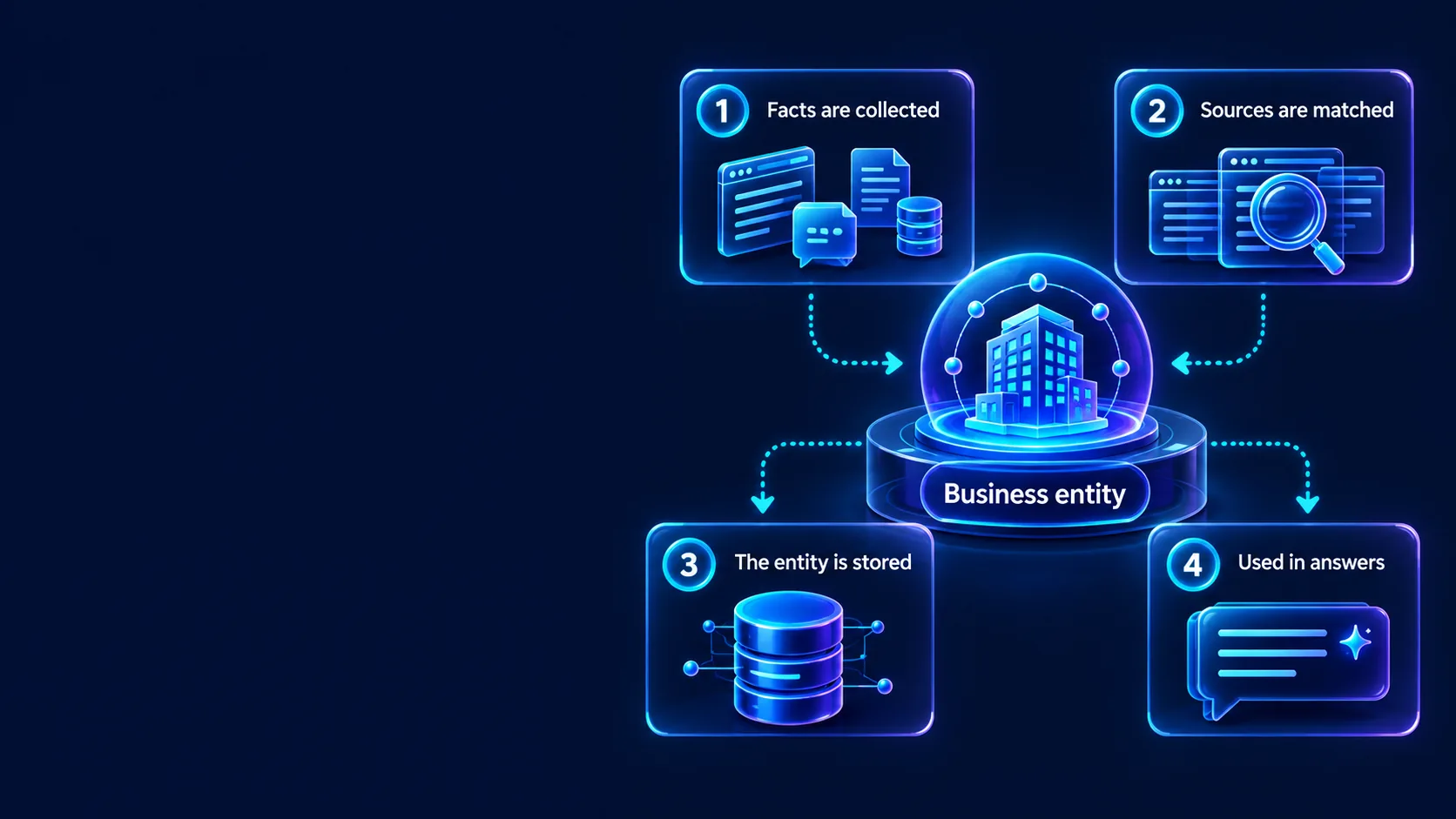
To a search engine, a business is a record of facts with connections to other records. The record is built in four steps.
- 1
Facts are collected
They come from your website, your structured data, business listings, social profiles and reference sources.
- 2
They are matched up
The same name, address and website on every source point to one business. Mismatches create doubt or a duplicate.
- 3
The entity is stored
Google keeps entities and their relationships in its Knowledge Graph. AI models hold a looser version from their training.
- 4
It is used in answers
A recognised entity can show a knowledge panel and can be named with confidence in an AI answer.
AI answers name entities, not web pages
To be named, a model has to know who you are.
Inconsistent names split your identity
Different spellings, legal names and trading names across the web can be treated as different businesses.
Similar names get confused
Without clear distinguishing facts, an assistant may merge you with another company of the same name.
Recognition needs corroboration
Your own site saying who you are is not enough. Independent sources have to agree.
Signs you need Entity & Knowledge Graph SEO
If two or more of these sound familiar, this service is likely to pay back. If none do, tell us and we will say so.
Switch on the signs that sound familiar.
Not sure where you stand? We will check for you.
Ask for the free auditWho Entity & Knowledge Graph SEO is for
Search engines and assistants need to know exactly who you are before they can recommend you. These organisations gain most from being unmistakable.
Businesses with common names
Distinct identity signals stop you being mixed up with a namesake.
Rebrands and mergers
Old and new names are linked so recognition carries across.
Founders, authors and experts
Individuals are defined in their own right and tied to the organisation.
Multi-location brands
Every branch is described separately and connected to the parent.
Franchises and dealer networks
Head office and local outlets stop competing for the same knowledge panel.
Professional practices
Partners, credentials and specialisms become facts a machine can verify.
Software and product companies
Product names are separated from the company that makes them.
Charities and membership bodies
Registration numbers and official listings confirm you are the genuine organisation.
What our entity SEO service includes
Define, connect and corroborate.
- 01
Entity audit
How Google and AI assistants currently identify and describe your business.
- 02
Canonical identity
One agreed name, description and set of facts used everywhere.
- 03
Organization schema
Structured data with sameAs links to every official profile.
- 04
About and author pages
Pages that state clearly who you are, who leads the business and what you are known for.
- 05
Profile alignment
Directories, social profiles and data sources updated to match.
- 06
Knowledge sources
Wikidata and other reference sources, where the business genuinely qualifies.
Entity SEO vs keyword SEO
The differences that matter when you decide where to put time and budget.
| Aspect | Keyword SEO | SDMEntity SEO |
|---|---|---|
| Focus | Search phrases | The business, people and products themselves |
| Goal | Rank pages for queries | Be recognised and described accurately |
| Key assets | Optimised pages | Consistent identity, schema and corroborating sources |
| Where it shows | Standard results | Knowledge panels and AI answers as well |
| Relationship | Finds the demand | Makes sure it is connected to you |
Our entity SEO process
Six stages. The site and profiles are usually aligned within six weeks. Corroboration then builds over the following months.
- 01
Entity audit
We search Google and ask the main assistants who you are. We record the name variations, the descriptions, any confusion with other companies and whether a knowledge panel shows.
You receiveAn entity audit across Google and the main assistants.
- 02
Agree the canonical facts
One name, one description, the founding date, the leadership, the locations and the services are written down. You sign them off. Everything after this uses that sheet.
You receiveA canonical fact sheet for your business.
- 03
Align the site
Organization schema is added with sameAs links to every official profile and then validated. Your About and author pages are rewritten to state the facts plainly.
You receiveValidated schema and updated About and author pages.
- 04
Align profiles and listings
Directories, social profiles and business data sources are updated one by one to match the fact sheet.
You receiveA list of every profile updated, with its status.
- 05
Corroborate
We build independent confirmation through trade bodies, press and reference sources. That includes Wikidata, where the business genuinely qualifies.
You receiveA corroboration log.
- 06
Follow-up check
Once the sources have been re-crawled, the audit is repeated and compared with the first.
You receiveA before-and-after comparison.
Timings are typical for a single website; your proposal sets out the exact schedule.
How we work with you
Sachkhand Digital Marketing has worked with businesses in 30 countries since 2017. The team is remote-first and keeps to your time zone, and the specialists who audit your site are the ones who do the work. This is how the work is shared on an entity SEO project.
- What we need from youYour input, mostly at the start
- Your legal and trading names, founding details and leadership
- Owner access to your profiles and listings
- A decision on the single name to use everywhere
- Evidence for reference sources: registrations, awards and press
- What our team handlesEverything else, start to finish
- The entity audit and follow-up check
- Schema, About pages and author pages
- Updating profiles and listings
- Outreach for independent confirmation
- Free audit before any quoteWe look at your site first. After a 30-minute call you get a written proposal within 48 hours, with the scope, the timeline and the cost.
- One account managerA single point of contact who knows your account, on WhatsApp and email, with a reply within one business day.
- Plain-English reportingReports match your own analytics and are followed by a review call. A weak month comes with the reason and the plan.
- No lock-in contractOngoing work is billed monthly and can be stopped with 30 days' notice.
What you receive
An entity audit across Google and the main assistants.
A canonical fact sheet for your business.
Organization schema implemented and validated.
Aligned profiles and listings.
A follow-up check after the changes are picked up.
What we will not promise
- Google decides whether to show a knowledge panel. Nobody can guarantee one.
- Wikipedia and Wikidata have their own rules. We do not create entries for businesses that do not meet them.
- Entity recognition builds gradually as sources are re-crawled.
What you can count on
- A dated baseline before work starts, so progress is measured and not guessed.
- The agreed scope of work, delivered every month.
- A plain answer at each review if something is not working, with what we will change.
We tell you this before you start, not after.
How entity SEO helps your business grow
Entity work is a foundation. Its value shows up in everything that depends on being recognised.
Targets we plan against, for engagements of six months or more
- Target+178%AI search visibilityTarget by month 6
- Target94%AI Overview citation ratePriority question set
- Target3×Brand mention growthAcross AI tools
- Target+62%Branded searchTarget by month 6
- 1Named correctly when you are recommended
A clearly defined business is described accurately. A vague one is described loosely or left out.
How we measure itHow the assistants describe you before and after.
- 2No enquiries lost to a namesake
Confusion with a similarly named company sends buyers elsewhere, or attaches their reviews to you.
How we measure itInstances of confusion found in each audit.
- 3A stronger result for your brand name
Consistent facts and schema support a knowledge panel and clean brand results, so people who search your name find the right details.
How we measure itBrand impressions and clicks, and whether a panel shows.
- 4Other marketing adds up
PR, reviews and content all build one identity when the name and facts match, and are split across several when they do not.
How we measure itConsistency of name and details across your profiles.
Published client results
- 1.8KAI mentionsHome services franchise client
- 218Pages cited in AI answersPlumbing and HVAC client
- ~70×Organic visitsFranchise client, about 1K to 69.8K
- 98%Client retention600+ clients in 30 countries
What we guarantee
We do not guarantee a ranking or a mention in an AI answer. The search engines and assistants decide that, and no agency controls them. We guarantee the work, the measurement and the honesty.
- A dated baseline before work starts.Every result is measured against a starting point you have seen.
- The agreed scope, delivered every month.You know what will be done before the month begins.
- Honest reporting.Reports match your own analytics. A quarterly review tells you plainly if something is not working.
- White-hat methods only.No bought links, no fake reviews and nothing that risks a penalty.
- Your approval before anything is published.No page, pitch or listing change goes live without your sign-off.
- No lock-in.Billed monthly. Stop with 30 days' notice.
Mistakes we see most often
These come up in almost every first audit. Each one is avoidable.
- Mistake 01
Inconsistent naming
“Acme Ltd”, “ACME Limited” and “Acme Co.” look like three businesses to a machine.
Do this insteadPick one form of the name and use it everywhere.
- Mistake 02
Schema without sameAs links
Without those links, your official profiles are not tied to one entity.
Do this insteadLink your Organization schema to your official profiles.
- Mistake 03
No About or author pages
Thin or missing pages leave gaps in how your business is defined.
Do this insteadDefine the entity on your own site with full About and author pages.
- Mistake 04
Chasing a Wikipedia page
Wikipedia has strict notability rules, and most businesses do not meet them.
Do this insteadAim for Wikidata, industry bodies and reputable directories, which are usually more achievable.
Five checks you can do this week
You do not need us for the first steps. These take under an hour and show you where you stand.
Check the basics yourself, free
Three of our free tools cover the first checks we make. No signup is needed.
- Free
- No signup
- Results in seconds
Entity & Knowledge Graph SEO: key terms explained
- Entity
- A distinct, well-defined thing such as a company, person, place or product.
- Knowledge Graph
- Google’s database of entities and the relationships between them.
- Knowledge panel
- The information box Google shows for a recognised entity.
- sameAs
- A schema property that links an entity to its official profiles elsewhere.
- entity SEO services
- entity optimisation
- entity-based SEO
- Knowledge Graph optimization
- Knowledge Graph SEO
- Google knowledge panel services
- brand entity optimization
- semantic SEO services
- Wikidata for SEO
- entity disambiguation
Entity & Knowledge Graph SEO: common questions
Straight answers to the 9 questions we are asked most.
01What is an entity in SEO?
An entity is a distinct thing that a search engine or AI model can identify, such as a business, a person, a product or a place, along with the facts and relationships that define it.
02What is entity SEO?
It is the work of making your business a clearly defined entity: one consistent name and description, structured data linking your official profiles, and corroborating mentions on trusted independent sources.
03Can you get me a Google knowledge panel?
We cannot guarantee one, because Google decides. What we can do is put in place the consistent identity, schema and corroboration that knowledge panels are built from.
04Do I need a Wikipedia page?
No, and most businesses do not qualify for one. Consistent details across your site, schema, listings and reputable third-party sources do most of the work.
05How does entity SEO help with AI search?
AI assistants name businesses they can identify with confidence. Clear, consistent, corroborated facts make you easier to recognise, describe accurately and recommend.
06How long does it take for an entity to be recognised?
Consistent identity and schema can be in place within weeks. Recognition by search engines and AI models follows over one to several months as sources are re-crawled.
07Is entity SEO only for large brands?
No. Small and local businesses benefit most, because they are the ones most often confused with others or described vaguely.
08What if a competitor has the same name as us?
We strengthen the signals that distinguish you: location, sector, founders, registration details and linked profiles. That makes it easier for search engines and AI models to tell the two apart.
09Do you create Wikidata entries?
Where a business meets Wikidata’s notability requirements and has independent sources, we can prepare and submit an entry. We advise first on whether it is appropriate.
Send it to us and you get a reply within one business day.
Ask your own questionSee how clearly your business is defined
Send us your business name and website. We will check how Google and the main assistants identify you today.
- No cost for the audit
- Written proposal in 48 hours
- No lock-in contract