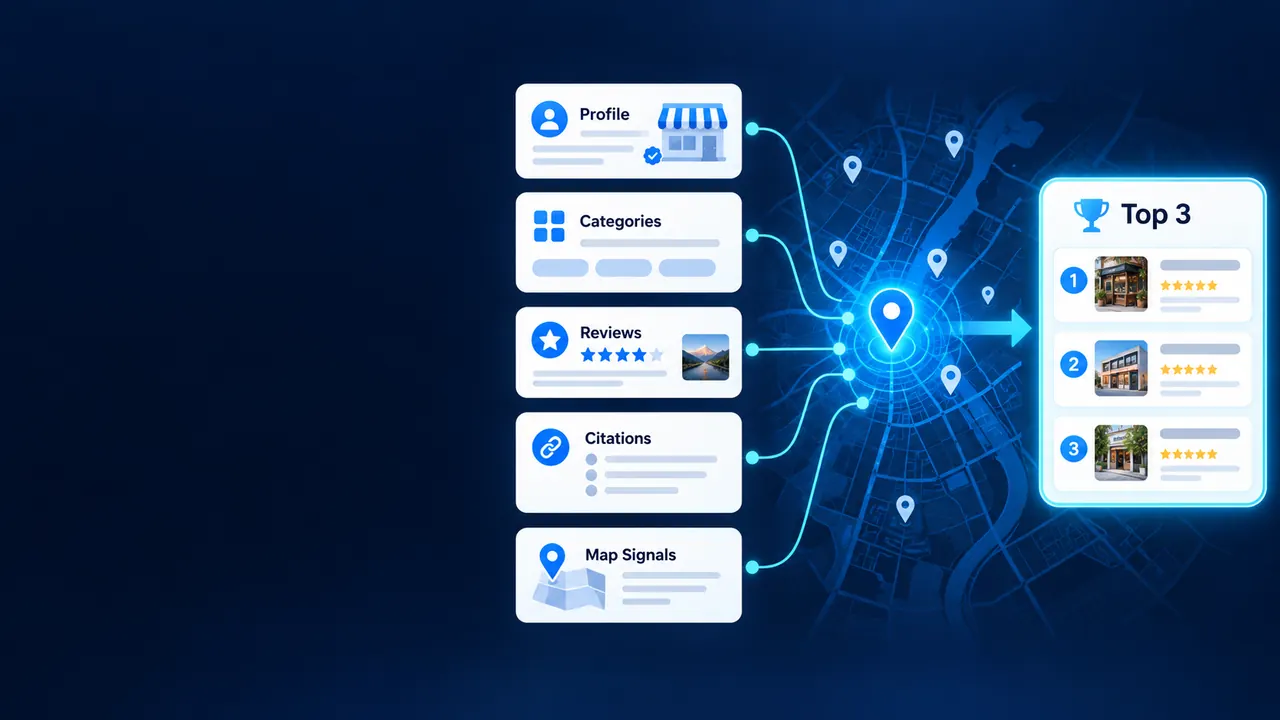
Google Business Profile Optimization Services at a glance
Our Google Business Profile optimization services are built to win the Google Maps 3-pack. Google Map SEO and map pack SEO cover categories, services, reviews, photos, posts and citations — tracked with grid rankings so you can see your local map ranking in every area you serve.
Get a free audit →- Google Business Profile setup
- Category & service optimisation
- Review management
- Citation building
- Google Maps SEO
- Grid rank tracking
Your Business Profile is the listing. Everything else supports it.
Google Business Profile optimization is the work of turning your listing into the strongest profile in your category: the right primary and secondary categories, complete services and attributes, fresh photos, a steady flow of reviews with replies and posts that show the business is active.
The mechanics are different from organic SEO because the ranked object is different. You are not optimising a URL; you are strengthening an entity in Google’s local index, then giving it enough corroboration across the web and enough on-site local content to be trusted for each area you claim.
- One broad categoryPrimary + secondary set
- Reviews arrive by luckSteady monthly velocity
- NAP conflicts unresolvedSingle authoritative record
- One generic services pageDifferentiated area pages
- Q&A left unansweredSeeded and managed
- Ranks only where you sitRanks across the service area
Distance is one of three ranking inputs. Prominence and relevance are the ones you can actually build — which is how a well-optimised business two suburbs away outranks the one on the searcher’s street.
- Business Profile engineering
- Primary and secondary categories chosen from competitive analysis, complete service and product catalogues, attributes, hours, geotagged imagery and an actively managed Q&A section.
- Local keyword architecture
- Service-plus-area mapping across every location you serve, with intent segmented into emergency, comparison and research so each gets the page format it needs.
- Review acquisition systems
- Compliant, automated request flows that generate steady monthly velocity with natural service-keyword language, plus structured response handling for every review.
- Citation & NAP cleanup
- Audit and correction across primary directories, industry verticals and the data aggregators that quietly repopulate bad records after you fix them.
- Location page builds
- Genuinely differentiated pages per service area with local proof, embedded maps, service-area schema and internal linking that reinforces geographic relevance.
How we optimise your Business Profile for the map pack
Six workstreams that run in parallel, sequenced so entity confidence is built before we start competing for additional service areas.
Grid-based rank audit
We measure your current pack position across a geographic grid rather than from one point, exposing precisely where visibility drops off. That heatmap becomes the plan — it usually contradicts what a single-location rank tracker reports.
What’s included
- Google Maps rankings across your service area
- Heatmap of local pack visibility
- Competitor comparison by location
You receive: A Google Maps ranking heatmap
Profile rebuild
Categories reverse-engineered from the businesses currently winning, complete service and product catalogues, every attribute claimed, geotagged photography on a publishing cadence and Q&A seeded with real buyer questions.
What’s included
- Google Business Profile categories and attributes
- Photos, posts and Q&A
- Services and products listed in full
You receive: A fully optimised Google Business Profile
Citation & entity cleanup
We fix conflicting records at the aggregator level, not just the visible directories, so corrections stick instead of quietly reverting six weeks later. Then we add the vertical citations that carry weight in your category.
What’s included
- NAP consistency across directories and data aggregators
- Duplicate and incorrect listings removed
- Industry citations that build local authority
You receive: A local citation audit and cleanup log
Review engine
Compliant request automation timed to the moment of highest satisfaction, producing consistent velocity with natural keyword and location language, plus a response protocol that handles negatives without escalating them.
What’s included
- Automated review requests after every job
- Replies to every Google review
- Review keywords that support local rankings
You receive: A Google review generation system
Service-area content
Differentiated location pages with genuine local proof — projects, staff, landmarks, service specifics — supported by service-area schema and an internal link structure that concentrates geographic relevance.
What’s included
- Pages for each service area
- Local proof and landmarks
- Internal links to your Business Profile
You receive: Service-area landing pages
Defend & expand
Monthly grid re-scans, spam-listing takedowns against competitors gaming the system, and expansion into the next tier of service areas once the core grid is held.
What’s included
- Monthly geo-grid rank tracking
- Competitor spam and fake listing reports
- Expansion into new service areas
You receive: A local rankings defence plan
Get a free audit →Measured on grid coverage, not a single rank check
Local visibility varies street by street. Any agency reporting one local ranking number is measuring the wrong thing, and usually the most flattering thing.
Geo-grid reporting
We report pack position across a grid of points covering your whole service area, so you see genuine coverage and its edges rather than a single convenient reading from your own postcode.
Compliant review velocity
Systems that generate a steady, natural review flow within platform policy. No incentivisation, no gating, nothing that puts the profile at risk of suspension — because a suspended profile costs more than slow growth.
Suspension-safe practice
We keep edits inside guidelines and document every change. Aggressive shortcuts win for a quarter and then lose the listing entirely, which is a trade no established business should accept.
Multi-location at scale
Bulk profile management, per-location content that avoids doorway-page patterns, and consistent entity data across hundreds of records — the failure mode that breaks most franchise and multi-site programmes.
Calls and direction requests
We report the actions that generate revenue — calls, messages, direction requests, bookings — attributed back to profile visibility rather than stopping at impressions.
Competitor spam removal
We systematically document and report fake listings and keyword-stuffed names crowding your market. In contested categories this is often the single fastest ranking gain available.
One rank number hides everything that matters locally
Local performance is geographic. We measure it geographically, then tie it to the actions that put revenue in the business.
Grid pack coverage
Share of grid points where you appear in the top three, mapped as a heatmap so you can see exactly where visibility ends and why.
Profile interactions
Calls, messages, direction requests, bookings and website taps straight from the profile — the actions that actually precede revenue.
Review velocity & sentiment
New reviews per month, average rating trend, service keywords appearing in review text, and response coverage.
Discovery vs branded split
How much visibility comes from people finding you for a service versus already searching your name — the honest measure of whether local SEO is working.
Cost per local lead
Blended cost per call and booking from organic local, benchmarked against your paid local spend so the comparison is concrete.
Our Google Business Profile process: four stages, repeated every month
Local rankings move continuously as competitors, reviews and Google’s own model change. The programme is built to keep pace rather than deliver once.
Audit
Grid rank scan across your service area, full profile teardown against the businesses currently winning, citation and NAP consistency check at aggregator level, and review-profile analysis. You get a heatmap showing exactly where you are invisible.
DeliverableCoverage heatmap + gap analysisBuild
Profile rebuilt to specification, citations corrected at source, review engine deployed, and the first tranche of service-area pages published with local proof and schema. Entity confidence gets established before we widen the geographic claim.
DeliverableRebuilt profile + corrected citationsAmplify
Steady review velocity, regular posts and geotagged photography, Q&A seeded with real buyer questions, and vertical citations added in your category. This is the prominence work that lifts you past nearer competitors.
DeliverableRising prominence signalsDefend & expand
Monthly grid re-scan, competitor spam reporting, and expansion into the next tier of service areas once the core grid holds. Reporting stays on calls and bookings rather than impressions.
DeliverableMonthly grid report + next tier
Proven results from real SEO clients
Published case studies from our clients — each with the starting point, the dates, the source and what the numbers don’t prove.
Local pack for “air conditioning repair murrieta”; organic is 75% of sessions.
Read the case study →HVAC & plumbing SEOIn Google’s local pack for “heater repair” across Fresno & Sacramento.
Read the case study →Plumbing SEOPlumbing, HVAC & electrical across 40+ Dallas–Fort Worth towns.
Read the case study →Google Business Profile FAQs: the questions we get asked most
Practical answers on how Maps ranking works, what you can influence, and how long it takes.
Further reading
Go deeper on this
The thinking behind the work. These guides go deeper on the methods this page describes — written by the team that runs them.