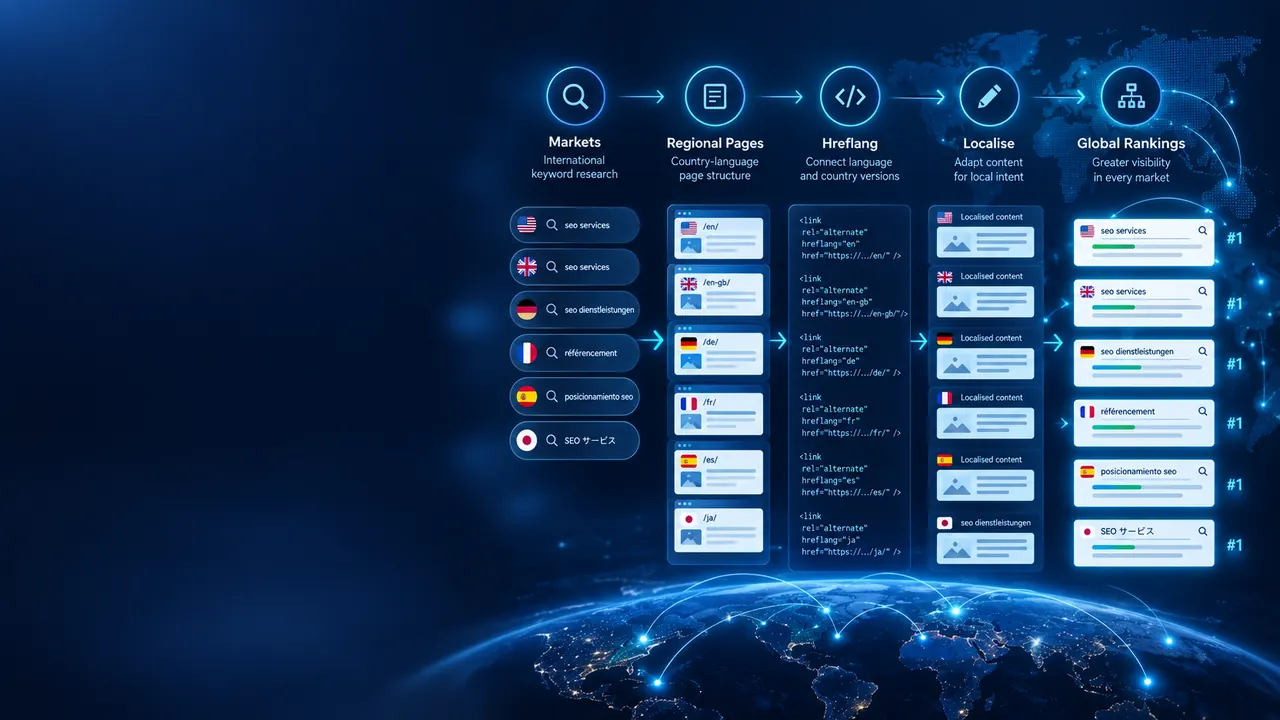
International SEO Services at a glance
Our international SEO services help brands rank in every country and language they sell in — global SEO strategy, multilingual SEO content, hreflang implementation and localised technical SEO, planned market by market rather than translated once.
Get a free audit →- Hreflang implementation
- Multilingual SEO
- Market-by-market keyword research
- ccTLD & subfolder strategy
- Localised content
- Per-market reporting
Translating your site is not international SEO — and it usually makes things worse
Most global expansions fail the same way: the existing site gets translated, hreflang is added roughly, and the result is a set of pages competing with each other while ranking in none of the target markets. Search behaviour, competitive sets, buying conventions and even the phrasing of the same concept differ meaningfully between markets — including between countries that share a language.
- Hreflang errors
Hreflang implemented incorrectly
Missing return tags, wrong region codes and conflicting canonicals are extremely common. Broken hreflang does not merely fail to help — it actively creates duplication and cannibalisation across your market versions.
- Literal translation
Translation instead of localisation
Directly translated keywords frequently have low or no search volume in the target market, because people search using different terminology. Ranking for a phrase nobody types is the usual outcome.
- No local authority
No local authority signals
Search engines weight local relevance heavily. A market version with no local links, citations or presence looks foreign and is treated as such, regardless of how strong the parent domain is.
- Markets competing
Markets cannibalising each other
US, UK, Australian and Canadian versions of near-identical English content compete directly. Without correct targeting and differentiation, engines pick one and suppress the rest.
One strategy per market. Not one strategy translated many times.
Global SEO is the work of building genuine per-market search presence: correct technical targeting, keyword research conducted natively in each market, localised content reflecting local conventions, and authority signals that establish local relevance.
The technical layer — domain structure, hreflang, geotargeting — is the part most teams get wrong and the part that is cheapest to get right. The strategic layer, where you accept that each market needs its own keyword set and competitive analysis, is what separates expansions that work from expansions that stall.
- Keywords translated directlyResearched natively in-market
- Hreflang added roughlyValidated bidirectional tags
- One competitive analysisPer-market competitor sets
- Parent-domain links onlyIn-market authority built
- Markets cannibalisingCleanly differentiated
- One global reportPer-market performance
US, UK, Australian and Canadian searchers use different terminology, face different competitors and expect different conventions. Treating them as one market is the most common and most expensive international mistake.
- Domain & URL structure
- CcTLD, subdomain or subdirectory chosen on evidence about your resources, brand and markets rather than on a blanket rule.
- Hreflang implementation
- Correct bidirectional annotation with proper language and region codes, validated at scale — the most commonly broken element in international SEO.
- Native keyword research
- Conducted in-market by people who speak the language, because translated keyword lists systematically miss how people actually search.
- Content localisation
- Adapted for local conventions, examples, currency, regulation and search intent — not translated and republished.
- Local authority building
- In-market links, citations and presence, since engines weight local relevance heavily when deciding which market version to trust.
How we build international search presence
Six workstreams, technical targeting first so that content investment lands in the right market from the outset.
Market prioritisation
Opportunity sized per market against competitive difficulty and your operational capacity. Entering six markets badly is considerably worse than entering two properly, and this is where that decision gets made.
What’s included
- International search demand by country
- Competition and revenue potential per market
- Launch order for global SEO
You receive: An international SEO market plan
Structure & hreflang
Domain architecture chosen on evidence, then hreflang implemented with correct bidirectional annotation and validated at scale. Broken hreflang creates duplication rather than merely failing to help.
What’s included
- Subfolder, subdomain or ccTLD decision
- Hreflang tags implemented and validated
- International site architecture
You receive: An international SEO structure
Native keyword research
Conducted in-market by native speakers, because translated keyword lists systematically miss the terminology people actually use. This routinely reshapes the entire content plan.
What’s included
- Keyword research by native speakers
- Local search terms and spelling
- Search volumes for each country
You receive: A native keyword list for each market
Content localisation
Adapted for local conventions, examples, currency, regulation and intent — and differentiated enough between markets that versions stop competing with each other.
What’s included
- Native-language content rather than literal translation
- Local search terms, currency and examples
- Cultural review before publishing
You receive: Localised landing pages for each market
Local authority building
In-market links, citations and presence so each market version reads as locally relevant rather than as a foreign page serving a translated string.
What’s included
- Links from local publications and directories
- Country-specific domains and citations
- Local PR in each market
You receive: A local link plan for each market
Per-market measurement
Separate reporting per market, because a global average conceals a market collapsing behind one performing well — which is exactly the failure mode we see most.
What’s included
- Rankings and traffic for each country
- Hreflang and indexation monitoring
- Revenue reporting by market
You receive: An international SEO dashboard
Get a free audit →Four core markets natively, thirty-plus supported
We operate in the US, UK, Australia and Canada in timezone, with native capability extending across 15+ languages.
Native, not translated
Keyword research and content produced by people who speak the language and know the market. Translated keyword lists miss how people genuinely search, every time.
Hreflang validated at scale
We validate bidirectional annotation across the full URL set rather than spot-checking. Broken hreflang is the most common international failure and the most quietly damaging.
Per-market reporting
Separate performance per market, because a global average hides a market failing behind one that is working — and that is precisely what usually happens.
Honest market prioritisation
We will tell you when a market is not worth entering yet. Expanding into six markets badly is worse than entering two properly, and most plans we see are over-extended.
In-market authority
Local link and citation building per market, since local relevance signals are what determine which version engines actually trust.
In-timezone operation
We work in your markets’ hours, not just your own. It matters more than it sounds for outreach, PR and anything requiring local responsiveness.
Why Businesses Choose SDM for Global SEO
Same budget, very different outcomes. Point by point, here’s how a specialist partner compares to a typical agency or going it alone.
| What actually matters | With SDM | Typical Agency | In-House / DIY |
|---|---|---|---|
| Senior specialist on your account | Always | Often a junior | Stretched thin |
| Custom strategy built for your goals | Tailored | Templated | Guesswork |
| Deep audit before any work begins | ✓ | Surface-level | Skipped |
| White-hat, penalty-safe methods | Guaranteed | Varies | High risk |
| Plain-English reporting tied to revenue | Monthly | Jargon PDFs | None |
| Direct access to your specialist | ✓ | Account-manager relay | N/A |
| Native in-market keyword research | ✓ | Translated lists | Guesswork |
| Hreflang validated across all URLs | ✓ | Spot-checked | Often broken |
| Content localised, not translated | ✓ | Machine translated | Translated |
| In-market authority building | ✓ | Parent domain only | None |
| Per-market performance reporting | ✓ | Global average | Unclear |
| Ongoing competitor gap analysis | ✓ | One-off | Manual |
| Conversion-focused, not just traffic | ✓ | Traffic-first | Unclear |
| Premium tools included (Ahrefs, SEMrush) | ✓ | Sometimes | Costly extra |
| No long lock-in contracts | Flexible | 6–12 mo lock-in | N/A |
| Established agency, operating since 2017 | ✓ | Varies | Learning curve |
| Fast onboarding & early quick wins | ~2 weeks | Slow | Trial & error |
| Human, SEO-led content (no AI spam) | ✓ | Outsourced / AI spam | Time-heavy |
| Focus on compounding, long-term ROI | Core promise | Short-term wins | Slow & ad-hoc |
| Recovery from Google penalties | ✓ | Sometimes | Very hard |
20 reasons growing brands make the switch. See the difference for yourself →
A global average hides the market that is failing
We report every market separately, because aggregate international numbers routinely conceal one market collapsing behind another performing well.
Per-market performance
Traffic, rankings and revenue separated by market, so problems surface where they occur rather than being averaged away.
Hreflang health
Validation coverage and error rate across the full URL set, monitored since these break silently whenever templates change.
Cross-market cannibalisation
Whether market versions are competing with each other — the most common and least visible international failure.
Local authority per market
In-market referring domains and citations, which determine whether each version reads as locally relevant.
Revenue by market
Attributed revenue per market against investment, so expansion decisions are made on contribution rather than traffic.
Our International SEO process: four stages, repeated per market
We enter markets deliberately and sequentially rather than launching everywhere at once and diluting everything.
Prioritise
Opportunity sized per market against competitive difficulty and your operational capacity to serve it. You get a sequenced entry plan rather than a simultaneous launch that under-resources every market.
DeliverableSequenced market entry planBuild the technical base
Domain structure decided, hreflang implemented and validated at scale, geotargeting configured. This happens before content so investment lands in the right market from the start.
DeliverableValidated international structureLocalise
Native keyword research, content adapted for local conventions and intent, and differentiation between market versions so they stop competing with each other.
DeliverableLocalised, differentiated contentBuild local authority
In-market links, citations and presence, with per-market reporting. Once a market holds, the next in the sequence begins.
DeliverablePer-market report + next market
Proven results from real SEO clients
Published case studies from our clients — each with the starting point, the dates, the source and what the numbers don’t prove.
A home services franchise group — 34.1K ranking keywords and 1.8K AI mentions.
Read the case study →B2B SaaS SEO77.9K Google clicks in three months — organic is the top channel.
Read the case study →Home services SEOTop 3 for “emergency plumber”, cited on 218 pages in AI answers.
Read the case study →International SEO FAQs: the questions we get asked most
Practical answers on structure, sequencing and what international expansion realistically requires.
Further reading
Go deeper on this
The thinking behind the work. These guides go deeper on the methods this page describes — written by the team that runs them.