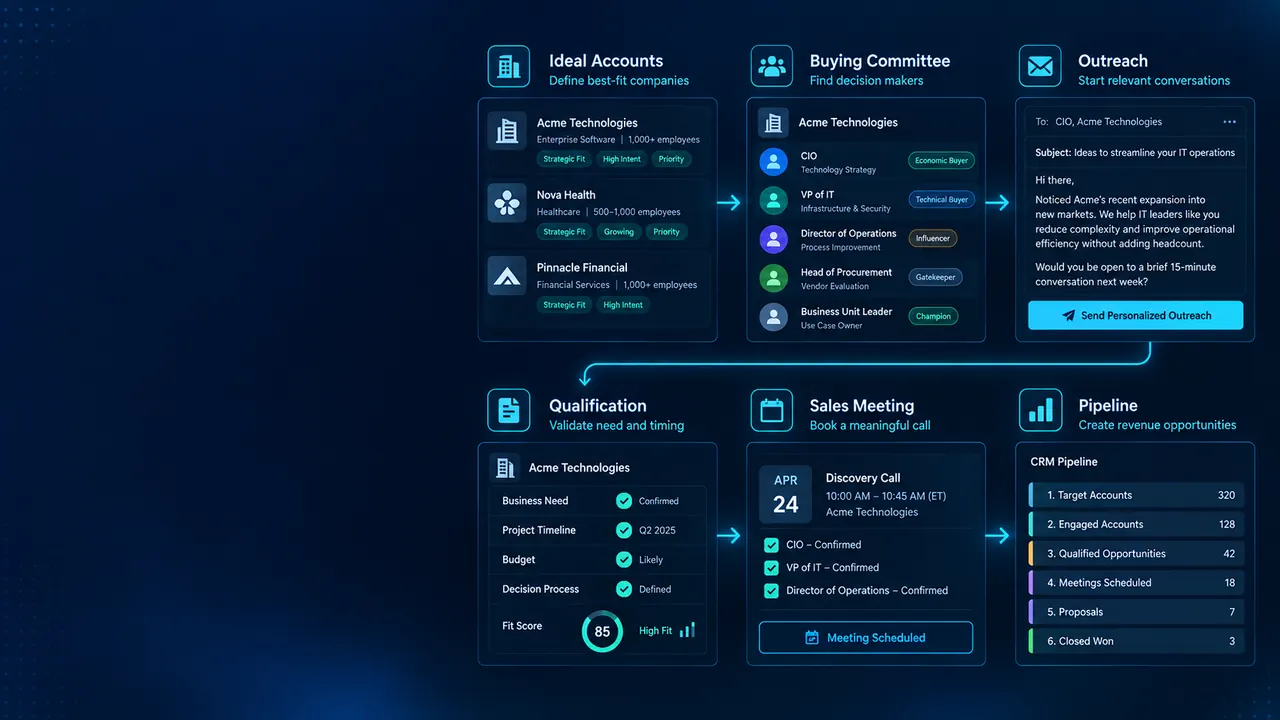
B2B Lead Generation Services at a glance
Our B2B lead generation services build pipeline you can forecast. As a B2B lead generation agency, we combine search, LinkedIn, content and account based marketing for named target accounts — B2B lead gen measured on sales-qualified opportunities, not form fills.
Get a free audit →- Ideal customer profile
- Account based marketing
- LinkedIn & search campaigns
- Lead scoring
- CRM integration
- Pipeline reporting
You are not generating a lead. You are entering a committee decision already in progress
By the time a B2B buyer fills anything in, they have usually shortlisted. Research happens across a group — the person who searches is rarely the person who signs — and most of it leaves no trace in your analytics. Programmes built around capturing an individual at the moment of intent miss the part where the decision is actually made.
One contact treated as the buyer
The researcher, the technical evaluator, the budget holder and the eventual signatory are different people with different questions. Speaking to one of them loses the other three.
MQL defined by activity, not fit
Scoring someone highly because they opened four emails tells you they read email. Company fit and buying signal predict deals; engagement alone does not.
Short-cycle measurement
Judging a B2B programme on ninety days when the sales cycle is six months guarantees it gets cut before the pipeline it built ever closes.
Attribution collapsed to last click
A deal touched by twelve pieces of content over eight months gets credited to whichever one came last. Budget then flows to the wrong place.
Reach the account, not just the individual.
We build visibility across the questions the whole committee asks — the technical evaluation, the commercial comparison, the risk and compliance questions the person who signs will raise. That means content depth on unglamorous topics, not a single gated asset.
Then we make the pipeline measurable across a long cycle: fit-based scoring, staged handover to sales, and reporting that follows a deal from first touch to close rather than crediting whichever click came last.
- Targets one individual
- Scores on email opens
- Judged at 90 days
- Last-click attribution
- One gated ebook
- Volume targets
- Addresses the whole committee
- Scores on company fit
- Judged across the sales cycle
- Multi-touch from the CRM
- Depth on evaluation questions
- Pipeline value targets
the boring pages. Security posture, integration detail, implementation time, what it costs, who it is not for. These get read by the people who can veto a purchase, and almost nobody writes them properly.
- Committee mapping
- Who is involved in a decision in your category, what each one needs answered, and which of those questions you currently address.
- Fit-based scoring
- Company profile and buying signal weighted ahead of engagement activity, so sales gets accounts worth working rather than keen readers.
- Bottom-funnel content depth
- Comparison, integration, security and pricing questions — the pages that get read late in a decision and rarely get written.
- Account-based targeting
- Where deal value justifies it, paid and outreach concentrated on a defined account list rather than sprayed across a category.
- Long-cycle attribution
- Multi-touch reporting from your CRM so the content that started a deal is not invisible next to the form that ended it.
How B2B pipeline gets built
Six components, sequenced so early work compounds rather than being redone.
Committee & ICP mapping
Who decides, who evaluates, who blocks. Plus the account profile that actually closes, drawn from your own won-deal data.
Intent coverage audit
Which evaluation-stage queries you cover, which competitors own, and which nobody has answered properly yet.
Bottom-funnel build
Comparison, integration, security, pricing and objection content — written for the evaluator rather than the browser.


Account-based layer
Where deal size justifies it, concentrated paid and outreach against a named account list rather than a broad category.
Scoring & handover
Fit-weighted scoring with an agreed threshold, so sales receives accounts at the point they are genuinely workable.
Pipeline reporting
Multi-touch attribution across the full cycle, reported as pipeline value rather than lead count.


We report pipeline, not leads
A lead count says nothing about deal value. In B2B the two are frequently unrelated.
ICP built from won deals
Your ideal profile comes from analysing what actually closed, not from a persona workshop. The two are often very different.
We write the unglamorous pages
Security, integration, implementation and pricing. These decide deals and almost every competitor leaves them thin.
Measured across the real cycle
If your cycle is six months we report on six months, and we say so upfront rather than showing thin ninety-day numbers.
Fit before engagement
A perfect-fit account that read one page beats a poor-fit contact who read nine. Scoring reflects that.
ABM only where it pays
Account-based work is expensive per account. We recommend it when deal value supports it and say so when it does not.
Pipeline value as the headline
Reported in currency against your CRM, because that is the number a board can act on.
Why Businesses Choose SDM for B2B Lead Generation
Same budget, very different outcomes. Point by point, here’s how a specialist partner compares to a typical agency or going it alone.
| What actually matters | With SDM | Typical Agency | In-House / DIY |
|---|---|---|---|
| Senior specialist on your account | Always | Often a junior | Stretched thin |
| Custom strategy built for your goals | Tailored | Templated | Guesswork |
| Funnel & CRM audit before any spend | ✓ | Surface-level | Skipped |
| Consented, GDPR-compliant data only | Always | Varies | Risky |
| Plain-English reporting tied to revenue | Monthly | Jargon PDFs | None |
| Direct access to your specialist | ✓ | Account-manager relay | N/A |
| ICP built from closed-won data | ✓ | Persona workshop | Guesswork |
| Evaluation-stage content written | ✓ | Top-funnel only | Rarely |
| Fit-weighted lead scoring | ✓ | Activity scoring | None |
| Reported as pipeline value | ✓ | Lead count | Unclear |
| Measured over the real sales cycle | ✓ | 90 days | n/a |
| Ongoing competitor offer analysis | ✓ | One-off | Manual |
| Conversion paths fixed before buying traffic | ✓ | Traffic-first | Rarely |
| CRM, tracking & call analytics included | ✓ | Extra cost | Patchy |
| No long lock-in contracts | Flexible | 6–12 mo lock-in | N/A |
| Established agency, operating since 2017 | ✓ | Varies | Learning curve |
| Fast onboarding & early quick wins | ~2 weeks | Slow | Trial & error |
| Human-written offers & nurture copy | ✓ | Templated | Time-poor |
| Optimised to closed revenue, not volume | ✓ | Lead count | Unclear |
| Speed-to-lead process built in | ✓ | Rarely | Slow |
20 reasons growing brands make the switch. See the difference for yourself →
Pipeline value, and what it cost to create
Everything else is a leading indicator of these two.
Pipeline value created
Currency value of opportunities attributable to marketing, taken from your CRM rather than a platform.
SQL acceptance rate
The share of marketing-qualified leads sales accepts. The clearest test of whether scoring reflects reality.
Accounts engaged
Target accounts showing meaningful activity, counted at account level rather than per contact.
Cost per opportunity
Total spend divided by genuine opportunities — comparable to deal value in a way cost per lead is not.
Cycle length
Whether well-informed buyers are moving faster. Good bottom-funnel content usually shortens this measurably.


Our B2B Lead Generation process: four stages, measured over the real cycle
Expect leading indicators in the first quarter and pipeline in the second.
Define the account
ICP from closed-won analysis, committee mapping, and a scoring model agreed with sales.
Agreement on what countsCover the evaluation
Bottom-funnel content built where competitors are thin and buyers get stuck.
Found during evaluationConcentrate reach
Search, paid and where justified account-based outreach against the defined list.
Accounts engagingReport pipeline
Multi-touch attribution across the full cycle, reviewed quarterly against pipeline value.
A number the board uses
B2B Lead Generation FAQs: the questions we get asked most
On cycles, committees and why lead count is the wrong target.
Further reading
Guides, terms and related services
Go deeper on the methods behind this service, with guides written by the specialists who run them, plain-English definitions and the services that usually work alongside it.
 Performance Marketing
The Omnichannel ROI Framework: Stop Burning Ad Spend
A digital marketing ROI framework for 2026: server-side tracking, MER, incrementality testing, marketing mix modelling, LTV:CAC and payback period.
Read the guide Digital Marketing
Content That Converts: Copywriting That Sells
How to write content that converts: copywriting formulas, benefit-led messaging, specificity, social proof, microcopy and calls to action that work.
Read the guide Digital Marketing
Email Marketing in 2026: Deliverability & ROI
Email marketing in 2026: sender authentication, Gmail and Yahoo rules, list health, automation flows, segmentation and measuring revenue, not opens.
Read the guide