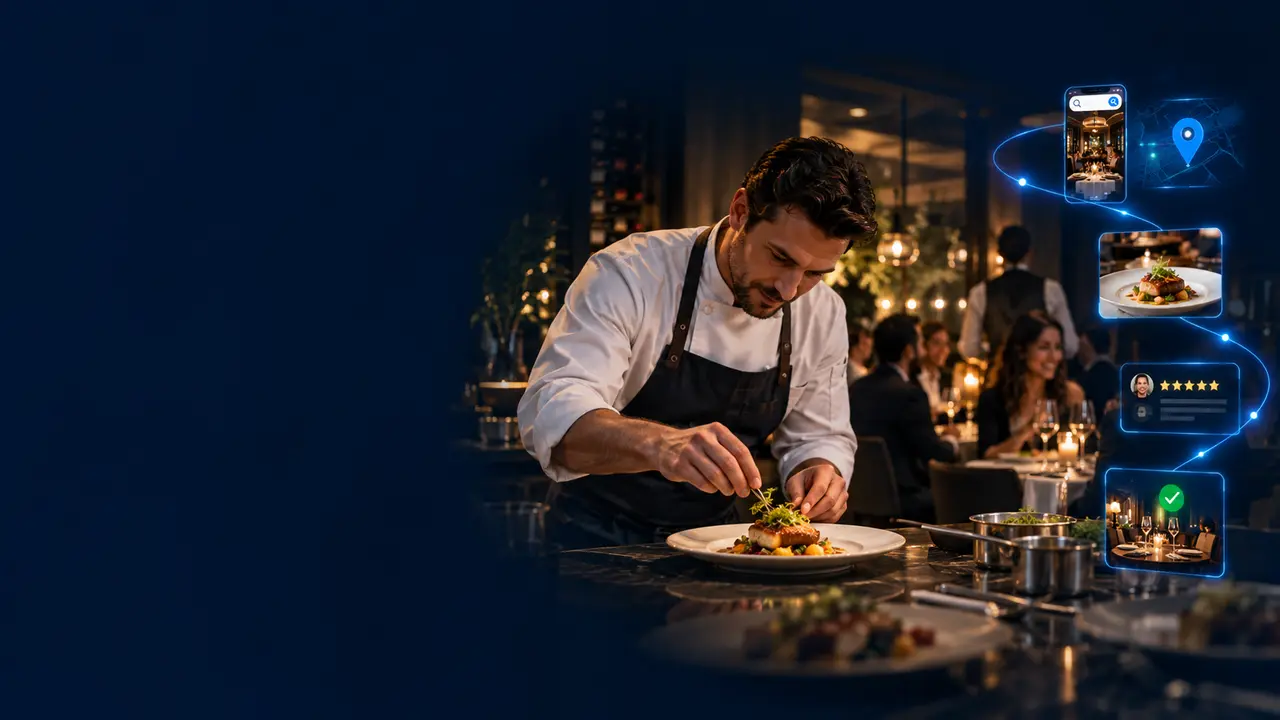
SEO for Restaurants at a glance
Our restaurant SEO wins the decisions made in under three minutes. Restaurant marketing, local restaurant SEO and cafe SEO cover your Google Business Profile, menus, photos and reviews — so diners find you, trust you and book a table.
Get a free audit →- Google Business Profile
- Menu & photo optimisation
- Local restaurant SEO
- Cafe SEO
- Review management
- Table booking tracking
Most restaurant decisions are made in under three minutes
Restaurant search is fast, visual and overwhelmingly mobile. The decision is made on photographs, rating and how easy it is to book — usually before anyone reads a word of your menu description.
Where shall we eat?
Often within an hour of eating. Mobile, location-led, and decided almost entirely on what appears in the map pack.
Photos and rating
They look at the food photography, the rating and a couple of recent reviews. Anything below roughly 4.2 is skipped.
Practical details
Opening hours, whether it takes bookings, parking, dietary options. Missing information loses the table.
Table or takeaway
They book or walk in. A broken booking link or an outdated menu sends them to the next result on the list.
What poor visibility costs a restaurant
Restaurant search is decided almost entirely in the map pack, and the top three positions capture the overwhelming majority of local intent. Below that, you are effectively invisible during the moment people are choosing.

Not in the map pack
Three results appear above everything for “restaurants near me”. If you are not among them, most nearby diners never see you exist, however good the food is.

Rating below the filter
Diners filter hard on rating, and most will not consider a restaurant below about 4.2. A stale review profile also suppresses your map position directly.

Outdated menu or hours
Incorrect opening hours and PDF menus that will not open on a phone are among the most common and most costly errors in restaurant search.

Commission on every booking
Third-party reservation and delivery platforms charge per cover or per order on customers who, in many cases, were already searching for you specifically.
The queries that fill tables
Restaurant search is dominated by immediate, location-led intent. We prioritise the queries that produce covers tonight, then build the occasion and cuisine queries that fill weekday gaps.
| Search term | Intent | Volume | Why it matters |
|---|---|---|---|
| “restaurants near me” | Very high | Very high | The core query. Decided by map pack position, photos and rating. |
| “[cuisine] near me” | Very high | High | Cuisine-specific and highly winnable with correct categories. |
| “restaurants open now” | Very high | High | Immediate intent. Won purely on accurate hours markup. |
| “best restaurants in [area]” | High | High | Comparison phase, dominated by lists and review sites. |
| “restaurants with private dining” | Very high | Medium | High-value group bookings, consistently under-targeted. |
| “vegan restaurant [city]” | Very high | Medium | Dietary filter searches convert strongly and face light competition. |
| “sunday roast near me” | Very high | Medium | Occasion-led and seasonal. Very high conversion when targeted. |
| “restaurants for birthday [area]” | Very high | Medium | Group booking intent, larger covers, higher spend per table. |
Restaurant search is intensely seasonal and occasion-driven. We build a calendar around your local demand patterns rather than optimising for a flat annual average.
Who is between you and your diners
Restaurant search is heavily intermediated by platforms whose business model is charging you for customers who were often already looking for you.

Booking & delivery platforms
OpenTable, TheFork, Deliveroo and similar rank prominently for restaurant queries and charge per cover or per order for diners you frequently already earned.

Review sites and local lists
TripAdvisor, Yelp and “best restaurants in” roundups own the comparison-phase queries where diners narrow their shortlist.

Chains and local competitors
Chains have marketing budget and consistent profiles; a handful of local independents have taken map pack visibility seriously.
Our restaurant SEO services: the work that fills a dining room
Restaurant SEO is won on map pack position, visual appeal and frictionless booking. Everything below runs as a single programme.
Google Business Profile
Correct cuisine categories, accurate hours including holidays, professional food photography on a cadence, menu integration and managed Q&A.
- Primary and secondary categories audited against the top-ranking restaurants
- Services, attributes, hours and booking links completed in full
- Weekly posts, geotagged photos and a managed Q&A section
Review engine
Compliant review generation timed to the end of a positive visit, plus response handling — the strongest lever on both ranking and diner choice.
- Automated review requests timed to the moment of delivery
- Response templates that stay personal and compliant
- Review velocity tracked against the restaurants ranking above you
Crawlable menus
HTML menus rather than PDFs, marked up with schema so dishes, prices and dietary options are readable by search engines and diners alike.
- Menus published as real HTML text, not PDFs or images
- Dishes, prices and dietary information structured
- Menu schema linked to the Business Profile

Occasion & event content
Private dining, group bookings, seasonal menus and occasion pages that capture higher-value covers most restaurants never target.
- Pages for private dining, parties and events
- Set menus and group pricing explained
- Enquiry forms tailored to each occasion
Direct booking
Fast mobile pages with a direct reservation path, reducing dependence on per-cover platform fees.
- Reservation links on the Business Profile and every menu page
- Table booking integrated without third-party commission
- Event and group enquiry forms that respond fast

Dietary & filter visibility
Vegan, gluten-free, halal and allergen information properly marked up, capturing high-intent filter searches with light competition.
- Vegan, gluten-free and allergen information structured
- Dietary attributes completed on the Business Profile
- Dedicated pages for common dietary searches
Your first 90 days of restaurant SEO
Map pack and reviews first, because those produce covers fastest in a category where decisions are made in minutes.
An independent restaurant that stopped paying per cover
A well-reviewed independent restaurant sat outside the map pack for every relevant query. Its menu was a PDF that would not open properly on mobile, opening hours were wrong on the profile, and most bookings came through a platform charging per cover.
We rebuilt the profile with correct cuisine categories and professional food photography, replaced the PDF with a schema-marked HTML menu, corrected hours including holidays, deployed a review engine, and built occasion and private dining pages.
We were paying commission on people who had searched for us by name. Fixing the basics put us in the top three, and now most bookings come straight through our own site.
Restaurant SEO FAQs: questions restaurants ask
Practical answers on visibility, reviews and reducing platform dependence.
Further reading
Guides, terms and related services
Go deeper on the methods behind this service, with guides written by the specialists who run them, plain-English definitions and the services that usually work alongside it.
 SEO
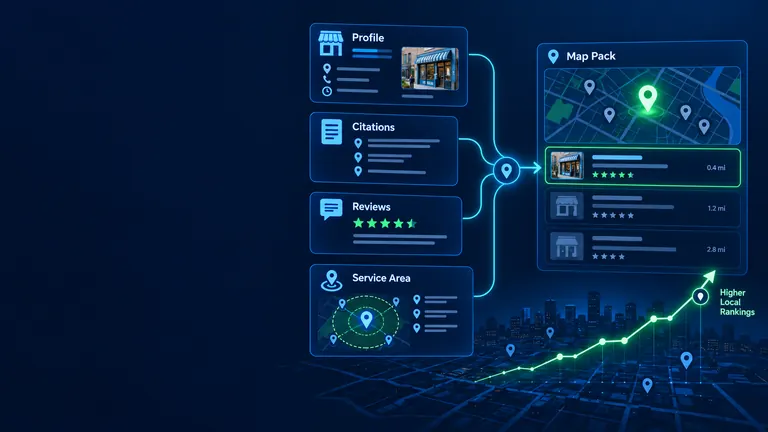
SEOLocal SEO Playbook: Dominate Your City in 90 Days
The local SEO playbook for 2026: win the Google Maps local pack with Google Business Profile, reviews, citations, location pages and local links.
Read the guide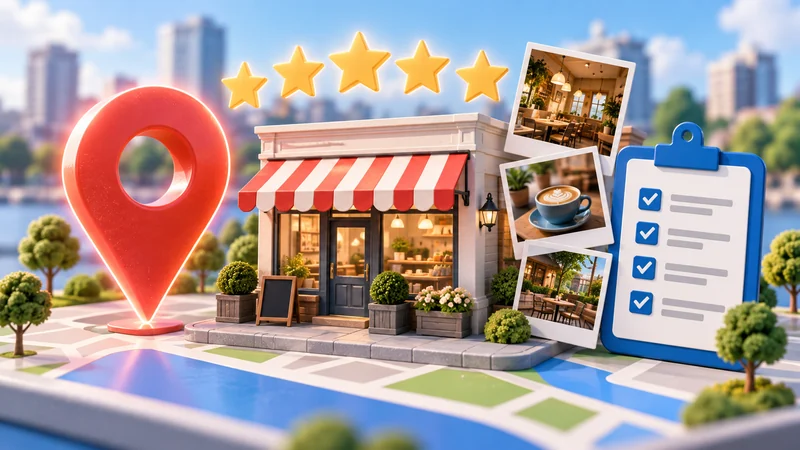 SEO
SEOGoogle Business Profile Optimization Checklist 2026
A complete Google Business Profile optimization checklist for 2026: categories, services, photos, reviews, posts, suspensions, multi-location tips and tracking.
Read the guide AI SEO
Generative Engine Optimization (GEO): 2026 Playbook
The generative engine optimization (GEO) playbook for 2026: how AI Overviews, ChatGPT and Perplexity choose sources, the GEO checklist and how to measure it.
Read the guide