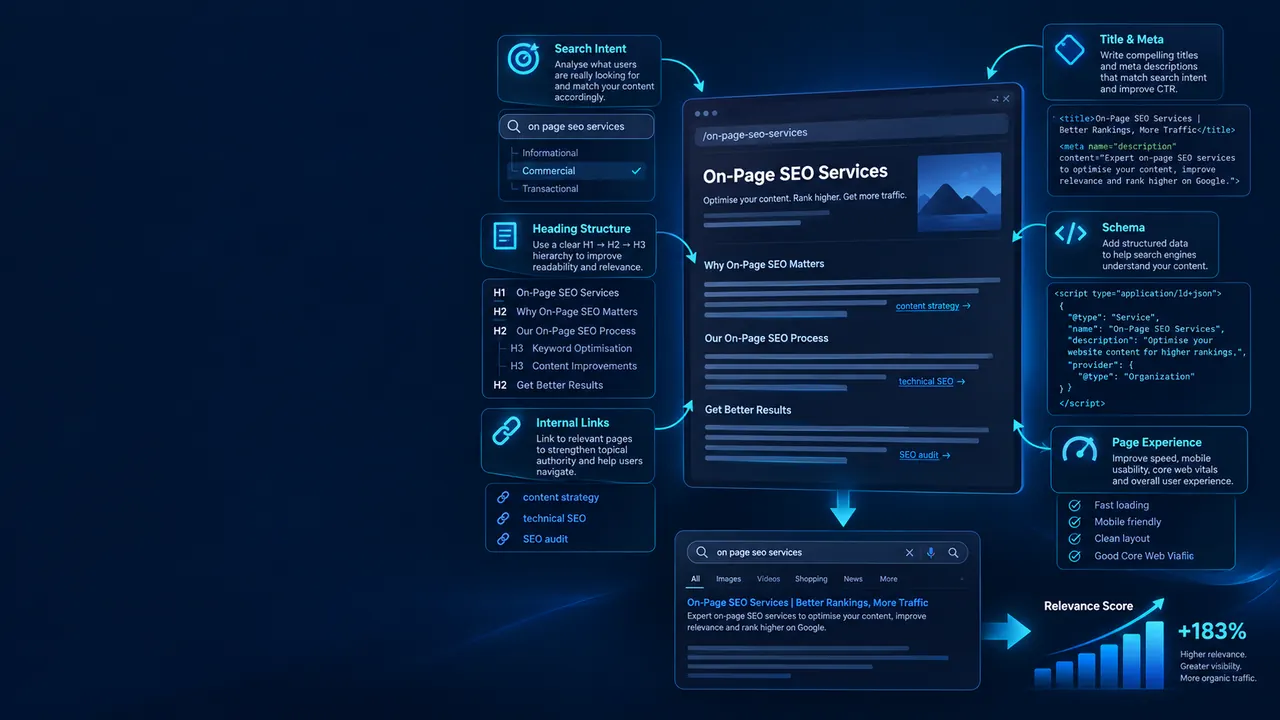
On-Page SEO Services at a glance
Our on-page SEO services make every page the best answer for its query — on page optimisation of title tags, meta descriptions, headings, content depth, internal links and schema, backed by keyword research and search intent mapping.
Get a free audit →- Keyword research
- Title tags & meta descriptions
- Header structure
- Content optimisation
- Internal linking
- Schema markup
Technical SEO makes a page crawlable. On-page makes it the right answer.
On-page SEO is everything within a page’s own content and markup that determines what query it deserves to rank for: titles, headings, body content, entity coverage, media, internal links and structured data.
It sits between technical SEO (can the page be reached and rendered?) and off-page authority (does anyone vouch for it?). On-page is the layer you fully control, which is why it usually produces the fastest measurable movement — no third-party outreach, no engineering backlog, no waiting.
- Brand-first titleIntent-first title
- H2s describing layoutH2s decomposing the topic
- Two pages, one queryOne page, one intent
- Generic ‘click here’ anchorsDescriptive keyword anchors
- No schemaValidated rich-result markup
- Orphaned deep pagesLinked topical clusters
On-page changes need no outreach, no link acquisition and no engineering release cycle. A retitled, restructured page can move within one crawl — often days, not quarters.
- Keyword-to-URL mapping
- One primary intent per page, documented across the whole site so cannibalisation is designed out rather than discovered later.
- Title and meta engineering
- Titles built to carry the query and win the click, tested against truncation limits and actual SERP competition.
- Heading and content architecture
- An H-structure that mirrors how the topic decomposes, with the subtopics and questions the query implies genuinely covered.
- Entity and semantic coverage
- The people, products, places and concepts a credible page on this topic would reference, stated explicitly rather than implied.
- Internal link engineering
- Descriptive anchors, hub-and-spoke topical clusters, and authority routed deliberately toward the pages that earn revenue.
- Structured data
- The schema types your page qualifies for, validated, so you become eligible for the rich results your competitors already hold.
How we rebuild a page to rank
Six stages applied page by page, prioritised by commercial value so revenue pages get fixed before blog archives.
Intent & cannibalisation audit
We map every URL to the query it should own, then surface every case where two pages compete. Consolidation decisions come first, because optimising two cannibalising pages just entrenches the problem.
What’s included
- Pages competing for the same keyword
- Search intent mismatches found
- Merge, redirect or re-target decisions
You receive: A keyword cannibalisation report
SERP-derived specification
For each target query we analyse the pages currently ranking — their format, depth, subtopic coverage and entity set — and turn that into a concrete content specification rather than a word count.
What’s included
- Content brief built from top-ranking pages
- Headings, entities and questions to cover
- Target length and search intent
You receive: An SEO content brief
Title, meta & heading rebuild
Titles engineered to carry intent and earn the click, meta descriptions written as ad copy, and heading structures that decompose the topic the way the query implies it should be.
What’s included
- Title tags written for keywords and clicks
- Meta descriptions that improve CTR
- Clean H1 to H3 structure
You receive: On-page metadata rewrites
Content depth & entity coverage
We close the gap between what your page covers and what the query requires, adding the subtopics, entities, figures and questions a definitive page would include — and cutting what dilutes focus.
What’s included
- Entities and subtopics Google expects on the page
- Semantic keyword coverage from top-ranking pages
- Supporting FAQs and worked examples
You receive: An on-page content depth brief
Internal link engineering
Topical clusters with hub pages, descriptive anchors, and authority routed toward commercial pages. We also fix orphans, which are almost always present and almost always ignored.
What’s included
- Contextual internal links in body copy
- Link equity routed to money pages
- Orphan pages fixed
You receive: An internal link implementation list
Schema & rich-result eligibility
Every schema type the page legitimately qualifies for, implemented and validated, so you compete for the enhanced result formats already held by competitors.
What’s included
- FAQ, article and breadcrumb schema
- Validation in the Rich Results Test
- Rich snippet opportunities
You receive: Schema markup for key pages
Get a free audit →Specification-driven, not checklist-driven
Most on-page audits produce a generic checklist. We produce a per-page specification derived from what is actually winning the query today.
SERP-derived specifications
Every recommendation traces to observed evidence about what ranks for your specific query, not to a general best-practice list that ignores your category’s conventions.
Cannibalisation resolved first
We fix competing pages before optimising anything, because the alternative is spending months strengthening two pages that will continue to split each other’s signals.
Internal linking as a discipline
We treat internal links as an authority routing system with a documented architecture, rather than adding a handful of related-post links and hoping.
Per-page attribution
You see which specific pages moved, for which queries, and what that traffic did commercially — so on-page investment is defended with numbers rather than adjectives.
Multi-market on-page
Intent and phrasing differ by locale even in one language. We build per-market specifications instead of translating a single keyword map, which is what makes international on-page work hold.
Writers briefed on specifications
Our content team works from the entity and subtopic specification directly, removing the usual gap between what the audit asked for and what the page ends up saying.
On-page work should show up per page, per query, per month
Because on-page changes are isolated and fast, they are unusually measurable. We report at page level so cause and effect stay legible.
Query coverage per page
How many distinct queries each optimised page ranks for, and how that set widens as topical depth improves.
Position movement by page
Before-and-after ranking for every page touched, so each change is attributable rather than lost in a sitewide average.
Click-through rate
Impressions versus clicks per page, isolating title and meta performance from ranking performance — two problems that look identical in a traffic chart.
Internal link equity
Link depth, orphan count and authority distribution across the site, tracked as the cluster architecture is built out.
Revenue per optimised page
Conversions and assisted revenue attributed to the specific pages rebuilt, which is how on-page budget gets renewed.
Our On-Page SEO process: four stages, repeated every month
We work in prioritised tranches, highest commercial value first, so early cycles pay for the later ones.
Audit & map
Full crawl, intent mapping of every URL, cannibalisation analysis, and a prioritised page list scored by commercial value and effort. You get a documented keyword-to-URL map that becomes the site’s reference architecture.
DeliverableKeyword map + prioritised page listSpecify
For each page in the tranche we build a specification from the current SERP: required subtopics, entities, format, depth, schema and internal link targets. Writers and developers work from this rather than a vague brief.
DeliverablePer-page content specificationsRebuild
Titles, metas, headings, body content, media and schema implemented; internal links wired into the cluster; redirects handled where pages consolidate. Changes ship in batches so impact stays attributable.
DeliverableRebuilt pages, shipped in batchesMeasure & iterate
Per-page before-and-after on rankings, CTR and conversions. Pages that underperform get re-specified against whatever is now winning; the next tranche enters the queue.
DeliverablePage-level report + next tranche
Proven results from real SEO clients
Published case studies from our clients — each with the starting point, the dates, the source and what the numbers don’t prove.
Recovered from a Google update drop — page one for “furnace repair near me”.
Read the case study →Home services SEOTop 3 for “emergency plumber”, cited on 218 pages in AI answers.
Read the case study →Franchise SEOA home services franchise group — 34.1K ranking keywords and 1.8K AI mentions.
Read the case study →On-Page SEO FAQs: the questions we get asked most
Practical answers on scope, sequencing and what on-page work can realistically move.
Further reading
Go deeper on this
The thinking behind the work. These guides go deeper on the methods this page describes — written by the team that runs them.
 SEO
SEOThe Complete Guide to SEO in 2026
The complete guide to SEO in 2026: how Google ranks pages, technical SEO, content, links, local and AI search, a 6-month roadmap and how to measure ROI.
Read the guide Content Marketing
Content Clusters & Topical Authority: 2026 Guide
How to build content clusters and topical authority in 2026: pillar pages, cluster research, internal linking, content briefs, updates and measuring results.
Read the guide