A meta description is an HTML attribute that provides a short summary of a web page. Search engines often display it as the snippet under the page title in results. It is not a direct ranking factor, but a clear, compelling description can increase the number of people who click.
On this page
- What a meta description looks like
- Do meta descriptions affect rankings?
- Ideal meta description length
- How to write a good meta description
- Why Google rewrites meta descriptions
- Meta description examples
- Writing meta descriptions at scale
- How to test whether a meta description works
- Meta description checklist
- Meta description templates by page type
- How meta descriptions appear in AI and social previews
- Quick reference
- Frequently asked questions
What a meta description looks like
It sits in the page’s <head>:
<meta name="description" content="Book a certified emergency plumber in Houston in under 60 minutes. Upfront pricing, 24/7 callouts and a 12-month repair guarantee.">
Do meta descriptions affect rankings?
No. Google confirmed back in 2009 that it does not use the meta description as a ranking signal. It matters because it is your sales pitch in the results page: a better description earns more clicks from the same position.
Ideal meta description length
Google cuts snippets by pixel width, not a fixed character count. Around 150–160 characters usually displays in full on desktop, and slightly less on mobile. Put the essential message in the first 120 characters so it survives truncation.
How to write a good meta description
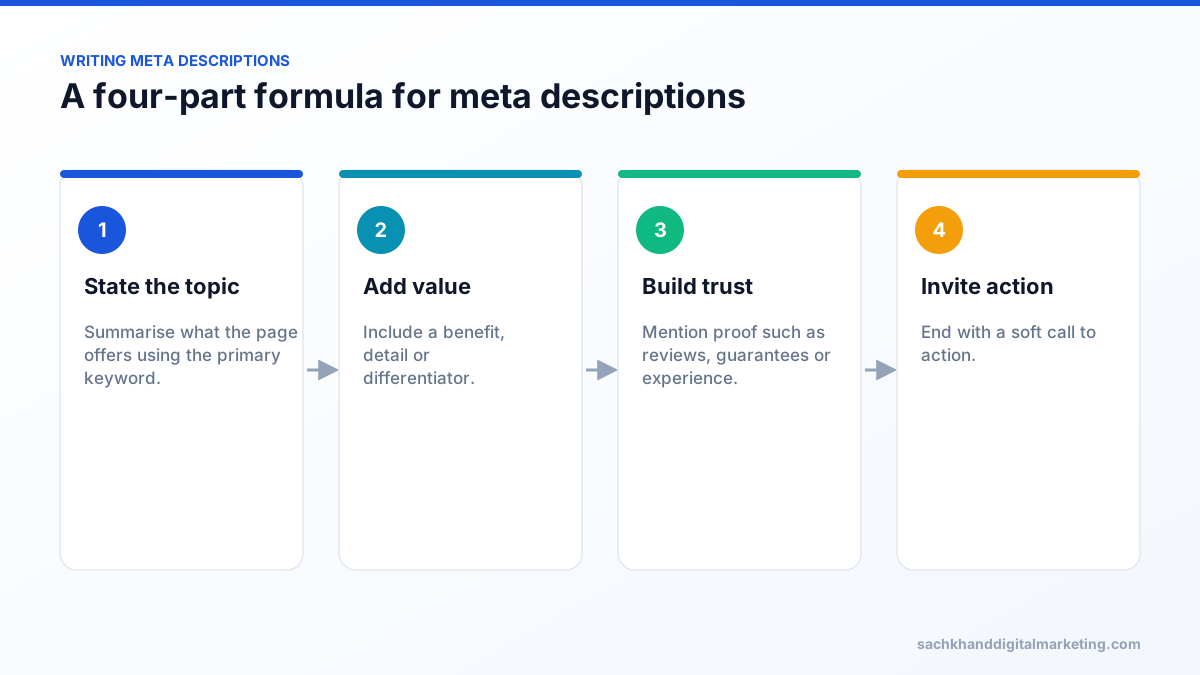
- Summarise the page accurately — misleading descriptions increase bounces and are more likely to be replaced.
- Include the primary keyword — Google bolds matching words, which draws the eye.
- Give a reason to click — price, speed, guarantee, a free resource or what the reader will learn.
- Make each one unique — duplicated descriptions across many pages are often ignored.
- Use active language and a soft call to action.
Why Google rewrites meta descriptions
Google frequently generates its own snippet from the page content when it thinks a different passage better answers a particular query. That is normal, especially for long-tail searches. Pages with a well-matched description still see it used for their main queries. If you do not want part of a page used in snippets, the data-nosnippet attribute or max-snippet directives can restrict it.
Meta description examples
| Page | Example meta description |
|---|---|
| Local service | Same-day boiler repair in Leeds from Gas Safe engineers. Upfront pricing, 12-month guarantee and 4.9★ from 600+ reviews. Book online in minutes. |
| Ecommerce category | Shop women’s waterproof hiking boots from top brands. Free delivery over £50, free returns and expert fit advice for every trail. |
| Product | Lightweight 20L daypack with padded laptop sleeve, rain cover and lifetime warranty. In stock in 5 colours with next-day delivery. |
| Blog guide | Learn how to write meta descriptions that increase clicks, with examples, character limits and templates for every type of page. |
| SaaS feature | Automate shift scheduling for restaurant teams. Build rotas in minutes, send updates by SMS and cut overtime. Start a free 14-day trial. |
Writing meta descriptions at scale
Large ecommerce and directory sites cannot handwrite thousands of descriptions. Use templates that combine unique fields with persuasive fixed text, for example: “Buy [product name] in [colour] from [brand]. [Key feature]. Free delivery over [threshold] and [returns policy].” Handwrite descriptions for the most important categories and pages, and use templates for the long tail.
How to test whether a meta description works
- In Search Console, find pages with high impressions and below-average click-through rates for their position.
- Rewrite the meta description (and title if needed) to be more specific and compelling.
- Note the date of the change.
- Compare CTR for the same queries over the following four to eight weeks, allowing for seasonality and ranking changes.
Meta description checklist
- Unique for every important page.
- Accurately summarises the page.
- Includes the primary keyword naturally.
- Contains a benefit or differentiator.
- Around 150–160 characters, key message in the first 120.
- No double quotation marks that can truncate the attribute.
Meta description templates by page type
| Page type | Template |
|---|---|
| Local service | [Service] in [city] from [credential]. [Speed or guarantee]. [Proof such as review rating]. [Call to action]. |
| Product | [Product] with [top feature] and [second feature]. [Price, delivery or stock]. [Returns or warranty]. |
| Category | Shop [category] from [brands or range]. [Delivery offer], [returns policy] and [expert help]. |
| Article or guide | Learn [topic] with [examples, steps or data]. Covers [subtopic], [subtopic] and [subtopic]. |
| Homepage | [Brand] helps [audience] [achieve outcome] with [services]. [Proof]. [Call to action]. |
How meta descriptions appear in AI and social previews
Many platforms use the meta description as a fallback when no specific preview text is set. Open Graph descriptions control previews on Facebook and LinkedIn, and some AI tools read page metadata when summarising results. Writing a clear, accurate description therefore helps across search, social sharing and messaging apps, not only in Google.
Quick reference
| Question | Answer |
|---|---|
| Ranking factor? | No |
| Affects clicks? | Yes |
| Recommended length | About 150–160 characters |
| Unique per page? | Yes, for important pages |
| Will Google always use it? | No, it may generate its own snippet |
Frequently asked questions
Are meta descriptions still important for SEO?
They do not affect rankings directly, but they influence click-through rate, which makes them an important part of on-page SEO.
What happens if a page has no meta description?
Google creates a snippet from the page content. That can work, but you lose control over the message searchers see.
How many characters should a meta description be?
Aim for roughly 150–160 characters, with the key message in the first 120 so it is not cut off on mobile.
Can I leave meta descriptions blank?
You can, and Google will generate a snippet from page content. For important pages it is better to write a description, because you control the message and can improve click-through rate.
Want experts to handle this for you?
Our specialists turn these fundamentals into rankings, leads and revenue. Start with a free, no-obligation audit of your site.