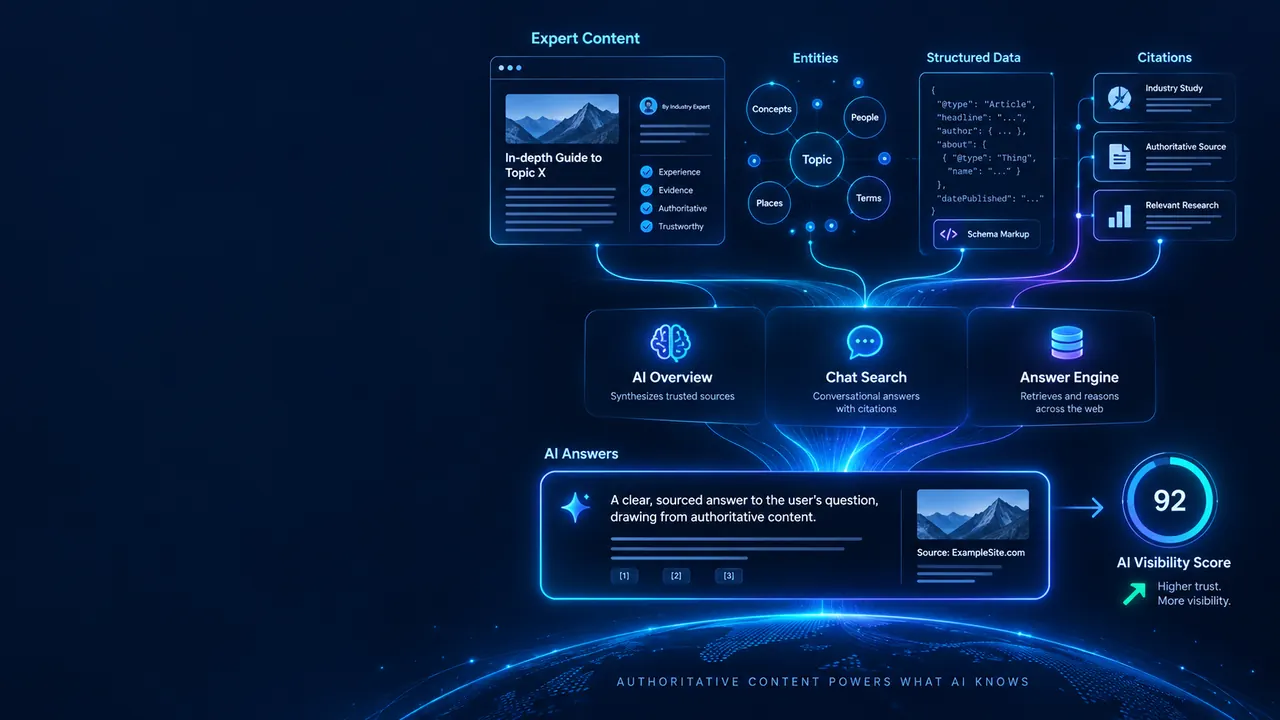
AI SEO Services at a glance
Our AI SEO services keep your brand visible across classic Google results, AI Overviews optimisation, AI Mode, ChatGPT and Perplexity. We combine technical SEO, GEO (generative engine optimisation) and AEO (answer engine optimisation) so AI systems can find, trust and cite your pages.
Get a free audit →- AI Overviews optimisation
- ChatGPT & Perplexity visibility
- GEO
- AEO
- Entity & schema markup
- AI citation tracking
You can rank first on Google and still be absent from the answer people actually read
AI answer layers do not rank pages — they synthesise them. A model reads a set of sources, composes a response, and names a handful of them. Whether you are among those named depends on signals most SEO programmes never optimise for: entity clarity, extractable claims, corroboration across independent sources, and consistency of how your brand is described everywhere it appears.
- Missing from AI answers
Invisible inside generated answers
Your page may rank well organically while never being cited in the AI Overview that sits above it. Those are different selection mechanisms, and optimising for one does not automatically deliver the other.
- Weak entity signals
Weak entity signals
If a model cannot resolve confidently who you are, what you do and where you operate, it will cite a source it can. Inconsistent naming and descriptions across the web quietly disqualify you from citation.
- Unextractable claims
Claims that cannot be extracted
Models lift specific, verifiable, self-contained statements. Marketing prose full of unquantified superlatives supplies nothing extractable, so it gets passed over regardless of how well the page ranks.
- No corroboration
No corroboration elsewhere
Models weight claims that appear consistently across independent sources. A claim that exists only on your own site carries far less weight than one echoed by publications, directories and third parties.
Classic SEO earns the ranking. AI SEO earns the mention inside the answer.
AI SEO is the practice of making your brand and content the source that generative systems reach for — across Google’s AI Overviews, ChatGPT, Perplexity, Gemini and Copilot — while continuing to hold the classic organic rankings that still drive most commercial traffic.
It runs on the same infrastructure as SEO but optimises different signals. Where classic SEO asks whether a page deserves to rank, AI SEO asks whether a claim deserves to be repeated and attributed. That shifts emphasis onto entity strength, extractable specificity, corroboration and factual durability.
- Keyword relevanceEntity clarity
- Page-level authorityClaim-level corroboration
- Persuasive marketing copySpecific verifiable claims
- Backlink countConsistent cross-source mentions
- Optimised for a clickOptimised for a citation
- Measured by positionMeasured by citation share
Classic rankings still drive the majority of commercial traffic, and AI surfaces increasingly own research and comparison. Optimising for one and ignoring the other leaves half the funnel uncovered.
- Entity establishment
- Consistent naming, description and structured identity across your site, knowledge panels, directories and third-party mentions so models can resolve who you are unambiguously.
- Extractable claim writing
- Specific, dated, self-contained statements that survive being lifted out of context — the unit models actually quote and attribute.
- Corroboration building
- Getting your key claims echoed by independent publications and datasets, since cross-source agreement is what models weight most heavily.
- Answer-first structuring
- Question-shaped headings with complete answers beneath, which serves AI extraction and featured snippets from the same underlying work.
- Citation monitoring
- Systematic sampling of what each AI surface says about your category, who it cites, and how your share of those citations moves.
How we get your brand into AI answers
Six workstreams that build the entity strength, extractability and corroboration generative systems select on.
AI visibility baseline
We systematically prompt every major surface across your category’s question set and record who gets cited, how often and in what context. That baseline is what everything afterwards is measured against.
What’s included
- Prompt testing across ChatGPT, Gemini, Perplexity and AI Overviews
- Share of AI answers that cite your brand
- Competitor citation gaps by topic
You receive: An AI search visibility baseline report
Entity establishment
Consistent naming, descriptions and structured identity across your site, schema, knowledge panel, directories and third-party profiles — so models resolve your brand with confidence rather than ambiguity.
What’s included
- Knowledge panel and entity signals
- Organization and Person schema
- Consistent brand information across sources
You receive: An entity SEO foundation
Extractable claim building
We rewrite core content into specific, dated, self-contained claims that remain true and verifiable when lifted out of context. Unquantified marketing language is replaced with figures a model can safely repeat.
What’s included
- Clear, quotable statements AI can extract
- Facts backed by sources and data
- Structured headings, lists and tables
You receive: Pages optimised for AI citations
Corroboration campaigns
Digital PR and original research designed to get your key claims echoed by independent publications, because cross-source agreement is the strongest citation signal available.
What’s included
- Brand mentions on trusted third-party sites
- Consistent company facts across the web
- Reviews and listings AI models reference
You receive: A brand corroboration tracker
Structured data & grounding
Organization, Person, Product and FAQ schema tied together so entity relationships are machine-readable rather than inferred from prose.
What’s included
- Organization, product and FAQ schema
- Facts linked to trusted sources
- Grounding signals for AI answers
You receive: Structured data for AI search
Monitoring & defence
Ongoing sampling across surfaces to track citation share, catch factual drift about your brand, and correct misattribution before it propagates into training data.
What’s included
- AI citation and brand mention monitoring
- Incorrect AI answers corrected quickly
- Competitor visibility changes tracked
You receive: A monthly AI visibility report
Get a free audit →Measured on citation share, not on impressions
Most agencies have added AI SEO to a service list without changing what they measure. The measurement is the discipline.
Systematic citation sampling
We prompt every major surface across your question set on a fixed cadence and record citation share. Without that instrumentation, AI SEO is untestable assertion.
Entity work done properly
Brand identity reconciled across your site, schema, knowledge panel, directories and third-party profiles — the unglamorous groundwork that gates everything else.
Factual accuracy as strategy
Every claim grounded in a dated, citable figure. Extracted statements get scrutinised, and a claim that fails verification costs you citation eligibility permanently.
Classic rankings maintained
AI visibility never comes at the cost of organic performance. Both run as one programme, because most commercial traffic still arrives through classic results.
Multi-surface, multi-market
Citation behaviour differs by platform and by locale. We track and optimise per surface rather than assuming what works on one carries to the rest.
Drift correction
We catch and correct inaccurate statements models make about your brand before they propagate. Left alone, factual drift becomes very difficult to reverse.
Why Businesses Choose SDM for AI SEO
Same budget, very different outcomes. Point by point, here’s how a specialist partner compares to a typical agency or going it alone.
| What actually matters | With SDM | Typical Agency | In-House / DIY |
|---|---|---|---|
| Senior specialist on your account | Always | Often a junior | Stretched thin |
| Custom strategy built for your goals | Tailored | Templated | Guesswork |
| Deep audit before any work begins | ✓ | Surface-level | Skipped |
| White-hat, penalty-safe methods | Guaranteed | Varies | High risk |
| Plain-English reporting tied to revenue | Monthly | Jargon PDFs | None |
| Direct access to your specialist | ✓ | Account-manager relay | N/A |
| Systematic AI citation tracking | ✓ | Rarely | No method |
| Entity & knowledge panel work | ✓ | Overlooked | Unknown |
| Claims grounded in dated sources | Always | Marketing copy | Ad-hoc |
| Optimised for AI Overviews & ChatGPT | Built-in | Rarely | Unlikely |
| Classic rankings maintained alongside | ✓ | Traded off | Uncertain |
| Ongoing competitor gap analysis | ✓ | One-off | Manual |
| Conversion-focused, not just traffic | ✓ | Traffic-first | Unclear |
| Premium tools included (Ahrefs, SEMrush) | ✓ | Sometimes | Costly extra |
| No long lock-in contracts | Flexible | 6–12 mo lock-in | N/A |
| Established agency, operating since 2017 | ✓ | Varies | Learning curve |
| Fast onboarding & early quick wins | ~2 weeks | Slow | Trial & error |
| Human, SEO-led content (no AI spam) | ✓ | Outsourced / AI spam | Time-heavy |
| Focus on compounding, long-term ROI | Core promise | Short-term wins | Slow & ad-hoc |
| Recovery from Google penalties | ✓ | Sometimes | Very hard |
20 reasons growing brands make the switch. See the difference for yourself →
If you are not sampling the answers, you are guessing
AI visibility is measurable, but not with rank-tracking tools. We instrument the surfaces directly and report citation share against your competitive set.
Citation share by surface
How often you are named as a source across AI Overviews, ChatGPT, Perplexity, Gemini and Copilot, benchmarked against competitors.
Entity confidence signals
Knowledge panel presence, naming consistency and structured identity coverage — the prerequisites that gate citation eligibility.
Classic ranking health
Organic positions and non-branded traffic, confirming AI work is additive rather than coming at the expense of existing performance.
Branded search lift
Growth in branded query volume, which is the most reliable commercial proxy for AI visibility since citations rarely pass a click.
Our AI SEO process: four stages, repeated every month
Baseline first, because without measurement AI SEO is unfalsifiable and impossible to improve deliberately.
Baseline
Systematic prompting across every major surface for your category’s question set, recording who is cited and how often. You get a competitive citation-share map that shows exactly where you stand.
DeliverableCitation baseline + competitive mapEstablish the entity
Brand identity reconciled across site, schema, knowledge panel, directories and third-party profiles. This gates everything downstream, so it happens before content work begins.
DeliverableConsistent, machine-readable identityBuild extractability
Core content rewritten into specific, dated, self-contained claims with answer-first structuring, plus corroboration campaigns to get key claims echoed independently.
DeliverableExtractable claims + corroborationMonitor & correct
Ongoing sampling to track citation share, catch factual drift and correct misattribution. Classic rankings tracked in parallel to confirm the work is additive.
DeliverableCitation report + drift corrections
Proven results from real SEO clients
Published case studies from our clients — each with the starting point, the dates, the source and what the numbers don’t prove.
Top 3 for “emergency plumber”, cited on 218 pages in AI answers.
Read the case study →Franchise SEOA home services franchise group — 34.1K ranking keywords and 1.8K AI mentions.
Read the case study →B2B SaaS SEO77.9K Google clicks in three months — organic is the top channel.
Read the case study →AI SEO FAQs: the questions we get asked most
Straight answers on how AI visibility works and what can actually be influenced.
Further reading
Go deeper on this
The thinking behind the work. These guides go deeper on the methods this page describes — written by the team that runs them.
 AI SEO
The Future of AI SEO: Winning in AI Overviews
The future of AI SEO: how AI Overviews, AI Mode and AI assistants change search, what still ranks, and a practical strategy to stay visible in 2026 and beyond.
Read the guide AI SEO
Generative Engine Optimization (GEO): 2026 Playbook
The generative engine optimization (GEO) playbook for 2026: how AI Overviews, ChatGPT and Perplexity choose sources, the GEO checklist and how to measure it.
Read the guide AI SEO
AEO: Ranking in ChatGPT & Perplexity
Answer engine optimization (AEO) in 2026: how ChatGPT, Perplexity, Copilot and Google AI Overviews choose sources, and how to get your brand cited.
Read the guide