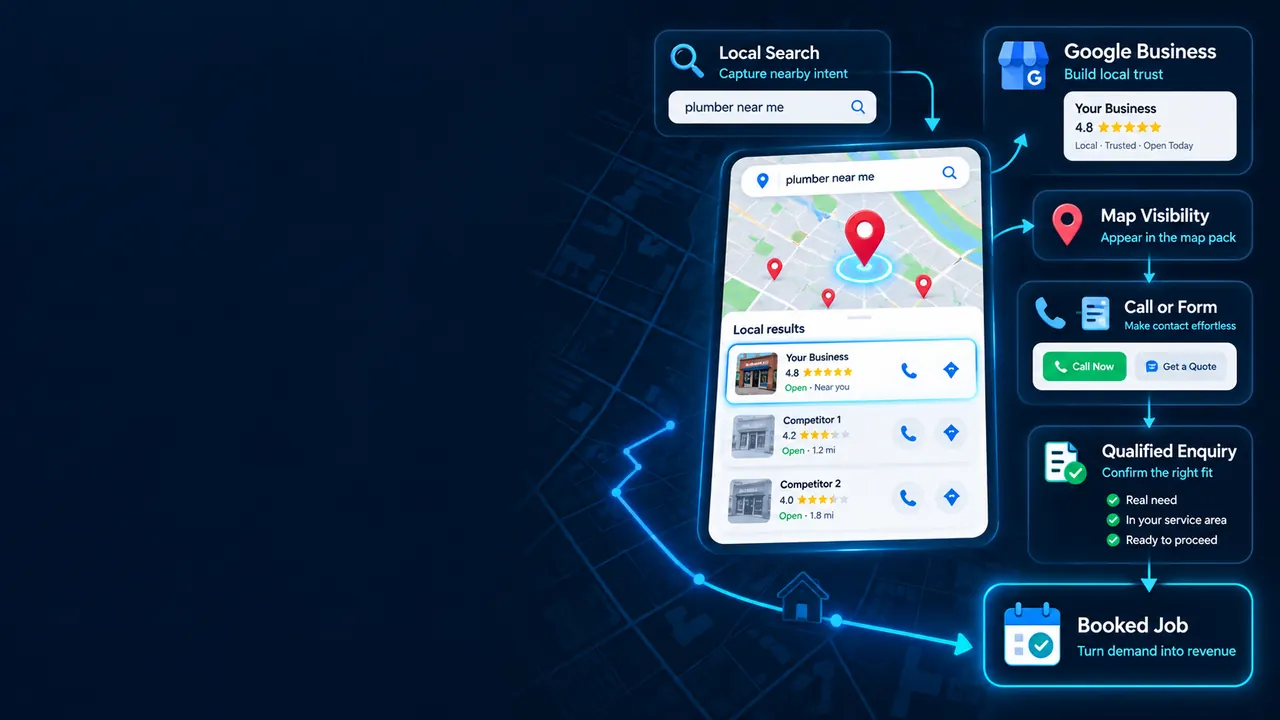
Local Lead Generation Services at a glance
Our local lead generation services fill your calendar from people nearby who are ready to buy. Local lead gen combines Google Map Pack leads, Local Services Ads and local SEO leads from service-area pages — every call and form tracked to its source.
Get a free audit →- Google Map Pack leads
- Local Services Ads
- Local SEO
- Service-area pages
- Call tracking
- Cost-per-lead reporting
Most local leads are lost after they arrive, not before
A local buyer with an urgent problem contacts three businesses and books the first one that picks up. Ranking well and then taking four hours to return a voicemail loses the job to a competitor ranked below you. In local services the marketing and the operations are the same problem, and the response side is usually the cheaper thing to fix.
Slow response
Local intent is immediate. A callback the next morning is a callback to someone who already booked a competitor.
Calls untracked
For most local businesses the phone produces more revenue than the form. If calls are not tracked, most of the marketing is being judged on the minority of leads.
Map pack ignored
The three map results capture most local enquiry volume. Businesses optimising only for organic listings compete for the traffic beneath them.
Reviews left to chance
Review count and recency drive both ranking and click-through in local. Waiting for reviews to arrive is a strategy that produces very few.
Rank in the pack, capture the call, answer it fast.
Local lead generation has three parts and most programmes only do the first. Visibility gets you the enquiry, capture makes sure you can see it, and response speed decides whether you win it.
We build all three, and we report on calls answered and jobs booked rather than on sessions — because for a local service business those are the only numbers that describe the outcome.
- Reports sessions
- Website-first
- Calls untracked
- Reviews left to chance
- Templated suburb pages
- Stops at the enquiry
- Reports calls and bookings
- Map pack first
- Every call attributed
- Review generation systemised
- Genuine area content
- Measures response time too
answer the phone faster. Most local service businesses could raise booked jobs meaningfully without spending anything more on marketing, simply by cutting the time it takes to return a missed call.
- Google Business Profile as the priority
- Categories, services, attributes, photos and posts fully built out. It outranks the website for most local queries and is usually half-finished.
- Review generation systemised
- Asked at the moment the customer is happiest, not by an email a week later. Recency matters as much as count.
- Service-area and suburb coverage
- Genuine area pages with real local detail, not name-swapped templates — which get filtered.
- Call tracking installed
- Dynamic number insertion so every call is attributed to the campaign that produced it, including map pack calls.
- Speed-to-lead measurement
- How long a missed call takes to return, reported alongside the marketing metrics because it decides the conversion.
How local lead flow is built
Six components. The first two usually produce movement inside a month.
Profile rebuild
Google Business Profile completed properly — primary category, services, attributes, photos and posting cadence.
Review engine
A request process at the point of completion, with responses to every review including the negative ones.
Area coverage
Genuine content for the suburbs and districts you actually serve, built on real local knowledge rather than swapped names.


Call tracking
Dynamic number insertion and call recording so every enquiry is attributed and the quality is auditable.
Response process
Missed-call follow-up, out-of-hours handling and a target response time, measured like a marketing metric.
Booked-job reporting
Calls, bookings and job value reported together, so cost per booked job is visible rather than cost per click.


We report booked jobs, not sessions
A local business does not care about traffic. It cares whether the diary filled.
Calls tracked from day one
Including calls placed directly from the map pack, which most setups never attribute at all.
Response time treated as a metric
We measure it and report it, because it decides more conversions than any ranking change we could make.
Map pack before website
Effort goes where the enquiries are. For most local categories that is the three map results, not position four organic.
Reviews asked for properly
At the moment of completion, in person or by message, not by an email a week later that nobody opens.
Real area content
We write about areas you actually work in. Templated suburb pages get filtered and can drag the whole site down.
Cost per booked job
The headline number, reconciled against your diary or CRM rather than against platform conversions.
Why Businesses Choose SDM for Local Lead Generation
Same budget, very different outcomes. Point by point, here’s how a specialist partner compares to a typical agency or going it alone.
| What actually matters | With SDM | Typical Agency | In-House / DIY |
|---|---|---|---|
| Senior specialist on your account | Always | Often a junior | Stretched thin |
| Custom strategy built for your goals | Tailored | Templated | Guesswork |
| Funnel & CRM audit before any spend | ✓ | Surface-level | Skipped |
| Consented, GDPR-compliant data only | Always | Varies | Risky |
| Plain-English reporting tied to revenue | Monthly | Jargon PDFs | None |
| Direct access to your specialist | ✓ | Account-manager relay | N/A |
| Calls tracked and attributed | ✓ | Forms only | None |
| Map pack prioritised | ✓ | Website only | Neglected |
| Review generation systemised | ✓ | Ad hoc | Left to chance |
| Response time measured | ✓ | Not tracked | No |
| Reported as cost per booked job | ✓ | Cost per click | Unclear |
| Ongoing competitor offer analysis | ✓ | One-off | Manual |
| Conversion paths fixed before buying traffic | ✓ | Traffic-first | Rarely |
| CRM, tracking & call analytics included | ✓ | Extra cost | Patchy |
| No long lock-in contracts | Flexible | 6–12 mo lock-in | N/A |
| Established agency, operating since 2017 | ✓ | Varies | Learning curve |
| Fast onboarding & early quick wins | ~2 weeks | Slow | Trial & error |
| Human-written offers & nurture copy | ✓ | Templated | Time-poor |
| Optimised to closed revenue, not volume | ✓ | Lead count | Unclear |
| Speed-to-lead process built in | ✓ | Rarely | Slow |
20 reasons growing brands make the switch. See the difference for yourself →
Calls, bookings and what each one cost
Rankings are reported, but they are never the headline.
Tracked calls
Every enquiry call attributed to source, including those placed straight from the map pack.
Answer and callback time
How fast enquiries are handled. The cheapest conversion lever most local businesses have.
Map pack position
By service and by suburb, because local position varies street by street rather than citywide.
Review velocity
New reviews per month and average rating, tracked because recency drives both ranking and clicks.
Cost per booked job
Reconciled against your diary, with job value so the return is visible rather than inferred.

Our Local Lead Generation process: four stages, movement inside a quarter
Local responds faster than most SEO because the map pack moves quickly.
Profile & tracking
Google Business Profile rebuilt and call tracking installed before anything else, so results are visible.
Every call attributedReviews & areas
Review process launched and genuine area content built for the suburbs you actually serve.
Map pack movementResponse process
Missed-call handling and a target response time agreed and measured with the team.
More calls convertedReport on jobs
Cost per booked job reconciled monthly against the diary, with budget moved to what books.
A number you can act on
Local Lead Generation FAQs: the questions we get asked most
On calls, map pack, reviews and response speed.
Further reading
Guides, terms and related services
Go deeper on the methods behind this service, with guides written by the specialists who run them, plain-English definitions and the services that usually work alongside it.
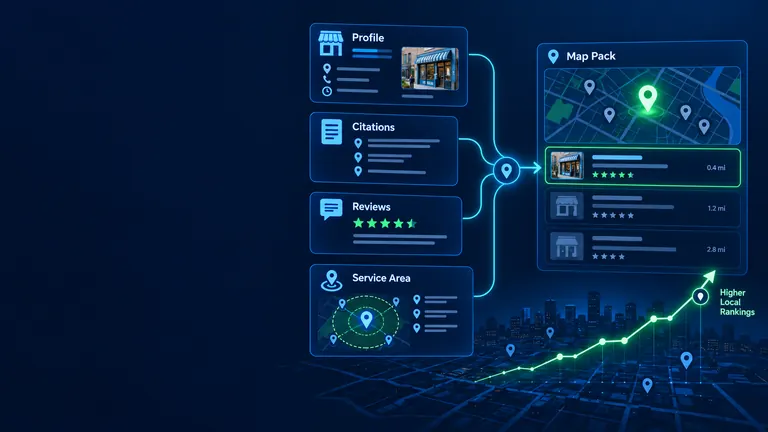 SEO
SEOLocal SEO Playbook: Dominate Your City in 90 Days
The local SEO playbook for 2026: win the Google Maps local pack with Google Business Profile, reviews, citations, location pages and local links.
Read the guide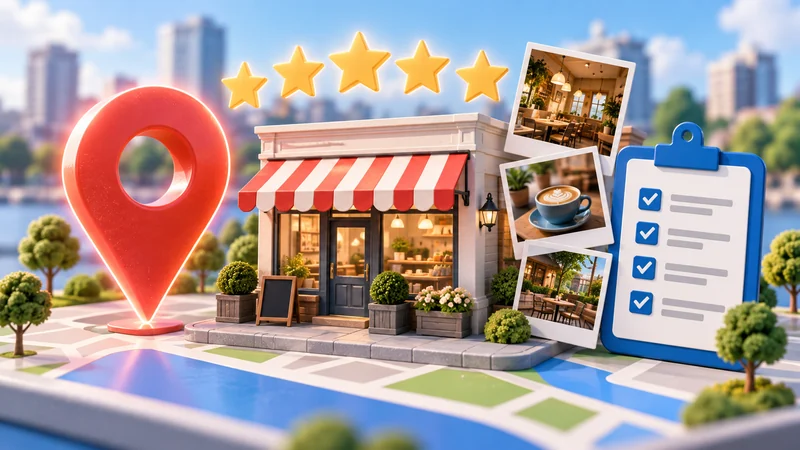 SEO
SEOGoogle Business Profile Optimization Checklist 2026
A complete Google Business Profile optimization checklist for 2026: categories, services, photos, reviews, posts, suspensions, multi-location tips and tracking.
Read the guide Google Ads
The Complete Google Ads Guide for 2026
The complete Google Ads guide for 2026: campaign types, Performance Max, bidding, keywords, Quality Score, conversion tracking, costs and scaling.
Read the guide