Performance Marketing

Every pound accountable.
Every channel measured.

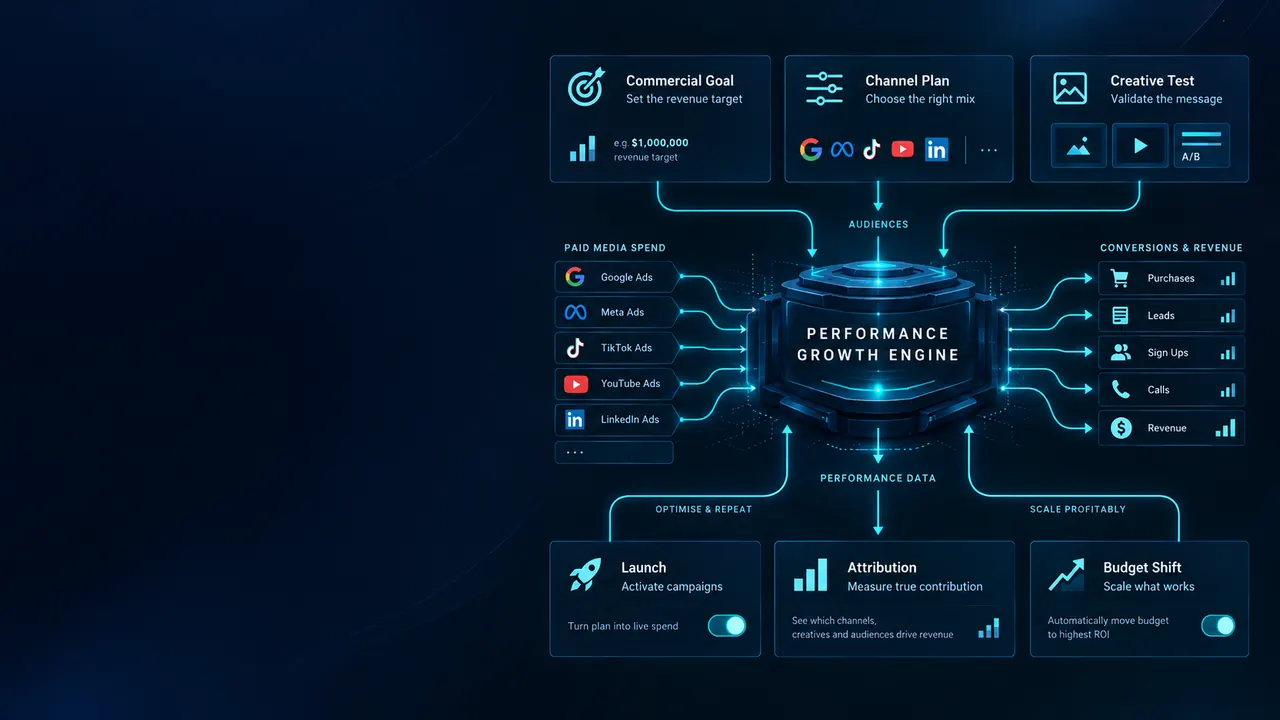
Performance marketing is not a channel — it is a discipline. We run paid across search, social and display against one blended target, moving budget toward whatever is genuinely producing rather than whatever reports best inside its own dashboard.

BLENDED ROAS4.8xSPEND£42kREVENUE£202kCPA−38%
Blended ROAS
CAC management
Incrementality
Creative testing
01
The attribution problem

Every platform claims the same conversion. Added up, they report more revenue than you made.

Each ad platform is measured by its own pixel and incentivised to claim credit. Run three channels and the reported conversions frequently exceed actual orders. Budget then gets allocated on numbers that cannot all be true — usually toward whichever platform is most aggressive about claiming attribution rather than whichever is genuinely driving growth.

Platforms double-count

Meta, Google and every other network claim conversions their pixel touched. Summed across channels the total exceeds real revenue, which makes per-platform ROAS unusable for allocating budget.

CAC rising as you scale

The cheapest audience segments get exhausted first. Spending more against the same targeting produces steadily worse returns, and most accounts scale straight into that wall.

Creative fatigue unmanaged

Performance decays as frequency rises. Accounts running the same creative for months are paying increasing amounts for declining attention without seeing the cause in the dashboard.

No incrementality testing

Some conversions would have happened anyway — particularly on branded search and retargeting. Without holdout testing you cannot tell what your spend genuinely caused.

4.8×
Target blended ROAS achieved
−38%
Typical CPA reduction
3+
Channels managed as one
8+
Years running paid programmes
02
What we actually do

One blended target. Budget moves to whatever earns it.

We manage paid channels against a single blended efficiency target rather than optimising each platform to its own reported ROAS. That reframing is what stops budget drifting toward whichever network claims credit most aggressively.

Underneath it sits the unglamorous work: correct conversion tracking, structured creative testing, audience expansion sequenced so CAC does not spike, and periodic holdout tests to establish what spend is genuinely incremental.

  • Blended efficiency targets — one CAC or ROAS figure across all paid, so channels are compared on the same basis rather than on self-reported numbers.
  • Server-side conversion tracking — properly implemented measurement that survives browser restrictions, because bad data produces confidently wrong decisions.
  • Structured creative testing — a standing test programme with enough volume to reach significance, and retirement rules for fatigued assets.
  • Audience sequencing — expansion planned so CAC rises predictably rather than spiking when the efficient segments are exhausted.
  • Incrementality testing — geo and audience holdouts on branded search and retargeting, to establish what your spend actually caused.
Channel-by-channel
Blended performance
Each platform's own ROAS
One blended target
Conversions double-counted
Deduplicated reporting
Creative runs until it dies
Tested and retired on schedule
Scale by raising budgets
Scale by expanding audiences
Retargeting assumed to work
Incrementality tested
Browser-based tracking only
Server-side measurement

The uncomfortable test: add up the conversions every platform reports and compare it to orders in your own system. If the first number is meaningfully larger, you are allocating budget on figures that cannot all be true.

03
The Sachkhand blueprint

How we build a paid programme that scales

Six workstreams, measurement first — because optimising against broken tracking makes performance worse with total confidence.

01

Measurement foundation

Server-side conversion tracking, deduplication and a blended reporting layer. Nothing else matters if the numbers being optimised against are wrong.

02

Account & spend audit

Structure, targeting overlap, wasted spend and creative fatigue across every channel. Most accounts have meaningful budget going to segments that never convert.

03

Blended targets set

One CAC or ROAS goal across all paid, with channel roles defined — prospecting, capture, retention — so each is judged on the job it is doing.

04

Creative testing programme

Standing tests with defined win conditions and retirement rules, because creative is the largest lever in paid social and the fastest to decay.

05

Audience expansion

Sequenced so efficiency degrades predictably as you scale rather than collapsing when the cheapest segments run out.

06

Incrementality testing

Geo and audience holdouts run periodically, particularly on branded search and retargeting where reported returns are usually most inflated.

04
What is changing through 2026

Four shifts in paid media

Signal loss and platform automation have changed where the operator adds value. It is no longer in manual bid management.

01

Signal loss made tracking a skill again

Browser restrictions and privacy changes degraded conversion data substantially. Server-side tracking and modelled conversions are now table stakes, and accounts without them are optimising on partial information.

02

Automation moved the job to inputs

Platforms handle bidding and placement better than manual management. The operator’s value has shifted entirely to what goes in — creative, audience definition, conversion signals and budget allocation.

03

Creative is the main lever

With targeting increasingly automated, creative is what differentiates performance. Accounts testing systematically outperform accounts with better targeting and static assets.

04

Incrementality replaced last-click

As attribution degrades, holdout testing is becoming the credible way to establish what spend caused. It is uncomfortable because it usually reveals that some channels were being over-credited.

05
Why Sachkhand

We report the number that is uncomfortable

Blended CAC is harder to make look good than platform ROAS. It is also the only figure that reflects what actually happened to your business.

Blended, not platform-reported

We lead with blended CAC and ROAS. Platform figures appear as diagnostics, clearly labelled as self-reported rather than presented as truth.

Tracking fixed first

Server-side measurement before optimisation. Tuning an account against broken conversion data produces confident, expensive mistakes.

Incrementality tested

We run holdouts even when the result is awkward. Discovering that retargeting was over-credited is worth more than a flattering report.

Creative as the primary lever

Structured testing with real win conditions, because with bidding automated, creative is where the remaining performance difference lives.

We will tell you to stop spending

If a channel is not incremental we recommend cutting it, even though that reduces the budget we manage. Managing spend that does not work is not a service.

Coordinated with organic

Paid and SEO planned together so you are not buying clicks for terms you already rank first for, which is one of the most common avoidable wastes.

06
The Honest Comparison

Why Businesses Choose SDM for Performance Marketing

Same budget, very different outcomes. Point by point, here’s how a specialist partner compares to a typical agency or going it alone.

What actually matters With SDM Typical Agency In-House / DIY
Senior specialist on your accountAlwaysOften a juniorStretched thin
Custom strategy built for your goalsTailoredTemplatedGuesswork
Deep audit before any work beginsSurface-levelSkipped
White-hat, penalty-safe methodsGuaranteedVariesHigh risk
Plain-English reporting tied to revenueMonthlyJargon PDFsNone
Direct access to your specialistAccount-manager relayN/A
Blended CAC as headline metricPlatform ROASPlatform ROAS
Server-side conversion trackingBrowser onlyDefault pixel
Incrementality holdouts runNeverNever
Creative retirement rulesRun till deadAd-hoc
Coordinated with organic searchSiloedOverlapping
Ongoing competitor gap analysisOne-offManual
Conversion-focused, not just trafficTraffic-firstUnclear
Premium tools included (Ahrefs, SEMrush)SometimesCostly extra
No long lock-in contractsFlexible6–12 mo lock-inN/A
Established agency, operating since 2017VariesLearning curve
Fast onboarding & early quick wins~2 weeksSlowTrial & error
Human, SEO-led content (no AI spam)Outsourced / AI spamTime-heavy
Focus on compounding, long-term ROICore promiseShort-term winsSlow & ad-hoc
Recovery from Google penaltiesSometimesVery hard

20 reasons growing brands make the switch. See the difference for yourself →

07
Measurement

If the platforms disagree with your accounts, believe your accounts

We reconcile platform-reported performance against actual revenue and report the gap rather than hiding it.

Blended CAC

Total paid spend divided by total new customers — the figure that cannot be inflated by attribution windows.

Blended ROAS

All paid spend against actual revenue from your own system, not the sum of what each platform claims.

Incremental lift

Holdout-tested contribution, so you know what spend genuinely caused rather than what it was near.

Creative performance curve

How each asset decays with frequency, driving retirement decisions before efficiency collapses.

Marginal CAC by segment

What the next customer costs as audiences expand — the number that tells you where scaling stops being efficient.

Paid performance
All channels blended — rolling 90 days
LIVE
Blended ROAS
4.8x
CAC
−38%
Incremental
71%
Creative win
46%
Wasted spend
−91%
↑ 4.8x blended ROAS vs 2.1x at start
08
The engagement

Four stages, repeated every month

Fix measurement, cut waste, then scale — scaling before the first two multiplies the problem.

01

Fix measurement

Server-side tracking, deduplication and blended reporting built before any optimisation. You get an honest baseline, which is frequently lower than the platforms were claiming.

→ Trustworthy numbers
02

Cut the waste

Overlapping audiences, fatigued creative, non-converting placements and branded-search overspend removed. This usually funds the rest of the programme by itself.

→ Same results, lower spend
03

Test creative systematically

A standing programme with defined win conditions, run at volumes that reach significance, with retirement rules for decaying assets.

→ A compounding creative library
04

Scale & verify

Audience expansion sequenced against marginal CAC, with periodic holdout tests to confirm incrementality as spend grows.

→ Efficient, verified scale
09
Outcomes

The targets we set for paid engagements

Targets we plan against for ecommerce, SaaS, lead-generation and multi-location clients after six months.

4.8×
Blended ROAS
From 2.1× at start
−38%
Blended CAC
Same or higher volume
71%
Spend verified incremental
Holdout tested
−91%
Identified wasted spend
Removed in first 60 days

Targets rather than best cases. The largest early gains almost always come from cutting waste rather than improving performance — which means results are biggest on accounts that have been running unaudited for a long time. These are planning targets rather than a record of past client averages; we agree a realistic range against your own baseline before an engagement starts.

10
Scenarios

Performance marketing in action — three sectors

Different models, the same sequence: measure honestly, cut waste, then scale. The scenarios below are composites drawn from situations we encounter repeatedly — they illustrate method, not the account of any single named client.

Ecommerce

When the platforms reported more revenue than the business made

Challenge

Meta and Google together reported roughly 140% of actual order revenue. Budget was being shifted toward whichever platform claimed hardest.

What we did

Implemented server-side tracking with deduplication, set one blended ROAS target, and ran geo holdouts on branded search and retargeting.

4.9×
Blended ROAS
−42%
CAC
B2B SaaS

Cutting spend and increasing signups

Challenge

Paid spend had grown steadily while trial volume plateaued. Audience overlap meant campaigns were bidding against each other.

What we did

Restructured account to remove overlap, retired fatigued creative, built a standing test programme and reallocated toward prospecting.

−34%
Spend
+58%
Trial signups
Multi-location services

Finding out retargeting was not incremental

Challenge

Retargeting reported the best ROAS in the account and received a growing share of budget on that basis.

What we did

Ran an audience holdout that showed most of those conversions occurred anyway. Reallocated the majority of that budget to prospecting and local campaigns.

+86%
New customers
0
Extra spend
11
Questions

The questions we get asked most

Direct answers on attribution, scaling and what paid can realistically deliver.

Why do your numbers look worse than the platform dashboards?+

Because platform dashboards over-credit themselves. Each network counts conversions its pixel touched, so running three channels means the same order gets claimed multiple times. We report blended CAC and ROAS against revenue in your own system, which is almost always a lower number and the only one that reflects what actually happened.

What is incrementality testing and why does it matter?+

It is running a holdout — withholding ads from a matched geography or audience — to see what happens without the spend. It matters because some conversions occur regardless, particularly on branded search and retargeting. Without it you cannot distinguish spend that caused revenue from spend that was merely present when revenue happened.

Should we be bidding on our own brand name?+

Sometimes, and it is worth testing rather than assuming. If competitors bid on your brand, defending it is usually justified. If nobody does and you rank first organically, much of that spend may be buying clicks you would get free. A geo holdout answers it in a few weeks, and the answer varies by market.

How do we scale without CAC exploding?+

By expanding audiences deliberately rather than raising budgets on existing ones. Cheapest segments exhaust first, so simply spending more against the same targeting buys progressively worse traffic. We sequence expansion and track marginal CAC, so you can see exactly where efficient scaling stops.

Is creative really more important than targeting?+

On most platforms now, yes. Automated bidding and placement handle much of what used to be manual targeting work, which means creative is where the remaining performance difference lives. Accounts with systematic creative testing routinely outperform accounts with more sophisticated targeting and static assets.

Will you manage all our channels or just one?+

Preferably all paid, because the value comes from allocating between them against one target. Managing a single channel in isolation means optimising to its self-reported numbers, which is the problem we are trying to solve. We can work alongside another agency on a different channel, but blended targets need someone seeing the whole picture.

How long before we see improvement?+

Waste reduction shows within the first thirty to sixty days and frequently funds the engagement by itself. Creative testing produces compounding gains from month two or three. Incrementality testing needs a few weeks per test to reach significance, so a full picture typically takes a quarter.

Next step

Ready to know what your paid spend actually earns?

We will audit your tracking, reconcile platform-reported conversions against your real revenue, and show you where budget is going that does not produce.

Free paid account audit
Attribution reconciliation
Wasted spend analysis
Blended target model
BLENDED ROAS4.8x
Chat With Us
🚀 Book Free Audit & consultation!
45 min · Free audit + strategy + consultation · No obligation