Platforms need volume to optimise
Automated ad delivery needs creative variety to test against. A handful of assets per quarter starves it, so systematic production has become a performance factor rather than a nice-to-have.
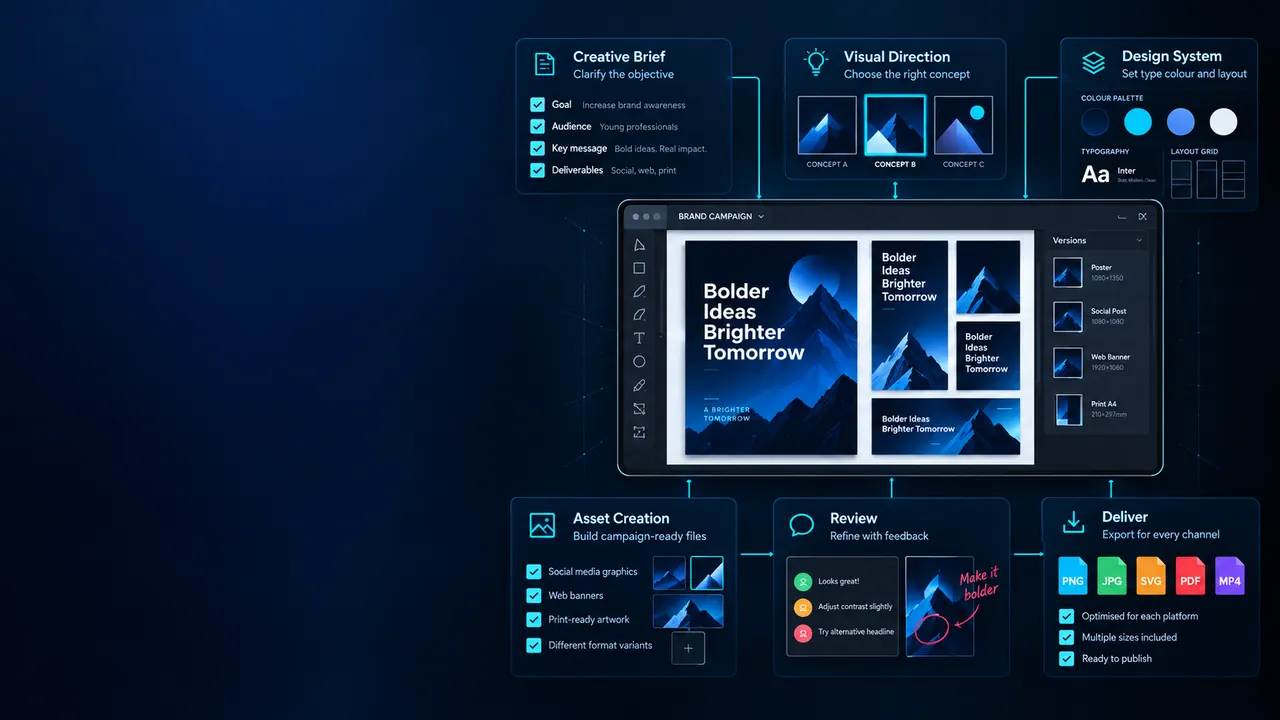
Good graphic design makes a message land before anyone has decided to read it. We produce the day-to-day creative that businesses actually need — at volume, on brand, and built for where it will be seen.
Our graphic design services produce the assets that marketing actually runs on — ad creative design, social media design, presentations and brochure design services. As a marketing design agency, we design for performance and brand consistency, not decoration.
Get a free audit →Everything a marketing team needs to publish consistently, built as a reusable system rather than one-off files.
Static, carousel and motion-ready ads sized for every placement you run.
Editable post, story and cover templates your team can publish from.
Brochures, one-pagers and sell sheets that match the rest of the brand.
Complex information made readable at a glance, on screen and in print.
Packaging, signage and event graphics, pre-flighted for the printer.
Pitch and sales decks built on master slides your team can extend.
Most design problems that reach a customer are technical rather than aesthetic — and they are entirely preventable.
Work is reviewed at real dimensions on a phone, not zoomed on a desktop. A design that only works at full size fails in the feed, which is where nearly all of it is actually encountered.
Bleed, crop marks and CMYK for print; RGB, dimensions and text-safe areas for screen. Sending an RGB file to a printer or an oversized text overlay to an ad platform wastes budget in ways nobody notices until it is live.
Text checked against background contrast ratios. Low-contrast type looks refined in a review and becomes unreadable on a phone in daylight, which is the actual viewing condition.
Assets assembled from defined tokens and components rather than improvised each time. It is what keeps a hundred pieces looking related without policing every one.
Layered, organised, named files handed over as standard. Withholding source to secure future work is common and something we will not do.
Commercial licences confirmed for every typeface and stock asset. Unlicensed use is genuinely enforceable and lands on the client, not the designer.
Volume expectations have risen sharply while attention has fallen. Both change how work should be produced.
Automated ad delivery needs creative variety to test against. A handful of assets per quarter starves it, so systematic production has become a performance factor rather than a nice-to-have.
Most creative is now consumed vertically on a phone. Landscape work repurposed by cropping consistently underperforms assets designed for the format from the start.
AI handles some ideation and variation quickly. What it does not do is judge whether a message lands, keep a brand coherent, or set a file up correctly for print — so the value moved to direction and craft.
Contrast, caption legibility and alt text are increasingly expected on commercial creative, not just on interfaces, and some platforms now surface it as a quality signal.
Most engagements move from brief to hand-over in two to three weeks.
We review your brand assets, channels and what is already performing.
Two directions shown on real placements, not blank artboards.
Revisions, variants and every size you need.
Layered source files, export presets and a reusable template kit.
Practical answers on pricing, turnaround, files and working with your team.
Both. Projects suit defined pieces of work with a clear end — a campaign, a packaging run, a deck. Retainers suit businesses producing creative continuously, where the value comes from the system and the speed it enables rather than from any single asset. We will recommend whichever matches your actual volume.
Two to five working days per asset from an approved brief, faster once a template system exists. What delays projects is rarely production; it is briefs that change mid-way or approval spread across several people without a single decision-maker.
Yes, always, layered and organised. Some studios withhold source files so clients must return for every change. We hand them over as standard, along with editable templates where relevant, because holding files hostage is not a business model we are interested in.
Yes, and we prefer it. If guidelines exist we build to them exactly. If they are thin or being ignored we will say so and suggest tightening the system first, since producing volume against unclear rules just multiplies the inconsistency.
Two rounds as standard, which is usually sufficient when the brief was clear. Additional rounds are chargeable, but in practice the projects needing many revisions are the ones where the brief was vague or the decision-maker was not in the first conversation — so we spend time on the brief.
For some ideation and variation, where it genuinely speeds things up. It does not replace judgement about whether a message lands, brand coherence, or correct technical setup for print and platforms. Everything is directed and checked by a designer, and we will tell you where it was used if you ask.
We supply print-ready artwork with correct bleed, colour profiles and resolution, and we will pre-flight before submission. We can liaise with your printer or recommend one, though you contract them directly so you keep control of cost and quality.
Show us what you are producing now. We will review consistency, technical setup and turnaround, and show you what a template system would change.
Further reading
Go deeper on the methods behind this service, with guides written by the specialists who run them, plain-English definitions and the services that usually work alongside it.
 Web Design
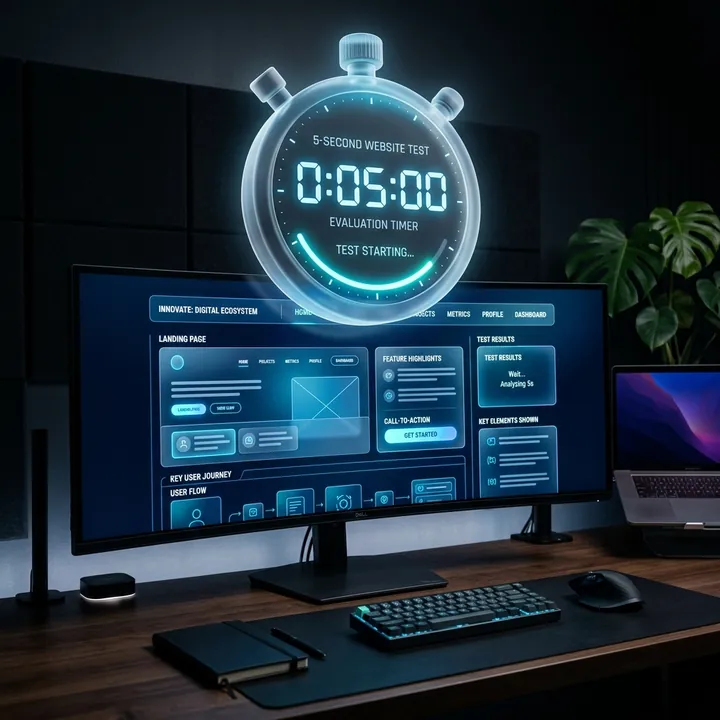
The 5-second website test: how to check if visitors instantly understand what you do, how to run it, the questions to ask and fixes that improve conversions.
Read the guide Digital Marketing
How to write content that converts: copywriting formulas, benefit-led messaging, specificity, social proof, microcopy and calls to action that work.
Read the guide Web Design
The 2026 conversion rate optimization guide: research, value proposition, friction, trust, forms, A/B testing and prioritisation to turn traffic into revenue.
Read the guide