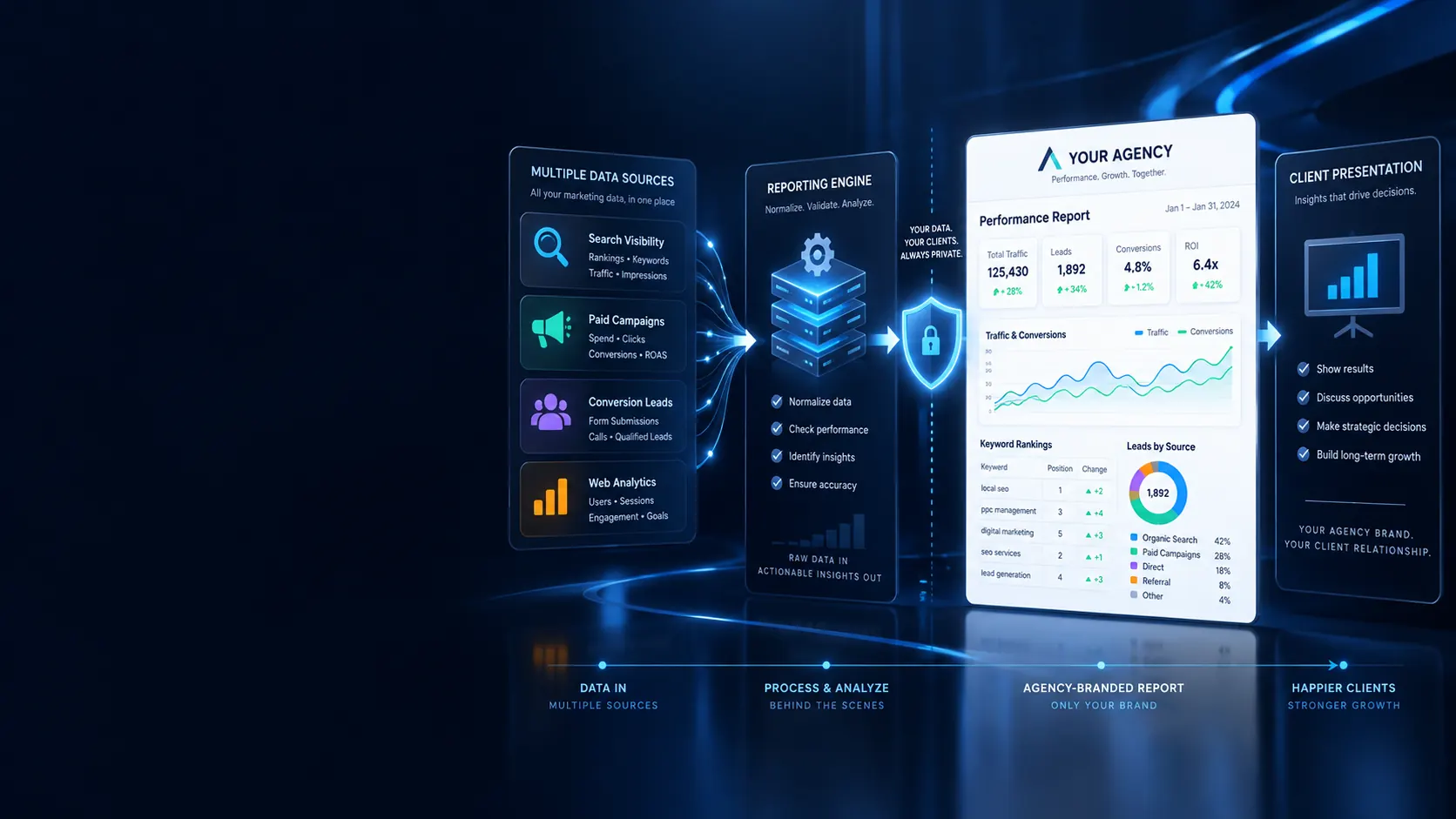
White Label SEO ReportsReports your clients read.
With your logo at the top.
Most agency reporting shows activity rather than outcome, which is why clients skim it and then ask what they are paying for. Our white label SEO reports are built in your brand to answer that question directly — and never mention us anywhere.
White Label SEO & Marketing Reports at a glance
Our white label marketing reports give agencies branded client reporting on SEO, PPC and social — your logo, your colours, your domain. Instead of paying for separate agency reporting software, you get a white label dashboard and monthly reports written in plain English that clients actually read.
Get a free audit →- Your logo & colours
- White label dashboard
- SEO, PPC & social data
- Plain-English commentary
- Monthly & on-demand reports
- Client-ready PDFs
Why clients stop reading agency reports
Churn is rarely caused by poor results. It is caused by clients not being able to tell whether results are good. A report full of activity metrics answers a question nobody asked, and a client who cannot explain your value to their own board eventually stops renewing.
| Report content | Typical agency report | What we send |
|---|---|---|
| Opens with | Traffic chart | Answer to “is this working?” |
| Keyword data | 500-row rankings table | Movement on commercial terms |
| Work done | Task list | What changed and why it mattered |
| Conversions | Often missing | Leads or revenue attributed |
| Bad months | Buried or omitted | Explained plainly with a plan |
| Next period | Generic “continue” | Specific, prioritised actions |
| Length | 40 pages, unread | One page that gets read |
| Client can defend spend | Rarely | That is the whole purpose |
The detail still exists — full ranking and technical data sit behind the summary for anyone who wants it. The difference is what leads. A report should let a marketing manager forward one page to their finance director without having to interpret it first.
Your brand on the front. Nothing of ours anywhere.
White label reporting fails on details: a logo in a chart, our name in the PDF author field, a template footer nobody checked. Invisibility has to be systematic rather than careful.
The detail most providers miss: file metadata. A PDF can carry the producing agency's name in its author and creator fields even when nothing visible does — and clients do occasionally check document properties. Every file we release is stripped and verified before it reaches you.
What your client actually receives
A client report rendered entirely in a partner agency’s brand: outcome metrics first, movement explained, and no trace of who produced it.
- emergency plumber3 → 1
- boiler repair cost9 → 4
- bathroom fitting14 → 8
- PDF, your brandemailed monthly
- Live dashboardyour subdomain
- Slide summaryfor QBRs
- Raw data exportCSV / API
Three ways clients receive reporting
Different clients want different things. A marketing director wants a dashboard; an owner-operator wants one page in an email.
- Your brand throughout
- One-page executive summary
- Detailed appendix behind it
- Written commentary included
- Metadata stripped and verified
- Editable before you send
- Runs on reports.youragency.com
- Real-time data connections
- Your brand and colours
- Client logins you control
- Monthly written commentary layered on
- Automated email digests
- Presentation-ready slides
- Quarter-on-quarter analysis
- Competitive position summary
- Next-quarter roadmap
- Raw data export for their analysts
- Speaker notes for your team
Most partners run a monthly PDF plus a live dashboard, with QBR packs on larger accounts. Reporting is included in wholesale delivery rather than charged separately — it is part of the work, not an addition to it, so there is nothing extra to price up.
How reporting is stood up
Setup happens once. After that reporting runs on your cycle without you assembling anything.
Logo, colours, typography and tone examples loaded into the reporting templates so output looks like yours from the first document.
Analytics, Search Console, rank tracking, call tracking and CRM connected per client, so figures come from source rather than being retyped.
What each client is judged on, decided per account. A lead-generation client and an e-commerce client should not receive the same headline metric.
Draft to you for review before anything reaches your client, with metadata stripped and every surface checked for brand leakage.
How we keep reporting invisible
Every guarantee below exists because it is a place white label reporting has been known to leak.
Author, creator, producer and company fields cleared on every PDF, plus document properties on slides and spreadsheets. Checked on release rather than trusted to a template.
Dashboards run on a subdomain you control, with your certificate. No shared provider domain in the address bar and no provider branding in the interface.
Nothing goes to your client directly. You review, edit and send, so you are never surprised by something a client saw before you did.
No analytics of ours, no referral parameters and no links back to our properties anywhere in a report or dashboard.
We write the plain explanation and the recovery plan and give it to you early. You decide how to present it, but you will never learn about a bad month from your client.
If the partnership ends, historical reports and underlying data are handed over in full. Reporting history is client relationship equity, and it belongs to you.
What agencies ask about reporting
Practical concerns from partners who have been burned by reporting before.
Not from the reporting. Visible branding, dashboard domain and file metadata are all yours, and every file is checked before release. The place white label usually leaks is not the report at all — it is an email signature or a calendar invite from someone forgetting the arrangement, which is why we never contact your client.
Yes, and we encourage it. You get editable files, not locked PDFs. Your commentary is usually better than ours because you know the client's internal politics, what their board cares about, and what was discussed on the last call.
Change it. Drafts come to you precisely so you can adjust framing before a client sees it. The one thing we ask is that you do not remove an honest explanation of a bad month, because clients remember being managed and it costs more later than the awkward conversation would have.
Yes, where you give us data access. Many partners run paid media in-house and want one report covering everything so the client sees a single picture. We will label clearly which channels we delivered and which we are only reporting.
Review and send, typically fifteen to thirty minutes per client per month once set up. Assembling reporting manually is usually one of the largest hidden time costs in a small agency, and it is work clients never see or value.
You take it. Historical reports, dashboards and underlying data are handed over. Reporting history is part of your client relationship, and withholding it to make leaving painful is not something we would do.
Four shifts in client reporting
What clients expect from reporting has changed faster than most agency templates have.
Marketing budgets face more scrutiny, so your contact needs a report they can forward to finance without interpreting it. Reports that only make sense with a call attached fail at exactly that moment.
With personalised, localised and AI-influenced results, a ranking table is a weak proxy. Clients increasingly want visibility, traffic quality and revenue instead of position counts.
Self-serve access is now normal. The monthly report changed from a data delivery into an interpretation layer, which is the part clients actually cannot do themselves.
Clients now ask whether they appear in AI answers and assistants. Reporting that ignores it looks dated, even though measurement in this area is still genuinely imprecise.
The service levels we commit to
Reporting is the most visible part of delivery, so timing and brand integrity are what we hold ourselves to.
These are planning targets rather than a record of past client averages; we agree a realistic range against your own baseline before an engagement starts. Report timing depends partly on third-party data availability — some platforms finalise figures several days into the following month, and we would rather send an accurate report late than a fast one that gets revised.
Reporting questions, answered plainly
Detail on formats, branding, data sources and what happens if you leave.
What does a white label report actually include?
A one-page summary answering whether the work is producing results, then movement on commercial keywords, what changed on the site and why it mattered, conversions or revenue attributed where tracking allows, and specific priorities for the next period. Full ranking and technical detail sits behind that for anyone who wants it.
Can the dashboard run on our own domain?
Yes. Dashboards are hosted on a subdomain you control — typically something like reports.youragency.com — with your certificate, so the address bar shows your domain rather than a shared provider one. Client logins are managed by you.
Which data sources can you connect?
Analytics, Search Console, rank tracking, Google Business Profile, call tracking, ad platforms and most common CRMs. Where a client uses something unusual we will connect it if it has an API, and tell you plainly if manual entry is the only option.
Is reporting charged separately?
No. It is included in wholesale delivery because it is part of doing the work rather than an addition to it. Providers charging separately for reporting are charging you to find out what you already bought.
How do you handle a month where results went backwards?
We write the honest explanation and the recovery plan and send it to you early, before your reporting cycle. You decide the framing. What we will not do is quietly omit it — clients notice patterns, and a bad month explained well damages trust far less than one discovered later.
Can we use your reporting without buying delivery?
Generally no. Reporting is built on work we are doing, and reporting on someone else's delivery means presenting analysis we cannot stand behind. The exception is a partnership where we handle some channels and report across all of them with your data access.
What if a client asks for a custom metric?
We will build it if the data exists. The more useful conversation is usually why they want it — a request for an unusual metric often means the current headline number is not answering their real question, which is worth fixing rather than working around.
Want to see a report in your own brand?
Send us your logo and one client's analytics access. We will produce a sample report in your brand so you can see exactly what your client would receive.
Further reading
Guides, terms and related services
Go deeper on the methods behind this service, with guides written by the specialists who run them, plain-English definitions and the services that usually work alongside it.
 Performance Marketing
The Omnichannel ROI Framework: Stop Burning Ad Spend
A digital marketing ROI framework for 2026: server-side tracking, MER, incrementality testing, marketing mix modelling, LTV:CAC and payback period.
Read the guide SEO
SEOThe Complete Guide to SEO in 2026
The complete guide to SEO in 2026: how Google ranks pages, technical SEO, content, links, local and AI search, a 6-month roadmap and how to measure ROI.
Read the guide Technical SEO
The Technical SEO Audit Playbook for 2026
A step-by-step technical SEO audit playbook for 2026: crawling, indexing, site architecture, JavaScript, Core Web Vitals, structured data and prioritisation.
Read the guide