Structured data, done properly
Schema markup tells search engines and AI tools exactly what a page is: a business, a product, an article, a set of questions. We plan it, write it, test it and keep it correct as your site changes.
- Written in JSON-LD
- Validated before launch
- Monitored for errors
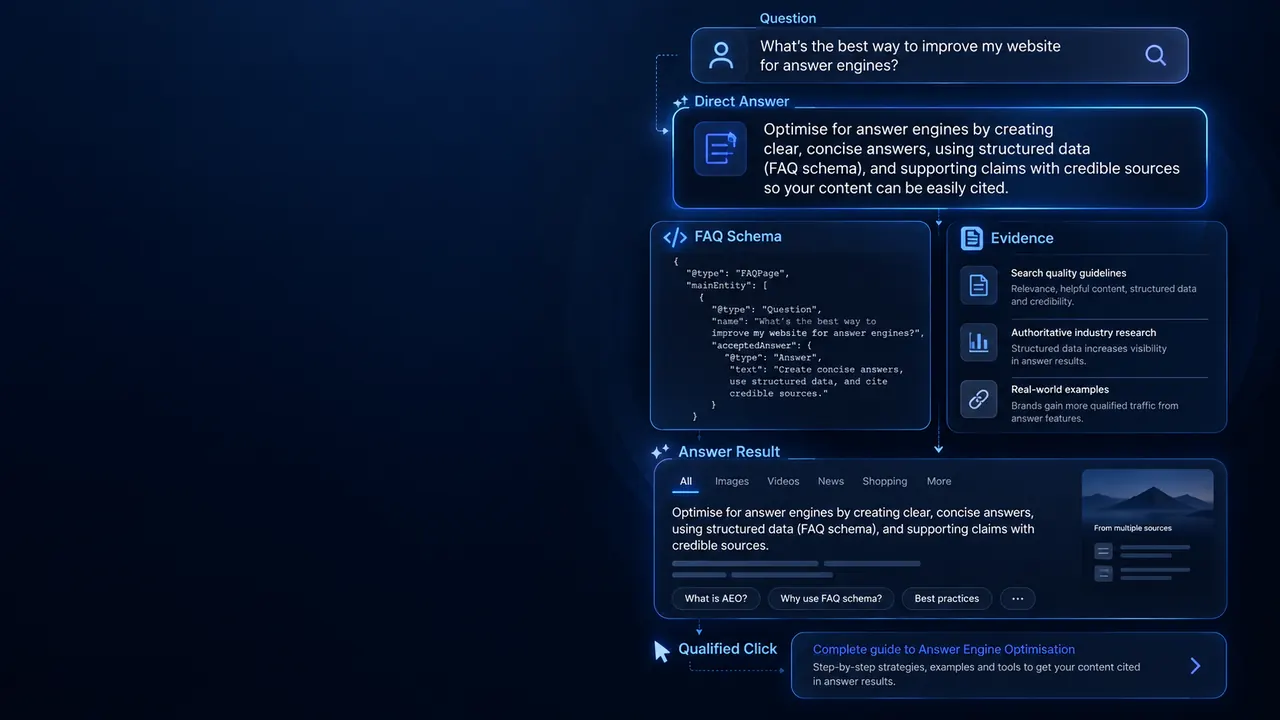
What is schema markup?
Schema markup, also called structured data, is code added to a page that states what the content is in a standard vocabulary from Schema.org. It helps search engines show rich results and helps AI tools read facts such as prices, hours and authorship without guessing. It has to match what is visible on the page.
In practice. Visitors never see it. Machines do. It lets Google show rich results such as review stars, prices and breadcrumbs, and it lets AI tools read facts such as opening hours and authorship without guessing.
Who it is for. Every business website. It matters most for online stores, local businesses, publishers and sites with reviews, events or FAQs.
What it is not. It is not a ranking trick, and it must match what is visible on the page. Markup for content that is not there can be penalised.
Read the full explanation and see an exampleShow less
Schema markup, also called structured data, is a block of code added to a page that states what the content is: a business, a product, an article, a review, a set of questions. It uses a shared vocabulary from Schema.org that search engines understand.
Schema does not change what visitors see. It changes how reliably machines understand it. A price, a rating or an opening time written as plain text has to be interpreted. The same fact in structured data is stated outright. That clarity is what makes rich results possible and what helps AI tools quote your facts correctly.
ExampleThe same product page, as a machine reads it
- 49 (just a number)
- 4.8 (meaning unknown)
- 9 to 5 (plain text)
A price or a rating is just text in a paragraph, and machines have to guess what it means.
- Price: 49
- Rating: 4.8 from 212 reviews
- Opening hours: 9am to 5pm
The same facts are labelled, so search engines and AI tools read them exactly.
How structured data is used
Schema markup is read by machines, not by visitors. From your page to a search result, it passes through four steps.
- 1
You add it to the page
A block of JSON-LD in the page code states what the content is, using the Schema.org vocabulary.
- 2
Crawlers read it
Search engines read the markup alongside the visible content.
- 3
They check it
The markup has to be valid and has to match what a visitor can see. If it does not, it is ignored.
- 4
It is put to use
Valid markup can produce rich results in search, and it gives AI tools facts they do not have to guess.
Machines should not have to guess what your page is
Without structured data, a price is just a number in a paragraph.
Missing markup means missed rich results
Review stars, prices and other enhancements in search results depend on valid structured data.
Wrong markup is worse than none
Schema that does not match the visible page can be ignored or lead to a manual action from Google.
Sites drift out of date
Templates change, plugins conflict and markup breaks without anyone noticing.
Signs you need Schema Markup Services
If two or more of these sound familiar, this service is likely to pay back. If none do, tell us and we will say so.
Switch on the signs that sound familiar.
Not sure where you stand? We will check for you.
Ask for the free auditWho Schema Markup Services is for
Structured data labels what is on a page so machines do not have to guess. Wherever the detail matters, the markup pays off.
E-commerce
Product, Offer and review markup carries prices, stock and ratings.
Local businesses
LocalBusiness markup states address, hours and service areas.
Publishers and blogs
Article and author markup settles attribution and dates.
Service and B2B companies
Organization, Service and FAQ markup clarifies who you are and what you sell.
Events and venues
Event markup puts dates, places and ticket links in plain view.
Recipe and food sites
Ingredients, timings and nutrition become readable fields.
Education and course providers
Course markup names the provider, format and schedule.
Software and apps
SoftwareApplication markup shows platform, pricing model and rating.
What our schema markup service includes
Plan, implement, validate, maintain.
- 01
Schema audit
Every template checked for what is present, missing or broken.
- 02
Schema plan
The right types for each page: Organization, LocalBusiness, Product, Service, Article, FAQ and more.
- 03
Implementation
JSON-LD written and added to your templates or tag manager.
- 04
Entity linking
Types connected with identifiers and sameAs links so they describe one business.
- 05
Validation
Tested with Google's Rich Results Test and the Schema.org validator.
- 06
Monitoring
Search Console enhancement reports watched and errors fixed.
Common schema types and what they do
The differences that matter when you decide where to put time and budget.
| Aspect | Used for | What it enables |
|---|---|---|
| Organization | Your business identity and official profiles | Clear entity information and knowledge panel signals |
| LocalBusiness | Address, hours, service area | Accurate local details in search and AI answers |
| Product and Offer | Price, availability, reviews | Product rich results and shopping surfaces |
| Article and Person | Authorship and publication dates | Clear attribution and expertise signals |
| BreadcrumbList | Site hierarchy | Breadcrumb trails in results |
Our schema markup process
Six stages. Most sites are audited, marked up and validated within four weeks. Monitoring continues after that.
- 01
Schema audit
Every template is checked for what is present, missing or broken. The enhancement reports in Search Console are reviewed for existing errors and warnings.
You receiveA schema audit by template.
- 02
Schema plan
We choose the right types for each template and set out how they link together to describe one business. The plan is agreed with you and your developer before any code is written.
You receiveA schema plan for the whole site.
- 03
Write and implement
JSON-LD is written and added to your templates, your CMS or your tag manager. Values are pulled from the page itself wherever possible, so the markup stays in step when the content changes.
You receiveJSON-LD on staging or live, template by template.
- 04
Validate
Each template is tested with Google's Rich Results Test and the Schema.org validator. It is also compared with the visible page, because the two must match.
You receiveValidation results for each template.
- 05
Documentation
We write down what each block does and where its values come from, so your developers can maintain it.
You receiveDocumentation for your developers.
- 06
Monitor and maintain
Search Console is watched for new errors and warnings. They are fixed as templates and plugins change.
You receiveOngoing monitoring of errors and warnings.
Timings are typical for a single website; your proposal sets out the exact schedule.
How we work with you
Sachkhand Digital Marketing has worked with businesses in 30 countries since 2017. The team is remote-first and keeps to your time zone, and the specialists who audit your site are the ones who do the work. This is how the work is shared on a schema markup project.
- What we need from youYour input, mostly at the start
- Access to your templates, CMS or tag manager, or a developer
- Access to Google Search Console
- Accurate business data: hours, prices and authors
- Notice of template changes and redesigns
- What our team handlesEverything else, start to finish
- The audit and the schema plan
- Writing the JSON-LD
- Implementation, or support for your developer
- Validation and monitoring
- Free audit before any quoteWe look at your site first. After a 30-minute call you get a written proposal within 48 hours, with the scope, the timeline and the cost.
- One account managerA single point of contact who knows your account, on WhatsApp and email, with a reply within one business day.
- Plain-English reportingReports match your own analytics and are followed by a review call. A weak month comes with the reason and the plan.
- No lock-in contractOngoing work is billed monthly and can be stopped with 30 days' notice.
What you receive
A schema audit by template.
A schema plan for the whole site.
Validated JSON-LD on your pages.
Documentation for your developers.
Ongoing monitoring of errors and warnings.
What we will not promise
- Valid markup makes a page eligible for rich results. Google decides whether to show them.
- Structured data is not a direct ranking factor, and Google has said no special schema is needed for AI Overviews.
- We only mark up what is visible on the page. We will not add review or FAQ markup for content that is not there.
What you can count on
- A dated baseline before work starts, so progress is measured and not guessed.
- The agreed scope of work, delivered every month.
- A plain answer at each review if something is not working, with what we will change.
We tell you this before you start, not after.
How schema markup helps your business grow
Structured data is not a direct ranking factor, and we will not claim it is. Its value is in how your results look and how reliably your facts are read.
Targets we plan against, for engagements of six months or more
- Target+178%AI search visibilityTarget by month 6
- Target94%AI Overview citation ratePriority question set
- Target+180%Featured snippetsTarget by month 6
- Target3.4×AI citation rateAgainst the starting baseline
- 1Search listings that stand out
Review stars, prices, availability and breadcrumbs make a result larger and more informative, which tends to earn more clicks.
How we measure itRich result impressions and clicks in Search Console.
- 2Facts read correctly by AI tools
A price, opening hours or an author stated in a standard format is less likely to be misread or misquoted.
How we measure itAccuracy of those facts in assistant answers we test.
- 3Fewer errors and no penalties
Markup that does not match the page can cost you rich results or lead to a manual action. Validated, monitored markup avoids that.
How we measure itErrors and warnings in the enhancement reports.
- 4Product data that feeds shopping results
Valid Product and Offer markup supports free product listings in Google.
How we measure itValid items in the Search Console product reports.
Published client results
- 1.8KAI mentionsHome services franchise client
- 218Pages cited in AI answersPlumbing and HVAC client
- ~70×Organic visitsFranchise client, about 1K to 69.8K
- 98%Client retention600+ clients in 30 countries
What we guarantee
We do not guarantee a ranking or a mention in an AI answer. The search engines and assistants decide that, and no agency controls them. We guarantee the work, the measurement and the honesty.
- A dated baseline before work starts.Every result is measured against a starting point you have seen.
- The agreed scope, delivered every month.You know what will be done before the month begins.
- Honest reporting.Reports match your own analytics. A quarterly review tells you plainly if something is not working.
- White-hat methods only.No bought links, no fake reviews and nothing that risks a penalty.
- Your approval before anything is published.No page, pitch or listing change goes live without your sign-off.
- No lock-in.Billed monthly. Stop with 30 days' notice.
Mistakes we see most often
These come up in almost every first audit. Each one is avoidable.
- Mistake 01
Marking up content that is not on the page
Mismatches break Google’s guidelines and can lead to a manual action.
Do this insteadMark up only what users can see on the page.
- Mistake 02
Relying on plugin defaults
Defaults are often incomplete, duplicated or wrong for your business type.
Do this insteadReview the markup and correct it for your business type.
- Mistake 03
Adding review markup for your own business
Self-serving review stars on Organization or LocalBusiness pages are not eligible for rich results.
Do this insteadKeep review markup off your own Organization and LocalBusiness pages.
- Mistake 04
Never revalidating
Templates change and schema breaks silently.
Do this insteadMonitor it, and revalidate after every release.
Five checks you can do this week
You do not need us for the first steps. These take under an hour and show you where you stand.
Check the basics yourself, free
Three of our free tools cover the first checks we make. No signup is needed.
- Free
- No signup
- Results in seconds
Schema Markup Services: key terms explained
- Schema.org
- The shared vocabulary used to describe content in structured data.
- JSON-LD
- The format Google recommends for adding structured data to a page.
- Rich result
- An enhanced search listing, such as one showing stars, prices or breadcrumbs.
- Validation
- Testing markup for errors with the Rich Results Test or Schema Markup Validator.
- schema markup services
- structured data services
- structured data implementation
- schema markup agency
- JSON-LD implementation
- rich results optimization
- schema SEO services
- schema markup consultant
- structured data audit
- Organization schema
Schema Markup Services: common questions
Straight answers to the 9 questions we are asked most.
01What is schema markup?
Schema markup is structured data added to a web page that describes its content in a standard vocabulary from Schema.org, so search engines and AI tools can read facts such as business details, prices and authorship directly.
02Does schema markup improve rankings?
It is not a direct ranking factor. It makes pages eligible for rich results, which can improve click-through, and it helps machines understand the page accurately.
03Which format do you use?
JSON-LD, which is the format Google recommends. It sits in the page code separately from the visible content, which makes it easier to maintain.
04Does schema help with AI search?
It helps machines read your facts without guessing, and it supports a clear business identity. Google has said no special schema is required for AI Overviews, so we treat it as a foundation and not a shortcut.
05Can I add schema myself?
Yes, for simple cases. Our free FAQ Schema Builder produces ready-to-paste code. A full service matters when you have many templates, products or locations to keep consistent.
06How long does schema implementation take?
An audit and plan take about a week. Implementation takes one to four weeks depending on the number of templates and how changes are deployed on your site.
07Will you work with our developers or CMS?
Yes. We can implement directly in common platforms, or provide tested JSON-LD and instructions for your developers and check the result after release.
08Can incorrect schema cause a penalty?
Yes. Markup that is misleading or does not match the visible page can lead to a manual action that removes rich results. Accurate markup carries no such risk.
09Which pages should be marked up first?
Start with the homepage for Organization details, then your highest-traffic templates: products, services, locations and articles.
Send it to us and you get a reply within one business day.
Ask your own questionFind out what your structured data is missing
Send us your website. We will review your templates and show you which schema types are missing or broken.
- No cost for the audit
- Written proposal in 48 hours
- No lock-in contract