A prompt is the text, question or instruction you give a generative AI model — such as ChatGPT, Gemini or Claude — to get a response. It can be a single question or a detailed brief with context, examples and the format you want, and its quality largely determines the quality of the output.
On this page
- Prompt examples
- What makes a good prompt
- Types of prompts
- Why prompts matter for marketing and SEO
- Prompt examples for marketing tasks
- Prompting techniques that improve results
- Prompt mistakes to avoid
- How businesses can track prompts about their brand
- Prompts vs search keywords
- A reusable prompt template
- Frequently asked questions
Prompt examples
- Simple: “What is a meta description?”
- With context: “I run a dental practice in Leeds. Suggest five blog topics patients search for before booking Invisalign.”
- With format: “Summarise this article in three bullet points under 20 words each.”
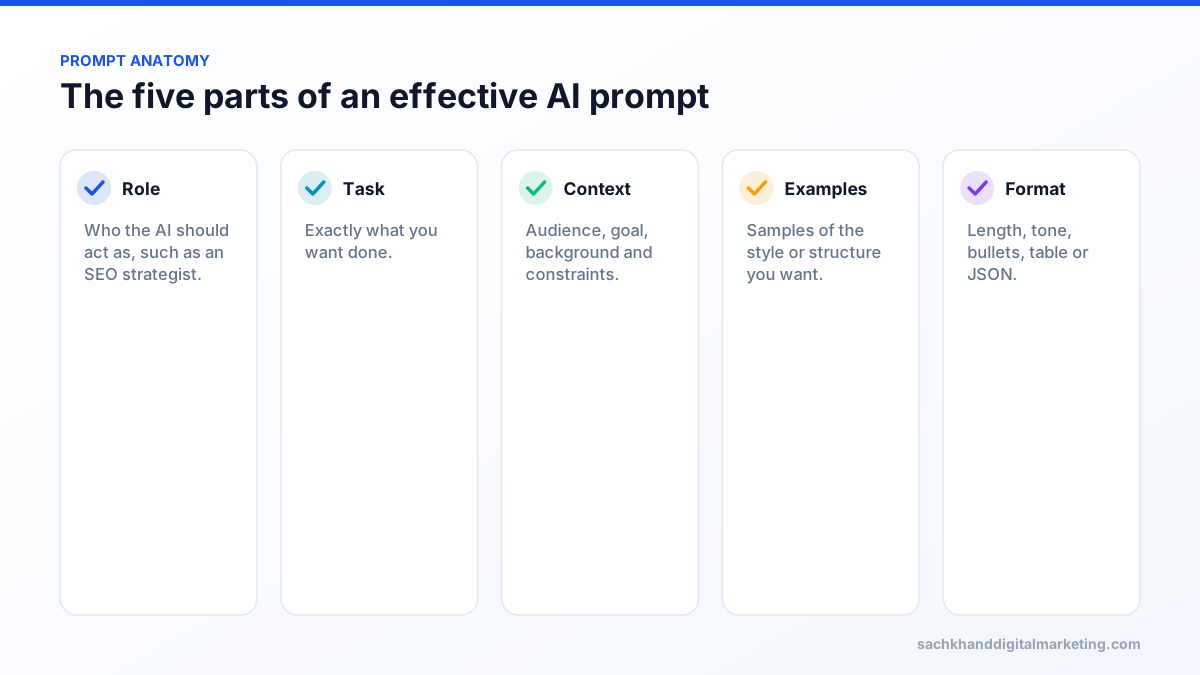
What makes a good prompt
- A clear task — say exactly what you want done.
- Context — audience, goal, background and constraints.
- Examples — show the style or structure you expect.
- Output format — length, tone, bullet points, table or JSON.
- Iteration — refine based on the first answer rather than expecting perfection immediately.
The practice of designing prompts to get reliable results is called prompt engineering.
Types of prompts
- Zero-shot — a task with no examples.
- Few-shot — a task with a handful of examples to copy.
- System prompt — background instructions set by an application that shape every response.
- Multimodal prompt — combines text with images, audio or files.
Why prompts matter for marketing and SEO
People increasingly research products by asking AI assistants instead of typing short keywords into Google. Those prompts are longer, more conversational and more specific: “which CRM is best for a 10-person sales team that uses Gmail?” rather than “best CRM”. For businesses this means:
- Content should answer full, specific questions, not just match keywords.
- Brands need to be mentioned and trusted across the web for AI tools to recommend them.
- Tracking which prompts mention your brand in ChatGPT, Gemini, Perplexity and Google AI Overviews is becoming a core part of generative engine optimisation (GEO).
Prompt examples for marketing tasks
| Task | Weak prompt | Better prompt |
|---|---|---|
| Blog ideas | Give me blog ideas | Act as a content strategist for a Houston HVAC company. List 10 blog topics homeowners search before replacing an AC unit, with the search intent for each, as a table. |
| Meta descriptions | Write a meta description | Write 3 meta descriptions under 155 characters for a page about emergency boiler repair in Leeds. Include same-day service and a 12-month guarantee. Avoid clickbait. |
| Ad copy | Write Google Ads | Write 10 Google Ads headlines under 30 characters for a dental implant clinic in Chicago targeting people comparing costs. Include financing and free consultations. |
| Summaries | Summarise this | Summarise this customer interview in 5 bullet points: main problem, alternatives considered, objections, decision trigger and exact phrases used. |
Prompting techniques that improve results
- Be specific: define audience, goal, constraints and length.
- Provide source material: paste the brief, data or page content you want used.
- Show examples of the output style you want (few-shot prompting).
- Break complex tasks into steps and ask for one step at a time.
- Ask for options and then refine the best one.
- Request a check: ask the model to flag assumptions or missing information.
Prompt mistakes to avoid
- Vague requests with no context or audience.
- Trusting statistics or facts without verifying them against sources.
- Pasting confidential customer data into tools without approval.
- Publishing AI output without expert review and editing.
- Asking for too many unrelated tasks in one prompt.
How businesses can track prompts about their brand
Create a list of prompts buyers might use, such as “best accountant for small businesses in Manchester” or “[your brand] reviews”. Test them monthly in ChatGPT, Gemini, Perplexity and Google AI Mode, and record whether your brand appears, how it is described and which sources are cited. Improvements to content, reviews and third-party coverage can then be measured over time. Our GEO playbook explains this process.
Prompts vs search keywords
| Search keyword | AI prompt | |
|---|---|---|
| Typical length | 2–5 words | Often a full sentence or paragraph |
| Style | Shorthand | Conversational |
| Context | Little | Personal details, constraints, preferences |
| Expected output | List of links | A complete answer or recommendation |
| Follow-ups | New search | Continues in the same conversation |
A reusable prompt template
You are a [role]. Your task is to [task] for [audience]. Context: [background, goal, constraints]. Use this information: [source material]. Output: [format, length, tone]. Before answering, list any assumptions or missing information.
Saving tested templates for recurring tasks, such as briefs, ad copy or report summaries, makes AI output more consistent across a team.
Frequently asked questions
What is a prompt in AI?
A prompt is the input you give an AI model, such as a question or instruction, that tells it what to generate.
What is prompt engineering?
Prompt engineering is the skill of writing and structuring prompts, with clear tasks, context, examples and formats, to get accurate and useful AI output consistently.
How are AI prompts different from search keywords?
Prompts are usually longer and conversational, often include personal context, and expect a complete answer rather than a list of links.
What is a good prompt?
A good prompt gives the AI a clear task, relevant context, any examples or source material and the output format you want. Specific prompts produce more accurate and useful results than short, vague ones.
Want experts to handle this for you?
Our specialists turn these fundamentals into rankings, leads and revenue. Start with a free, no-obligation audit of your site.