Retail media is advertising sold by retailers against their own first-party purchase data, on and off their sites. It works because it reaches shoppers at the moment of purchase, and it is dangerous for the same reason: much of what it claims as conversion would have happened anyway. Judge it on contribution margin after all fees, not on platform ROAS, and prove it with a holdout before you scale. Listing quality sets the ceiling — no bid fixes a weak product page.

On this page
- What retail media actually is
- Why budgets are shifting
- The three layers of retail media
- The honest case for retail media
- When retail media is a bad idea
- Marketplace ads: the formats that matter
- The margin maths that decides everything
- Where retail media fits against search and social
- Listing quality is the ceiling
- Choosing which networks to join
- Creative and content inside retail media
- Measuring retail media honestly
- What you give up
- A 90-day retail media test
- Who should run it, and how often
- Common mistakes in retail media
- Is retail media right for your brand?
- Frequently asked questions
What retail media actually is
Retail media is advertising sold by a retailer against its own first-party purchase data. Amazon sells placements in its search results. Walmart Connect sells placements across Walmart’s site, app and stores. Instacart sells them inside the grocery basket. Dozens of other retailers, from pharmacy chains to DIY, now run their own networks, and the category is often called commerce media when it extends beyond the retailer’s own properties. This guide covers retail media advertising on Amazon Ads, Walmart Connect and other retail media networks, and how retail media fits alongside search and social.
Two things make it different from the channels you already run. The data is transactional rather than inferred — the retailer knows what was actually bought, by whom, how often. And the distance between the ad and the purchase is almost zero: the shopper is already in a buying context, with a basket open.
That combination is why budgets are moving. It is also why retail media flatters itself in reporting more than any other channel, and why the first question is never “how do we scale this?” but “how much of this would have happened anyway?”
Retail media buys attention at the moment of purchase. That is its genuine advantage and the source of every measurement problem it has.
Why budgets are shifting
- Purchase data survived the privacy shift. As third-party signals weakened, retailers kept something better: logged-in customers and real transaction histories.
- Closed-loop reporting. The retailer sees the ad and the sale, so attribution inside its own walls is complete — if self-reported.
- Shelf is finite, search is not. Digital shelves can be expanded endlessly, so retailers can sell far more placements than a physical aisle ever had.
- High margins for the retailer. Ad revenue is dramatically more profitable than selling groceries, which is why every retailer of scale is building a network.
- Trade budget migration. Much retail media spend is not new marketing money. It is trade and shopper marketing budget moving from in-store promotions into digital placements.
That last point matters for how you plan. If retail media is funded from trade spend, it is competing with promotions and listing fees, and it should be judged on the same commercial terms. If it is funded from your marketing budget, it is competing with paid search and social, and you need a fair comparison rather than two sets of self-reported numbers.
The three layers of retail media
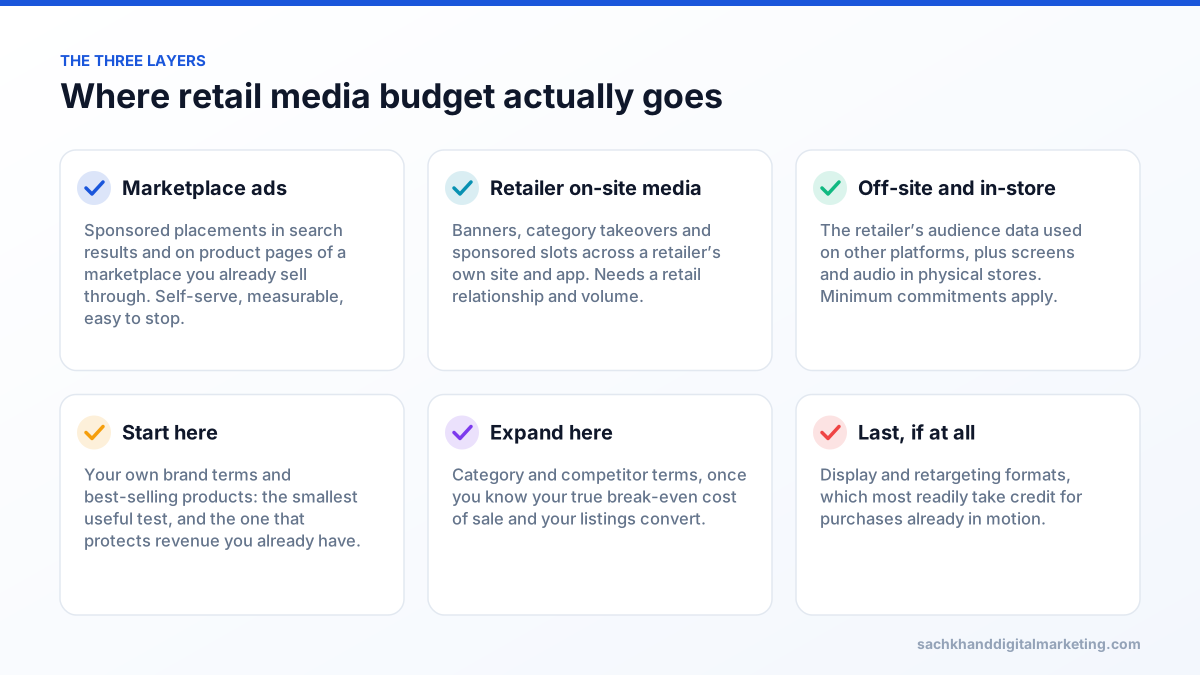
| Layer | What it is | Who it suits |
|---|---|---|
| Marketplace ads | Sponsored placements inside search and product pages on a marketplace you already sell through | Any brand with products and stock on that marketplace |
| Retailer on-site media | Banners, category takeovers and sponsored placements across a retailer’s own site and app | Brands with a retail relationship and enough volume to matter |
| Off-site and in-store | The retailer’s audience data activated on other platforms, plus screens and audio in physical stores | Larger brands with trade budgets and a data partnership |
The layers have very different economics. Marketplace ads are self-serve, measurable within the platform and easy to start or stop. Off-site and in-store activations usually involve minimum commitments, account managers and reporting you cannot independently verify. Start where you can switch it off next week.
The honest case for retail media
Intent is already formed
A shopper typing a product category into a retailer’s search bar has made most of the decisions that matter. They have chosen the retailer, chosen the category, and opened a session where buying is the expected outcome. No amount of interest targeting elsewhere reproduces that.
You are defending as much as attacking
If you do not bid on your own brand terms inside a marketplace, a competitor will appear above your product on your own listing page. A meaningful share of retail media spend is defensive, and defensive spend needs a different justification than growth spend — it is insurance, and insurance should be sized deliberately.
The data comes back to you
Even where the reporting is self-serving, retail media teaches you things your own analytics cannot: what your buyers purchase alongside your product, how often they repeat, which pack sizes move, which competitor is being considered in the same session.
When retail media is a bad idea
The honest list, which vendors rarely lead with:
- Thin margins. If contribution margin after fees and fulfilment is slim, there is nothing left to fund media, and advertising simply accelerates losses.
- Weak listings. Ads send traffic to a product page. A poor page converts poorly, and you pay for every click regardless.
- Stock problems. Advertising into low or erratic stock wastes spend and can damage your standing with the retailer.
- No brand demand at all. Retail media harvests demand efficiently; it rarely creates it. If nobody is searching your category, start further up the funnel.
- One retailer dominates your P&L. Deepening dependence on a single channel that also sets your fees, owns your customer data and may launch a competing own-brand product is a strategic decision, not a media one.
- You cannot measure it independently. Without a holdout or a blended view, you will scale on numbers the seller produced.
Marketplace ads: the formats that matter
Naming conventions differ by platform, but three broad formats recur, and they do different jobs.
- Sponsored product placements. Your item appears in search results and on competitor product pages. Closest to the purchase, usually the first and largest line of spend.
- Sponsored brand placements. A banner-style unit at the top of results featuring your range. Better for range awareness and defending category terms than for direct efficiency.
- Sponsored display and retargeting. Follows shoppers on and off the retailer’s properties. Easiest to over-invest in, because it takes credit for purchases already in motion.
The sequencing that works for most brands: get listings right, then run sponsored product on your own best-sellers and defensive brand terms, then expand into category and competitor terms once you know your true break-even. Only then consider brand and display units, and only with a clear job for each.
The margin maths that decides everything
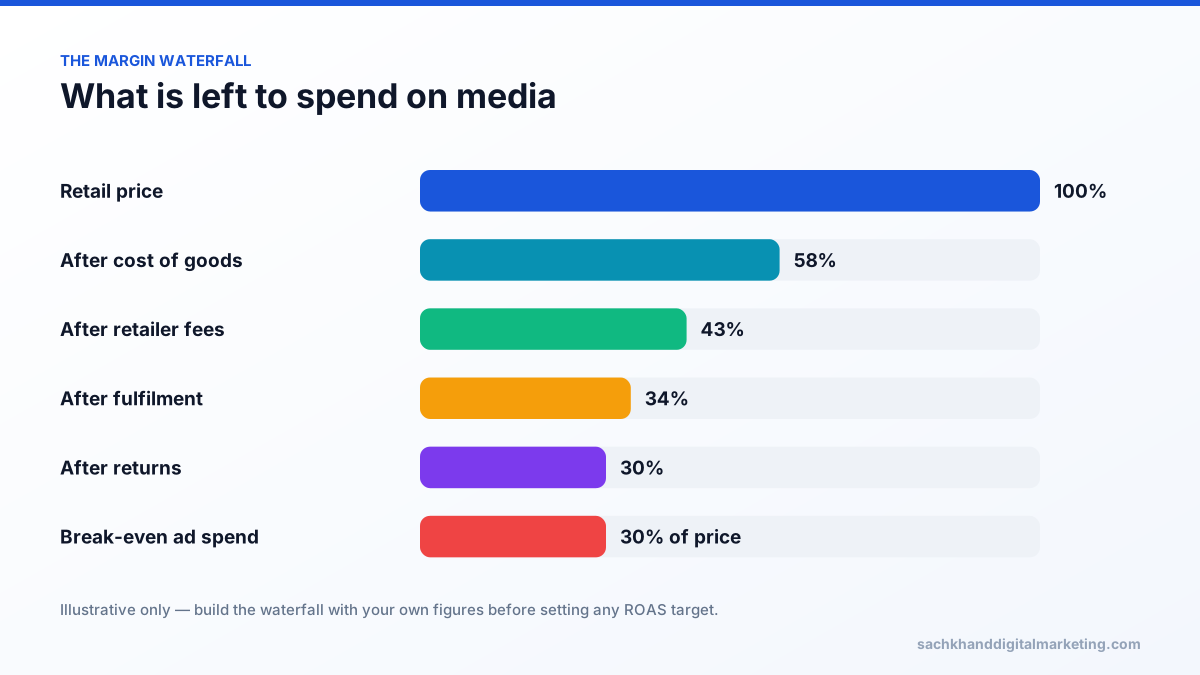
Retail media is the channel where platform ROAS is most misleading, because so much cost sits outside the ad account. Work the whole chain before you set a target.
- Start with retail price, not RRP — the price the shopper actually pays after promotions.
- Subtract cost of goods, including packaging and inbound freight.
- Subtract retailer or marketplace fees: referral or commission, storage, fulfilment, returns handling.
- Subtract returns and damages at your real rate, not the category average.
- What remains is what media can spend from. Divide it by price to get your break-even advertising cost of sale.
Two metrics keep teams honest here. Advertising cost of sale on attributed revenue tells you how the ads performed inside the platform. Total advertising cost of sale — ad spend against all revenue from that retailer, not just attributed revenue — tells you what you are really paying to hold the position. The second number is the one to report upward, because it cannot be inflated by generous attribution.
A 4:1 platform ROAS looks healthy until fees, fulfilment and returns come out. On thin-margin goods that same campaign can be selling at a loss, profitably only in the dashboard.
Where retail media fits against search and social
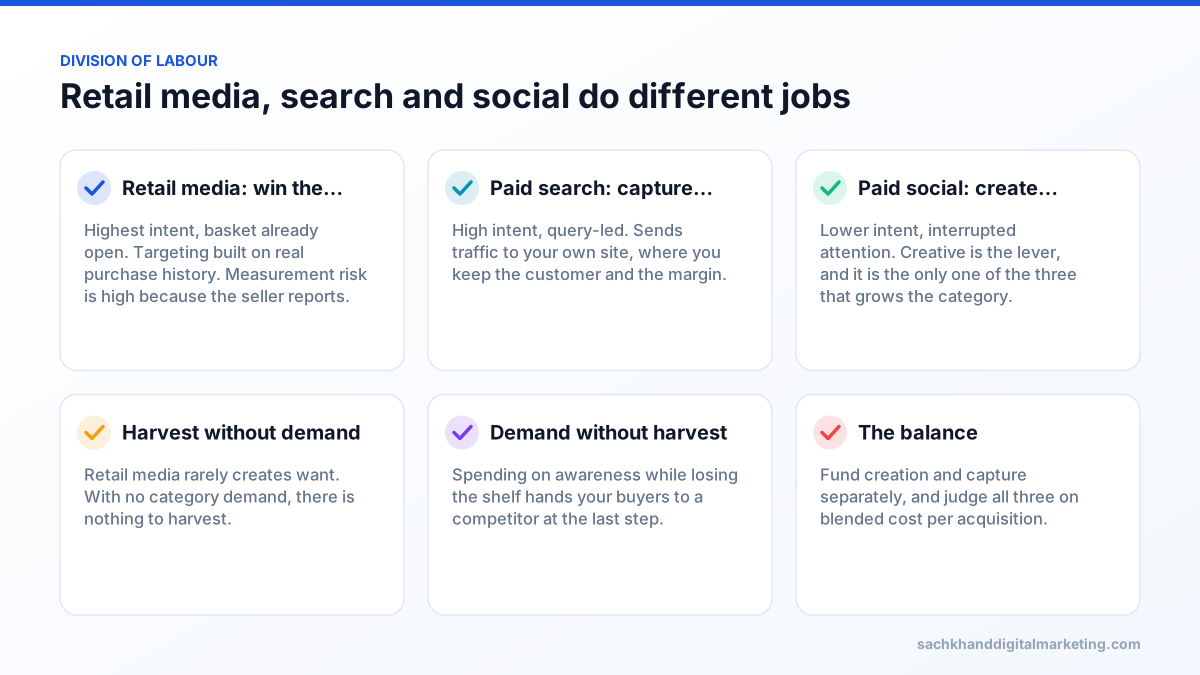
| Retail media | Paid search | Paid social | |
|---|---|---|---|
| Shopper intent | Highest — basket open | High — actively looking | Low to moderate — interrupted |
| Targeting data | Retailer purchase history | Query intent | Behaviour and first-party lists |
| Main job | Win the shelf | Capture demand | Create demand |
| Creative demands | Low — listing does the work | Low to moderate | High — creative is the lever |
| Measurement risk | High — seller reports | Moderate | Moderate to high |
| Where it breaks | Thin margin, weak listings | Low search volume | Weak offer, weak creative |
Read it as a division of labour rather than a ranking. A brand with no demand cannot harvest its way to growth, and a brand with demand it is not harvesting is leaving money on the shelf. The omnichannel ROI framework covers how to hold all three in one view without letting each platform claim the same sale.
Listing quality is the ceiling
Every retail media pound lands on a product page you may not have looked at in a year. That page sets the conversion rate for all the traffic you buy, which makes it the highest-leverage work in the channel.
- Title and key attributes written for how shoppers search, not how your catalogue is organised.
- Images that survive a phone screen: the product filling the frame, scale shown, the detail people ask about visible.
- The objection answered in the bullets — sizing, compatibility, what is in the box, what it does not do.
- Reviews actively earned, and responded to. Rating is a conversion lever and often a ranking one.
- Stock and variant hygiene: no advertising into out-of-stock variants, no orphaned duplicates splitting your reviews.
This is the same discipline as ecommerce SEO, applied inside someone else’s search engine. Brands that treat marketplace listings as a compliance exercise and their own site as the real storefront consistently underperform on both.
Get a prioritised action plan from our specialists, free.
Choosing which networks to join
There are now dozens of retail media networks and you cannot run them all well. Five questions settle most decisions:
- Do your customers actually buy there? Not “is it big”, but “is it where your category is bought”. A grocery network is irrelevant to a furniture brand however impressive its reach.
- Is it self-serve? If you cannot start, pause and read results yourself, the cost of learning is much higher and the exit is slower.
- What is the minimum commitment? Annual minimums and managed-service fees turn a test into a bet.
- How good is the reporting? Ask what you get at SKU level, how conversions are attributed, what the lookback window is, and whether you can export raw data.
- Who else is on the shelf? If the retailer sells a competing own-brand product in your category, understand how that affects placement before committing.
For most mid-sized brands the sensible pattern is one primary network run properly plus one test, rather than five networks run badly. Depth on the network where your category is genuinely bought will beat presence everywhere.
Creative and content inside retail media
Retail media is often sold as a purely bidding-led channel, which is why so much of it underperforms. The creative assets sitting behind the placement do a great deal of the work.
- The primary image is your ad. It is what shoppers scan in a grid of near-identical thumbnails, so it must read at phone size, with the product filling the frame.
- Enhanced product content — comparison tables, lifestyle modules, sizing guides — lifts conversion on the page your ads are paying to fill.
- Brand storefronts give higher-funnel placements somewhere sensible to land, and turn a single product click into a range visit.
- Video in results is increasingly available and still under-used, particularly for products that need demonstration.
- Seasonal refreshes matter here as much as in social; the same hero image all year quietly loses share to competitors who update theirs.
A practical rule: before raising bids on a product, look at its images and content modules. Improving the page usually returns more than paying more for the click, and it improves organic marketplace ranking at the same time.
Measuring retail media honestly
Closed-loop attribution inside a platform is complete and self-interested at the same time. Three habits keep the read truthful.
Run a holdout
Switch the channel off in comparable regions or for comparable product groups, and compare total sales against a matched control. You sacrifice a little volume for a fortnight or two and get back the only answer that matters: how much of this revenue existed without the ads?
Track total cost of sale, not attributed cost of sale
Spend against all revenue from that retailer. If total cost of sale rises while total revenue is flat, you are buying sales you already had.
Watch the halo, in both directions
Retail media can lift your own site’s branded search, and heavy marketplace promotion can also pull customers away from your direct channel, where the margin is better. Measure both, and decide deliberately which channel you want the customer to land in.
What you give up
Three trade-offs deserve a board-level conversation rather than a media-team decision.
- Customer relationship. On most marketplaces the customer belongs to the retailer. You gain volume and lose the ability to market to them directly.
- Price and promotion control. Deep marketplace participation tends to compress pricing power and train customers to wait for deals.
- Competitive intelligence given away. The retailer can see exactly which of your products sell, at what price, to whom — including when it decides to launch its own version.
None of these are reasons to avoid retail media. They are reasons to size it deliberately, and to keep building the direct channel where you own the customer, the margin and the data.
A 90-day retail media test
| Weeks | Focus | Output |
|---|---|---|
| 1–2 | Margin model, listing audit, stock check, break-even cost of sale | You know what you can afford to pay |
| 3–4 | Fix listings and images on the products you intend to advertise | The page converts before you buy traffic |
| 5–8 | Sponsored product on best-sellers and defensive brand terms only | A clean read on your core range |
| 9–12 | Holdout test, total cost of sale review, decision on expansion | Evidence, not a platform dashboard |
Resist expanding formats before week nine. The commonest failure we see is a brand running four ad types across two hundred products within a month, with no margin model and no control group, and then arguing about a number nobody can verify.
Who should run it, and how often
Retail media falls between teams more often than any other channel. It is bought like media, it depends on listings owned by ecommerce, it is funded like trade spend, and it lives or dies on stock controlled by supply chain. Deciding ownership early prevents most of the dysfunction.
- One accountable owner for the budget and the numbers, whoever they report to.
- A standing link to ecommerce, because listing and image changes move performance more than bids.
- Stock visibility before spend decisions, not after a campaign has burned budget on unavailable variants.
- Finance in the loop on the margin model, so targets reflect real contribution rather than platform ROAS.
- A weekly rhythm and a monthly review. Weekly: pacing, stock, search terms, obvious waste. Monthly: total cost of sale, margin, expansion decisions.
The failure pattern is familiar: media buys the placements, nobody owns the product page, stock runs out mid-flight, and the postmortem argues about attribution. A fortnightly fifteen-minute standing meeting between the three functions prevents nearly all of it.
Common mistakes in retail media
- Judging it on platform ROAS alone. The seller counts the conversions and keeps the fees.
- Advertising a weak listing. You are buying clicks onto a page that cannot convert them.
- Ignoring total cost of sale. Attributed revenue hides how much of the shelf you are renting from yourself.
- Funding it by cutting demand creation. Harvesting grows until there is nothing left to harvest.
- Spreading spend thinly across the whole catalogue. Concentration beats coverage while you are learning.
- Never running a holdout. Without one, every expansion decision rests on the platform’s own marking.
- Forgetting your own storefront. The customer you win on a marketplace is rarely yours to keep.
Is retail media right for your brand?
A short qualifying test. Three or more yes answers and it is worth a structured 90-day test; fewer, and the money is better spent on demand and conversion first.
- You have contribution margin of a reasonable size after all retailer fees and fulfilment.
- Your listings convert well already, or can be fixed within a month.
- Stock is reliable for the products you would advertise.
- There is existing search demand in your category on that retailer.
- Competitors are appearing on your brand or product pages.
- You can run a holdout without disrupting the business.
If you are unsure, start with the defensive slice only: your own brand terms, your best-selling products. It is the smallest useful test, it protects the revenue you already have, and it tells you quickly whether the wider opportunity is real. Our advertising team can build the margin model with you before any budget moves.
Frequently asked questions
What is a retail media network?
A retail media network is an advertising business run by a retailer, selling placements against its own first-party purchase data. That usually means sponsored placements in the retailer’s search results and product pages, and often extends to the retailer’s audience data being used on other sites and on in-store screens.
Is retail media worth it for small brands?
It can be, but only where contribution margin after all fees supports paid traffic and the listings already convert. Small brands usually get the best return from a narrow start: sponsored placements on best-selling products and defensive brand terms, rather than broad category bidding.
How is retail media different from Google Shopping?
Google Shopping captures demand across the open web and sends traffic to your own site, where you own the customer and the margin. Retail media places you inside a retailer’s own shelf, closer to the purchase but on their terms, with the customer relationship staying with them. Most ecommerce brands need both, doing different jobs.
What is TACoS and why does it matter?
Total advertising cost of sale measures ad spend against all revenue from a retailer, not just the revenue the platform attributes to your ads. It is harder to flatter than attributed cost of sale, which makes it the more honest number to report upward — particularly when you are largely advertising on your own brand terms.
Does retail media cannibalise my own website sales?
It can. Heavy marketplace promotion trains customers to buy where it is easiest, which is usually not your own site. Track direct-channel revenue alongside marketplace revenue, and decide deliberately how much volume you are willing to move into a channel with lower margin and no customer relationship.
How do I measure retail media incrementality?
Run a holdout. Switch the channel off for comparable regions or product groups for a few weeks and compare total sales against a matched control. Pair that with total cost of sale and your blended margin. Platform-reported conversions alone cannot tell you what would have happened anyway.
Should we bid on our own brand terms?
Often yes, but as insurance rather than growth. If you do not appear on your own brand and product pages, competitors will. Size that defensive spend consciously, measure it separately from category and competitor bidding, and test pausing it occasionally to see what it is really protecting.
What does retail media do to my margin?
It comes out of contribution margin after cost of goods, retailer fees, fulfilment and returns. Build the full waterfall before setting targets: a campaign with a healthy platform ROAS can still be unprofitable once every fee is counted, especially on low-priced or bulky items.
Do I need good listings before advertising?
Yes. Advertising sends paid traffic to a product page you do not control the template of. Titles, images, bullets, reviews and stock reliability determine whether that traffic converts, so fixing listings almost always returns more than raising bids.
How much budget should we start with?
Enough to generate readable data on a narrow set of products, and no more. Concentration beats coverage while you are learning: a small budget on best-sellers and brand defence produces a clearer answer than the same budget spread across the full catalogue.
Not sure whether retail media earns its place?
We build the margin model, audit the listings and design the holdout before any budget moves — so the decision rests on your numbers, not the platform’s.