Automation now sets bids, picks placements and assembles creative, which moves the work upstream: conversion data quality, first-party audiences, feed hygiene, exclusions and creative volume. Keep humans on budget allocation between brand and non-brand, negatives and exclusions, offers and landing pages, and incrementality testing — because platform-reported ROAS will always flatter the platform. Fix measurement first, then creative, then structure.

On this page
- From levers to inputs: what AI actually changed in PPC
- Feed the model properly, or nothing else matters
- Creative is the new targeting
- What to keep human
- Campaign structure in an automated PPC account
- Performance Max, Advantage+ and lead generation
- Measurement in an AI-run account
- Budget allocation when the machine spends it
- Where AI helps beyond bidding
- What PPC automation means for small budgets
- Landing pages: the lever automation cannot pull
- A 90-day plan for an AI-run account
- First-party data and audience signals in PPC
- Reporting an AI-run PPC account to a board or client
- Weekly PPC guardrails: what to check when the machine is running
- Common mistakes with PPC automation
- Frequently asked questions
From levers to inputs: what AI actually changed in PPC
Ten years ago a skilled buyer won on execution: bid adjustments, match type discipline, placement exclusions, device modifiers, dayparting. Most of those controls have been absorbed into the platforms’ own models. Performance Max, Advantage+ campaigns and smart bidding decide where, when and how much, using signals no human account manager can see. This guide covers AI PPC automation across Google Ads Performance Max, Smart Bidding and Meta Advantage+ — and where human PPC management still earns its fee.
This is frequently described as the job getting smaller. It is the opposite. The decisions that remain have larger consequences, because a model amplifies whatever you feed it. Poor conversion data now produces confidently wasted budget at scale, and it does so faster than a manual account ever could.
The modern PPC job is four inputs: the accuracy of your conversion data, the quality and volume of your creative, the structure of your offer and landing experience, and an honest read on incrementality. Everything else is increasingly the machine’s.
You no longer optimise the auction. You optimise what the auction optimiser learns from. Garbage in, efficient garbage out.
Feed the model properly, or nothing else matters
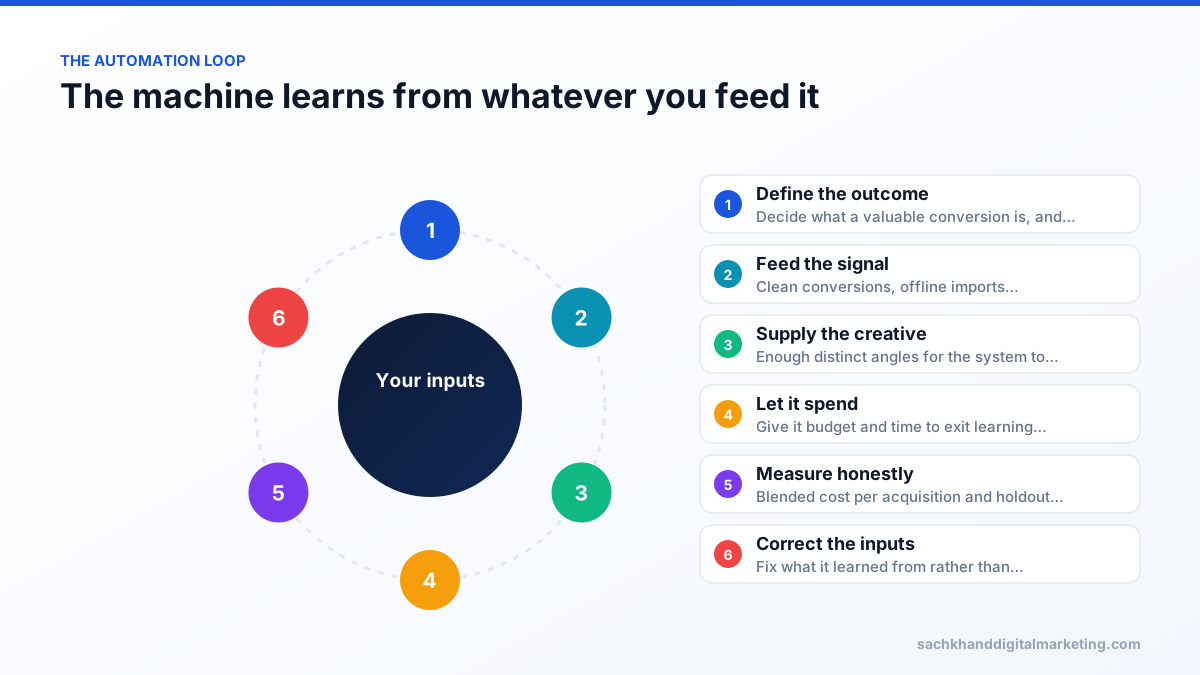
Every audit we run starts here, and most of them stop here for the first month. If the conversion signal is wrong, improving anything downstream is wasted effort.
Conversion accuracy
Deduplicate conversions, exclude the junk, and make sure what you count is what you want more of. An account optimised toward “leads” that are largely spam will buy more spam very efficiently, and the dashboard will look excellent while the sales team quietly stops answering the form.
Values, not just events
Pass values rather than counts wherever possible. A booked job, a qualified opportunity and a closed deal are not worth the same as a newsletter signup, and a bidding model told they are will optimise toward the cheapest one. Offline conversion imports from the CRM are the single highest-leverage change available to most lead-generation accounts.
First-party data
Customer lists, high-value segments, lapsed customers, and exclusion lists of people you do not want to pay for again. As third-party signals weaken, first-party data becomes the differentiator between two advertisers running the same automated campaign type.
Feed hygiene for retail
Titles, attributes, availability, images and product categorisation drive more retail performance than bid strategy now. A well-structured feed is a targeting asset; a neglected one is a ceiling no bid adjustment can lift.
Exclusions and guardrails
Brand terms, existing customers, irrelevant placements, low-value geographies. Automation optimises toward the cheapest conversions available, and the cheapest conversions are usually people who were already going to buy.
An account “performing well” on platform ROAS while optimising toward form fills the sales team never contacts. Fix measurement before touching campaign structure — every other decision depends on numbers you have to be able to trust.
Creative is the new targeting
When the machine chooses the audience, creative decides who responds. That makes creative the largest remaining lever, and it changes what a creative process needs to look like.
- Build asset groups around themes — service lines, problems, audiences, seasons — rather than one catch-all group.
- Supply genuine variety. Multiple angles, formats and aspect ratios so the system has something meaningful to choose between.
- Test messages, not decoration. Offers, objections, proof, urgency and audience framing — not button colours.
- Refresh on a schedule before fatigue shows in the numbers, not after.
- Use real material. Real jobs, real staff, real customers. Authentic footage consistently outperforms polished stock in service categories.
- Keep a control. Always run a known performer alongside tests so you can tell a bad test from a bad week.
The volume question comes up constantly. The practical answer is: enough distinct angles that the system can learn something, refreshed often enough that performance does not decay. For most small and mid-sized accounts that means a monthly cadence with a handful of genuinely different concepts, not a hundred variations of the same headline.
What to keep human
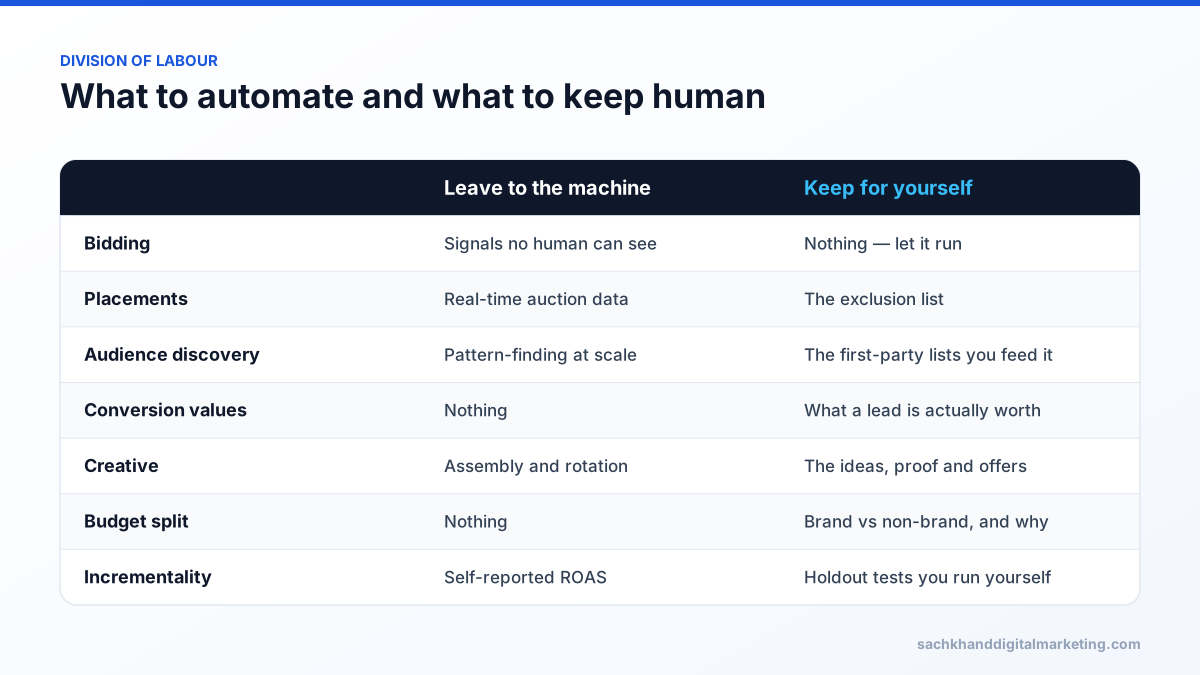
| Decision | Owner | Why |
|---|---|---|
| Bids and placements | Automated | The model sees more signals than any human can |
| Audience discovery | Mostly automated | Signals guide it; rigid targeting usually limits it |
| Budget split: brand vs non-brand | Human | Automation will happily harvest cheap brand clicks |
| Negatives and exclusions | Human | Only you know which traffic is worthless to your business |
| Offer and landing page | Human | The biggest conversion lever, untouched by bidding |
| Creative direction | Human | Distinctiveness cannot be generated from the average |
| Conversion definitions and values | Human | This is the instruction set; get it wrong and everything follows |
| Incrementality decisions | Human | Platforms grade their own homework |
| Compliance and brand safety | Human | Automated placement needs human boundaries |
A useful heuristic: automate the questions with a measurable right answer inside the auction, and keep the questions that require knowledge of your business, your margins and your customers.
Campaign structure in an automated PPC account
Structure has not stopped mattering; it has changed purpose. It used to be how you controlled targeting. Now it is how you control budget, reporting and learning.
- Separate what you need to read separately. If brand and non-brand sit in one campaign, you cannot see either clearly.
- Group by margin or business value, not only by product category, so budget follows profit.
- Avoid fragmenting into starvation. Too many small campaigns split the conversion data the model needs to learn.
- Keep search terms visible. Review the reporting you do get, regularly, and add negatives from it.
- Give changes time. Learning periods are real; changing structure weekly guarantees the model never stabilises.
The balance to strike is between control and data density. Every split you make buys you clarity and costs you signal. Make splits you will actually act on, and consolidate the rest.
Performance Max, Advantage+ and lead generation
Automated campaign types work for lead generation, but they are unforgiving of bad inputs in a way that ecommerce is not, because the conversion signal is noisier and the value of a conversion varies enormously.
- Define the conversion you actually want. Qualified lead, booked appointment or sales-accepted opportunity — not raw form fills.
- Import offline outcomes so the model learns which leads became revenue.
- Exclude existing customers and, where appropriate, brand traffic.
- Watch the placements and search terms in whatever reporting the platform provides.
- Protect the phone path. Many service businesses convert by call; if calls are not tracked, half the signal is missing.
- Give it enough budget and time to exit learning, or the results describe the learning period rather than the campaign.
If a lead-gen account cannot pass qualified-lead data back to the platform, expect automated types to underperform a well-run search campaign. Fix the data path first; it is usually a fortnight of work and it changes everything downstream. Our complete Google Ads guide covers campaign mechanics in more depth, and the Advantage+ versus manual comparison covers the Meta side.
Measurement in an AI-run account
Platform-reported ROAS includes conversions the platform claims credit for, including many that would have happened anyway. That is not dishonesty; it is the limit of self-reported attribution. Three checks keep you honest.
Geo holdouts
Switch a channel off in comparable regions and compare total demand against matched control regions. It costs some volume for a few weeks and answers a question no attribution model can. This is the cheapest credible incrementality test available to most advertisers.
Brand-term tests
Pause paid brand in a controlled window and watch total enquiries rather than paid enquiries. Some accounts find most of the paid brand spend was buying clicks they already owned; others find real defensive value against competitor bidding. Both answers are useful, and neither can be deduced from the dashboard.
Blended reporting
Track total marketing cost against total new customers, monthly, alongside the platform numbers. If blended cost per acquisition is flat while platform ROAS improves, the improvement is a reporting artefact. This single line, tracked consistently, prevents more bad decisions than any attribution model.
Larger accounts can layer on marketing mix modelling, but most businesses get further with one well-run holdout per quarter than with another dashboard. The omnichannel ROI framework covers how to combine these views without double-counting.
Budget allocation when the machine spends it
Automation optimises within the budget you give it; it does not decide whether that budget should exist. Allocation remains the most consequential human decision in the account.
- Brand versus non-brand. Watch the share of conversions coming from brand terms. If it climbs while total enquiries stay flat, you are paying for demand you already had.
- Prospecting versus remarketing. Remarketing always looks efficient because it targets people who already know you. Cap it deliberately.
- Channel versus channel. Judge on incrementality tests, not on each platform’s self-reported numbers, which will collectively claim more conversions than you had.
- Seasonality. Fund the peak before it starts; models need data before the surge, not during it.
- Reserve for testing. Ring-fence a small percentage for creative and channel experiments so testing does not compete with delivery.
Get a prioritised action plan from our specialists, free.
Where AI helps beyond bidding
Bidding gets the attention, but the practical AI wins in PPC are often elsewhere in the workflow:
- Drafting and varying ad copy for human selection and compliance review
- Producing creative variants and resizes at a volume that manual production cannot match
- Summarising search term and placement reports into a shortlist of actions
- Detecting anomalies — spend, conversion rate or lead quality shifts — earlier than a weekly review would
- Scoring and routing leads so the sales team works the best ones first
- Drafting landing page variants for CRO tests, which a human then validates
Each of these keeps a human decision at the end. The pattern across the whole discipline is the same: let the machine generate and score, let the human decide and be accountable.
What PPC automation means for small budgets
Most PPC automation guidance is written for accounts spending six figures a month. Below that, the constraint is data density: automated bidding needs conversions to learn from, and a small account may generate only a handful a week.
- Consolidate rather than fragment. One campaign with enough conversions beats five that each sit below the learning threshold.
- Optimise toward a higher-volume signal further up the funnel — qualified enquiries rather than closed deals — then validate against revenue offline.
- Be patient with changes. Small accounts take longer to exit learning, so weekly tinkering is disproportionately damaging.
- Narrow the geography or service list before narrowing the budget. Depth in one area produces learnable data; thin coverage everywhere does not.
- Expect more variance. With few conversions, week-to-week swings are noise. Judge monthly, not daily.
Small accounts also have a genuine advantage worth using: the owner usually knows exactly which enquiries were worth having. That judgement, fed back as conversion values, is higher-quality training data than most large accounts manage to produce with far more infrastructure.
Landing pages: the lever automation cannot pull
No bidding strategy fixes a page that does not convert. As targeting decisions move to the platforms, the landing experience becomes a larger share of the controllable difference between accounts.
- Message match. The page repeats the promise the ad made, in the same words.
- One obvious next step, visible without scrolling on a phone.
- Proof close to the ask. Reviews, guarantees, credentials and real photography beside the form, not three screens away.
- Fewer fields. Every optional field costs conversions; collect the rest after the lead exists.
- Speed. Paid traffic is impatient and largely mobile; Core Web Vitals translate directly into cost per lead.
- Call handling. For service businesses, the biggest conversion lever is often answering the phone faster, which no platform can automate for you.
A 90-day plan for an AI-run account
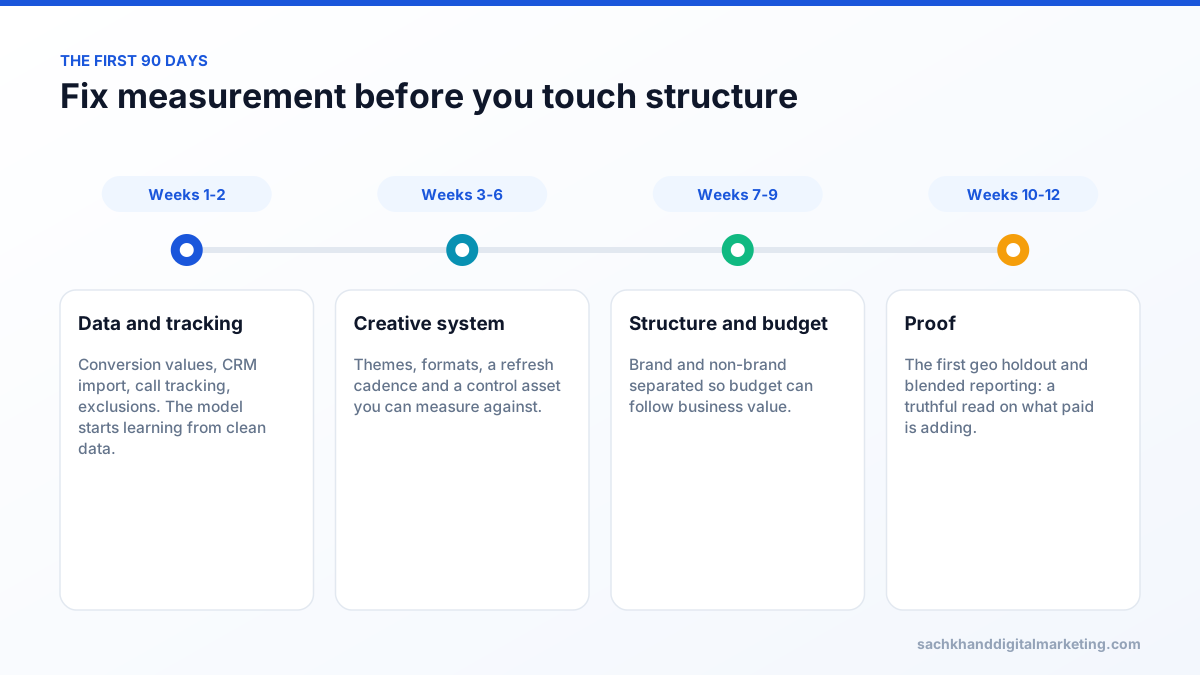
| Weeks | Focus | Outcome |
|---|---|---|
| 1–2 | Tracking audit, conversion values, CRM import, exclusions, call tracking | The model learns from clean data |
| 3–6 | Creative system: themes, formats, refresh cadence, a control asset | Enough variety for automation to work with |
| 7–9 | Structure and budget split; brand versus non-brand clarity | Budget follows business value |
| 10–12 | First incrementality test; blended reporting; landing page fixes | A truthful read on what paid is adding |
Run it in that order. Restructuring campaigns before fixing measurement is the most expensive mistake in modern paid media, because every decision afterwards rests on numbers you cannot trust — and with automation, wrong instructions get executed faster and at greater scale than they ever did manually.
First-party data and audience signals in PPC
Every platform now asks for audience signals, and most accounts supply something perfunctory. Done properly, this is one of the few remaining sources of durable advantage, because your customer data is the one input a competitor running the same campaign type cannot copy.
The lists worth building
- Customers, segmented by value. Top quartile by lifetime value, not one undifferentiated list.
- Recent purchasers or booked jobs, for exclusion as much as targeting.
- Lapsed customers, who are often the cheapest revenue available.
- Qualified leads that did not convert, which describe your best prospects better than any demographic.
- Poor-fit enquiries, used as a negative signal where the platform allows it.
Keeping them alive
Lists decay. A customer file uploaded once and never refreshed is worth progressively less each month, and match rates fall as contact details change. Automate the refresh if you can, schedule it if you cannot, and check match rates rather than assuming the upload worked.
Consent and hygiene
Use data you are permitted to use, honour marketing preferences, and keep the consent basis documented. This is both a legal matter and a practical one: an account built on data you later have to remove is an account that loses its advantage overnight.
The pairing that matters most is simple — clean conversion values flowing back from the CRM, plus segmented customer lists going out. Those two together change what the model learns more than any settings change available in the interface.
Reporting an AI-run PPC account to a board or client
Automation has made reporting harder, not easier. The platform produces more numbers and fewer of them mean what a stakeholder assumes they mean. A report that survives scrutiny holds three layers.
| Layer | What it shows | Typical source |
|---|---|---|
| Business outcome | New customers, revenue, blended cost per acquisition | CRM and finance |
| Channel contribution | Spend, leads, qualified leads, platform-reported ROAS | Ad platforms |
| Evidence of incrementality | Holdout or brand-pause results, blended trend over time | Tests you ran |
Lead with the first layer. Platform metrics belong in the report as diagnostics, not as the headline, because stakeholders reasonably assume a headline number is the truth. Any report where the platform numbers add up to more conversions than the business recorded needs a reconciliation line, every month, in plain language.
- State what is estimated and what is counted.
- Show the same metrics in the same order every month.
- Explain learning periods before they affect results, not afterwards.
- Attach one decision to every section, so the report drives action.
Honest reporting is also commercially safer. Accounts sold on platform ROAS tend to be lost on blended numbers the moment a finance team looks closely; accounts reported on blended numbers from the start survive that conversation.
Weekly PPC guardrails: what to check when the machine is running
Automated does not mean unattended, and PPC is no exception. A short weekly routine catches most of the expensive failures before they compound.
- Spend pacing against budget, by campaign, looking for sudden shifts.
- Lead quality, sampled from the CRM rather than counted in the platform.
- Search terms and placements, with negatives added from what you find.
- Conversion tracking health — a broken tag is the single most expensive silent failure in paid media.
- Creative fatigue signals: falling click-through or rising cost per acquisition on ageing assets.
- Brand share of conversions, to catch automation drifting toward demand you already had.
- Landing page availability and speed, because paid traffic amplifies any site problem.
Fifteen minutes weekly, plus a deeper monthly review, is sufficient for most accounts. The discipline is to check the inputs rather than tinker with the settings: with automation, the highest-value intervention is almost always correcting what the system is learning from, not overriding what it decided.
Common mistakes with PPC automation
- Optimising toward unqualified leads. The model does exactly what you asked, expensively.
- Judging automation by platform ROAS alone. Self-reported numbers flatter the reporter.
- Starving campaigns of data by splitting them into too many small segments.
- Changing everything weekly. Nothing exits learning, so nothing can be evaluated.
- Letting automation eat brand traffic without exclusions or a separate budget.
- Treating creative as a design task rather than the primary targeting input.
- Ignoring the phone. Untracked calls mean an incomplete signal and undervalued campaigns.
- No control group, ever. Without a holdout you are describing correlation and calling it performance.
Frequently asked questions
Does Performance Max work for lead generation?
It can, but it depends on the quality of the conversion signal. Feed it qualified-lead or booked-appointment data rather than raw form fills, import offline outcomes from your CRM, exclude existing customers and brand terms where appropriate, and review search-term and placement reporting regularly. Accounts that cannot pass back lead quality usually see automated types underperform a well-run search campaign.
Should we still run manual search campaigns in 2026?
Many accounts keep tightly themed search campaigns alongside automated ones, particularly for high-value, sensitive or tightly regulated terms where control matters. The right answer comes from tests in your own account rather than a rule of thumb, and it changes as your data quality improves.
How much creative do we need for AI-driven campaigns?
Enough genuinely different angles that the system has something to learn from, refreshed before performance decays. For most small and mid-sized accounts that means a monthly cadence with a handful of distinct concepts across the required formats, rather than hundreds of near-identical variations.
How do we stop automation eating our brand traffic?
Use brand exclusions where the platform supports them, keep brand and non-brand budgets separate so you can read each clearly, and monitor the share of conversions coming from brand terms. If that share rises while total enquiries stay flat, you are paying for demand you already had.
What is the cheapest way to measure incrementality?
A geo holdout. Choose comparable regions, switch the channel off in one group for a few weeks, and compare total demand against the control. It costs some volume and answers a question no attribution model can. A controlled brand-term pause is the second cheapest test.
Why does platform ROAS look better than our actual results?
Because platforms report conversions they claim credit for, including many that would have happened anyway, and each platform claims independently. Add blended reporting — total marketing cost against total new customers — and an occasional holdout test, and the gap becomes visible and manageable.
Do we still need negative keywords with automated campaigns?
Yes. Automation optimises toward the cheapest available conversions, and only you know which traffic is worthless to your business. Review whatever search term and placement reporting the platform provides and maintain exclusion lists as an ongoing task rather than a one-off setup step.
How important is first-party data for PPC now?
It is one of the few durable advantages left. Customer lists, high-value segments, exclusion lists and offline conversion imports all improve what the model learns from, and they are unavailable to competitors running the same campaign type with default settings.
How long should we wait before judging an automated campaign?
Long enough to exit the learning period and accumulate meaningful conversion volume — typically several weeks rather than several days, and longer for low-volume, high-value lead generation. Frequent changes restart learning, which is why impatient accounts often conclude that automation does not work.
Can AI replace a PPC manager?
It has replaced much of the manual execution, not the judgement. Someone still has to define what a valuable conversion is, keep the data clean, supply creative, decide budget allocation between brand and prospecting, run incrementality tests and interpret what the results mean for the business. Those decisions set the ceiling on what automation can deliver.
Not sure what your ad spend is actually buying?
We audit tracking, creative and structure, then show you where automation is working and where it is quietly wasting budget.