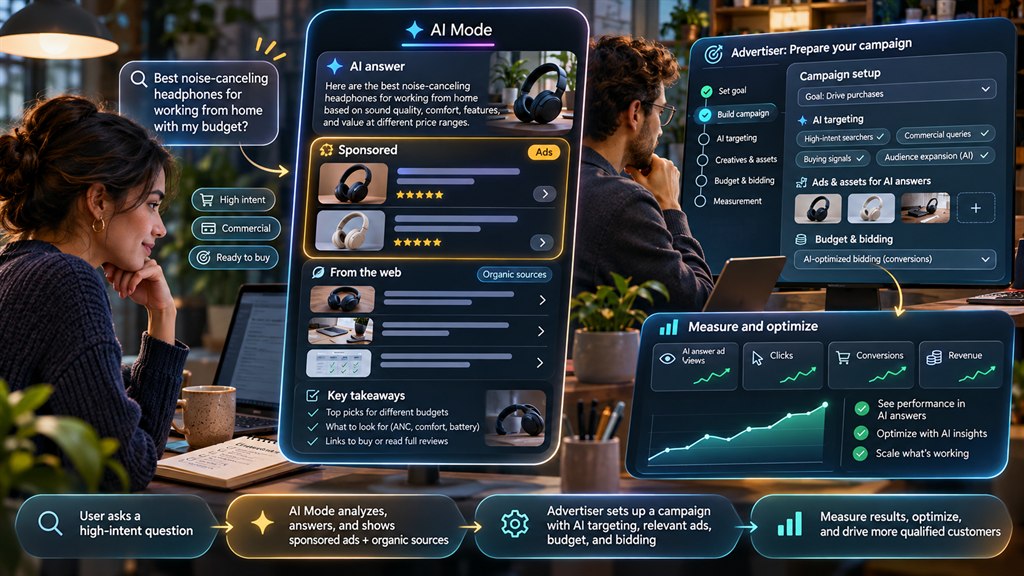
Ads in Google AI Mode are Search and Shopping ads that Google places inside, or just below, an AI Mode answer, labelled Sponsored. There is no separate campaign type: according to Google’s Ads Help documentation, eligible ads come from existing Search campaigns (using broad match or AI Max for Search), Shopping campaigns and Performance Max. On 28 October 2026 Google expanded ads in AI Mode from the US to ten more countries, including India, and started showing ads in follow-up turns of a conversation in the US. To prepare: loosen keyword-only control, fix your product feed, make landing pages answer real questions, and get conversion tracking right.
On this page
- What is Google AI Mode and how does it work?
- What are ads in Google AI Mode?
- Ads in AI Overviews vs ads in AI Mode
- Where AI Mode ads run
- Which campaigns are eligible
- What is AI Max for Search?
- How ads are matched to conversations
- New AI Mode ad formats
- AI Mode ads for ecommerce, local and B2B businesses
- How to prepare your Google Ads account
- AI Mode ads checklist
- Google Ads setup checklist before you widen matching
- Google AI Mode vs ChatGPT search vs Perplexity: where to advertise
- Measuring AI Mode ad performance
- AI tools for Google Ads in 2026
- Choosing a Google Ads agency in India
- What it means for advertisers in India
- Google’s wider AI advertising tools in 2026
- Quick answers
- How we prepare a Google Ads account for AI Mode
- Google Ads management services: agency, consultant or in-house?
- Ads vs organic citations in AI Mode
- Frequently asked questions
For two years, the question about Google’s AI answers was how to be cited in them. Now there is a second question: how to buy your way in. Google has been testing Google AI Mode ads in the US since 2025 and, in late October 2026, switched them on in ten more markets. If you run Google Ads in India, Australia, Canada or Singapore, some of your budget may already be serving there. This guide explains what is known, what is not, and what to change. If you are new to the product itself, start with our guide on how to optimize for Google AI Mode.
What is Google AI Mode and how does it work?
What is Google AI Mode? It is a conversational search experience inside Google Search, powered by a custom version of Google’s Gemini model. How does Google AI Mode work? It breaks a question into sub-topics, runs many searches at once (Google calls this query fan-out), and writes one answer with links to its sources. You can then ask follow-up questions.
- How to use Google AI Mode: open Google Search and choose the AI Mode tab or button, then type, speak or upload an image. Is Google AI Mode free? Yes, it is free to use with a Google account.
- Google AI Mode vs AI Overview: AI Overviews add a short summary above normal results; AI Mode is a separate, longer conversation.
- Is Google AI Mode the same as Gemini? No. AI Mode is part of Google Search and grounded in web results; the Gemini app is Google’s general assistant. Both use Gemini models.
- Google AI Mode in India: available since 2025, and since October 2026 Indian users can also see Sponsored ads in it.
What are ads in Google AI Mode?
AI Mode is Google’s conversational search experience: you ask a long question, Gemini writes an answer with cited sources, and you can ask follow-ups. Ads in AI Mode are text or Shopping ads that appear within that experience, clearly labelled as Sponsored, when Google judges an ad relevant to both the question and the answer it has written.
Two points matter for advertisers. First, you do not create “AI Mode campaigns”; eligibility comes from campaigns you already run. Second, matching works on the meaning of a whole conversation rather than a single short keyword, which changes how much control exact keyword lists give you.
Ads in AI Overviews vs ads in AI Mode
Google runs ads in two AI experiences, and people often mix them up:
| Ads in AI Overviews | Ads in AI Mode | |
|---|---|---|
| Where they appear | Within or below the AI summary at the top of normal Google results | Within or below the answer in the separate, conversational AI Mode |
| Type of query | Shorter informational and commercial searches | Longer, multi-part questions and follow-ups |
| Eligible campaigns | Search (broad match or AI Max), Shopping, Performance Max | The same campaign types |
| Label | Sponsored | Sponsored |
Because eligibility is shared, preparing for ads in AI Overviews also prepares you for AI Mode. The difference is the user: people in the conversational mode are usually further into their research, asking detailed questions with more context.
Where AI Mode ads run
On 28 October 2026 Google announced that ads in AI Mode were expanding beyond the US. Reports of the announcement list ten new markets:
| Status | Markets |
|---|---|
| Live (US first) | United States |
| Added 28 Oct 2026 | Australia, Canada, India, Kenya, Malaysia, New Zealand, Nigeria, Pakistan, the Philippines, Singapore |
| Reported as next | Brazil, Mexico and the UK, later in Q4 2026 |
| Not currently | European Union (AI Mode stays ad-free there for now) |
Google also launched multi-turn ads in the US: ads that can appear in a follow-up answer, not only the first one. Availability changes quickly, so treat this table as a snapshot and check Google’s announcements for your market.
Which campaigns are eligible
Google’s Ads Help documentation for ads in AI Overviews and AI Mode lists these campaign types as eligible:
- Search campaigns using broad match keywords, or with AI Max for Search switched on (AI Max can match beyond your keyword list).
- Shopping campaigns, which rely on your Merchant Center product feed.
- Performance Max campaigns, which can serve across Search and Shopping inventory.
The practical consequence: an account built entirely on exact and phrase match, with no AI Max and no Shopping or Performance Max, has little or no route into these placements. Reports on the expansion also say advertisers in the new countries cannot opt out of these placements separately; eligible campaigns simply become eligible.
What is AI Max for Search?
AI Max for Search is a one-click feature set for Google Search campaigns, launched in 2025. It bundles three things:
- Search term matching: broad match plus keywordless matching that uses your landing pages and assets to find relevant searches, including long conversational ones.
- Text customisation: Google generates headlines and descriptions from your site and assets to fit the query.
- Final URL expansion: Google can send people to the most relevant page on your site, not only the one you chose.
It also adds controls: brand inclusions and exclusions, location targeting based on the intent of the query, and URL exclusions. In the search terms report, matches found by AI Max are labelled so you can see what it added. AI Max vs broad match: broad match is one part of AI Max; AI Max adds keywordless matching, generated text and URL expansion on top.
AI Max vs Performance Max
Performance Max (PMax) is a separate campaign type that runs across all Google inventory (Search, Shopping, YouTube, Display, Discover, Gmail, Maps) from one campaign. AI Max is a feature you switch on inside a normal Search campaign, so you keep Search reporting and controls. Many advertisers use both: PMax for feed-led sales and AI Max to widen proven Search campaigns.
How ads are matched to conversations
A classic search ad matches a short query such as “CRM software”. A conversational question looks more like “which CRM works for a 12-person sales team that uses WhatsApp, and what does it cost in India?”. Google reads that intent, writes an answer, and then looks for ads relevant to the question and to the answer itself. That is why Google steers advertisers towards broad match and AI Max: they let its systems match long, specific, conversational intent that no keyword list would anticipate.
With multi-turn ads, matching also uses the conversation so far. Someone who has asked three questions about running shoes for flat feet may see a relevant Shopping ad on the fourth answer, even if that last question never names a product.
We review match types, feeds, landing pages and tracking, then tell you what to change first.
New AI Mode ad formats
At Google Marketing Live on 20 May 2026, Google announced several formats built for AI answers. Names and rollout dates vary by market, so check what your account shows:
- Conversational Discovery ads: ads designed to sit naturally within an exploratory, multi-question journey.
- Highlighted Answers: a format that surfaces a brand’s product or offer where it directly answers part of the question.
- AI-powered Shopping ads: product ads assembled from your feed and matched to the specifics of a shopping question.
- Business Agent for leads: an AI agent, grounded in your business information, that can answer questions and capture leads on your behalf.
All of these depend on the same inputs: good product and business data, clear landing pages, and conversion signals Google can learn from.
AI Mode ads for ecommerce, local and B2B businesses
- Ecommerce: Shopping and Performance Max campaigns are the main route into conversational shopping answers. Feed quality decides everything: titles, attributes, prices, stock, images and promotions. See our Black Friday AI shopping guide.
- Local businesses: Google’s AI answers handle questions like “which dentist near me does same-day implants?”. Use location assets, call assets and accurate opening hours, and make sure your Google Business Profile matches your ads.
- B2B and SaaS: conversational queries are long and specific (integrations, team size, pricing). AI Max with strong landing pages and offline conversion imports from your CRM gives bidding the signal it needs.
- Lead generation: watch lead quality closely when you widen matching; import qualified-lead and sale outcomes so Smart Bidding optimises for real value.
How to prepare your Google Ads account
- Test broad match or AI Max on your best campaigns. Pair it with Smart Bidding and a clear conversion goal; broad match without good signals wastes money. Start with campaigns that already convert well.
- Fix your Merchant Center feed. Specific titles, complete attributes (size, colour, material, compatibility), accurate prices and stock, and high-quality images. AI answers draw on these details. See ecommerce schema markup for the on-site side.
- Make landing pages answer questions. If the ad appears beside an answer about “CRM for small sales teams in India”, the page it lands on should cover pricing, team size, integrations and setup, not just a generic headline.
- Strengthen negative keywords and brand exclusions. Broader matching needs guardrails: exclude irrelevant themes, jobs and free-intent searches.
- Get conversion tracking right. Use enhanced conversions and import offline conversions (qualified leads, sales) so bidding learns from real value, not form fills.
- Write assets for longer questions. Add headlines and descriptions that address specific needs, use cases and objections; Google assembles ads from them.
- Keep business information consistent. Hours, locations, prices and policies should match across your site, Google Business Profile and feed.
For the wider picture of automation in paid search, see our guide to AI PPC automation and the complete Google Ads guide.
AI Mode ads checklist
- Confirm which campaigns are eligible: Search with broad match or AI Max, Shopping, Performance Max.
- Turn on AI Max on one proven Search campaign as a test; keep a comparable control.
- Audit the Merchant Center feed; fix disapprovals and missing attributes.
- Add brand exclusions and negative keywords before widening match types.
- Check landing pages answer the long questions people now ask Google.
- Set up enhanced conversions and offline conversion imports.
- Review the search terms report weekly for new conversational queries.
- Judge results on cost per qualified lead, ROAS or profit, not clicks.
Google Ads setup checklist before you widen matching
Broader matching amplifies whatever is already in your account, good or bad. Before testing AI Max or broad match, check the Google Ads basics:
- Campaign and ad group structure: one theme per Google Ads ad group, so generated text stays relevant.
- Google Ads ad copy: at least 10 distinct headlines and 4 descriptions per ad, covering benefits, proof and offers; aim for an “Excellent” Google Ads ad strength.
- Google Ads audience targeting: add your customer lists and website visitors as observation audiences so bidding learns who converts.
- Google Ads auto tagging switched on and linked to GA4, so you can see what happens after the click.
- Google Ads ad schedule and location settings that match when and where you can actually serve customers.
- Ad rank health: relevant ads and landing pages lower your costs in every auction, including conversational ones.
New to the platform? Google’s free Skillshop courses and the Google Ads Search certification cover these fundamentals; our Google Ads guide covers the strategy.
Google AI Mode vs ChatGPT search vs Perplexity: where to advertise
| Google AI Mode | ChatGPT | Perplexity | |
|---|---|---|---|
| Ads available | Yes, Sponsored Search and Shopping ads in supported countries | Yes, for Free and Go users in supported countries | Limited sponsored formats |
| How you buy | Existing Google Ads campaigns | OpenAI Ads Manager or sales team | Direct with Perplexity |
| Measurement | Full Google Ads conversion tracking | Pixel and Conversions API | Basic |
| Best first step | Make current campaigns eligible | Small controlled test | Earn organic citations |
On Google AI Mode vs ChatGPT search for advertisers, Google wins on reach, tooling and measurement today; see ChatGPT ads vs Google Ads for the full comparison. Google AI Mode vs Perplexity and Google AI Mode vs Copilot matter more for organic visibility than for paid media at the moment.
Measuring AI Mode ad performance
This is the weak point today. AI Mode placements are reported within your Search and Shopping results rather than as a clean, separate channel, so you cannot simply filter for them and see their cost per lead. Practical ways to read the impact:
- Watch the search terms report for longer, question-style queries appearing after you enable broad match or AI Max.
- Compare conversion rate and cost per conversion before and after the change, with the same budget and season where possible.
- Judge on qualified outcomes (leads that became customers, revenue) rather than clicks; AI-referred visitors often arrive further along in their research.
- Run controlled tests: one campaign with AI Max on, a comparable one with it off, for a fixed period.
Our digital marketing ROI framework covers how to tie this back to revenue.
AI tools for Google Ads in 2026
Does Google Ads use AI? Heavily: bidding, matching, asset creation and campaign building are all AI-driven now. The most useful Google Ads AI tools:
- Google Ads AI Max: AI matching, text customisation and URL expansion inside Search campaigns.
- Google Ads AI assistant: Gemini-powered help in the Google Ads interface to build campaigns, suggest keywords and draft assets.
- Google Ads automation: Smart Bidding, automated rules, and scripts to automate budgets with target CPA or rules.
- Google Ads Keyword Planner: still useful to size demand, now best paired with the search terms report to find conversational queries.
- Auction insights: shows which competitors appear in the same auctions as you, including as you widen matching.
- Google Ads Transparency Center: lets you see the ads any advertiser is running, a quick way to check competitors’ messaging.
- Google Ads API: for agencies and in-house teams building reporting and automation, including AI agents that adjust campaigns through the API.
What is the best AI for Google Ads? For most advertisers, Google’s own automation plus good data beats any add-on. Third-party AI tools help with reporting and copy drafts, but the biggest gains come from clean conversion signals and strong landing pages.
Choosing a Google Ads agency in India
If you are looking for the best Google Ads agency in India to prepare for AI Mode, ask: Do they test AI Max with proper control campaigns? Do they import offline conversions from your CRM? Do they show you search terms and placements, not just clicks? Do they report cost per qualified lead and revenue? A good Google Ads audit should answer these before any budget changes. See our Google Ads management and performance marketing services.
What it means for advertisers in India
India is one of the first markets outside the US to get AI Mode ads, which makes the next few months a learning window. Indian searchers already ask long, mixed-language, very specific questions, the kind Google’s AI answers are built for. Businesses that act early, with clean feeds, question-answering landing pages and proper conversion tracking, will have more data and better-trained bidding than competitors who wait. It also overlaps with peak season: festive and wedding-season demand is running now (see our wedding-season marketing playbook).
Google’s wider AI advertising tools in 2026
These placements sit inside a bigger shift to AI-powered Google Ads. The tools most advertisers now use:
- Smart Bidding: automated bidding for conversions or conversion value (target CPA, target ROAS).
- Gemini in Google Ads: conversational help to build campaigns, generate keywords and write assets.
- Asset generation: AI-created headlines, descriptions and images, which you should always review before they run.
- Demand Gen campaigns: visual ads across YouTube, Discover and Gmail for creating demand before people search.
- Performance Max: one campaign across all Google inventory, driven by your goals, assets and feed.
The common thread: Google’s AI performs only as well as the signals you give it, meaning conversion data, feeds, assets and landing pages. That is where most of the work, and most of the advantage, now sits.
Quick answers
How does Google AI Max work?
You switch it on in a Search campaign’s settings. Google then matches your ads to relevant searches beyond your keywords, tailors headlines to the query and can choose the best landing page. Its matches are labelled in the search terms report.
Is AI Max and Performance Max the same?
No. AI Max is a feature inside a Search campaign; Performance Max is its own campaign type across all Google inventory.
How to turn off AI Max for Google Ads?
Open the Search campaign’s settings and switch AI Max off. Your keywords and match types continue as before.
How to run ads on Google AI Overviews and AI Mode?
Run an eligible campaign: Search with broad match or AI Max, Shopping, or Performance Max, in a supported country. There is no separate setting for these placements.
What is Google AI Mode shopping?
Google AI Mode shopping lets people shop with AI Mode: ask for products in plain language and get options with prices, reviews and stock from Google’s Shopping data, alongside Sponsored Shopping ads.
What is Google AI Mode SEO?
Google AI Mode SEO means making your pages likely to be cited in AI Mode answers. It is the organic side of this guide; see our AI Mode optimization guide.
How we prepare a Google Ads account for AI Mode
This is the routine we follow at SDM when a client asks whether they are ready for ads in AI Mode. It is deliberately boring: most of the gains come from fixing basics before switching on anything new.
- Read 90 days of search terms first. We export the search terms report and flag queries of seven words or more. If those already convert, conversational traffic is worth chasing; if they never convert, we fix landing pages before widening matching.
- Pick one campaign for the test. We choose a campaign with steady conversion volume, duplicate the settings into a control, and switch on AI Max in only one of them, so the comparison is fair.
- Check what bidding is learning from. If the conversion action is “form submitted”, we push for offline imports of qualified leads first. Broad matching on weak signals is the fastest way to waste budget.
- Clean the feed for Shopping. We work through Merchant Center diagnostics: missing GTINs, vague titles, price mismatches, then promotions.
- Review weekly, decide at six weeks. Every week we add negatives and brand exclusions from new search terms. After about six weeks we compare cost per qualified lead or ROAS between the two campaigns and decide whether to roll AI Max out more widely.
Google Ads management services: agency, consultant or in-house?
Once AI Mode, AI Max and Performance Max are in play, many businesses look for outside help. The options people search for, and what each is good for:
| Option | Best for | Watch out for |
|---|---|---|
| Google Ads agency | Businesses that want strategy, campaign management, creative and reporting from one team | Long lock-in contracts and reports that show clicks but not leads or revenue |
| Google Ads consultant | A one-off Google Ads audit, a rebuild, or coaching an in-house person | Limited capacity for day-to-day changes |
| Freelance Google Ads specialist | Small budgets and simple accounts | Gaps in tracking, feeds and landing page work |
| In-house | Large, steady budgets with a full-time owner | Keeping up with constant platform changes alone |
What good Google Ads account management includes
Whoever you hire, proper Google Ads account management services should cover: conversion tracking and offline imports, search terms and negatives every week, feed management for Shopping, ad and asset testing, landing page feedback, and reporting on qualified leads or revenue. Google Ads campaign management services that only adjust bids and send a monthly PDF are not enough once AI handles the bidding.
How much do Google Ads cost in India?
There are two separate costs. Ad spend is what you pay Google: you set the budget, there is no minimum, and you mainly pay per click. Google Ads cost per click varies widely by industry, competition and location, which is why honest agencies give ranges only after looking at your keywords. Management fees are what you pay an agency or consultant, usually a fixed monthly fee, a percentage of ad spend, or a mix of both. When comparing Google Ads agency pricing, ask what is included, who does the work and how results will be reported. You can see how we price our work on our pricing page.
Choosing the best PPC management services
The best PPC agency for you is the one that asks about your margins and sales process before talking about clicks. Read Google Ads agency reviews, ask for an example report, and check whether they will give you full ownership of the account. If you are in the tricity, we are a digital marketing agency in Mohali serving Chandigarh, Panchkula and Zirakpur, and we also manage accounts for clients across India and abroad through our Google Ads management service.
Ads vs organic citations in AI Mode
Paid placement does not replace being cited. Google says ads are shown separately from, and do not influence, the organic answer and its sources. The strongest position is both: an organic citation that builds trust and a Sponsored ad that captures the click when someone is ready to buy. For the organic side, see our AI Overviews and AI Mode optimization service.
Ads in Google AI Mode: frequently asked questions
What are ads in Google AI Mode?
Search and Shopping ads that Google shows inside or below an AI Mode answer, labelled Sponsored, when they are relevant to the question and the answer.
Do I need a new campaign type for AI Mode ads?
No. According to Google, eligible ads come from existing Search campaigns using broad match or AI Max, Shopping campaigns and Performance Max.
Are AI Mode ads available in India?
Yes. On 28 October 2026 Google expanded ads in AI Mode to ten more countries, including India, Australia, Canada, Singapore and New Zealand.
Can I opt out of showing ads in AI Mode?
Reports on the expansion say there is no separate opt-out; eligible campaigns become eligible for AI Mode automatically. Using exact and phrase match only reduces eligibility.
What are multi-turn ads?
Ads that can appear in a follow-up answer of an AI Mode conversation, matched to the whole conversation so far. Google launched them in the US in October 2026.
Can I see AI Mode ad performance separately?
Not cleanly. AI Mode placements are reported within Search and Shopping results, so use search terms, before-and-after comparisons and controlled tests.
Do ads affect what AI Mode says about my business?
Google says ads are shown separately and do not influence the organic answer or which sources it cites.
Are AI Mode ads shown in the EU?
Not at the time of writing; AI Mode remains ad-free in the European Union.
What is AI Max for Search?
A one-click feature set for Google Search campaigns that adds broad and keywordless search term matching, text customisation and final URL expansion, with brand and location controls.
What is the difference between ads in AI Overviews and AI Mode?
AI Overview ads appear with the AI summary at the top of normal results; AI Mode ads appear in the separate conversational mode. Both draw on the same eligible campaign types.
Does Performance Max show ads in AI Mode?
Yes. Performance Max is one of the campaign types Google lists as eligible for ads in AI Overviews and AI Mode.
How do I prepare my Google Ads account for AI Mode?
Test AI Max or broad match with Smart Bidding, fix your Merchant Center feed, add brand exclusions and negatives, improve landing pages and import offline conversions.
Is Google AI Mode free?
Yes. AI Mode is free to use in Google Search. Advertisers pay only for their ads, on the usual Google Ads pricing.
Is Google AI Mode the same as Gemini?
No. AI Mode is part of Google Search and grounded in web results, while the Gemini app is Google’s general assistant. Both use Gemini models.
Is AI Max the same as Performance Max?
No. AI Max is a feature inside Search campaigns; Performance Max is a separate campaign type that runs across all Google inventory.
Sources
Facts and figures in this guide come from these sources. Forecasts are projections, not results; product details change often, so check the original before planning spend.
- Search Engine Roundtable: Google expands ads in AI Mode – 28 October 2026 expansion and multi-turn ads
- YourStory: AI Search ads arrive in India as Google expands global rollout – India launch
- PPC Land: Advertisers in 10 more countries can't opt out of Google's AI Mode ads – opt-out and eligibility
- Google Ads Help: ads in AI Overviews and AI Mode – eligible campaign types (check the current page in your Google Ads account)
- Google Marketing Live, 20 May 2026 – new AI ad formats announced