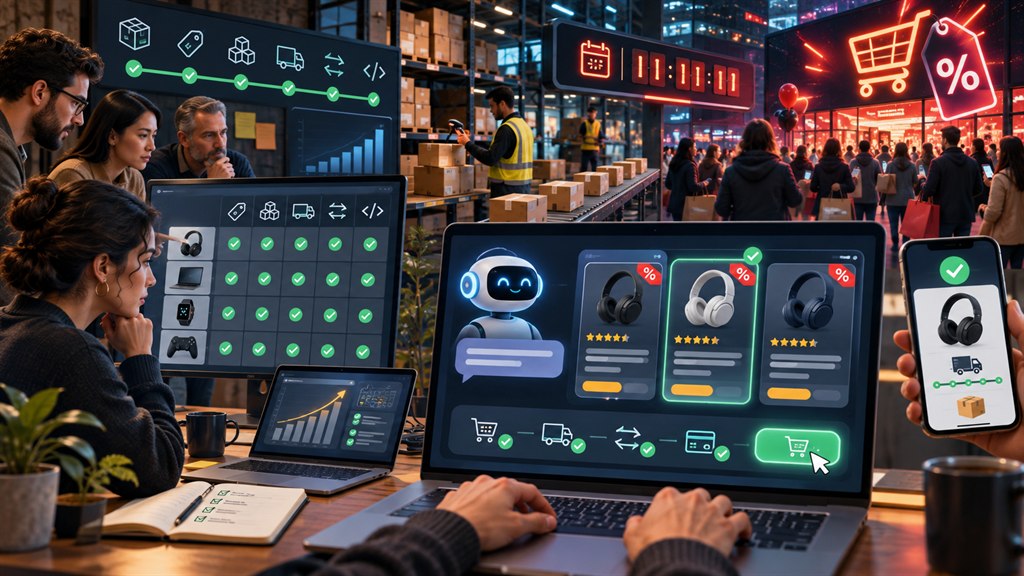
Black Friday 2026 is on Friday 27 November, with Cyber Monday on 30 November. Adobe forecasts US online holiday sales of $275.1 billion (1 November to 31 December, up 6.7%), and expects traffic from AI assistants to US retail sites to rise 130% year over year, including a 95% rise on Black Friday itself. Shoppers increasingly ask an assistant to find, compare and sometimes check out for them, and Google launched Universal Cart in the US in October. To prepare: make your product feed complete and accurate, keep prices and stock in sync, use product and offer schema, put deals on a permanent URL, and track AI referrals in GA4.
On this page
- What is Black Friday? Meaning and a brief history
- Black Friday 2026 key dates
- Black Friday 2026 dates around the world
- What the 2026 forecasts say
- How AI shopping changes Black Friday
- Agentic commerce explained: meaning, examples and protocols
- AI shopping assistants compared
- AI shopping assistants explained
- Google Universal Cart and agent checkout
- Fix your product feed first
- On-site SEO for Black Friday
- Black Friday marketing strategy: a six-week plan
- Black Friday advertising ideas
- Black Friday marketing ideas that still work
- Black Friday email marketing and social media
- Black Friday sales in India: how they work
- Black Friday for small businesses
- Black Friday ads in AI Mode and Shopping
- Black Friday for Indian sellers
- Two-week Black Friday checklist
- Black Friday metrics to track
- Getting help: ecommerce marketing agencies, SEO services and tools
- Our Black Friday preparation routine
- Measuring AI shopping traffic
- Frequently asked questions
Every year the big November sale rewards the same things: the right products, a sharp offer, a site that does not fall over. In 2026 there is a new layer. A growing share of shoppers now start with an AI assistant (ChatGPT, Gemini, Google AI Mode, Perplexity) and ask it to shortlist products, compare prices and find deals. If your product data is incomplete or out of date, the assistant will recommend someone else. This guide covers what has changed and a practical two-week plan. For the background, read agentic commerce explained.
What is Black Friday? Meaning and a brief history
What is Black Friday? It is the Friday after US Thanksgiving, traditionally the start of the Christmas shopping season and one of the biggest retail days of the year. The name is usually traced to 1960s Philadelphia, where police used “Black Friday” for the traffic and crowds the day brought. Retailers later popularised a friendlier story: that it was the day their books moved from loss (“in the red”) to profit (“in the black”).
The sale spread online and around the world. Cyber Monday was added for online deals, and today Black Friday in India, the UK, Canada, Australia and many other countries runs on the same date, usually as a week or more of offers. For many Indian shoppers, the Black Friday meaning in India is simple: international brands and D2C stores running a late-November sale between Diwali and the year-end.
Black Friday 2026 key dates
| Day | Date |
|---|---|
| Thanksgiving (US) | Thursday 26 November 2026 |
| Black Friday | Friday 27 November 2026 |
| Small Business Saturday | Saturday 28 November 2026 |
| Cyber Monday | Monday 30 November 2026 |
Many retailers now run deals across the whole of November, so “Black Friday week” often starts well before the 27th.
Black Friday 2026 dates around the world
Black Friday falls on the same day almost everywhere it is celebrated: the Friday after US Thanksgiving. So the Black Friday 2026 date is 27 November for the USA, UK, Canada, Australia, New Zealand and India, with Cyber Monday on 30 November. Searches like Black Friday 2026 UK, Black Friday 2026 Australia and Black Friday 2026 Canada peak in the weeks before, which is why retailers publish their sale pages early.
The holiday shopping season 2026 timeline
- October: early sales events start the season; Adobe expects October online spending of about $95.8 billion in the US.
- 1 November: start of Adobe’s holiday season measurement window.
- Black Friday week: Thanksgiving (26 Nov), Black Friday (27 Nov), Small Business Saturday (28 Nov), Cyber Monday (30 Nov).
- December: gift buying, shipping cut-off dates and last-minute click-and-collect.
- 31 December: end of the season window; returns and January sales follow.
What the 2026 forecasts say
Adobe’s holiday forecast, published on 28 September 2026, is the most widely cited benchmark. Note that these are projections for the US, not results:
- US online holiday sales of $275.1 billion from 1 November to 31 December, up 6.7% on 2025.
- Cyber Monday expected to be the biggest online day, at about $15.1 billion.
- AI traffic (clicks from AI chat and browser services to retail sites) up 130% year over year, with the sharpest increases expected on Thanksgiving (+159%), Black Friday (+95%) and Cyber Monday (+88%).
AI-referred visits are still a small share of total retail traffic, but they are growing far faster than any other source, and they cluster on exactly the days that matter most.
How AI shopping changes Black Friday
Three behaviours are new this year:
- Delegated research. Shoppers ask “find the best noise-cancelling headphones under $200 on sale this week”. The assistant reads product pages, feeds and reviews, then names a few options. Being one of those few is the new page-one ranking.
- Price and stock checks in real time. Assistants compare prices across retailers. A deal that is live on your site but missing from your feed, or a feed that still shows a product in stock when it has sold out, costs you twice: lost recommendations and lost trust.
- Agent-assisted checkout. Some assistants can now add items to a cart or hand the shopper to checkout with details filled in. This is still early and uneven. OpenAI scaled back ChatGPT’s Instant Checkout in March 2026 and now sends more purchases to merchants’ own checkouts, and Amazon blocks many third-party AI agents from its site.
Agentic commerce explained: meaning, examples and protocols
Agentic commerce means AI agents doing parts of shopping on a person’s behalf: searching, comparing, adding to cart and, in some cases, paying. The simplest agentic commerce definition: the shopper states the goal (“a waterproof jacket under ₹5,000 that arrives by Friday”) and the agent does the legwork.
Agentic commerce examples
- Google: shopping in AI Mode and Gemini, and Universal Cart in the US, which collects products from different retailers in one place. Agentic commerce by Google runs on Merchant Center data and the Universal Commerce Protocol (UCP).
- OpenAI: product recommendations in ChatGPT, built with the Agentic Commerce Protocol (ACP) that OpenAI developed with Stripe. OpenAI has since moved more purchases to merchants’ own checkouts.
- Retail and platform assistants: marketplaces and ecommerce platforms, including agentic commerce on Shopify, are adding their own AI shopping features and connections to these protocols.
Agentic AI vs agentic commerce
Agentic AI is the general idea of AI that plans and takes actions to reach a goal. Agentic commerce is that idea applied to buying and selling. For a store, the practical question is agentic commerce readiness: can an agent read your products, prices, stock, delivery and returns accurately, and complete a purchase without getting stuck?
Agentic commerce optimization: a short checklist
- Complete, accurate product feeds in Merchant Center (and any other feeds you supply).
- Product and Offer schema that matches the page exactly.
- Clear shipping, returns and policy pages written in plain language.
- A fast, simple checkout that works without account creation.
- Robots.txt and firewall rules that let the AI crawlers you want reach your product pages.
Good AI shopping visibility comes from these basics, not from tricks. Our guide to agentic commerce goes deeper.
AI shopping assistants compared
| Assistant | What it does for shoppers | What it reads from your store |
|---|---|---|
| Google AI Mode and Gemini | Shopping answers with prices, reviews and stock; Universal Cart in the US | Merchant Center feed, product pages, reviews |
| ChatGPT | Product recommendations and comparisons; shopping ads from product feeds in some markets | Web pages, product feeds you supply |
| Perplexity | Research-style shopping answers with product cards | Web pages and product data |
| Amazon Rufus | AI shopping assistant inside the Amazon app | Your Amazon listings and reviews |
| Microsoft Copilot | Shopping help in Bing and Edge | Web pages and Microsoft Merchant Center |
So which is the best AI shopping assistant? For sellers, the question is which ones your customers use. For most stores that means Google first, then ChatGPT, and Amazon Rufus if you sell on Amazon.
AI shopping assistants explained
An AI shopping assistant is a chatbot or AI search feature that helps people find, compare and sometimes buy products. The main ones shoppers use:
- Google AI Mode and Gemini: shopping answers built on Google’s product data from Merchant Center, with prices, reviews and stock.
- ChatGPT: product recommendations and comparisons, plus shopping ads from product feeds in some markets (see ChatGPT ads vs Google Ads).
- Perplexity and Microsoft Copilot: research-style answers with product links.
- Retailer assistants: large marketplaces run their own AI shopping assistants inside their apps.
When these tools go further and act for the shopper, adding to cart or checking out, they become AI shopping agents. That is agentic commerce, and it depends on standards such as Google’s Universal Commerce Protocol and OpenAI’s Agentic Commerce Protocol, developed with Stripe, which let agents work with merchant checkouts.
Google Universal Cart and agent checkout
On 15 October 2026 Google launched Universal Cart in the US: a single cart that works across Google Search, AI Mode and Gemini, so shoppers can collect products from different retailers as they research. It is built on Merchant Center product feeds and Google’s Universal Commerce Protocol (UCP), a standard for letting AI agents work with merchant checkouts. If you sell in the US, check Merchant Center for eligibility and setup requirements. Outside the US, the takeaway is the same: Google’s AI shopping runs on your feed.
We audit your feeds, product pages and schema for AI shopping visibility before peak season.
Fix your product feed first
If you only have time for one thing before 27 November, make it the feed. In Merchant Center:
- Specific titles: brand, product type, key attribute, size or model (“Acme ANC-200 Wireless Noise-Cancelling Headphones, Black”).
- Complete attributes: GTIN, brand, colour, size, material, age group, condition. Assistants filter on these.
- Sale price and sale dates set with
sale_priceandsale_price_effective_date, so the discount shows only while it is real. - Accurate availability with frequent feed updates or the Content API, so sold-out items stop being recommended.
- Shipping and returns configured; “free returns” or delivery dates often decide a shortlist.
- Promotions submitted through Merchant Center so they can show as offers.
On-site SEO for Black Friday
- Use one permanent URL such as
/black-fridayand update it every year, rather than a new page each time. It keeps its links and rankings. - Product and Offer schema with price, currency, availability and priceValidUntil that match the visible page. See ecommerce schema markup.
- Answer buying questions on the page: sizes, compatibility, delivery cut-off dates, returns. This is what assistants quote. Our product page SEO checklist covers the details.
- Speed under load: test pages under peak traffic; slow checkouts lose sales. See Core Web Vitals and INP.
- Let AI crawlers in: check robots.txt and your CDN or firewall settings do not block the assistants you want to be recommended by.
Product schema example
Here is a simplified example of Product and Offer structured data for a sale item. Prices, currency, availability and dates must match what the page shows:
{
  "@context": "https://schema.org",
  "@type": "Product",
  "name": "Acme ANC-200 Wireless Headphones",
  "gtin13": "0123456789012",
  "brand": {"@type": "Brand", "name": "Acme"},
  "offers": {
    "@type": "Offer",
    "price": "149.00",
    "priceCurrency": "USD",
    "priceValidUntil": "2026-11-30",
    "availability": "https://schema.org/InStock"
  }
}
Black Friday marketing strategy: a six-week plan
A good Black Friday marketing strategy is mostly about timing. A simple plan that works for most online stores:
| When | What to do |
|---|---|
| 6 weeks before | Choose hero products and offers; check stock and margins; fix the feed |
| 4 weeks before | Publish the sale page; start collecting emails with an early-access signup |
| 3 weeks before | Build ad creative and email sequences; submit Merchant Center promotions |
| 2 weeks before | Warm up audiences with useful content: gift guides, comparisons, “what’s coming” |
| Black Friday week | Launch to subscribers first, then everyone; watch stock, feed errors and spend daily |
| Cyber Monday and after | Final push, then end sale prices on time and review results |
The best Black Friday marketing campaigns we see are not the ones with the deepest discount, but the ones that are easy to understand and ready early.
Black Friday advertising ideas
Practical Black Friday ad ideas for Google, Meta and email:
- Lead with the offer and the deadline in the first line; sale shoppers scan, they do not read.
- Show the product in use, not just a sale graphic. Short video works better than static images on Instagram and Facebook.
- Use price and promotion assets in Google Ads, and Merchant Center promotions for Shopping.
- Retarget carefully: people who viewed a product or added to cart, with a reminder that the offer ends.
- Keep the landing page simple: the offer, the products, delivery cut-off dates and returns.
Good Black Friday design ideas keep the brand recognisable: use your own colours and product photography, and keep the discount readable on a small phone screen. If you want help with the creative and campaigns, see our Google Ads and Instagram ads services.
Black Friday marketing ideas that still work
AI changes discovery, but the classic Black Friday marketing ideas still drive most sales:
- Early access for email and SMS subscribers, a few days before the public sale.
- Gift guides by budget and recipient, which also answer the questions AI assistants are asked.
- Bundles and tiered offers (spend more, save more) instead of blanket discounts that erode margin.
- Countdowns and clear end dates, honestly applied.
- Free shipping thresholds and easy returns, stated on product pages and in the feed.
- Loyalty rewards for repeat customers instead of discounting to everyone.
Black Friday email marketing and social media
Black Friday email marketing works best as a short sequence: teaser, early access, launch, reminder, last chance, then Cyber Monday. Segment by past purchases, keep subject lines specific, and warm up sending volume to protect deliverability. See email deliverability and subject line testing. On Black Friday social media, short videos showing real products, honest price comparisons and countdown Stories outperform generic sale graphics. Retarget engaged viewers with Meta ads; see our Meta ads service.
Black Friday sales in India: how they work
Black Friday in India is mostly an online event. International brands, D2C stores, electronics and fashion sellers run Black Friday sales in India on the same 27 November date, often as a week-long sale. Because it comes after Diwali and alongside wedding shopping, offers that suit gifting and weddings do well. For Indian stores, three points matter:
- Show GST-inclusive prices and delivery dates clearly; shoppers compare totals, not headline prices.
- Offer UPI and cash-on-delivery where you can; checkout friction loses sales on mobile.
- Use WhatsApp for order updates and quick questions; it converts better than email for many Indian shoppers.
Black Friday for small businesses
Black Friday for small businesses is not about matching big-retailer discounts. Compete on what large retailers cannot offer: expertise, personal service, local pickup, bundles and gift wrapping. Use Small Business Saturday (28 November) for a local-first message, keep your Google Business Profile hours and offers updated, and make your few best products impossible to miss.
Black Friday ads in AI Mode and Shopping
Google now shows Shopping and Search ads inside AI Mode in the US and, since 28 October, in ten more countries including India, Australia and Canada. Eligible campaigns are Shopping, Performance Max and Search campaigns using broad match or AI Max. Before the sale: raise budgets on proven products, use seasonality adjustments for short sale windows, and make sure promotions are approved in Merchant Center. See our guide to ads in Google AI Mode.
Black Friday for Indian sellers
The sale has become a big moment in India too, especially for D2C brands, electronics and fashion, and this year it overlaps with peak wedding-season shopping. Indian sellers should apply the same feed and schema basics, price in rupees with GST-inclusive pricing on the page, and plan creative that also works for wedding gifting. Our wedding-season marketing playbook covers local demand.
Two-week Black Friday checklist
- Now: audit the feed for missing GTINs, weak titles and disapprovals; fix the top sellers first.
- Now: confirm Product and Offer schema on key product pages and validate in Google’s Rich Results Test.
- 10 days out: publish or refresh the permanent sale page; link it from the home page and main menu.
- 10 days out: submit Merchant Center promotions and set sale price dates.
- 7 days out: load-test the site and checkout; freeze non-urgent code changes.
- 5 days out: segment your email list and schedule early-access emails; see abandoned cart emails.
- Sale week: monitor stock and feed errors daily; pause ads on sold-out products.
- After Cyber Monday: end sale prices on time so feeds and pages stay accurate.
Black Friday metrics to track
| Metric | Why it matters |
|---|---|
| Conversion rate | Shows whether traffic from each channel actually buys |
| Average order value (AOV) | Tells you if bundles and thresholds are working |
| ROAS and profit | Discount-heavy sales can grow revenue and shrink profit |
| AI referral traffic | Visits from ChatGPT, Perplexity, Gemini and Copilot, and how they convert |
| Feed errors and disapprovals | Products missing from Shopping and AI answers on peak days |
| New vs returning customers | Whether the sale brings customers you can keep |
Getting help: ecommerce marketing agencies, SEO services and tools
If you are short on time before the sale, it is worth knowing what kind of help to look for.
Ecommerce marketing agency or specialist?
An ecommerce marketing agency (sometimes sold as an ecommerce digital marketing agency or a D2C ecommerce marketing agency) can cover feeds, Shopping and Performance Max, Meta ads, email and SEO together. A single ecommerce marketing specialist is often enough for a smaller store with one main channel. For ecommerce digital marketing services in India, check that the team has worked with your platform (Shopify, WooCommerce, Magento) and with Indian payments and delivery.
When is the best time to hire SEO for an ecommerce site?
Before the season, not during it. The best time to hire an SEO service for ecommerce is two to three months before your peak, so category pages, product pages and schema are fixed and indexed in time. Good SEO services for ecommerce websites start with an audit of crawling, duplicate and faceted URLs, category page content and product data. See our ecommerce SEO and Shopify SEO services.
Shopify SEO apps and tools
Many store owners ask for the best SEO app for Shopify. Apps help with image compression, structured data and redirects, but they do not replace good category content, clean navigation and accurate product data. Use as few apps as you need; each one can slow the store down. For email, the best email marketing tools for ecommerce are the ones that connect to your store data for abandoned carts, browse reminders and post-purchase flows.
Does Google Merchant Center cost money?
No. Merchant Center itself is free, and products can appear in free listings across Google. You pay only if you run Shopping or Performance Max ads, on Google Ads’ usual pay-per-click basis.
Our Black Friday preparation routine
For ecommerce clients we start this work in October, not November. The order matters:
- Agree the products that matter. We ask for the 20 to 50 products expected to drive most of the season’s revenue. Those get fixed first; the long tail can wait.
- Fix the feed for those products. Titles, GTINs, attributes, images, sale price dates and promotions, then a check in Merchant Center diagnostics a few days later.
- Match the page to the feed. Price, stock and delivery promises on the product page must say exactly what the feed says. Mismatches cause disapprovals at the worst possible time.
- Freeze the site. About a week before the sale we stop non-urgent changes, so nothing breaks during the busiest days.
- Watch daily, then review. During the sale week we check feed errors, stock and ad spend every day, and in December we review which channels, including AI referrals, actually brought profitable orders.
Measuring AI shopping traffic
In GA4, build a channel group or exploration for AI referrers (chatgpt.com, perplexity.ai, gemini.google.com, copilot.microsoft.com and similar). Compare their conversion rate and order value with organic search. Google AI Mode traffic is reported within Google organic search, so watch Search Console for longer, question-style product queries. Our AI search visibility tracking guide goes further.
Black Friday 2026: frequently asked questions
When is Black Friday 2026?
Friday 27 November 2026. Thanksgiving is 26 November and Cyber Monday is 30 November.
How big will holiday online sales be in 2026?
Adobe forecasts US online sales of $275.1 billion between 1 November and 31 December 2026, up 6.7% year over year.
How much will AI shopping traffic grow this Black Friday?
Adobe expects AI traffic to US retail sites to rise 130% over the holiday season, with an expected 95% increase on Black Friday.
What is Google Universal Cart?
A cart Google launched in the US on 15 October 2026 that works across Search, AI Mode and Gemini, built on Merchant Center feeds and the Universal Commerce Protocol.
How do I get my products recommended by AI assistants?
Keep your product feed complete and accurate, use Product and Offer schema, answer buying questions on product pages and make sure AI crawlers can access your site.
Should I create a new Black Friday page every year?
No. Use one permanent URL such as /black-friday and update it each year so it keeps its links and rankings.
Can I advertise in Google AI Mode for Black Friday?
Yes, in supported countries. Shopping, Performance Max and Search campaigns using broad match or AI Max are eligible for ads in AI Mode.
How do I track traffic from ChatGPT and other assistants?
Group AI referrers such as chatgpt.com and perplexity.ai in GA4 and compare their conversion rate and order value with other channels.
Is Black Friday 2026 on the same date in the UK, Canada and Australia?
Yes. Black Friday is on Friday 27 November 2026 in the US, UK, Canada, Australia, New Zealand and India, with Cyber Monday on 30 November.
What is an AI shopping assistant?
A chatbot or AI search feature, such as Google AI Mode, Gemini, ChatGPT or Perplexity, that helps shoppers find and compare products, and sometimes buy them.
What are good Black Friday marketing ideas for small businesses?
Early access for subscribers, gift guides, bundles, local pickup, gift wrapping and a Small Business Saturday message, rather than matching big-retailer discounts.
What is agentic commerce?
AI shopping agents acting for the shopper, such as adding items to a cart or completing checkout, using standards that connect agents to merchant checkouts.
What is the meaning of Black Friday?
Black Friday is the Friday after US Thanksgiving and the traditional start of the holiday shopping season. The name is usually traced to 1960s Philadelphia police describing the crowds and traffic.
Is there Black Friday in India?
Yes. Many brands and online stores in India run Black Friday sales on the same date, 27 November in 2026, often as a week-long sale.
What is the Agentic Commerce Protocol?
A protocol developed by OpenAI with Stripe that lets AI agents work with merchant checkouts. Google has its own Universal Commerce Protocol for its shopping features.
What is the best AI shopping assistant?
It depends on where your customers shop. For most stores, Google AI Mode and Gemini matter most, then ChatGPT, and Amazon Rufus if you sell on Amazon.
Sources
Facts and figures in this guide come from these sources. Forecasts are projections, not results; product details change often, so check the original before planning spend.
- Adobe: U.S. holiday shopping season to hit record $275.1 billion online (Business Wire, 28 September 2026) – holiday forecast and AI traffic
- Digital Commerce 360: Adobe projects 2026 online holiday sales at $275 billion
- Google Merchant Center Help – sale price, promotions and product data requirements
- Google Search Central: Product structured data – Product and Offer schema