Good email subject lines are specific, honest and short enough to read on a phone — usually under about 40–50 characters — and work together with the preheader text. Make the benefit clear, use personalisation or urgency only when they are relevant and true, and avoid spammy phrasing. Then A/B test one change at a time, with a large enough sample, and judge winners on clicks and revenue, not just opens.
On this page
- How to write email subject lines
- Subject line length and preheader text
- Personalisation, emoji and urgency
- Spam trigger words and deliverability
- Subject line examples by email type
- A/B testing email: how to do it properly
- Beyond the subject line: email copywriting
- Subject lines by situation
- What else to test: sender name, send time and more
- Open rate benchmarks and better metrics
- AI and email testing tools
- Getting help with email copy and testing
- Frequently asked questions
The subject line decides whether an email gets read at all. But measuring subject lines has become harder: privacy features such as Apple Mail Privacy Protection pre-load emails, inflating the reported open rate. This guide covers how to write email subject lines that work and how to test them reliably. See our email marketing guide for the wider programme.
How to write email subject lines
- Be specific: “Your 3-step boiler service checklist” beats “Our latest newsletter”.
- Lead with the benefit or the most interesting detail.
- Match the email: a subject that over-promises raises unsubscribes and spam complaints.
- Write for mobile: put the key words first.
- Sound like a person, not a brochure.
Subject line length and preheader text
Subject line length: phones often show only the first 30–40 characters, so front-load the message. The preheader text (also called email preview text) appears next to or under the subject — use it to complete the thought rather than repeating the subject or leaving “View in browser” showing.
Personalisation, emoji and urgency
- Personalized subject lines work best when they use something meaningful — a product viewed, a location, an appointment date — not just a first name.
- Emoji in subject lines can stand out in a busy inbox; test them, and check they render on common email apps.
- Urgency in subject lines (“ends tonight”) works only when it is true. False urgency trains people to ignore you.
Spam trigger words and deliverability
Lists of spam trigger words are mostly outdated — modern filters focus on sender reputation, authentication and engagement rather than single words. Still, avoid all-caps, excessive punctuation and misleading phrasing (“Re:” on an email that is not a reply).
Subject line examples by email type
| Email type | Example |
|---|---|
| Welcome | “Welcome — here’s your 10% code” |
| Newsletter subject lines | “3 ways to cut your heating bill this winter” |
| Promotional email subject lines | “Free delivery on everything until Sunday” |
| Abandoned cart | “Still deciding? Your basket is saved” |
| Re-engagement | “Should we keep sending you emails?” |
These subject line examples are starting points; the best email subject lines for your list come from testing. See also our abandoned cart and re-engagement guides.
A/B testing email: how to do it properly
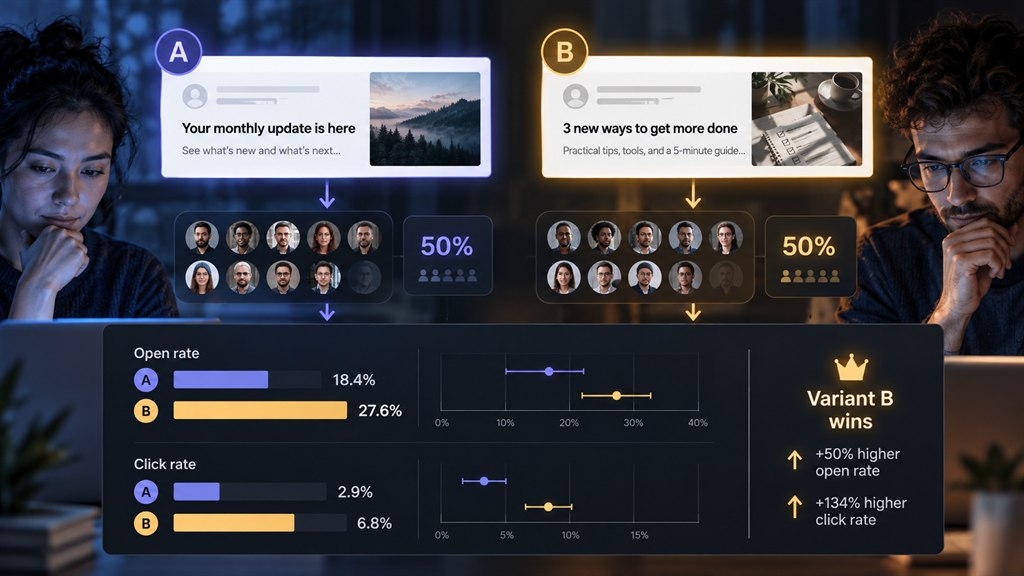
- Test one thing at a time: subject, sender name, preheader or send time.
- Use a big enough sample. Sample size for email tests matters: on small lists, differences of a few percent are usually noise.
- Pick the right metric. Because opens are inflated by privacy features, judge subject line testing on click-through rate email metrics, conversions or revenue where possible.
- Check statistical significance before declaring a winner — many platforms calculate it for you.
- Record what you learn so each test builds on the last.
Email A/B testing and email split testing mean the same thing; the discipline is what makes them useful.
We write, test and report on what actually lifts revenue.
Beyond the subject line: email copywriting
The subject line earns the open; the email has to earn the click. Strong email copywriting has one main message, a clear call to action and scannable formatting. Email copywriting services can help if writing is the bottleneck — see our email marketing service.
Subject lines by situation
| Situation | What works | Example |
|---|---|---|
| Subject lines for sales emails | Specific offer and deadline | “20% off winter boots until Sunday” |
| B2B email subject lines | Relevance to the reader’s role or problem | “Cutting month-end close from 10 days to 4” |
| Cold email subject lines | Short, personal, no hype | “Question about [company]’s site” |
| Follow-up email subject lines | Reference the earlier message | “Following up on your quote” |
| Holiday email subject lines | Timing and gift help | “Last day for Christmas delivery” |
| Black Friday subject lines | Stand out in a crowded inbox | “Our only sale of the year starts now” |
Catchy email subject lines still need to be honest — clever wording that hides what the email is about usually loses on clicks.
What else to test: sender name, send time and more
- Sender name: a person’s name plus the company often beats the company alone — test it.
- Send time optimization: many platforms choose the best time to send emails per subscriber; otherwise test a few slots based on when your audience buys.
- Multivariate testing combines several changes at once but needs much larger lists to produce reliable results.
Open rate benchmarks and better metrics
Published email open rate benchmarks vary by industry and are inflated by privacy features, so compare against your own history. Click-to-open rate — clicks divided by opens — shows how well the content matched the subject line, though it inherits the same open-rate inflation. Clicks per recipient and revenue per recipient are the most reliable.
AI and email testing tools
An AI subject line generator is useful for brainstorming variations to test, not for choosing the winner — your audience’s behaviour does that. Email testing tools also check rendering across email apps and spam-filter placement before you send. If writing is the bottleneck, an email copywriter can produce and test copy for you — see our email marketing service.
Getting help with email copy and testing
Subject line testing only pays off with steady volume and someone reviewing the results. If your team cannot test every send, email copywriting services or an email marketing agency can take on the copy, the test plan and the reporting. Ask any email marketing consultant how they decide a winner and what sample size they need, because small lists rarely produce reliable A/B test results.
Email subject lines: frequently asked questions
What is the best length for an email subject line?
Short enough to read on a phone — often under about 40 to 50 characters — with the key words first.
What is preheader text?
The preview text shown next to or under the subject line in most inboxes. Use it to add to the subject line rather than repeat it.
Are open rates still reliable?
Less than before, because privacy features can register opens automatically. Use clicks, conversions and revenue to judge tests where possible.
Do emojis in subject lines improve opens?
Sometimes. They can help an email stand out, but results vary by audience, so test them.
How big should my A/B test sample be?
Large enough that the difference is statistically significant. On small lists, test bigger changes and repeat tests before drawing conclusions.
What is the best time to send marketing emails?
It depends on your audience. Use your platform’s send-time optimisation if available, or test a few time slots and compare clicks and revenue.
Should I use an AI subject line generator?
It is useful for generating ideas to test. Let A/B test results, not the tool, decide which subject lines you keep.
What is click-to-open rate?
Clicks divided by opens. It shows how well the email content delivered on the subject line, although privacy features make opens less reliable.
What makes a good B2B email subject line?
Relevance to the reader’s role and problem, specificity, and no hype. Short and plain usually beats clever.
Is it worth paying for email copywriting services?
It is worth it when email drives real revenue and your team lacks time to write and test consistently. A good email copywriter or agency should show how they measure results, such as clicks and revenue per send, not just open rates.