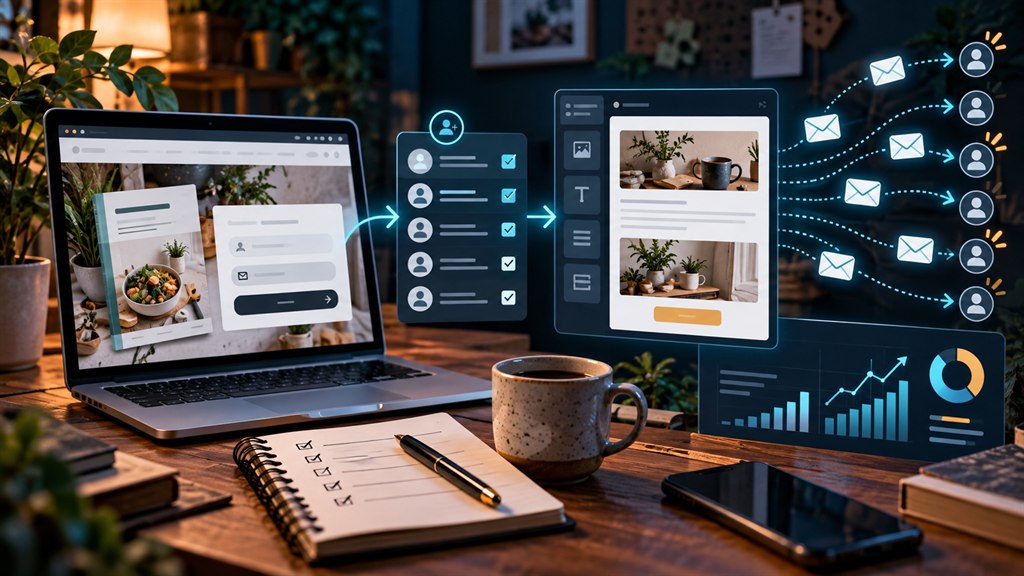
Email marketing for small business works because you own the list: no algorithm decides who sees your message. To start: choose an email platform, add a signup form with a clear reason to join (a lead magnet or offer), set up a welcome email, then send a useful newsletter or offer on a regular schedule — typically every one to four weeks. Add simple automations such as follow-ups after a purchase or enquiry, and measure revenue and enquiries, not just opens.
On this page
- A simple email marketing strategy
- How to build an email list
- What to send: newsletter ideas
- How often to send marketing emails
- Email marketing platforms and tools
- Email marketing for local and service businesses
- Email marketing cost and ROI
- Compliance: GDPR, CAN-SPAM and opt-in
- DIY or email marketing services?
- Email marketing tips and best practices
- Email marketing by industry
- How to grow your email list faster
- Email marketing services and packages for small business
- Frequently asked questions
Social reach goes up and down with every algorithm change, and ad costs keep rising. An email list is the one marketing channel a small business fully owns. This guide shows how to start email marketing with limited time and budget. Our email marketing guide covers deliverability and automation in more depth.
A simple email marketing strategy
- Pick one goal: repeat purchases, more bookings or nurturing enquiries.
- Decide what subscribers get: offers, tips, news, early access.
- Set a realistic schedule you can keep.
- Automate the basics — welcome, post-purchase or post-enquiry follow-up.
- Review monthly what drove sales or bookings.
That is a complete email marketing strategy for most small businesses.
How to build an email list
- An email signup form on every page and at checkout or booking.
- A lead magnet worth signing up for: a discount, checklist, guide or free consultation.
- Collect emails in person — at the counter, events, or with a QR code.
- Use pop-ups carefully: delayed or exit-intent forms work better than instant full-screen interstitials, which also hurt mobile SEO.
- Never buy lists — they damage deliverability and break privacy laws.
Steady email list building beats big one-off pushes.
What to send: newsletter ideas
An email newsletter does not need to be long. Newsletter ideas that work for small businesses:
- A seasonal offer or new product or service.
- A quick tip related to what you sell.
- A customer story or before-and-after.
- Behind the scenes: new staff, new premises, how you work.
- Local news or events you are part of.
How often to send marketing emails
How often to send marketing emails depends on how much useful content you have. Most small businesses do well with every two to four weeks; online shops with frequent new stock may send weekly. Consistency matters more than frequency.
Email marketing platforms and tools
| Need | Typical choice |
|---|---|
| Simple newsletters, small list | Mailchimp, MailerLite, Brevo (free tiers) |
| Online shop with automations | Klaviyo, Omnisend, Shopify Email |
| Service business with a CRM | HubSpot, ActiveCampaign, Zoho |
The best email marketing software is the one that connects to your website or shop and that you will actually use. Many free email marketing tools are fine to start; there are plenty of Mailchimp alternatives if you outgrow its pricing.
Email marketing for local and service businesses
- Email marketing for local business: reminders, seasonal offers, review requests and local event invitations.
- Email marketing for service businesses: follow-ups after enquiries, appointment reminders, maintenance reminders and referral requests.
We build lists, flows and templates that bring in revenue.
Email marketing cost and ROI
Email marketing cost for a small business is mostly the platform fee — often free or low-cost for small lists, rising with list size — plus the time to write emails. That low cost is why email marketing ROI is usually strong compared with paid channels. Measure it as revenue or bookings from email, divided by platform and time costs.
Compliance: GDPR, CAN-SPAM and opt-in
- Get clear consent; double opt-in (confirming by email) improves list quality.
- GDPR email marketing rules apply when you email people in the UK and EU; CAN-SPAM applies in the US.
- Include your business address and a working unsubscribe link in every email.
DIY or email marketing services?
Many small businesses run email in-house. An email marketing consultant or email marketing agency for small business is worth it when you want automations, templates and reporting set up properly. See our email marketing services.
Email marketing tips and best practices
- Send a welcome email immediately after signup — it gets the most attention of any email you send.
- Use a few reusable email templates so each send takes minutes, not hours.
- Set up automated emails for predictable moments: welcome, purchase, enquiry, birthday, renewal.
- Mix helpful content with promotional emails — not every email should sell.
- Plan with a simple email marketing calendar around seasons, holidays and your own busy periods.
These email marketing tips and email marketing best practices matter more than any single tool.
Email marketing by industry
| Business | Email campaign ideas |
|---|---|
| Email marketing for restaurants | New menus, events, quiet-night offers, birthday rewards |
| Email marketing for real estate | New listings, market updates, valuation offers, buyer guides |
| Email marketing for ecommerce | Launches, abandoned cart, back in stock, replenishment |
| Email marketing for nonprofits | Impact stories, appeals, volunteer calls, event invites |
| B2B email marketing | Case studies, webinars, product updates, nurture sequences |
These email campaign ideas and email marketing examples are starting points — keep the ones your customers respond to.
How to grow your email list faster
To grow email list numbers steadily: offer a genuinely useful sign-up incentive, put forms where intent is highest (checkout, booking confirmation, high-traffic blog posts), and promote sign-ups in-store and on social. Track email list growth monthly, net of unsubscribes. SEO helps too: blog posts that rank bring a steady stream of new subscribers — see how digital marketing channels work together.
Email marketing services and packages for small business
Email marketing services for small business usually cover setup (platform, forms, templates, automations) and ongoing campaigns. Email marketing packages are typically priced by number of campaigns per month and automation complexity. See our email marketing service.
Email marketing for small business: frequently asked questions
Is email marketing worth it for small businesses?
Yes. It is low cost, you own the list, and it is one of the most effective ways to win repeat business and referrals.
How do I start email marketing?
Choose a platform, add signup forms with a reason to join, set up a welcome email, and send a useful newsletter or offer on a schedule you can keep.
How often should a small business send emails?
Every two to four weeks suits most small businesses; shops with frequent new products may send weekly.
What is the best email marketing platform for a small business?
One that connects to your website or shop and fits your budget. Mailchimp, MailerLite and Brevo suit simple newsletters; Klaviyo suits online shops.
How much does email marketing cost?
Platforms are often free or low cost for small lists and charge more as your list grows. The main cost is the time to create emails.
What are some good email campaign ideas?
Seasonal offers, new product or service announcements, how-to tips, customer stories, behind-the-scenes updates, event invitations and loyalty rewards.
What should a welcome email include?
A thank-you, what subscribers can expect and how often, any promised incentive, and one clear next step such as browsing best sellers or booking.
How do I grow my email list?
Offer a useful incentive, add forms at high-intent moments such as checkout and booking, collect emails in person, and promote sign-ups on social and in content that ranks in search.
How much do email marketing packages cost?
It depends on campaign volume and automation complexity; small-business packages usually cover a set number of campaigns per month plus setup of core automations.