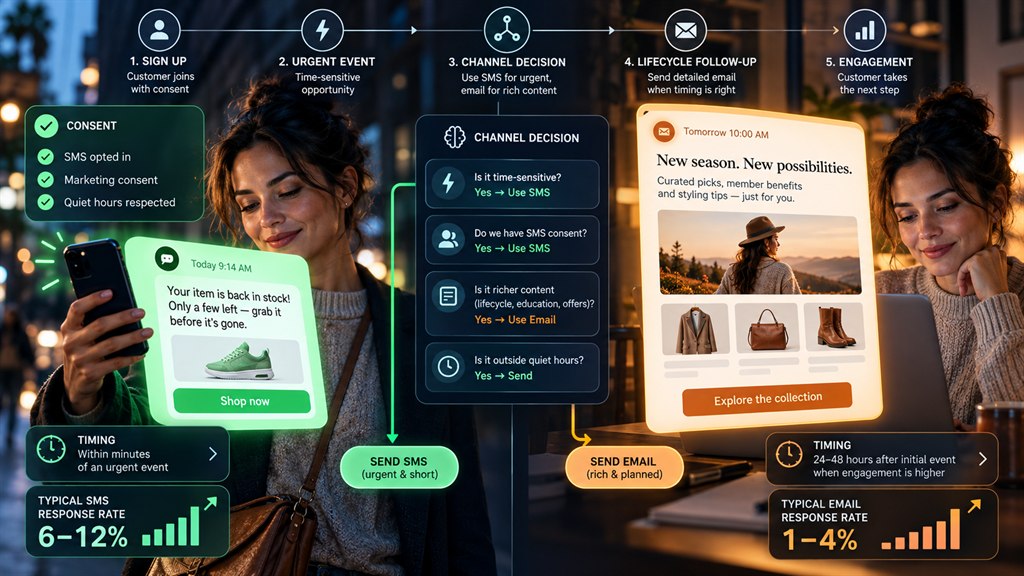
SMS vs email marketing is not either/or. SMS is immediate and almost always read, but costs more per message, has strict consent rules and suits short, time-sensitive messages. Email is cheap per message, supports rich content and suits newsletters, nurturing and detailed offers. Most businesses use email as the main channel and SMS for urgent, high-value moments — flash sales, reminders, delivery updates and abandoned carts.
On this page
- SMS vs email at a glance
- SMS open rate vs email open rate
- SMS marketing cost vs email
- When to use SMS
- When to use email
- SMS opt-in and compliance
- Where WhatsApp and RCS fit
- Using SMS and email together
- SMS marketing for small business
- SMS marketing best practices and examples
- SMS campaign ideas by industry
- Two-way SMS, short codes and 10DLC
- Push notifications, WhatsApp and SMS
- Frequently asked questions
Both channels reach people directly, without an algorithm in between, which is why they are often compared. But they suit different messages. This guide compares SMS marketing vs email marketing and shows how to combine them. For email in depth, see our email marketing guide.
SMS vs email at a glance
| SMS | ||
|---|---|---|
| Speed of reading | Minutes | Hours or days |
| Cost per message | Higher | Very low |
| Content | Short text, a link | Images, layout, long content |
| Consent | Strict, explicit opt-in | Opt-in, rules vary by country |
| Best for | Urgent, short, high-value moments | Newsletters, nurturing, detailed offers |
SMS open rate vs email open rate
Text messages are read far more consistently and quickly than emails — that is the main reason text message marketing works. The SMS open rate is hard to measure precisely, but the practical point is that SMS reaches people almost immediately. The email open rate is lower and, since privacy features inflate it, less reliable as a metric. Compare channels on clicks and revenue instead.
SMS marketing cost vs email
SMS marketing cost is charged per message (and per segment for longer texts), so it rises quickly with list size and frequency. Email costs are mostly a platform subscription. That is why most businesses send email routinely and reserve SMS for messages where speed is worth paying for.
When to use SMS
- Flash sales and last-chance offers.
- Appointment and booking reminders.
- Delivery and order updates (transactional SMS).
- Abandoned cart follow-ups — see our abandoned cart guide.
- Back-in-stock alerts.
When to use email
- Welcome series and onboarding.
- Newsletters, guides and content.
- Product launches with images and detail.
- Lead nurturing over weeks or months.
- Win-back and re-engagement — see our re-engagement guide.
SMS opt-in and compliance
SMS rules are stricter than email. Collect explicit SMS opt-in, state how often you will text, include opt-out instructions (“Reply STOP”), and respect quiet hours. In the US, TCPA compliance carries significant penalties for texting without consent; other countries have their own rules. Keep SMS consent separate from email consent.
We plan who gets which message, when, and track the revenue.
Where WhatsApp and RCS fit
- WhatsApp marketing suits markets where WhatsApp is the main messaging app, supporting rich messages and two-way conversation. See our WhatsApp marketing service.
- RCS messaging upgrades SMS with images, buttons and branding on supported Android and iOS devices, while falling back to SMS elsewhere.
Using SMS and email together
SMS and email together work best when each has a role: email carries the detail, SMS the urgent nudge. For example: email announces a sale with full details; SMS reminds subscribers on the last day. This kind of omnichannel marketing — or multichannel marketing, coordinating several channels around one customer — needs shared data so people are not messaged twice for the same thing.
SMS marketing for small business
SMS marketing for small business works best for appointment-based and local businesses: reminders reduce no-shows and short offers fill quiet days. Choose an SMS marketing platform that integrates with your booking or shop system. An SMS marketing agency or provider of email and SMS marketing services can plan both channels together — see our SMS marketing and email marketing services.
SMS marketing best practices and examples
- Identify your brand at the start of every message.
- Stay within the SMS character limit (160 characters per segment) to control cost.
- Send at sensible local times and keep frequency low.
- Always include opt-out instructions.
- Use a short, tracked link to one clear destination.
SMS marketing examples that work: “[Brand]: your table for 4 is booked for 7pm tomorrow. Reply C to cancel.” — an appointment reminder SMS — or “[Brand]: 24h only — free delivery on all orders. Shop: [link] Reply STOP to opt out.”
SMS campaign ideas by industry
- SMS marketing for restaurants: booking confirmations, quiet-night offers, new menu alerts.
- SMS marketing for ecommerce: flash sales, abandoned carts, delivery updates, back-in-stock alerts.
- Service businesses: appointment reminders, technician on-the-way messages, review requests.
These SMS campaign ideas share one trait: the message is useful right now.
Two-way SMS, short codes and 10DLC
Two-way SMS lets customers reply to confirm, reschedule or ask questions — often more valuable than one-way promotions. In the US, businesses send from short codes (5–6 digit numbers) or standard 10-digit numbers, which require 10DLC registration for business messaging. MMS marketing adds images or GIFs at a higher cost per message.
Push notifications, WhatsApp and SMS
- Push notifications vs SMS: push is free but only reaches people with your app installed and notifications on; SMS reaches any opted-in phone.
- WhatsApp vs SMS: WhatsApp supports richer, two-way conversations and dominates in many countries; SMS works on every phone.
- Email vs WhatsApp marketing: email suits long content and broad lists; WhatsApp suits conversational, high-intent messaging.
Choose SMS marketing software that connects to your shop, CRM or booking system. For planning across all of these, SMS marketing services from an omnichannel marketing agency keep messaging consistent — see our SMS marketing and WhatsApp marketing services.
SMS vs email marketing: frequently asked questions
Is SMS marketing better than email marketing?
Neither is better overall. SMS is faster and more consistently read but costs more and suits short, urgent messages; email is cheaper and suits detailed content and nurturing.
Should I use SMS or email marketing?
Most businesses should use email as the main channel and add SMS for time-sensitive, high-value messages such as reminders and last-chance offers.
How much does SMS marketing cost?
SMS is charged per message, so cost depends on list size, frequency, message length and destination country.
Do I need separate consent for SMS?
Yes. SMS marketing requires explicit opt-in, and in many countries consent for email does not cover text messages.
What is RCS messaging?
Rich Communication Services — an upgraded form of text messaging that supports images, buttons and branding on compatible phones, falling back to SMS elsewhere.
What is 10DLC registration?
A US registration process for businesses sending SMS from standard 10-digit phone numbers, required by carriers to reduce spam and improve delivery.
What is the SMS character limit?
160 characters per standard SMS segment; longer messages are split into multiple segments and usually cost more.
Is WhatsApp better than SMS for marketing?
In countries where WhatsApp is the main messaging app, it often performs better and supports richer content. SMS reaches every phone and needs no app.
What are good SMS campaign ideas?
Appointment reminders, flash sales, abandoned cart nudges, delivery updates, back-in-stock alerts and event reminders.